
L'acier inoxydable est largement utilisé dans l'usinage CNC en raison de son excellente résistance à la corrosion., haute résistance et résistance à la température. Different stainless steel types are suitable for different application scenarios, each with its own advantages and disadvantages. This article will introduce in detail the performance of several common stainless steel types in CNC machining and conduct a comparative analysis.
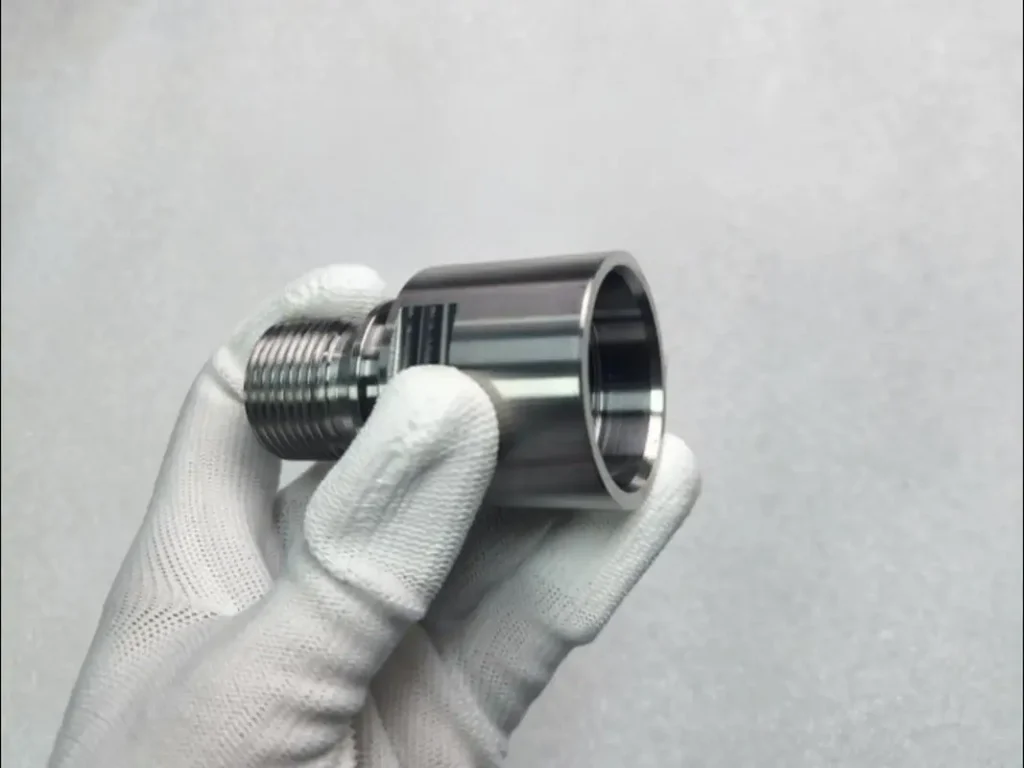
1. 304 stainless steel cnc machining parts
Avantages:
Wide applicability: 304 stainless steel is one of the most commonly used stainless steels and is suitable for a variety of industrial and household applications.
Bonne résistance à la corrosion: Contains 18% à 20% chromium and 8% à 10% nickel, providing excellent corrosion resistance.
Processability: Can be processed into complex shapes by CNC, and has good welding performance.
No heat treatment hardening phenomenon: Easy to process and manufacture.
Inconvénients:
Coût plus élevé: Due to the high proportion of nickel, the cost is relatively high.
Moderate strength: Although the strength is good, it is not as good as some high-strength stainless steel models.
2. 316 stainless steel cnc machining parts
Avantages:
Higher corrosion resistance: Compared with 304 acier inoxydable, 316 stainless steel adds molybdenum to improve corrosion resistance to reducing media.
Suitable for harsh environments: Suitable for use in seawater and other chemical media, commonly used in marine and chemical industries.
Inconvénients:
Coût plus élevé: Due to the addition of molybdenum, the cost is higher than 304 acier inoxydable.
Slightly more difficult to process: Requires harder cutting tools and more precise processing techniques.
3. 201 stainless steel parts CNC processing
Avantages:
Lower cost: Compared with 304 acier inoxydable, 201 stainless steel contains a lower nickel content, so it is less expensive.
Good formability: Suitable for applications that require deep drawing and other forming processes.
Inconvénients:
Mauvaise résistance à la corrosion: Due to the lower nickel content, the corrosion resistance is not as good as 304 et 316 acier inoxydable.
Easy to rust: More likely to rust in humid or corrosive environments.
4. 430 stainless steel parts CNC processing
Avantages:
Rentabilité: Due to the absence of nickel, the cost of 430 stainless steel is relatively low.
Magnetic properties: It is magnetic and suitable for applications that require magnetism.
Inconvénients:
Limited corrosion resistance: Compared with 300 series stainless steel, the corrosion resistance is lower.
Low strength: The strength and hardness are relatively low, not suitable for high-strength applications.
Precautions for stainless steel CNC machining
Choose the right stainless steel grade: Different stainless steel grades have different compositions, properties and uses. You need to choose the right stainless steel grade according to the function, environment, load and other factors of the part.
Choose the right cutting parameters: Cutting parameters include cutting speed, feed speed, profondeur de coupe, back cutting amount, etc., which affect the surface quality, dimensional accuracy, cutting force, thermal deformation, etc.. of the part.
Choose the right tool material: The tool material determines the wear resistance, résistance à la chaleur, dureté, etc.. of the tool, which affects the surface quality, dimensional accuracy, cutting force, etc.. of the part.
Choose the right surface treatment: Surface treatment includes polishing, sable, pulvérisation, electroplating and other methods, which can improve the appearance, protective performance, friction coefficient, etc.. of the part.
When choosing stainless steel CNC machining, you need to decide the most suitable stainless steel model according to the specific application requirements, budget des coûts et difficulté de traitement. Par exemple, pour les applications nécessitant une résistance élevée à la corrosion, 316 stainless steel may be the best choice; tandis que pour les applications sensibles aux coûts avec de faibles exigences de résistance à la corrosion, 201 ou 430 stainless steel may be more suitable. Understanding the characteristics and limitations of each stainless steel can help manufacturers select the most appropriate material to achieve the best processing results and cost-effectiveness.