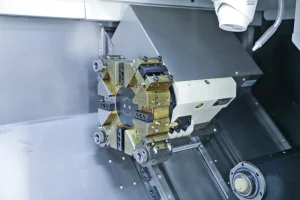

Lors de la rotation d'arbres minces, en raison de la mauvaise rigidité de la pièce, the shapes of the turning tool have a significant impact on the vibration of the workpiece. The geometric angles of CNC turning and milling mainly consider the following points:
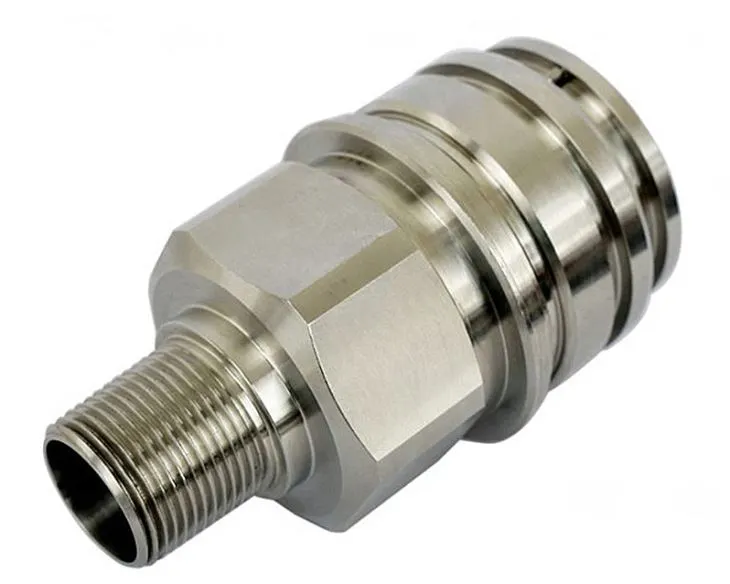
(1) Due to the poor rigidity of the thin shaft, in order to reduce the bending of the thin shaft, the smaller the radial cutting force, the better. The main rake angle of the turning and milling machine tool is the main factor affecting the radial cutting force. Without affecting the strength of the tool, try to reduce the main cutting force by selecting a smaller main cutting edge angle. The main cutting edge angle of the turning tool is 45°–60°.
(2) In order to reduce cutting force and cutting heat, a larger rake angle should be selected, taking γ = 15°–30°.
(3) A chip breaker groove of R0.5–2 mm should be ground in front of the turning tool to make the chips curl and break smoothly.
(4) Select a positive edge inclination angle, λs = +3°, to make the chips flow to the surface to be processed, so that the chip curling effect is good.
(5) The surface roughness requirement of the cutting edge is Rampe 0.4 μm or less, and always keep it sharp.
(6) In order to reduce the radial cutting force, the turning and milling compound machine tool should choose a smaller arc radius (rε = 0.3 MM). The chamfer width should also be small, à propos 0.05–0.2 mm.