
導入
What are the main factors causing workpiece deformation in precision CNC machining? 変形は加工精度に影響を与える可能性があります, 部品の組み立て, そして全体的なパフォーマンス. The following explores the key causes and preventive measures.
1. Workpiece Material and Structure
The amount of workpiece deformation is proportional to the complexity of the shape, aspect ratio, and wall thickness, as well as the rigidity and stability of the material.
したがって, during design, care should be taken to minimize the impact of these factors on the workpiece. Large parts, 特に, require a rational structure.
さらに, the hardness and porosity of the blank must be strictly controlled to minimize workpiece deformation.
2. Workpiece Clamping
Workpiece clamping can easily cause workpiece deformation.
To avoid this deformation, it is important to select the correct clamping point and then apply an appropriate clamping force based on the location of the clamping point.
Try to align the workpiece’s clamping point with the support point, allowing the clamping force to act on the support. This allows the clamping point to be closer to the workpiece surface, minimizing deformation caused by clamping.
When clamping forces act in multiple directions on a workpiece, the order of clamping forces must be considered. Clamping forces that establish contact between the workpiece and the support should be applied first and should not be too large. The main clamping force, which balances the cutting force, should be applied later.
In addition to completing the above steps, increasing the contact area between the workpiece and the fixture or using axial clamping forces is also necessary. Increasing part rigidity is an effective way to address clamping deformation. Increasing the contact area between the workpiece and the fixture significantly helps reduce workpiece deformation during clamping.
3. 精密CNC加工: Tool Cutting of Workpieces
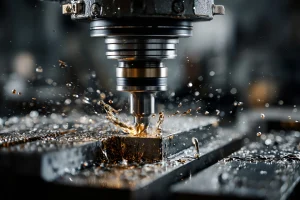
切断工程中, the workpiece is subjected to cutting forces, causing tool deflection, a type of elastic deformation in the direction of the force.
This deformation can be addressed by improving the tool. Precision machining requires sharp tools to reduce friction between the tool and the workpiece, improve heat dissipation during cutting, and reduce residual internal stress in the workpiece.
4. Stress Deformation After Precision CNC Machining
加工後, parts already have a relatively balanced internal stress state. While the part’s shape is relatively stable, the internal stresses change after material removal and heat treatment, requiring the workpiece to regain equilibrium.
Heat treatment can improve this situation. The workpieces to be straightened are stacked to a certain height and compressed flat using a fixture. The fixture and workpiece are then placed in a heating furnace. The heating temperature and time are adjusted based on the part material. Heat straightening stabilizes the workpiece’s internal structure.
RapidEfficient について
RapidEfficient は、高精度 CNC 加工を専門としています。 18 長年の経験. Its products cover medical, コミュニケーション, 光学, ドローン, intelligent robots, 自動車, およびOA部品.
The company’s CNC machining centers include four-axis, 5軸, and linkage machine tools and are equipped with precision projectors, three-coordinate measuring machines, 分光計, and other precision testing equipment.
加工精度は以下に達します 0.01mm, テスト精度は次のレベルに達します 0.001mm.