
Заключение первое
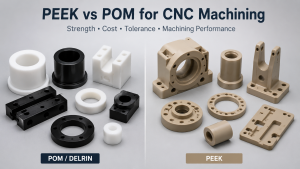
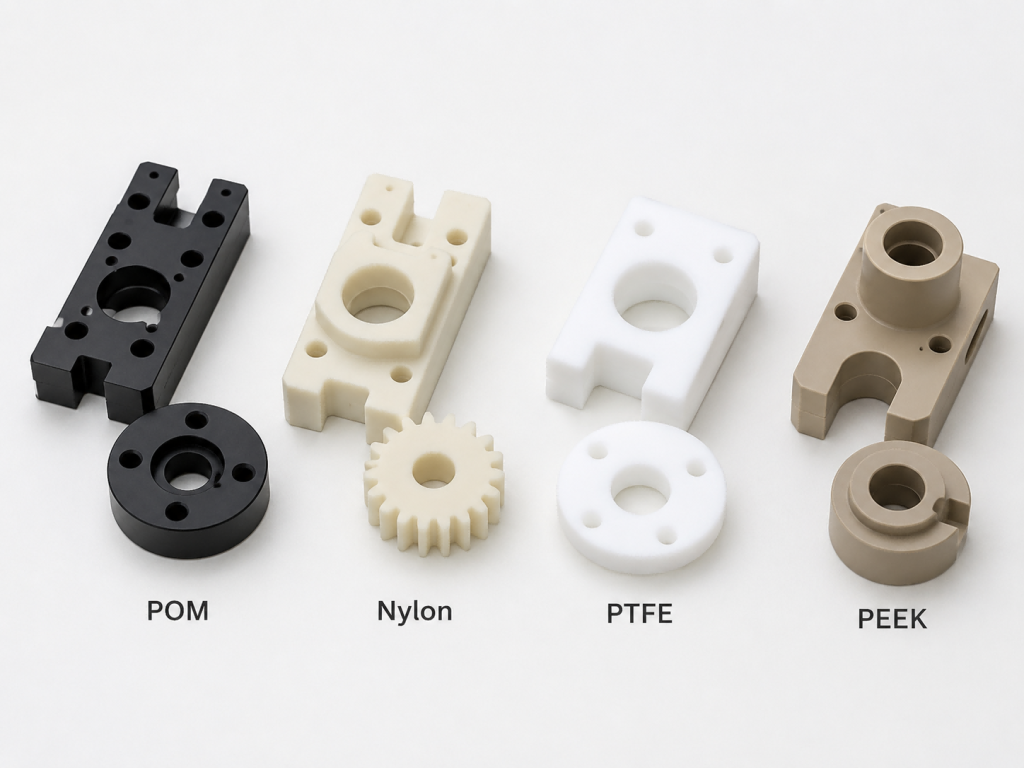
The best plastics for CNC machining depend on the part’s function, требование толерантности, уровень трения, температурное воздействие, химическая стойкость, and cost target. For most precision plastic components, ПОМ / Delrin is often the safest all-around choice because it machines cleanly, holds dimensions well, and offers low friction. Нейлон is strong and wear-resistant, but it absorbs moisture and needs tighter process control. ПТФЭ provides excellent chemical resistance and extremely low friction, but it is soft and easy to deform during clamping. ПЭК is the premium choice for aerospace, медицинский, and semiconductor applications where heat resistance, химическая стойкость, and dimensional stability are critical.
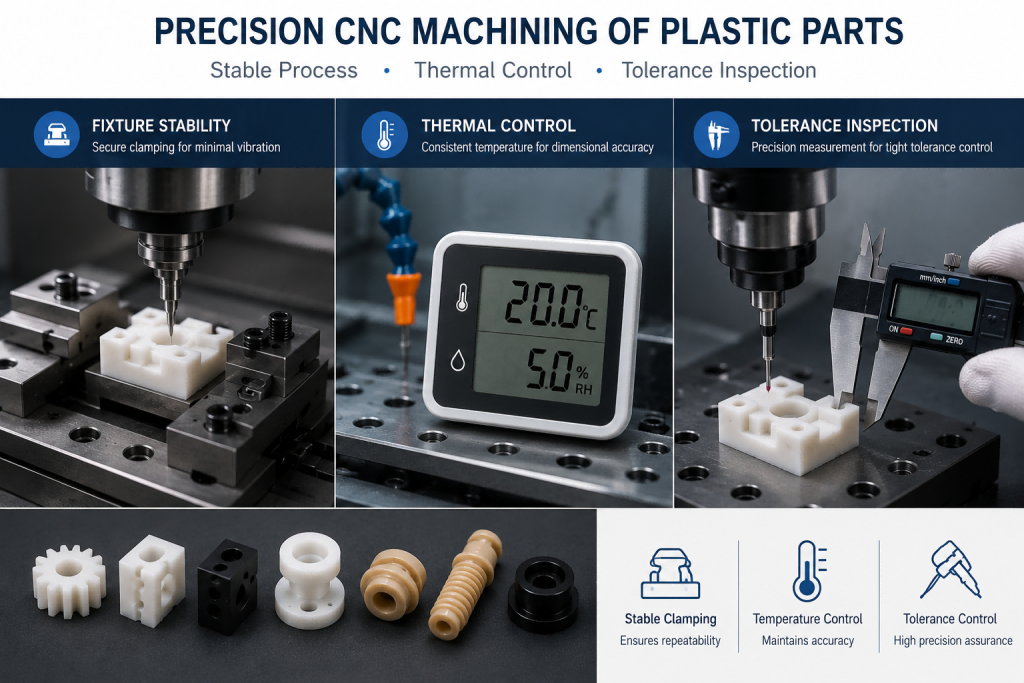
В RapidEfficient, we do not simply “cut” plastic parts. We manage material behavior—thermal expansion, moisture absorption, clamping deformation, and inspection timing—to help precision plastic parts remain stable after machining. With optimized fixturing, острый инструмент, thermal management, and controlled inspection, engineering plastics can be machined into reliable high-precision components.
Быстрый ответ: Какой пластик выбрать?
| Требование | Best Plastic Choice | Почему |
|---|---|---|
| Best all-around CNC plastic | ПОМ / Delrin | Отличная обрабатываемость, низкое трение, and good dimensional stability |
| Высокая износостойкость | Нейлон / Пенсильвания | Сильный, жесткий, and suitable for sleeves, rollers, and wear parts |
| Lowest friction | ПТФЭ | Extremely low friction and strong chemical resistance |
| Высокая термостойкость | ПЭК | Excellent thermal stability and mechanical performance |
| Transparent parts | ПММА / Acrylic or PC | Suitable for covers, lenses, and visual components |
| Low-cost prototypes | АБС | Easy to machine and cost-effective for non-critical parts |
| Tight tolerance plastic parts | POM or PEEK | Better dimensional control than softer or moisture-sensitive plastics |
Лучшие пластмассы для обработки на станках с ЧПУ: Core Comparison
| Plastic | Machinability | Стабильность | Best Applications | Main Risk |
|---|---|---|---|---|
| ПОМ / Delrin | Отличный | Отличный | Шестерни, втулки, sliders, precision mechanical parts | Minor springback |
| Нейлон / Пенсильвания | Good | Середина | Sleeves, rollers, изнашиваемые детали, функциональные компоненты | Поглощение влаги |
| ПТФЭ | Умеренный | Low to medium | Уплотнения, прокладки, chemical-resistant parts | Зажимная деформация |
| ПЭК | Fair to good | Отличный | Аэрокосмическая промышленность, медицинский, semiconductor, high-performance parts | High cost and tool wear |
| АБС | Отличный | Середина | Prototypes, корпуса, low-cost functional parts | Heat sensitivity |
| ПК / Поликарбонат | Good | Середина | Covers, impact-resistant parts, transparent components | Thermal stress |
| ПММА / Акрил | Умеренный | Середина | Lenses, displays, clear covers | Brittle edges |
1. ПОМ / Delrin: The Best All-Around CNC Plastic
ПОМ, often known by the trade name Delrin, is one of the most commonly used plastics for CNC machining. Обеспечивает превосходную обрабатываемость, низкое трение, good dimensional stability, and better stiffness than many general-purpose plastics.
POM is often used for:
- Шестерни
- Bushings
- Precision sliders
- Rollers
- Low-friction mechanical parts
- Fixtures and positioning components
- Small functional parts with tight fit requirements
ПОМ / Delrin is often the safest starting point for precision plastic machining because it cuts cleanly, holds dimensions well, and behaves more predictably than softer plastics.
Why POM Is Popular in CNC Machining
POM cuts cleanly and usually produces good surface quality. It is less difficult to machine than PTFE and less moisture-sensitive than Nylon. This makes it a practical option for functional prototypes and small-batch production parts.
Однако, POM is not the best choice for high-temperature applications. If the part will be exposed to heat, химикаты, or extreme mechanical loads, PEEK or another high-performance plastic may be more suitable.
2. Нейлон / Пенсильвания: Прочный и износостойкий, But Moisture-Sensitive
Nylon is strong, жесткий, and wear-resistant. It is often used when the part needs impact resistance, долговечность, and good mechanical strength.
Common Nylon CNC applications include:
- Sleeves
- Rollers
- Wear pads
- Bushings
- Guide blocks
- Functional machine components
- Industrial plastic parts
The biggest issue with Nylon is moisture absorption. Nylon can absorb water from the environment, which may cause dimensional change. For loose-tolerance parts, this may not be a major problem. But for precision CNC parts, moisture absorption must be considered during material selection, механическая обработка, хранилище, и осмотр.
Примечание инженера
For high-precision Nylon parts, pre-drying and controlled storage are important. If the material absorbs moisture before or after machining, dimensions may shift. This is why Nylon is not always the safest choice for tight-tolerance components unless the working environment and tolerance requirements are fully understood.
3. ПТФЭ: Excellent Low Friction, Difficult to Hold Precisely
PTFE is famous for its extremely low friction and excellent chemical resistance. It is often used in seals, прокладки, sliding parts, insulating parts, and chemical-resistant components.
PTFE is suitable for:
- Уплотнения
- Gaskets
- Low-friction pads
- Chemical-resistant parts
- Electrical insulation components
- Soft sealing parts
PTFE offers extremely low friction, but its softness makes it difficult to hold accurately. Standard vise pressure can distort the part before machining even begins, so fixture design is often more important than cutting speed.
For PTFE parts, soft jaws, вакуумные приспособления, low clamping force, sharp tools, and stable support are needed to avoid distortion.
For more strategies on controlling clamping distortion and dimensional movement, see our guide on how to reduce deformation during CNC machining.
4. ПЭК: Premium Plastic for High-Performance CNC Parts
PEEK is one of the highest-performance plastics used in CNC machining. It offers excellent heat resistance, химическая стойкость, механическая прочность, and dimensional stability. It is much more expensive than POM, Нейлон, or ABS, but it is often worth the cost in demanding applications.
PEEK is commonly used in:
- Аэрокосмические компоненты
- Детали медицинского оборудования
- Semiconductor equipment parts
- High-temperature fixtures
- Chemical-resistant parts
- Electrical insulation components
- Прецизионные механические детали
PEEK is especially valuable in semiconductor and medical applications because it can offer strong chemical resistance, low contamination risk, and stable performance in demanding environments.
Machining Challenge
PEEK is harder and more abrasive than many other plastics. Износ инструмента, heat buildup, and dimensional drift must be controlled carefully. Sharp carbide tools, stable fixturing, controlled coolant strategy, and proper inspection timing are important.
Related case study: Обработка деталей из PEEK с ЧПУ: Контроль допуска
5. АБС, ПК, and PMMA: Practical Options for Prototypes and Visual Parts
Not every CNC plastic part requires PEEK-level performance. For prototypes, covers, корпуса, and visual components, АБС, поликарбонат, and acrylic can be more cost-effective.
АБС
ABS is easy to machine and suitable for prototypes, корпуса, and non-critical functional parts. It is not ideal for high-temperature or high-load applications, but it is useful when cost and quick turnaround matter.
ПК / Поликарбонат
Polycarbonate offers good impact resistance and can be used for protective covers, transparent components, and durable housings. It can machine well, but heat buildup must be managed to avoid poor surface quality or dimensional movement.
ПММА / Акрил
Acrylic is commonly used for clear covers, lenses, displays, and optical-looking parts. It can produce a clean appearance, but it is brittle compared with PC. Tool sharpness, cutting strategy, and deburring are important to avoid cracking or chipping.
Plastic CNC Machining Risk Control Table
| Machining Factor | Risk in Plastic Parts | Engineering Control |
|---|---|---|
| Heat buildup | Dimensional growth, softening, or warping | Sharp tools, light cuts, coolant control, and part rest time |
| Поглощение влаги | Size change after machining | Pre-dry Nylon and control storage conditions |
| Clamping force | Distortion, surface marks, or out-of-round features | Soft jaws, вакуумные приспособления, and low-pressure clamping |
| Износ инструмента | Poor finish and tolerance drift | Use sharp carbide or PCD tools where needed |
| Образование заусенцев | Poor edge quality or assembly problems | Proper tool geometry and controlled deburring |
| Сроки проверки | Measurement drift after heat release | Allow parts to stabilize before final inspection |
Why Plastics Are Harder to Control Than They Look
Plastic CNC machining may look easier than metal machining because plastics are softer. In reality, precision plastic parts can be more difficult to control because many plastics move, слизняк, absorb moisture, or expand with temperature.
Many engineering plastics have a much higher thermal expansion coefficient than metals. For tight-tolerance plastic parts, even small temperature changes can affect final dimensions.
This is especially important for:
- Thin-wall plastic parts
- Long plastic components
- Press-fit features
- Bearing seats
- Sealing surfaces
- Medical or aerospace plastic parts
- Parts with tight flatness or true position requirements
For tight assemblies, dimensional stability should be reviewed together with tolerance stack-up. See our guide on CNC machining tolerance stack-up for a deeper explanation of how small errors can become assembly problems.
Hidden Cost: Why the Cheapest Plastic Is Not Always the Best Choice
Choosing the cheapest plastic can increase total project cost if the material causes deformation, плохая обработка поверхности, difficult inspection, or functional failure.
| Hidden Cost Driver | What Happens | How to Avoid It |
|---|---|---|
| Wrong material choice | Part wears out, deforms, or fails in service | Match plastic to load, температура, трение, and environment |
| Over-tight tolerance | Machining becomes slower and inspection cost increases | Use tight tolerances only on functional features |
| Poor fixture design | Soft plastics deform during machining | Use soft jaws, вакуумные приспособления, or custom supports |
| Moisture-sensitive material | Part size changes after delivery | Pre-dry Nylon and control packaging |
| No inspection plan | Problems appear during assembly | Define critical dimensions and inspection method before production |
Because material choice, терпимость, количество, and inspection all affect the final quote, it is useful to review the full cost structure before production. See our guide on CNC machining cost in China for more details.
Примечание инженера
In our shop, plastic parts are not treated as “easy parts.” For precision plastic components, the most common failure modes are not always tool breakage or machine accuracy. They are heat movement, clamping deformation, картавит, moisture absorption, and inspection timing.
For tight tolerance targets, the process must control more than the toolpath. Fixturing, резка тепла, part rest time, and final inspection environment all matter. A plastic part may measure correctly immediately after machining but shift slightly after cooling or moisture exposure.
This is why we review plastic parts by function first: скользящий, уплотнение, insulating, load-bearing, cosmetic, or high-temperature use. The material choice should always match the real working condition.
How to Choose the Right Plastic for CNC Machining
Use this simple decision logic:
- Choose ПОМ if you need a stable, low-friction, all-around CNC plastic.
- Choose Нейлон if you need toughness and wear resistance, and moisture is manageable.
- Choose ПТФЭ if low friction and chemical resistance are more important than stiffness.
- Choose ПЭК if the part requires high heat resistance, химическая стойкость, or premium performance.
- Choose АБС for low-cost prototypes and non-critical housings.
- Choose ПК for impact-resistant transparent or semi-transparent parts.
- Choose ПММА for clear visual components where appearance matters.
For a broader comparison of metals and plastics, see our CNC material selection guide.
Часто задаваемые вопросы: Лучшие пластмассы для обработки на станках с ЧПУ
What is the best plastic for CNC machining?
ПОМ / Delrin is often the best all-around plastic for CNC machining because it offers excellent machinability, низкое трение, good dimensional stability, and reasonable cost.
Which plastic is best for high-temperature CNC parts?
PEEK is one of the best choices for high-temperature CNC machined parts. It offers excellent thermal stability, химическая стойкость, and mechanical strength.
Which plastic is better, POM or Nylon?
POM is usually better for dimensional stability and low friction. Nylon is stronger and more wear-resistant, but it absorbs moisture and may change dimensions in humid environments.
Is PTFE easy to CNC machine?
PTFE is soft and chemically resistant, but it is not always easy to machine accurately. It can deform under clamping pressure, so fixture design and tool sharpness are important.
Can plastic CNC parts achieve tight tolerances?
Да, some plastic CNC parts can achieve tight tolerances, but this depends on material type, геометрия детали, приспособление, thermal control, and inspection timing. POM and PEEK are usually more stable than PTFE or moisture-sensitive Nylon.
Which plastic is best for low-friction parts?
PTFE offers the lowest friction, but POM is often a better choice when the part also needs stiffness, стабильность размеров, and easier machining.
Does Nylon need drying before CNC machining?
For high-precision Nylon parts, drying is recommended because Nylon absorbs moisture. Moisture can change part dimensions and affect final tolerance stability.
Заключение
The best plastics for CNC machining are not chosen by price alone. ПОМ, Нейлон, ПТФЭ, ПЭК, АБС, ПК, and PMMA each behave differently during cutting, clamping, отделка, и осмотр.
For stable precision parts, POM is often the safest starting point. For high-performance applications, PEEK provides superior heat and chemical resistance. For low-friction or sealing applications, PTFE may be the right choice, but it requires careful fixturing. For wear-resistant parts, Nylon is useful when moisture absorption can be controlled.
В RapidEfficient, we help customers choose the right plastic based on function, терпимость, расходы, and application environment. Send us your drawing or 3D model, and our engineers can review material selection, machining risk, and inspection requirements before production.