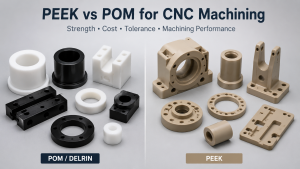

Заключение первое
For most precision mechanical applications, ПОМ / Delrin is usually the more cost-effective choice. Он работает чисто, holds dimensions well, offers low friction, and is suitable for gears, втулки, sliders, приспособления, and general precision plastic parts.
ПЭК, однако, is the premium choice when the application requires high temperature resistance, химическая стойкость, strength-to-weight performance, or long-term dimensional stability in demanding environments. It is commonly used in aerospace, медицинский, semiconductor, and high-performance industrial components.
В RapidEfficient, we do not simply “cut” plastic parts. We manage material behavior—thermal expansion, clamping deformation, внутреннее напряжение, and inspection timing—to help both POM and PEEK parts remain stable after machining.
Быстрый ответ: PEEK vs POM
| Требование | Better Choice | Почему |
|---|---|---|
| General precision plastic parts | ПОМ | Easier to machine, stable, и экономически эффективный |
| Высокая термостойкость | ПЭК | Maintains strength at much higher temperatures |
| Low friction parts | ПОМ | Excellent natural lubricity and smooth sliding behavior |
| Химическая стойкость | ПЭК | Better resistance in harsh environments |
| Cost-sensitive projects | ПОМ | Much lower material and machining cost |
| Aerospace or medical parts | ПЭК | Better long-term stability and high-performance properties |
| Tight tolerance plastic parts | POM or PEEK | Both can work, depending on geometry and process control |
Прямое сравнение: PEEK vs POM
| Особенность | ПОМ / Delrin | ПЭК | Practical Winner |
|---|---|---|---|
| Machinability | Отличный | Good, but more demanding | ПОМ |
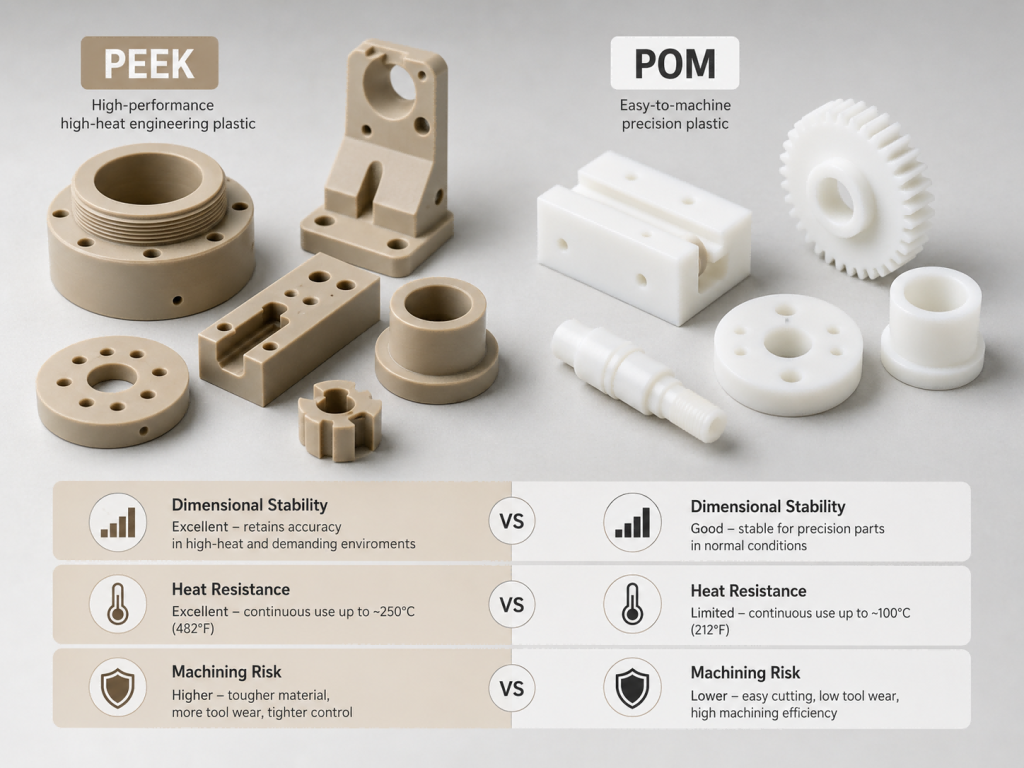
| Dimensional stability | Very good | Отличный | ПЭК |
| Термостойкость | Умеренный | Very high | ПЭК |
| Химическая стойкость | Good | Отличный | ПЭК |
| Friction performance | Отличный | Good | ПОМ |
| Стоимость материала | Low to medium | Very high | ПОМ |
| Износ инструмента | Низкий | Выше | ПОМ |
| Высокопроизводительные приложения | Ограниченный | Отличный | ПЭК |
1. What Is POM / Delrin?
ПОМ, also known as Delrin or acetal, is one of the most widely used engineering plastics for CNC machining. It is strong, rigid, low-friction, and dimensionally stable compared with many general-purpose plastics.
POM is often selected when engineers need a plastic part that behaves predictably during machining and assembly.
Common POM CNC applications include:
- Шестерни
- Bushings
- Rollers
- Precision sliders
- Low-friction mechanical parts
- Jigs and fixtures
- Positioning blocks
- Small functional components
ПОМ / Delrin is often the safest starting point for precision plastic machining because it cuts cleanly, holds dimensions well, and behaves more predictably than softer plastics.
Примечание инженера
POM is easier to machine than many plastics, but it is not “risk-free.” Thin walls, deep pockets, press-fit holes, and long unsupported sections can still move after machining. For tight-tolerance POM parts, острый инструмент, balanced material removal, and proper inspection timing are important.
2. What Is PEEK?
PEEK is a high-performance engineering plastic used when standard plastics are not enough. It offers excellent heat resistance, химическая стойкость, механическая прочность, and long-term dimensional stability.
PEEK is much more expensive than POM, but it is often the right choice when failure risk is high or the working environment is demanding.
Common PEEK CNC applications include:
- Аэрокосмические компоненты
- Детали медицинского оборудования
- Surgical instrument components
- Semiconductor equipment parts
- High-temperature fixtures
- Chemical-resistant parts
- Electrical insulation components
- Precision high-performance mechanical parts
PEEK is especially valuable in semiconductor, аэрокосмический, and medical applications because it can maintain performance under heat, chemical exposure, and strict functional requirements.
Machining Note
PEEK is harder and more abrasive than POM. Износ инструмента, heat buildup, and internal stress must be controlled carefully. If the cutting strategy is too aggressive, the part may develop stress-related movement after machining. Stable fixturing, sharp carbide tools, controlled coolant strategy, and staged machining are important.
Related case study: Обработка деталей из PEEK с ЧПУ: Контроль допуска
3. When Should You Choose POM?
Choose POM when the part needs good dimensional stability, низкое трение, clean machining, and reasonable cost.
POM is usually a strong choice for:
- Sliding parts
- Шестерни
- Bushings
- Rollers
- Low-friction mechanical assemblies
- Cost-sensitive precision parts
- Functional prototypes
- Small-batch production parts
POM is especially useful when the part works in a normal temperature environment and does not require extreme chemical resistance.
Best Use Case
If your part operates below high-temperature conditions, does not face aggressive chemicals, and needs smooth motion or stable dimensions, POM is often the better choice than PEEK.
4. When Should You Choose PEEK?
Choose PEEK when the part must survive demanding environments where POM may not be enough.
PEEK is the better choice when the part requires:
- Высокая термостойкость
- Strong chemical resistance
- Better long-term dimensional stability
- Высокое соотношение прочности и веса
- Medical or aerospace performance
- Semiconductor equipment compatibility
- Resistance to creep under load
PEEK is not selected because it is easy or cheap. It is selected because the application demands higher performance.
Best Use Case
If your part is used in aerospace, медицинский, semiconductor, chemical processing, or high-temperature equipment, PEEK may be worth the higher material and machining cost.
5. CNC Machining Risk Control: PEEK vs POM
| Machining Factor | Risk in POM | Risk in PEEK | Engineering Control |
|---|---|---|---|
| Heat buildup | Moderate dimensional movement | Internal stress or surface damage | Sharp tools, light finishing cuts, controlled coolant |
| Clamping force | Local deformation on thin features | Stress concentration on rigid sections | Soft jaws, custom fixtures, low-pressure clamping |
| Износ инструмента | Usually low | Higher due to abrasive behavior | Use sharp carbide or PCD tools where needed |
| Internal stress | Possible springback | Possible post-machining movement | Balanced roughing and finishing strategy |
| Сроки проверки | Size may shift after heat release | Final dimensions may stabilize after rest time | Allow parts to stabilize before final inspection |
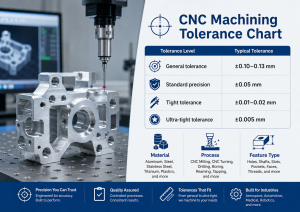
6. Контроль допуска: Can PEEK and POM Achieve Tight Tolerances?
Both POM and PEEK can achieve tight tolerances when the part geometry, стратегия обработки, приспособление, and inspection environment are properly controlled.
Однако, tight tolerance on plastic parts should never be judged by material alone. The real factors include:
- Толщина стенки
- Part length
- Hole depth
- Flatness requirement
- Clamping method
- Cutting heat
- Tool sharpness
- Сроки проверки
- Workshop temperature
Many engineering plastics have a much higher thermal expansion coefficient than metals. For tight-tolerance plastic parts, even small temperature changes can affect final dimensions.
For tight assemblies, dimensional stability should be reviewed together with tolerance stack-up. See our guide on CNC machining tolerance stack-up for a deeper explanation of how small errors can become assembly problems.
7. Hidden Cost: PEEK vs POM
PEEK is much more expensive than POM, but raw material price is only one part of the total cost.
| Cost Driver | ПОМ | ПЭК |
|---|---|---|
| Стоимость сырья | Ниже | Much higher |
| Время обработки | Быстрее | Помедленнее |
| Износ инструмента | Ниже | Выше |
| Inspection requirement | Умеренный | Often stricter |
| Application risk | Lower for general parts | Higher-value critical applications |
| Best value point | Cost-effective precision parts | High-performance parts where failure is expensive |
If the part does not need high temperature resistance, химическая стойкость, or extreme performance, POM may provide better value.
If the part works in a demanding environment where failure would be costly, PEEK may be the safer long-term choice.
Because material choice, терпимость, machining time, and inspection all affect the final quote, it is useful to review the full cost structure before production. See our guide on CNC machining cost in China for more details.
8. Deformation and Fixturing Considerations
Plastic parts can deform during machining even when the material seems rigid. POM can spring back after cutting, while PEEK can develop internal stress if heat and tool pressure are not controlled.
Common deformation risks include:
- Over-clamping
- Thin-wall movement
- Uneven material removal
- Heat buildup
- Poor support under the part
- Measuring too soon after machining
For POM, excessive clamping pressure can distort holes, плоскостность, or roundness. For PEEK, aggressive cutting can create stress that appears later during inspection or assembly.
For more strategies on controlling clamping distortion and dimensional movement, see our guide on how to reduce deformation during CNC machining.
Примечание инженера
In our shop, POM and PEEK are not treated as simple “plastic parts.” They require different machining logic.
POM rewards clean cutting, sharp tools, and stable fixturing. It is often the best balance of cost, обрабатываемость, and dimensional stability.
PEEK requires more process discipline. Износ инструмента, heat control, снятие стресса, and inspection timing must be planned before production. For high-value aerospace, медицинский, or semiconductor parts, this process control is often more important than machining speed.
The right material is not always the strongest one. It is the one that matches the real working condition, требование толерантности, and cost target.
PEEK vs POM: Final Selection Guide
Choose ПОМ если:
- The part is used in normal temperature conditions.
- Low friction is important.
- Cost control matters.
- The part needs good dimensional stability.
- The application is mechanical but not extreme.
Choose ПЭК если:
- The part is exposed to high temperature.
- Chemical resistance is critical.
- The part is used in aerospace, медицинский, or semiconductor equipment.
- Long-term dimensional stability is required.
- The cost of failure is higher than the cost of the material.
For a broader comparison of plastic materials, see our Best Plastics for CNC Machining Guide.
Часто задаваемые вопросы: PEEK против POM для обработки на станках с ЧПУ
Is PEEK better than POM?
PEEK is better for high-temperature, chemical-resistant, аэрокосмический, медицинский, and semiconductor applications. POM is usually better for general precision parts because it is easier to machine, более низкая стоимость, and excellent for low-friction mechanical components.
Is POM cheaper than PEEK?
Да. POM is much cheaper than PEEK in most projects. It also machines faster and usually causes less tool wear, which further reduces total machining cost.
Which is easier to CNC machine, PEEK or POM?
POM is easier to CNC machine. It cuts cleanly, produces good surface quality, and is easier to control than PEEK. PEEK requires more careful tooling, heat control, and inspection planning.
Can PEEK and POM achieve tight tolerances?
Да. Both PEEK and POM can achieve tight tolerances when the part design, приспособление, cutting strategy, контроль температуры, and inspection timing are properly managed.
Which material is better for gears, PEEK or POM?
POM is usually better for gears and low-friction sliding parts because it offers excellent lubricity, clean machining, and good dimensional stability at a lower cost.
Which material is better for semiconductor equipment?
PEEK is usually better for semiconductor equipment because it offers high heat resistance, химическая стойкость, and better long-term performance in demanding environments.
Should I choose PEEK if I only need a precision plastic part?
Not always. If the part does not require high temperature resistance, химическая стойкость, or extreme mechanical performance, POM is often a better and more cost-effective choice.
Заключение
PEEK and POM are both excellent CNC machining plastics, but they serve different purposes.
ПОМ / Delrin is the better choice for most cost-effective precision mechanical parts. Он работает чисто, offers low friction, and provides reliable dimensional stability for many gears, втулки, sliders, and functional components.
PEEK is the premium option for demanding applications. It should be selected when heat resistance, химическая стойкость, long-term stability, or aerospace, медицинский, and semiconductor performance are required.
В RapidEfficient, we help customers choose the right plastic based on function, терпимость, расходы, and working environment. Send us your drawing or 3D model, and our engineers can review material selection, machining risk, and inspection requirements before production.