
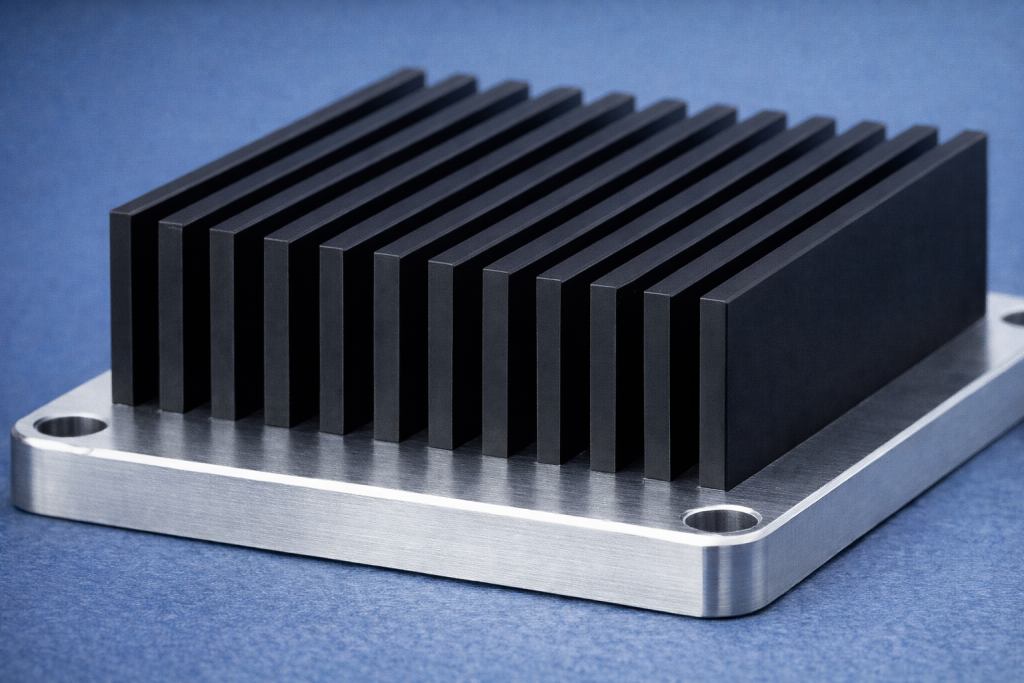
Радиатор — это прецизионный тепловой компонент., обычно изготавливается из алюминия или меди, designed to dissipate heat through conduction and convection.
В обработке на станках с ЧПУ, heat sinks are produced with high-density fins and tightly controlled base flatness (≤ 0.02 мм) to maximize contact area and minimize thermal contact resistance between the heat source and the cooling environment.
Why Heat Sinks Matter in Engineering
Heat sinks are critical in:
- Силовая электроника
- LED systems
- Automotive controllers
- Промышленное оборудование
Without proper heat dissipation:
- Components overheat
- Efficiency drops
- Failure rates increase
👉 In many real-world cases, poor thermal design—not material limits—is the root cause of system failure.
How a Heat Sink Works
Heat Transfer Process
A heat sink transfers heat through three stages:
- Conduction – Heat flows from the heat source into the base
- Spreading – Heat distributes across the base
- Convection – Heat dissipates through fins into surrounding air
👉 Engineering Insight:
Even a microscopic air gap at the interface dramatically increases thermal contact resistance, reducing overall cooling efficiency.
Types of Heat Sinks
1. Extruded Heat Sinks
- Бюджетный
- Limited geometry
- Suitable for general applications
2. CNC Machined Heat Sinks
- Сложная геометрия
- Высокая точность
- Best for critical thermal applications
👉 CNC machining enables tight tolerance control and optimized thermal performance.
3. Поверхностная обработка
- Smoother surface → better contact
👉 Typical surface roughness requirement: Ра 0.8-1.6 мкм
Materials Used in Heat Sink Machining
Material Selection Guide (Engineer’s Perspective)
- 6061 Алюминий (Золотой стандарт)
Best for ~90% of applications. Balanced cost, обрабатываемость, and thermal performance (~167 W/m·K). - 7075 Алюминий (High-Strength Option)
Used in aerospace or high-load structures where strength is critical. Lower thermal conductivity than 6061. - C11000 Copper (Extreme Performance)
Used for high heat flux applications (например, CPUs). ~391 W/m·K conductivity, but higher cost and weight.
Key Design Rules for CNC Heat Sinks
1. Base Flatness (Критический)
Flatness directly determines thermal contact quality.
👉 Poor flatness creates air gaps → increased thermal resistance
👉 In precision machining:
- Flatness can be controlled to ≤0.02 mm
👉 Example:
See our
👉 CNC aluminum heat sink machining case study
👉 In real-world machining, achieving ≤0.02 mm flatness requires stress control, stable fixturing, and precision finishing.
2. Fin Thickness and Spacing
- Too thin → vibration risk
- Too dense → airflow restriction
👉 Optimal balance improves heat dissipation efficiency.
3. Поверхностная обработка
- Smoother surface → better contact
- Typical requirement:Ра 0.8-1.6 мкм
4. Anodizing Strategy
- Fins → often black anodized (improves radiation)
- Base → typically machined (to maintain conductivity)
👉 Engineering Insight:
Anodizing improves emissivity but reduces thermal conductivity at contact surfaces.
Why CNC Machining Is Used for Heat Sinks
CNC machining offers:
- Tight tolerance control
- Superior flatness
- Flexible geometry design
👉 Especially critical for:
- High-power modules
- Precision electronics
- Thermal-critical systems
Common Problems in Heat Sink Machining
1. Base Warping
Caused by:
- Residual stress
- Improper clamping
2. Fin Vibration (Болтовня)
Leads to:
- Дефекты поверхности
- Reduced airflow efficiency
3. Thermal Inefficiency
Usually due to:
- Poor flatness
- Inadequate contact surface
Engineer’s Insight
Heat sink performance is not defined by size or material alone —
it is determined by machining accuracy, качество поверхности, and thermal interface control.
Start Your Heat Sink Project
If you’re designing a heat sink, focus on:
- Плоскостность
- Выбор материала
- Стратегия обработки
👉 For high-performance applications, CNC machining is often the most reliable solution.
Часто задаваемые вопросы
What is the best material for heat sinks?
6061 aluminum is the most widely used due to its balance of cost, обрабатываемость, and thermal performance.
Why is flatness critical?
Flatness directly affects thermal contact resistance and heat transfer efficiency.
Should heat sinks be anodized?
Fins are often anodized for radiation, while the base is typically left machined to preserve conductivity.