
Einführung: Why Laser Cutting Head Housings Require Extreme Precision
Laser cutting head housings are not just standard aluminum parts—they are critical components that directly affect cutting performance and equipment stability.
Inside the housing, structures such as optical lens mounts, cooling channels, and gas pathways must maintain extremely tight tolerances. Even micron-level deviations can result in poor beam quality, surface defects, or even damage to expensive optical components.
For this reason, CNC machining of laser head housings requires not only advanced equipment, but also deep process expertise.
Challenge 1: Deformation Control in Thin-Walled Structures
To reduce weight, laser cutting head housings are typically designed with thin walls. Jedoch, this introduces a major challenge: machining deformation caused by internal stress release.
Unsere Lösung
- Material Selection Optimization
Use stress-relieved aluminum such as AL7075-T651 to minimize internal stress - Multi-Stage Machining Strategy
- Grobbearbeitung (leave 0.5–1 mm allowance)
- Stress relief (natural or artificial aging)
- Semi-finishing
- Final finishing
- Low Cutting Force Finishing
Carefully control spindle speed, Futterrate, and cutting depth
👉 This staged process significantly improves dimensional stability and yield rate.
Challenge 2: Complex Geometry & Multi-Angle Machining
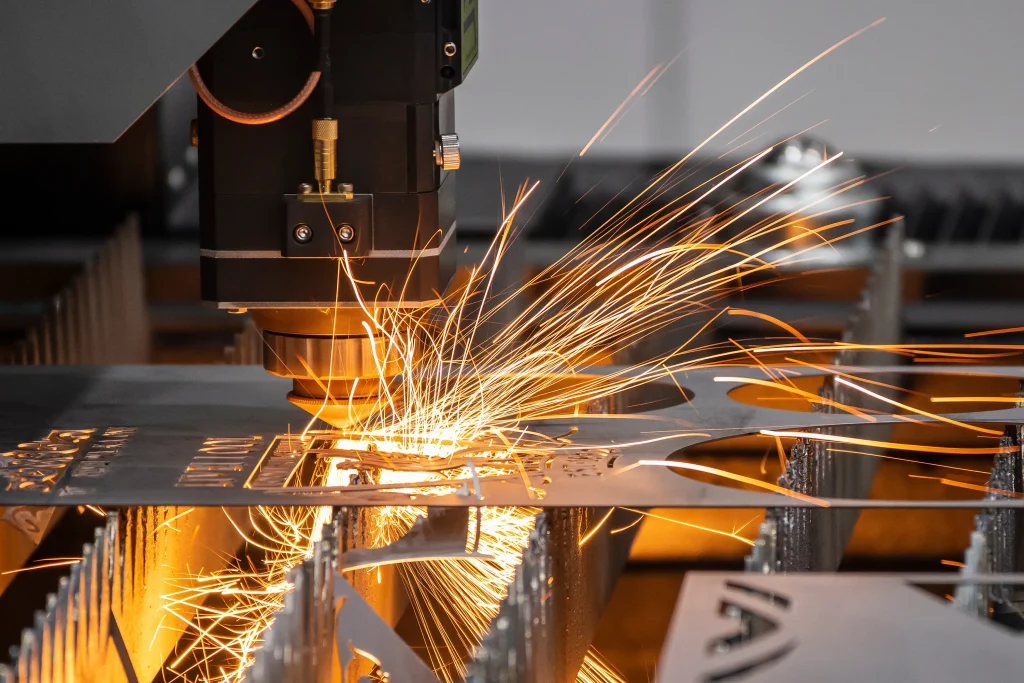
Modern laser cutting heads feature complex curved surfaces, multi-angle holes, and internal intersecting channels.
Traditional 3-axis machining requires multiple setups, leading to accumulated positioning errors.
Unsere Lösung
- 5-Axis CNC Machining
Enables single-setup machining for complex geometries - Process Concentration
Complete most features in one clamping to ensure accuracy - Deep Hole Drilling + Multi-Axis Positioning
Ensures smooth internal channels and prevents leakage risks - Turn-Mill Combined Machining
Guarantees high concentricity for threaded and connection features
👉 This approach improves both precision and efficiency for complex parts.
Challenge 3: Surface Finish Defects & Anodizing Control
Surface quality is critical, especially for visible parts.
For high-strength aluminum like AL7075, anodizing may cause:
- Uneven color (mottling)
- White spots
- Oberflächenfehler
Unsere Lösung
- Pre-Anodizing Testing
Trial anodizing before mass production - High-Quality Raw Material Control
Reduce impurity-related defects - Anodizing Thickness Compensation
Typischerweise 0.008–0,012 mm, pre-calculated in machining - Strict Surface Protection
Avoid scratches, dents, and handling damage
👉 This ensures both dimensional accuracy and cosmetic quality.
Fallstudie: High-Precision Laser Head Housing Project
A client required a complex laser cutting head housing with:
- Thin walls
- Complex internal cooling channels
- High precision requirements
Herausforderungen
- High deformation risk
- Complex machining paths
- Tight delivery schedule
Unser Ansatz
- Selected high-quality AL7075 material
- Designed vacuum fixtures to avoid clamping deformation
- Applied trochoidal milling strategy to reduce cutting force
- Conducted full CMM inspection
Results
- Stable production yield significantly improved
- Prototype delivered within 3–7 Werktage
- Successfully met customer requirements
Quality Control System
To ensure consistent quality, wir setzen um:
- Eingangsqualitätskontrolle (IQ)
- Qualitätskontrolle im Prozess (IPQC)
- Endgültige Qualitätskontrolle (FQC)
- CMM full inspection for critical dimensions
Our IPQC team conducts regular in-process inspections to detect and solve issues early—ensuring stable production quality.
Pricing Strategy: What Affects the Cost
When sourcing laser cutting head housings, price should not be the only consideration.
Wichtige Kostenfaktoren
- Material (7075 vs 6061)
- Part complexity
- Tolerance requirements
- Surface finishing
- Order quantity
Our Pricing Approach
We use a transparent pricing model based on:
- Machining time
- Part complexity
- Actual production cost
👉 No hidden charges, no low-price traps.
Why Choose Rapidefficient as Your CNC Machining Partner
- High-precision machining capability (±0,005 mm)
- Experience with complex industrial components
- Strong 5-axis machining capability
- Stabiles Qualitätskontrollsystem
- Fast prototyping: 3–7 Werktage
- Zuverlässige globale Lieferung
Abschluss
CNC machining of laser cutting head housings is far more complex than standard aluminum part production.
It requires:
- Deep understanding of material behavior
- Advanced machining strategies
- Strenge Qualitätskontrolle
Bei Rapidefficient, we combine engineering expertise with precision manufacturing to deliver reliable, high-quality components for demanding industrial applications.
FAQ
What material is best for laser cutting head housings?
Common choices include:
- Aluminium 6061 (kostengünstig)
- Aluminium 7075 (hohe Stärke, better performance)
How do you control deformation during machining?
- Stress-relieved materials
- Mehrstufige Bearbeitung
- Controlled cutting parameters
How long does production take?
- Prototyp: 3–7 Werktage
- Batch production: depends on quantity and complexity