
Fazit zuerst
Aluminum is one of the easiest metals to machine—but it still creates expensive production problems when tooling, füttert, Befestigung, or material selection are wrong.
The most common aluminum machining problems include:
- Burr formation
- Built-up edge
- Chatter marks
- Thin wall deformation
- Poor anodizing finish
- Tolerance drift
- Chip evacuation issues
👉 The good news: most aluminum machining problems are preventable with the right CNC strategy.
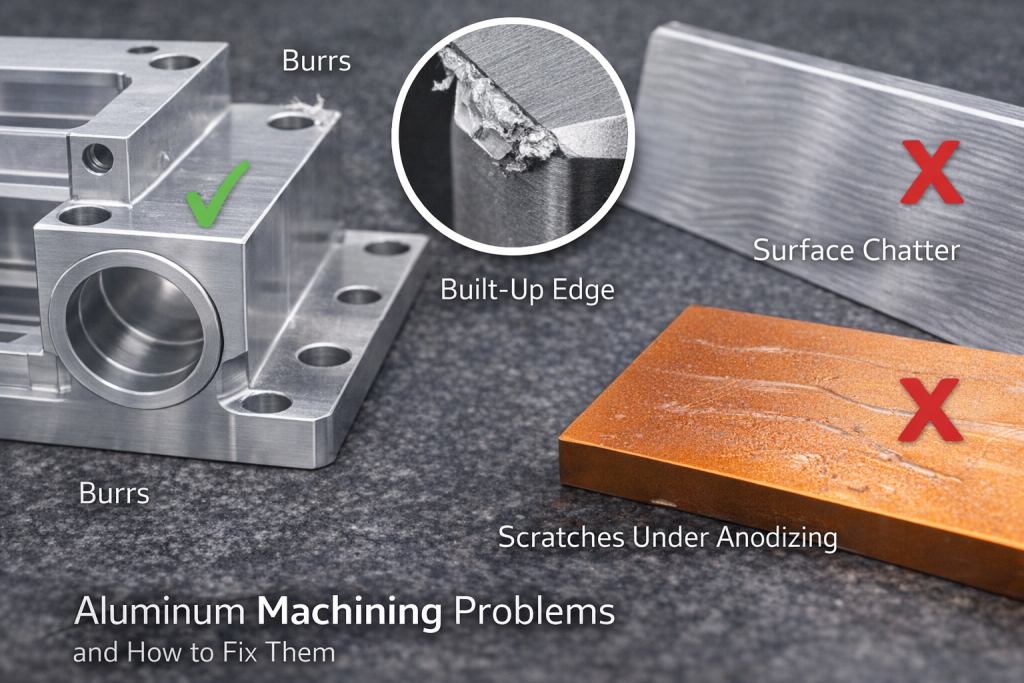
1. Burr Formation on Edges
Burrs are small unwanted metal edges left after cutting.
Common causes:
- Dull tools
- Wrong feed rate
- Poor exit strategy
- Excessive tool wear
How We Fix It
- Sharp carbide tools
- Optimized toolpath exit moves
- Secondary deburring if required
2. Aufbaukante (BOGEN)
Aluminum can stick to the cutting edge during machining.
This creates:
- Rough surface finish
- Dimension inconsistency
- Tool instability
- Sudden tool failure
Built-up edge also changes the tool’s effective geometry, creating unstable cutting forces and unpredictable results.
How We Fix It
- High polished flute tools
- Correct chip load
- Coolant or air blast
- DLC / ZrN coated tools
- O-flute cutters for high-speed aluminum machining
3. Chatter Marks on Surface
Chatter appears as wave-like vibration marks.
It is common on:
- Thin walls
- Long tools
- Weak fixturing setups
How We Fix It
- Shorter tool stick-out
- Higher rigidity setup
- Adjust spindle speed band
- Dynamic toolpaths
- Variable helix cutters when needed
4. Thin Wall Deformation
This is one of the biggest issues in aluminum housings and enclosures.
When too much force is applied, walls bend during cutting and spring back after unclamping.
Residual stress release often becomes visible only after the fixture is removed.
How We Fix It
- Vakuumvorrichtungen
- Onion skin strategy
- Light finishing passes
- Symmetrical roughing
- Balanced pocketing toolpaths
👉 See also: CNC-Bearbeitungsanleitung für dünnwandiges Aluminium
5. Poor Anodizing Appearance
Some machined parts look good before finishing, but poor after anodizing.
Common causes:
- Tool marks
- Uneven surface texture
- Wrong alloy choice
- Embedded contamination
- Hidden scratches
Anodizing does not hide machining mistakes—it often magnifies them.
How We Fix It
- Fine finishing passes
- Surface prep control
- Burr-free edges
- 6061 preferred for cosmetic parts
6. Tolerance Drift
The first parts are good. Later parts slowly go out of spec.
Causes:
- Werkzeugkleidung
- Thermal growth
- Fixture contamination
- Chip buildup
Aluminum has relatively high thermal expansion (um 23 µm/m/°C), so shop temperature changes can affect precision dimensions.
How We Fix It
- In-Prozess-Inspektion
- Tool life control
- Stable coolant temperature
- SPC monitoring
- Probe-based offset correction
7. Chip Evacuation Problems
Aluminum creates large chips that can recut surfaces.
This leads to:
- Oberflächenkratzer
- Broken tools
- Poor cycle time
How We Fix It
- High-pressure air blast
- Correct flute geometry
- Proper pocket clearing strategy
- High-speed chip evacuation paths
Quick Troubleshooting Table
| Problem | Grundursache | Expert Fix |
|---|---|---|
| Burrs | Material smearing | Sharp polished carbide tools |
| Aufbaukante | Heat / friction | DLC coating + coolant |
| Geschwätz | Resonance | RPM adjustment + Steifigkeit |
| Thin Wall Warp | Residual stress | Onion skin + balanced roughing |
| Bad Anodizing | Surface marks | Fine finish + entgraten |
| Drift | Heat / tragen | Probe checks + SPC |
Anmerkung des Ingenieurs
Aluminum is forgiving—but only to skilled machinists.
Its softness hides process mistakes until finishing, inspection, or final assembly.
That is why many “easy” aluminum parts become expensive remake jobs.
FAQ
Why does aluminum burr so easily?
Because soft material tends to smear instead of shear cleanly.
What aluminum is easiest to machine?
6061-T6 is usually the best all-around choice.
Why do thin wall aluminum parts warp?
Residual stress release and clamping distortion.
Why do anodized parts show scratches?
Because machining marks become more visible after finishing.
Final Thoughts
Most aluminum machining problems are not material problems.
They are process problems.
With the right tooling, Befestigung, and inspection control, aluminum parts can be produced quickly and consistently.
Need Better CNC Aluminum Parts?
Send us your drawings for a manufacturability review.
We help customers solve burrs, Geschwätz, tolerance drift, and cosmetic finish issues before production begins.