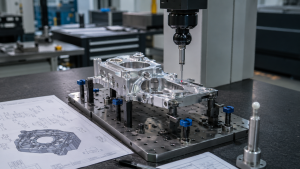

CNC 4-Achse-Bearbeitung fügt eine Rotationsachse hinzu (Normalerweise die A-Achse, drehen sich um die x-Achse, oder die B-Achse, rotating about the Y-axis) to traditional 3-axis (X, Y, and Z linear) Bearbeitung. By linking the rotary and linear axes, it enables efficient machining of complex workpiece surfaces, inclined holes, and multi-angle contours. Unten, we explain:
High Programming Complexity
The linkage paths of the rotary and linear axes must be considered to avoid tool interference (z.B., collisions between the tool and the workpiece or fixture during rotation). CAM software (such as UG or Mastercam) is typically used to automatically generate toolpaths and perform simulation verification.
Strict Precision Requirements for Rotary Axis
The positioning accuracy (generally around ≤±10″ for most machines, and up to ≤±5″ for high-end equipment) und Wiederholbarkeit (≤±3″) of the rotary axis directly impact machining quality and require regular calibration (z.B., using a laser interferometer). Außerdem, the concentricity error between the rotary axis and the worktable should typically be controlled within 0.01 mm to avoid radial dimensional deviations of the workpiece.
Matching Tools and Cutting Parameters
When machining inclined or curved surfaces, the cutting angle constantly changes. It is important to select tools suitable for multi-angle cutting (such as ball-end milling cutters and bullnose milling cutters). Dynamically adjust the feed rate (F value) und Spindeldrehzahl (S value) to avoid overcutting and poor surface quality.
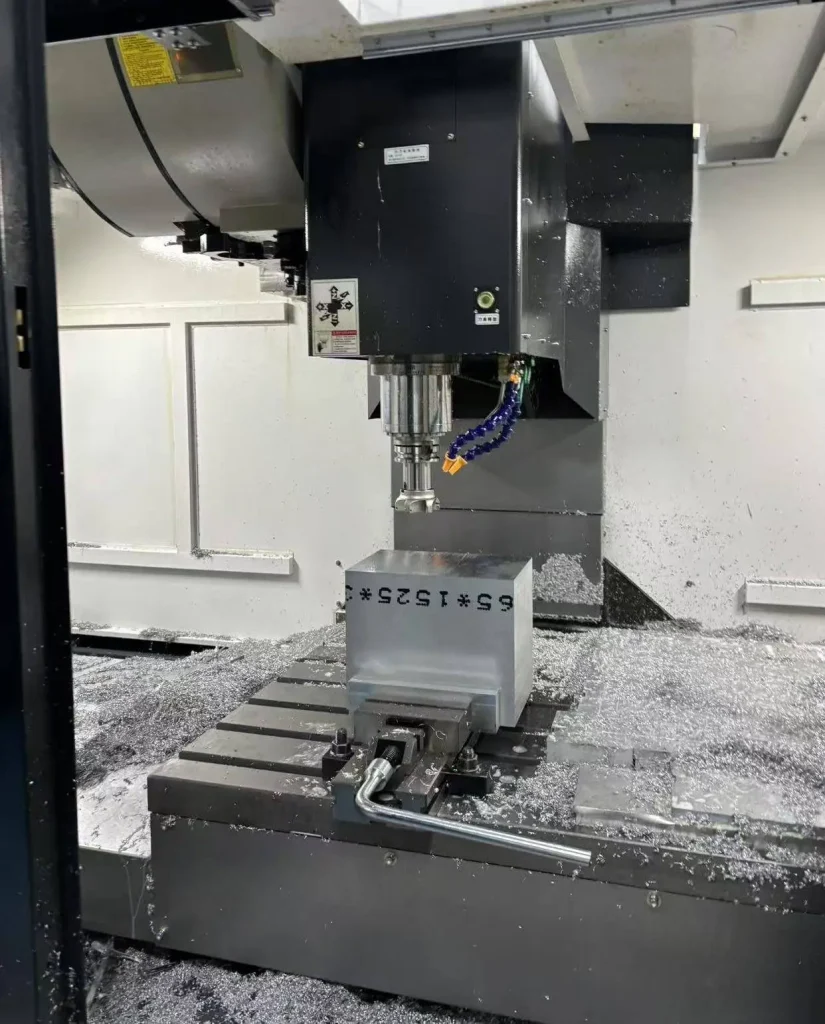
Fixture Design Must Adapt to Rotation
The fixture must be lightweight and not interfere with the movement of the rotating axis, while ensuring rigid clamping of the workpiece (especially at high rotation speeds, where centrifugal force can cause the workpiece to loosen). Hydraulic chucks, indexing heads, or custom fixtures are typically used. The clamping force should be calculated based on the workpiece weight and rotational speed (z.B., at 1000 rpm, the clamping force should be greater than the centrifugal force of the workpiece, often designed with a ≥1.5× safety factor).
Über RapidEfficient
RapidEfficient ist auf hochpräzise CNC-Bearbeitung spezialisiert 18 jahrelange Erfahrung. Die Produkte umfassen medizinische Produkte, Kommunikation, Optik, Drohnen, Intelligente Roboter, Automobil, und Büroautomationsteile.
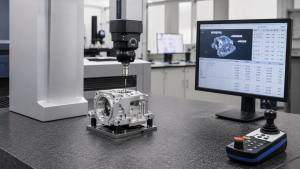
Die CNC-Bearbeitungszentren des Unternehmens verfügen über vier Achsen, fünfachsig, und Gestänge-Werkzeugmaschinen, und sind mit Präzisionsprojektoren ausgestattet, Drei-Koordinaten-Messmaschinen, Spektrometer, und andere Präzisionsprüfgeräte.
Bearbeitungsgenauigkeit: bis zu 0.01 mm
Prüfgenauigkeit: bis zu 0.001 mm