
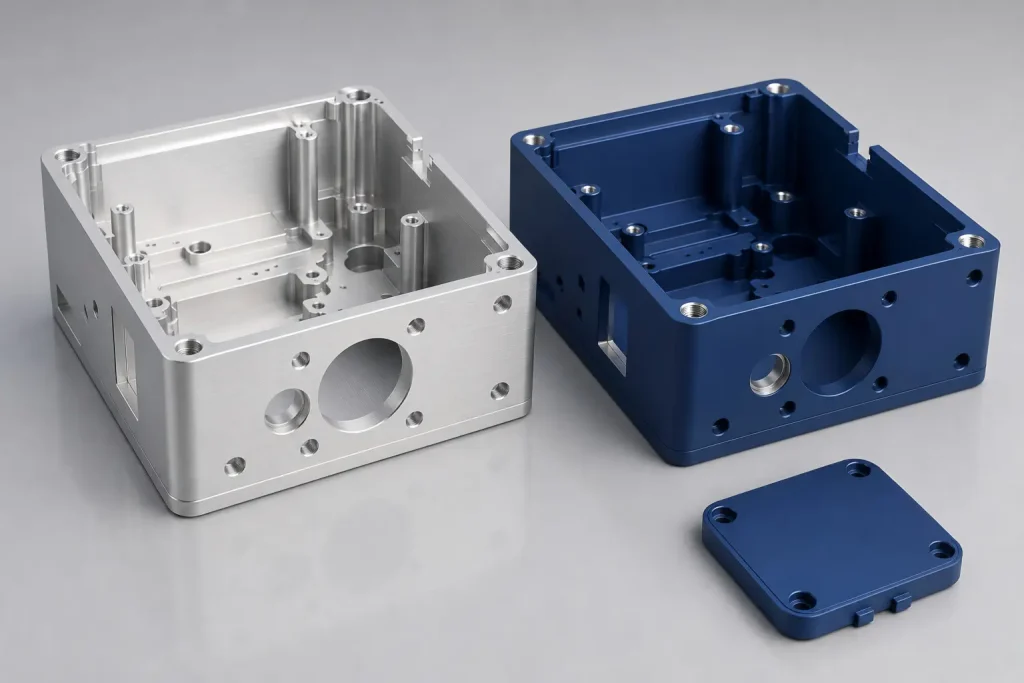
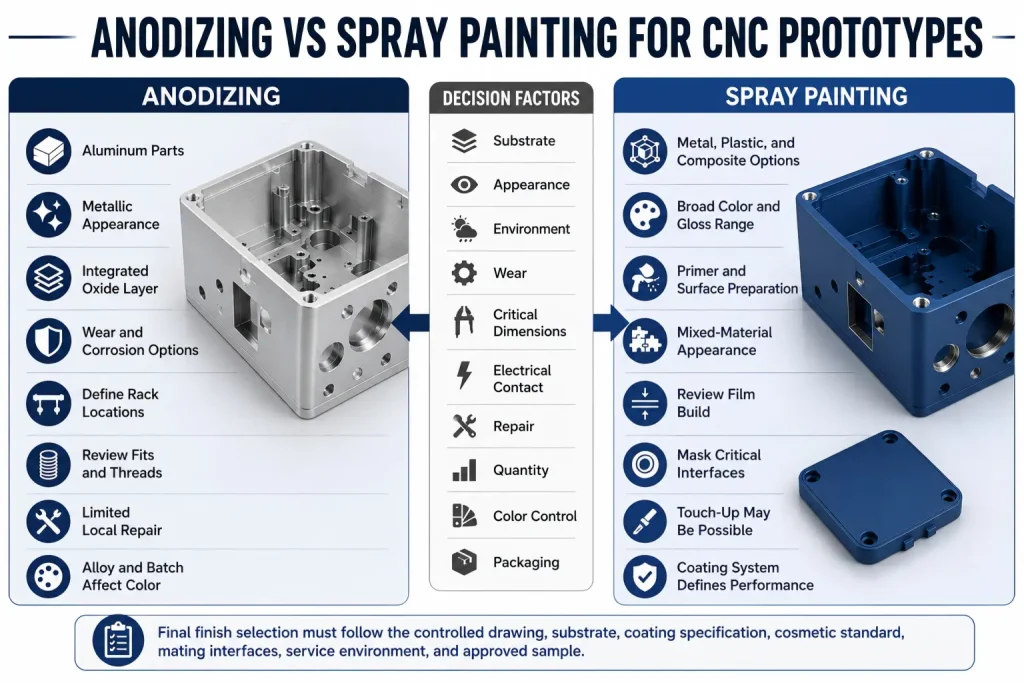
Anodizing and spray painting can both add color and protection to CNC-machined prototypes, but they are fundamentally different finishing processes.
Anodizing converts the surface of suitable aluminum into an integrated oxide layer. Spray painting applies a separate liquid coating system over the prepared substrate.
That difference affects:
- Material compatibility
- Metallic appearance
- Color range
- Wear behavior
- Corrosion protection
- Critical dimensions
- Masking
- Repair options
- Mixed-material assemblies
- Prototype cost
- Production repeatability
Neither finish is automatically better for every CNC prototype. The correct choice depends on the material, geometry, environment, appearance standard, assembly interfaces, production quantity, and expected service conditions.
Quick Answer
Choose anodizing when:
- The part is made from a suitable aluminum alloy.
- You want to retain a metallic appearance.
- Surface hardness or abrasion resistance matters.
- The finish should remain integrated with the aluminum surface.
- Critical visual surfaces can be controlled before finishing.
- Threads, fits, grounding areas, and rack locations can be planned in advance.
Choose spray painting when:
- The prototype combines metal, plastic, or composite parts.
- A specific color, gloss, texture, or brand appearance is required.
- The substrate cannot be anodized.
- You want to visually unify different materials.
- Local repair or touch-up may be useful.
- A suitable primer and paint system is available for the actual environment.
For aluminum parts, the decision is not simply “durability versus appearance.” Anodizing results depend on the alloy, surface preparation, anodizing specification, sealing, geometry, and color requirements. Spray-paint performance depends on cleaning, pretreatment, primer, paint chemistry, film build, cure, and service conditions.
Anodizing vs Spray Painting Comparison
| Factor | Anodizing | Spray painting |
|---|---|---|
| Basic process | Electrochemically converts the aluminum surface into an oxide layer | Applies a liquid primer, color coat, and possibly a clear coat |
| Main substrates | Suitable aluminum alloys | Metals, plastics, and composites when the coating system is compatible |
| Appearance | Retains more metallic character and underlying surface texture | Creates a coated appearance with broad control of color, gloss, and texture |
| Surface defects | Usually does not hide scratches, dents, tool marks, or uneven preparation | May reduce minor visual variation but does not reliably hide deep defects |
| Wear behavior | Can provide useful hardness and abrasion resistance, depending on specification | Depends on primer, paint chemistry, film thickness, cure, and environment |
| Corrosion protection | Depends on alloy, anodizing type, sealing, pretreatment, and exposure | Depends on preparation, primer, topcoat, coverage, cure, and exposure |
| Dimensional effect | Anodizing and pretreatment can affect critical dimensions | Adds an external coating film that may reduce clearance or soften details |
| Color range | Several colors are possible, but alloy, texture, thickness, dye, and batch affect appearance | Broad range of solid colors, gloss levels, metallic effects, and textures |
| Mixed materials | Cannot create the same anodized finish on plastic components | Can help unify metal and plastic parts when compatible systems are selected |
| Touch-up | Local repair is difficult to match | Local touch-up may be possible, although color and gloss can still vary |
| Masking | Often required for fits, threads, contacts, sealing faces, and rack areas | Often required for fits, threads, contacts, optical areas, and bonding surfaces |
| Prototype suitability | Functional aluminum prototypes and production-like validation | Visual prototypes, mixed-material assemblies, functional parts, and color validation |
| Cost | Influenced by anodizing type, color, masking, rack strategy, minimum lot, and inspection | Influenced by preparation, primer, color mixing, masking, curing, coats, and quantity |
Anodized appearance and performance can vary with alloy, temper, pretreatment, process type, coating thickness, and finishing conditions. Liquid coatings likewise depend on the complete coating system rather than the spraying method alone.
1. How Anodizing Works
For CNC aluminum parts, anodizing is an electrochemical process that converts the surface into aluminum oxide.
The oxide is formed from the aluminum substrate itself. It is not simply a colored film placed on top of the metal.
A typical finishing route may include:
- Cleaning
- Degreasing
- Etching or another surface-preparation step
- Desmutting
- Racking and electrical contact
- Anodizing
- Dyeing when color is required
- Sealing when specified
- Final cleaning
- Inspection
Different anodizing specifications are used for different appearance and performance requirements. The final result depends on the complete process rather than the word “anodized” alone.
Main Benefits of Anodizing
Anodizing may provide:
- Retained metallic character
- Improved surface hardness
- Useful abrasion resistance
- Corrosion protection
- Electrical insulation over coated areas
- Decorative color
- A finish integrated with the aluminum substrate
- Good suitability for many functional aluminum components
Main Limitations of Anodizing
Anodizing also has important limits:
- It is mainly an aluminum finishing option in this comparison.
- Alloy and material-batch differences can affect color.
- Tool marks and scratches may remain visible.
- Rack-contact marks are normally required somewhere on the part.
- Sharp edges, thin fins, deep pockets, and trapped-liquid areas can increase process risk.
- Critical fits and threads may require masking or machining allowance.
- Exact color matching between separate batches can be difficult.
- Local repair usually cannot reproduce the original finish perfectly.
For problems such as color variation, rack marks, burns, pitting, staining, poor sealing, and visible machining marks, review our aluminum anodizing defects guide.
2. How Spray Painting Works
Spray painting applies a liquid coating system over the prepared component.
A suitable process may involve:
- Cleaning
- Degreasing
- Abrasion or another surface-preparation method
- Chemical pretreatment where required
- Primer
- Base or color coat
- Clear coat when specified
- Flash-off
- Air drying, oven curing, or another approved cure
- Visual and adhesion inspection
The exact process depends on:
- Substrate
- Paint chemistry
- Environment
- Appearance requirement
- Film build
- Production quantity
- Required cure
- Supplier process
Surface preparation is especially important. Paint applied over oil, dust, release agents, oxidation, poor adhesion zones, or incompatible plastic can peel, blister, crack, or produce an uneven appearance.
Main Benefits of Spray Painting
Spray painting may provide:
- Broad color selection
- Matte, satin, gloss, metallic, or textured appearance
- Finishing of aluminum, steel, plastics, and composites when compatible
- Visual consistency across mixed-material assemblies
- Primer and topcoat systems selected for different environments
- Potential local touch-up
- Branding and color validation for prototypes
- Better visual coverage of minor base-material color differences
Main Limitations of Spray Painting
Spray painting also requires careful control:
- Adhesion depends on cleaning, preparation, primer, and substrate compatibility.
- Film thickness can affect fits, threads, slots, and assembly clearances.
- Paint may chip, scratch, peel, soften, fade, or lose gloss if the system is unsuitable.
- Thick coating can soften sharp edges, lettering, and fine details.
- Multiple coats and curing steps add time.
- Repair areas may show differences in color, texture, or gloss.
- Paint can hide some minor visual inconsistency but cannot reliably correct dents, gouges, deep scratches, burrs, or poor geometry.
3. Metallic Appearance vs Coated Appearance
Anodizing normally retains more of the visible metallic character of aluminum.
Machining lines, bead-blasted texture, brushing direction, polishing, alloy differences, and surface preparation may remain visible through the anodized finish.
This makes anodizing useful when the design requires:
- A technical metal appearance
- Brushed or machined texture
- Satin bead-blasted aluminum
- Colored aluminum that still looks metallic
- A relatively thin integrated finish
However, this also means that inconsistent machining or preparation may become more noticeable after anodizing instead of being hidden.
Spray painting creates a separate coating layer.
It may be more suitable when the design requires:
- A solid nonmetallic color
- High-gloss appearance
- Controlled matte or satin gloss
- Textured coating
- Color matching across aluminum and plastic
- Visual unification of different substrates
- A finish intentionally separated from the underlying metal texture
Do not assume that painting automatically hides all defects. Deep tool marks, dents, burrs, scratches, contamination, and uneven sanding transitions may still remain visible after coating.
4. Material Compatibility
Aluminum
Both finishes may be used on suitable aluminum parts.
Anodizing is directly linked to the aluminum substrate. Painting requires compatible cleaning, preparation, primer, and coating materials.
The aluminum alloy still matters. Different alloys and heat-treatment conditions can produce different anodized appearances, even when the same color name is specified.
Plastic
Plastic cannot receive an aluminum anodized finish.
Spray painting may be possible, but not every paint works on every plastic.
The supplier should confirm:
- Plastic type
- Surface energy
- Mold-release contamination
- Primer requirement
- Solvent compatibility
- Heat resistance during curing
- Flexibility
- Adhesion requirement
- Cosmetic standard
Some plastics require specialized preparation before painting.
Steel and Stainless Steel
Steel and stainless steel do not receive aluminum anodizing.
Liquid coatings may be used with suitable cleaning, pretreatment, primer, and topcoat systems.
Carbon-Fiber and Other Composites
Composite surfaces may be painted when the coating is compatible with the resin system, surface preparation, and service environment.
Exposed fibers, pinholes, sanding defects, resin variation, or conductive areas may require additional preparation.
Mixed-Material Assemblies
Spray painting is often more practical when the prototype includes:
- Aluminum housings
- Plastic covers
- Steel brackets
- Composite panels
- Molded inserts
- Separate cosmetic components
Painting may help the assembly share a similar color and gloss, but each substrate can still require a different preparation or primer.
5. Durability Depends on the Specification
It is too simple to say:
Anodizing is durable, while spray painting is only decorative.
Anodizing performance depends on:
- Aluminum alloy
- Surface preparation
- Anodizing type
- Coating thickness
- Dye
- Sealing
- Geometry
- Exposure
- Maintenance
Spray-paint performance depends on:
- Surface cleanliness
- Pretreatment
- Primer
- Paint chemistry
- Film thickness
- Number of coats
- Cure
- UV exposure
- Chemical exposure
- Temperature
- Abrasion
- Impact
Some anodized finishes are selected mainly for appearance, while others are selected for wear or corrosion resistance.
Some liquid coatings are mainly cosmetic, while others are engineered for UV, humidity, chemicals, abrasion, or outdoor exposure.
Questions to Ask Before Selecting a Finish
- Will the part be handled frequently?
- Will it slide against another component?
- Will fasteners contact the finish?
- Is the part exposed to sunlight?
- Will it contact coolant, oil, fuel, cleaner, or another chemical?
- Is the part used indoors or outdoors?
- Does it experience impact?
- Is the surface mainly cosmetic?
- Is electrical insulation or conductivity required?
- Is local repair expected?
The finish should be selected against the actual service requirement, not only from a generic durability ranking.
6. Dimensional Effects on CNC Parts
Both anodizing and spray painting can affect assembly dimensions.
Anodizing
Anodizing creates an oxide layer on and within the aluminum surface. Cleaning, etching, brightening, and other pretreatment steps can also alter dimensions.
The final dimensional effect depends on:
- Anodizing type
- Specified coating thickness
- Pretreatment
- Alloy
- Part geometry
- Finishing process
- Measurement method
Do not use one universal “per-side growth” value for every anodized CNC component.
Review these features before machining:
- Bearing bores
- Sliding fits
- Press fits
- Threads
- Dowel holes
- O-ring grooves
- Sealing faces
- Electrical grounding areas
- Optical interfaces
- Datum surfaces
Depending on the drawing, these areas may need:
- Machining allowance
- Masking
- Plugging
- Post-finish machining
- A defined final inspection condition
Spray Painting
Spray painting adds an external coating film.
The coating may affect:
- Hole diameter
- Slot width
- Thread fit
- Connector insertion
- Snap features
- Mating faces
- Engraved markings
- Sharp edges
- Flush assembly gaps
The required allowance depends on the primer, color coat, clear coat, application process, and film-build specification.
Critical areas may require masking rather than relying on the painter to keep the coating thin.
7. Threads, Fits, Masking, and Contact Areas
A finish note should define where coating is allowed.
Common Anodizing Masking Areas
- Precision bores
- Threads
- Bearing seats
- Grounding contacts
- Electrical connection points
- Sealing faces
- Optical contact surfaces
- Bonding areas
- Selected datum features
Anodizing also requires electrical contact with the part. The drawing or RFQ should therefore identify acceptable rack-contact areas when visible marks could create a dispute.
Common Paint Masking Areas
- Male and female threads
- Press-fit bores
- Bearing seats
- Grounding faces
- Connector contacts
- Adhesive-bonding surfaces
- Sealing areas
- Optical windows
- Labels
- Identification marks
- Sliding or mating surfaces
Masking may create visible transition lines. The acceptable boundary should be shown on the drawing instead of being left to interpretation.
8. Color Control and Batch Variation
Anodized Color
Anodized color may be influenced by:
- Alloy
- Temper
- Material batch
- Surface texture
- Machining direction
- Bead blasting
- Polishing
- Oxide thickness
- Dye
- Sealing
- Part geometry
- Production batch
A color description such as black anodized does not guarantee that every part will look identical.
For appearance-critical projects, consider:
- An approved sample
- An acceptable color range
- The same material batch
- The same finishing batch
- Defined cosmetic surfaces
- Controlled surface preparation
- Replacement-part matching requirements
Painted Color
Liquid paint normally provides greater freedom in:
- Solid color
- Gloss
- Matte level
- Metallic effects
- Texture
- Brand color
- Clear coat
- Visual matching across different materials
Painted appearance can still vary because of:
- Primer color
- Film thickness
- Spray technique
- Cure conditions
- Substrate texture
- Batch formulation
- Lighting
- Gloss angle
- Repair work
Use an approved sample when color and gloss are important.
9. Can Either Finish Hide Machining Marks?
Anodizing
Anodizing generally follows the existing aluminum surface.
It does not reliably hide:
- Cutter marks
- Chatter
- Scratches
- Dents
- Pits
- Uneven sanding
- Mixed blasting texture
- Burr-removal marks
A poor surface before anodizing may become more obvious after anodizing.
Spray Painting
Paint may reduce the visibility of minor variation, but it should not be treated as a repair process for poor machining.
Paint can still reveal:
- Deep scratches
- Dents
- Sharp burrs
- Sanding transitions
- Contamination
- Pinholes
- Poor filling
- Uneven primer
- Dust inclusions
High-build primers or fillers can change the visible surface, but they may also affect edge definition, dimensions, markings, flatness, and cost.
For cosmetic aluminum components, review our guide to preventing scratches on CNC aluminum parts.
10. Repair and Rework
Anodizing Rework
Anodized parts are difficult to repair locally without a visible difference.
Rework may require:
- Stripping
- Recleaning
- Re-anodizing
- Reinspection
- Dimensional review
- Surface review
- Remaking the part when stripping creates unacceptable risk
Repeated stripping and reprocessing should not be assumed harmless.
Paint Rework
Paint may be easier to touch up locally, but repair is not automatically invisible.
Possible differences include:
- Color
- Gloss
- Texture
- Film thickness
- Edge blending
- Cure
- Adhesion
- Overspray
For appearance-critical prototypes, the approved repair method should be agreed before production begins.
11. Cost for Prototypes and Low-Volume Parts
Do not assume spray painting is always cheaper or anodizing is always more expensive.
Anodizing Cost Factors
- Alloy
- Part size
- Anodizing type
- Color
- Masking
- Rack requirements
- Surface preparation
- Minimum lot charge
- Inspection
- Packaging
- Batch control
Spray-Painting Cost Factors
- Cleaning
- Surface preparation
- Primer
- Color matching
- Number of coats
- Clear coat
- Masking
- Manual handling
- Drying or curing
- Minimum paint quantity
- Spray-booth setup
- Touch-up
- Cosmetic inspection
For one or two prototypes in a custom color, paint mixing and setup may represent a large portion of the total price.
Anodizing may also have a minimum batch charge, even when the number of parts is small.
The correct comparison is the total finished-part cost under the actual specification.
12. When to Choose Anodizing
Anodizing is often the better starting point when:
- The part is aluminum.
- Metallic appearance is important.
- The machined or blasted texture should remain visible.
- Wear resistance is required.
- The part will be used as a functional prototype.
- A relatively thin integrated finish is preferred.
- The project can define rack marks and masking.
- Critical dimensions are reviewed before machining.
- The alloy and batch can be controlled.
- Local touch-up is not a major requirement.
Typical examples include:
- Aluminum housings
- Camera frames
- Control panels
- Heat sinks
- Robot brackets
- Optical equipment components
- Instrument enclosures
- Motor mounts
- Consumer-electronics prototypes
13. When to Choose Spray Painting
Spray painting is often the better starting point when:
- The prototype contains both metal and plastic.
- A precise brand color is required.
- The desired appearance is gloss, matte, textured, or nonmetallic.
- The substrate cannot be anodized.
- Different materials must look similar.
- A compatible industrial coating is available for the environment.
- Local touch-up may be required.
- Minor color differences in the base materials need to be reduced.
- The component is used for design validation, exhibition, user testing, or appearance approval.
- The coating system has been reviewed for adhesion, temperature, chemicals, and wear.
Typical examples include:
- Painted aluminum and plastic housings
- Consumer-product prototypes
- Display models
- Robot covers
- Instrument panels
- Control enclosures
- Automotive interior prototypes
- Mixed-material assemblies
14. When Neither Is the Best Choice
Other finishing methods may be more suitable depending on the project:
- Powder coating
- Chemical conversion coating
- Passivation
- Electroless nickel plating
- Electroplating
- Bead blasting
- Brushing
- Polishing
- As-machined finish
- Laser marking
- Soft-touch coating
- Protective film
Powder coating is not the same as spray painting with liquid paint. It uses dry powder followed by curing and has different film-build, edge, masking, repair, and production considerations.
For a direct comparison, review aluminum anodizing vs powder coating.
For a broader overview of available treatments, review our surface finishes for CNC-machined parts.
Decision Table
| Project requirement | Better starting option | Why |
|---|---|---|
| Metallic aluminum appearance | Anodizing | Retains more of the underlying metal character |
| Mixed aluminum and plastic assembly | Spray painting | Compatible systems can create similar color and gloss across substrates |
| High-wear aluminum surface | Anodizing, subject to specification | Suitable anodizing systems may provide useful hardness and abrasion resistance |
| Exact brand color | Spray painting | Usually provides broader color-matching options |
| Thin integrated aluminum finish | Anodizing | The oxide is formed from the aluminum surface |
| Local touch-up expected | Spray painting | Paint is generally more repairable, although matching remains difficult |
| Machining texture should remain visible | Anodizing | The finish normally follows the existing surface |
| Base-material color should be covered | Spray painting | An opaque coating can visually unify substrates |
| Critical electrical grounding area | Either, with masking | Both finishes can interfere with electrical contact |
| Precision bore or thread | Either, with allowance or masking | Both processes can affect fit |
| Outdoor use | Project-specific | Depends on the exact anodizing or paint specification |
| Chemical exposure | Project-specific | Must be evaluated against the actual chemical and coating system |
| One-off visual prototype | Spray painting may be practical | Flexible colors and mixed-material compatibility |
| Functional aluminum prototype | Anodizing may be practical | Metallic finish and integrated aluminum oxide layer |
RFQ Checklist
Provide the following information before quotation:
- 3D CAD model
- Controlled 2D drawing
- Material grade
- Aluminum temper where applicable
- Prototype or production quantity
- Finish type
- Anodizing type or paint system when known
- Color
- Gloss or texture
- Cosmetic surface zones
- Approved sample or color reference
- Surface preparation
- Threads and fits
- Masked areas
- Rack-contact areas
- Grounding or electrical contacts
- Sealing surfaces
- Bonding surfaces
- Operating temperature
- UV exposure
- Chemical exposure
- Wear or abrasion requirement
- Appearance-inspection conditions
- Packaging requirements
- Material and inspection documentation
Avoid using only notes such as:
Black anodized
or:
Spray paint white
These descriptions do not fully define alloy, pretreatment, masking, appearance, color tolerance, coating system, inspection, or packaging.
How Rapid Efficient Supports Prototype Finishing
Rapid Efficient supports custom CNC-machined metal and engineering-plastic prototypes, low-volume parts, and repeat production.
Project support may include:
- Drawing and DFM review
- Material selection
- CNC milling and turning
- Cosmetic-surface identification
- Anodizing coordination
- Liquid-painting coordination
- Powder-coating coordination
- Surface-preparation review
- Masking review
- Thread and fit allowance review
- Dimensional inspection
- CMM reports when requested
- Visual inspection against agreed requirements
- Individual protection and packaging
- International delivery coordination
Final feasibility depends on the material, geometry, quantity, tolerance, appearance requirement, finishing specification, inspection scope, and packaging requirements.
Learn more about our CNC aluminum machining services.
After receiving complete drawings, models, quantities, finishing requirements, and inspection expectations, Rapid Efficient typically provides quotation feedback within 24 hours.
FAQ
Is anodizing better than spray painting?
Not universally. Anodizing is often preferred for suitable aluminum parts that need a metallic appearance or integrated oxide finish. Spray painting is often preferred for mixed materials, broader color options, and a coated visual appearance.
Can aluminum be spray painted instead of anodized?
Yes. The aluminum must be properly cleaned and prepared, and the primer and paint system must be compatible with the service environment.
Can plastic parts be anodized?
No. Aluminum anodizing cannot be applied to plastic. Compatible liquid paint may be used on some plastics after suitable preparation and adhesion review.
Does anodizing hide machining marks?
Usually not. Cutter marks, scratches, polishing variation, blasting differences, and surface defects may remain visible or become more noticeable after anodizing.
Does spray painting hide scratches?
It may reduce the visibility of minor surface variation, but deep scratches, dents, burrs, and poor preparation can still remain visible after painting.
Does anodizing change part dimensions?
Yes. Anodizing and associated pretreatment can affect final dimensions. The result depends on the process, specified thickness, alloy, pretreatment, and geometry. Critical fits, threads, bores, and sealing areas should be reviewed individually.
Does paint affect CNC tolerances?
Yes. Primer, color coat, and clear coat add film thickness and can affect threads, bores, slots, fits, snap features, and assembly gaps.
Which finish offers more color options?
Spray painting generally provides broader control of color, gloss, texture, and visual effects. Anodizing can provide attractive metallic colors, but the final shade is more sensitive to alloy, preparation, thickness, dye, and batch conditions.
Which finish is easier to repair?
Spray paint is generally easier to touch up locally. Repaired areas may still show differences in color, gloss, texture, or thickness.
Is spray painting only for visual prototypes?
No. Industrial liquid-coating systems can be used for functional and end-use parts when substrate preparation, primer, topcoat, cure, and service requirements are properly specified.
Can anodizing and painting be used on the same part?
Yes, combined systems are possible for specific requirements. Masking, adhesion, process order, dimensions, electrical contact, and appearance must be reviewed with the finishing supplier.
Is powder coating the same as spray painting?
No. Powder coating applies dry powder followed by curing, while spray painting applies a liquid coating. Their film build, edge behavior, masking, repair, equipment, and production considerations differ.
Request a Surface-Finish Review
Send Rapid Efficient your:
- 2D drawing
- 3D model
- Material
- Quantity
- Intended finish
- Color and gloss requirement
- Cosmetic surfaces
- Threads and fits
- Masking requirements
- Operating environment
- Inspection expectations
- Packaging requirements
We can review whether anodizing, liquid painting, powder coating, or another finishing route better fits the prototype and production plan.