

CNC Machining Design Guide: Reduce Cost and Avoid DFM Risks
Two parts can look similar in CAD but require completely different machining strategies.
A design with thin walls, deep cavities, sharp internal corners, difficult tool access, small blind threads, or unnecessary tight tolerances may require longer cycle times, additional setups, special tooling, and more inspection work.
A strong CNC machining design does not simply ask:
Can this part be manufactured?
The better question is:
Can this part be manufactured consistently, inspected reliably, and delivered at a reasonable cost?
This guide explains the design decisions that matter most before quotation.
The most cost-effective CNC machined parts usually share five characteristics:
- Critical tolerances are applied only where function requires them.
- Internal corners allow practical cutting-tool access.
- Walls and tall features are rigid enough to resist vibration and deformation.
- Holes and threads are designed with realistic tool reach and chip evacuation in mind.
- Surface-finishing requirements are confirmed before machining begins.
The goal is not to simplify every design. The goal is to avoid paying for complexity that does not improve the final function of the part.
| Design Feature | Common Manufacturing Risk | Better Starting Point | When Engineering Review Is Important |
|---|---|---|---|
| Thin walls | Vibration, warping, and clamping deformation | Increase rigidity or reduce unsupported height | Large pockets, tall walls, plastics, tight flatness |
| Deep cavities | Long-tool chatter, poor surface finish, and higher cost | Reduce cavity depth or improve tool access | Narrow cavities, deep pockets, critical surfaces |
| Sharp internal corners | Standard milling tools cannot create a true internal square corner | Add a practical internal radius or dog-bone relief | Square mating parts, internal pockets, assembly constraints |
| Deep holes | Chip evacuation, tool deflection, and coolant-access problems | Review the depth-to-diameter ratio early | Small, blind, angled, or deep holes |
| Blind threads | Limited chip clearance and reduced usable engagement | Confirm thread depth and bottom clearance | Small threads, soft materials, stainless steel, copper |
| Tight tolerances | Higher machining and inspection cost | Tighten only functional features | Datum relationships, bearing bores, sealing faces |
| Undercuts | Special tools and additional setups | Simplify the feature or split the part | Internal grooves and inaccessible surfaces |
| Surface finishing | Dimensional change, masking, and appearance inconsistency | Confirm the finish before machining | Threads, fits, sealing surfaces, cosmetic faces |
This table is a starting point. Final decisions should be based on the drawing, material grade, production quantity, surface-finish requirements, and inspection plan.
Start with Function, Not with a Perfect CAD Model
A CAD model defines geometry. It does not automatically define the most stable manufacturing route.
Before machining begins, the drawing should make the functional priorities clear:
- Which surfaces locate the part during assembly?
- Which bores, holes, and threads control fit?
- Which dimensions belong to a datum chain?
- Which surfaces are cosmetic?
- Which areas can accept standard machining marks?
- Which features will receive anodizing, passivation, plating, or coating?
- Which dimensions require inspection reports?
The same nominal geometry may be quoted differently depending on whether the part is a prototype, a cosmetic enclosure, a bearing housing, a sealing component, or a repeat-production part.
Engineer’s Note
A useful DFM review does not remove complexity blindly. It separates necessary complexity from expensive complexity that adds no functional value.
Thin Walls, Large Pockets, and Deformation
Thin walls are one of the most common reasons a visually simple part becomes difficult to machine.
When material is removed from a housing, plate, bracket, or plastic component, the remaining structure becomes less rigid. Cutting forces, heat, clamping pressure, and residual stress can all influence the final shape.
The problem becomes more serious when the design includes:
- Large pockets
- Tall unsupported walls
- Long narrow ribs
- Thin floors
- Uneven material removal
- Tight flatness requirements
- Tight tolerances immediately after unclamping
- Plastics with high thermal expansion or moisture sensitivity
There is no universal minimum wall thickness for every CNC machined part. Material, feature height, geometry, tool access, clamping method, quantity, and tolerance level must be reviewed together.
A more stable machining route may include:
- Symmetrical material removal
- Multiple roughing and finishing stages
- Controlled clamping pressure
- Additional support during machining
- Rest periods between machining stages
- Inspection after unclamping
- Material-condition review before quotation
For a broader comparison of material behavior, dimensional stability, residual-stress risk, surface-finishing compatibility, and application fit, review our comprehensive CNC machining materials guide.
Hidden Cost: Large Pocketing Is Not Just Extra Material Removal
A large pocket may increase cost in several ways:
- Longer machining time
- More tool engagement
- Greater deformation risk
- Additional roughing and finishing stages
- More inspection work
- Possible rework after unclamping
- Higher surface-finishing sensitivity
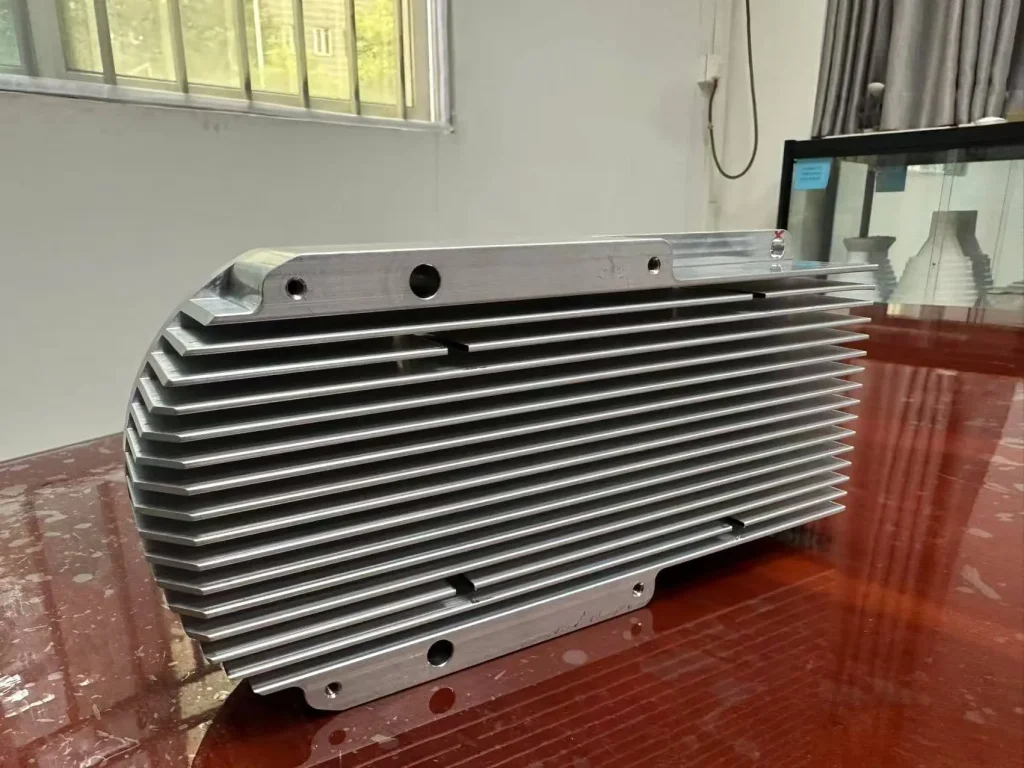
Tall, thin features require careful review of rigidity, machining strategy, handling risks, and dimensional stability.
Internal Corners, Cavities, and Tool Access
Standard milling tools are round. For this reason, a milled pocket naturally leaves an internal radius.
A sharp internal corner may look simple in CAD, but it can force the use of smaller tools, longer cycle times, additional operations, or a different manufacturing route.
When possible:
- Add an internal corner radius.
- Use the largest practical radius that does not interfere with assembly.
- Avoid extremely narrow slots that require fragile tools.
- Review cavity depth together with tool reach.
- Use dog-bone relief when a square or sharp-cornered mating component must fit into a milled pocket.
- Consider EDM review or a split-part design only when the geometry genuinely requires it.
A larger internal radius often allows a larger and more rigid cutting tool. This can improve machining stability and reduce cycle time.
Hidden Cost: The Smallest Corner Can Control the Entire Quote
A single small corner radius may force the machining plan to use:
- A smaller end mill
- Additional tool changes
- Slower cutting parameters
- Longer reach
- More vibration control
- Additional finishing passes
The rest of the part may be easy, but the smallest inaccessible feature can still control the cost.
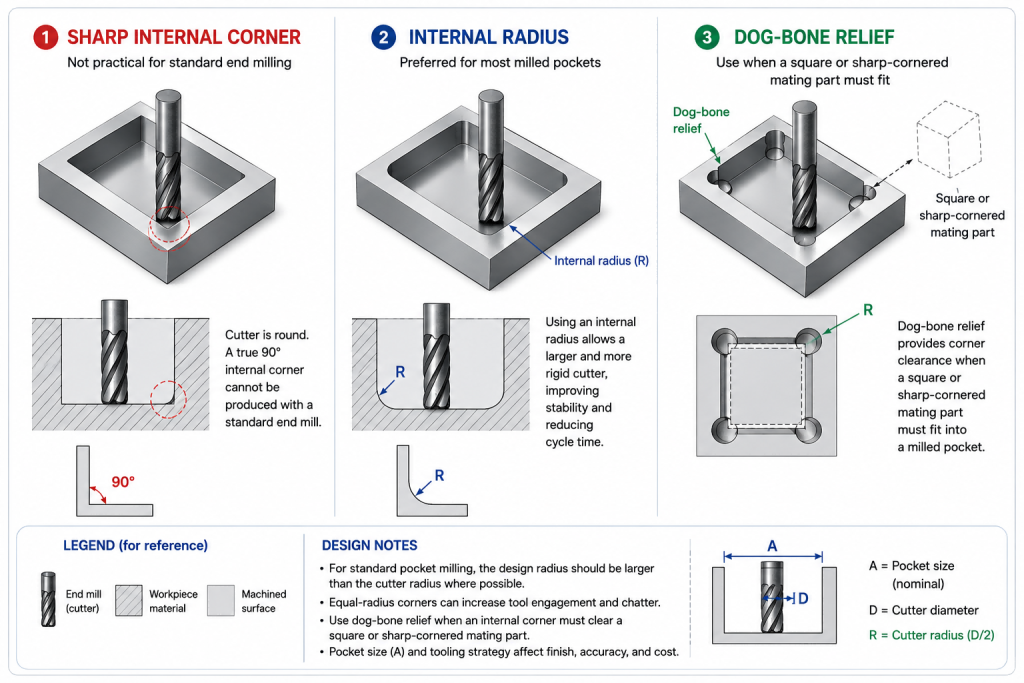
Standard end mills leave an internal radius. Dog-bone relief provides additional clearance when a square or sharp-cornered mating part must fit into a milled pocket.
Deep Cavities and Tall Features Need More Than a Dimension
A cavity is not difficult only because it is deep. It becomes difficult when the tool must reach into a narrow space while maintaining rigidity, chip evacuation, and surface quality.
Important design questions include:
- Can the tool reach the bottom surface?
- Is the opening wide enough for a rigid tool?
- Is the internal corner radius compatible with the tool diameter?
- Will long-tool vibration affect the sidewalls?
- Can chips escape from the cavity?
- Does the bottom surface require a cosmetic finish?
- Would a split-part design reduce risk?
Tall ribs and narrow standing features require similar review. As feature height increases relative to width, the structure becomes more sensitive to vibration and deflection.
Engineer’s Note
A cavity that is technically machinable may still be an expensive cavity. Tool reach, wall finish, chip evacuation, and inspection access all matter.
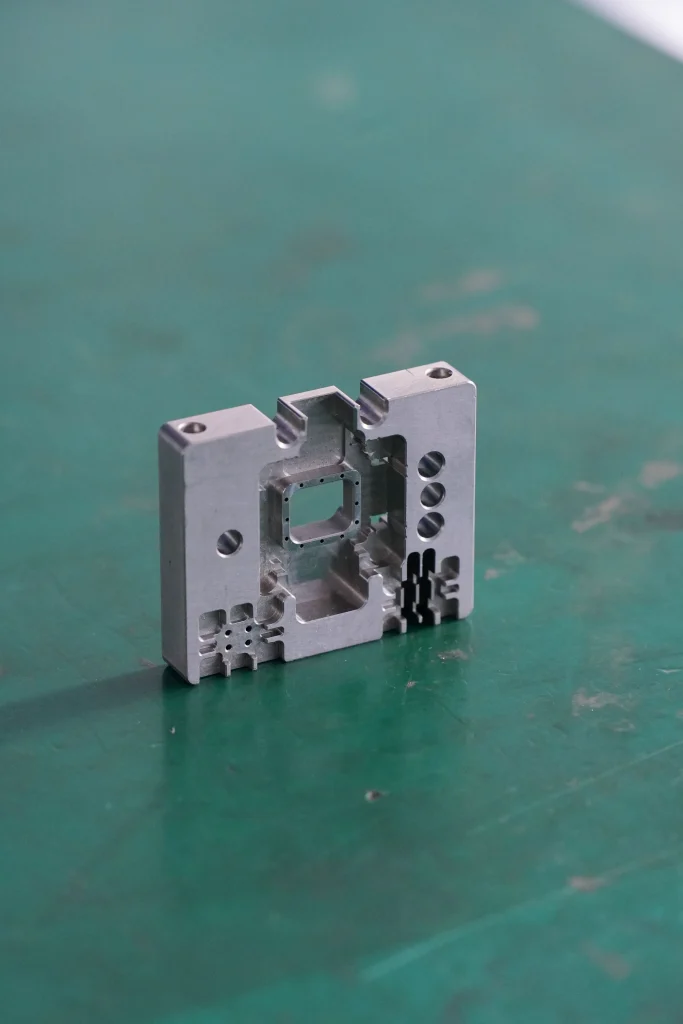
Complex internal cavities and narrow features require early review of tool access, corner radii, chip evacuation, and inspection strategy.
Holes and Threads: Small Features Are Not Small Problems
Holes and threads often look minor on a drawing, but they can create disproportionate manufacturing risk.
A through hole, a blind hole, and a blind threaded hole are not equivalent.
Through Holes
Through holes usually offer a simpler path for chip evacuation and tool exit. However, the machining strategy still depends on diameter, depth, material, access direction, tolerance requirements, and exit-side burr control.
Blind Holes
Blind holes need enough room for:
- Drill-point geometry
- Chip evacuation
- Tool approach
- Coolant access
- Bottom clearance
- Inspection
The specified usable depth should not be confused with the full drilled depth.
Internal Threads
Blind threads require additional attention because the usable thread engagement is shorter than the full drilled depth.
Before quotation, confirm:
- Thread standard
- Nominal size
- Pitch
- Through or blind condition
- Usable engagement length
- Bottom clearance
- Material grade
- Surface treatment
- Whether a go/no-go gauge check is required
Small blind threads in stainless steel, copper alloys, and soft materials deserve early review because tool wear, chip evacuation, burr formation, and thread quality can become significant issues.
Copper alloys deserve additional attention when a part includes small holes, blind threads, tight edge requirements, or appearance-sensitive surfaces. Review tooling behavior, burr control, oxidation risk, and inspection planning in our copper CNC machining guide.
Deep-Hole Review
As the hole depth-to-diameter ratio increases, drilling becomes more sensitive to:
- Tool deflection
- Chip evacuation
- Coolant delivery
- Hole straightness
- Burr control
- Inspection access
Holes approaching approximately 6×D or deeper should usually be reviewed separately rather than treated as routine drilled features. The exact strategy still depends on material, hole diameter, tolerance, access direction, and equipment.
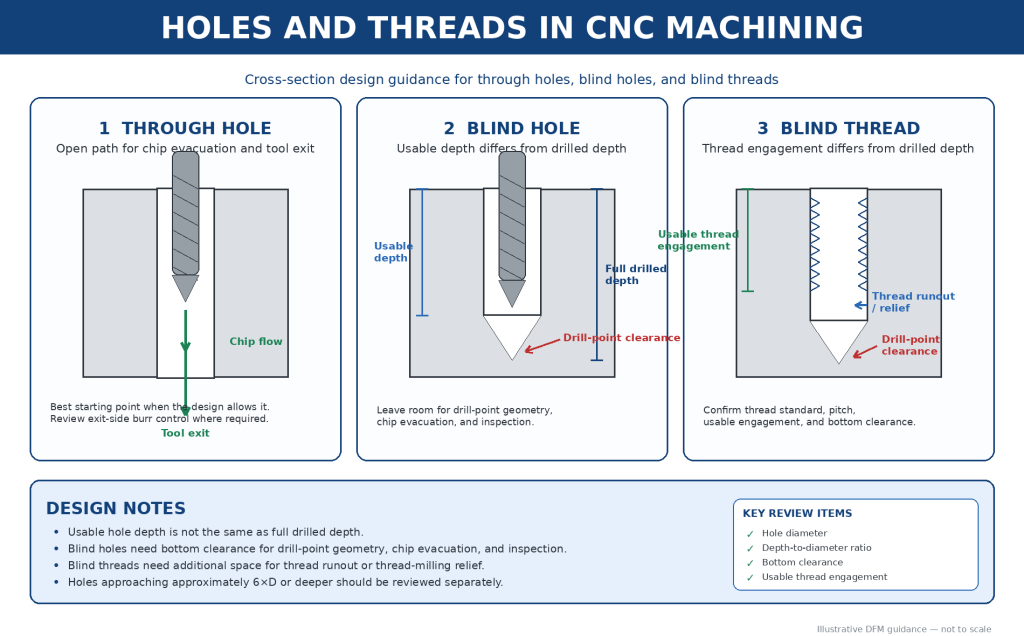
Blind holes and internal threads require space for drill-point geometry, chip evacuation, thread runout, and usable engagement.
Chamfers, Edge Breaks, and Deburring Notes
Sharp edges can affect handling, assembly, appearance, and final packaging.
A general edge-break note is often more efficient than adding a large number of individually dimensioned chamfers to non-critical edges.
Before finalizing the drawing, decide:
- Which edges require a controlled chamfer?
- Which edges only need deburring?
- Which edges affect assembly?
- Which edges are cosmetic?
- Which edges must remain sharp for functional reasons?
A typical note may specify deburring and breaking sharp edges unless otherwise stated. Functional chamfers should still be dimensioned individually.
Hidden Cost: Over-Specifying Every Edge
Adding a precise chamfer to every visible edge can increase programming, tool changes, inspection effort, and cycle time without improving function.
Undercuts and Inaccessible Features
An undercut is a feature that cannot be reached directly using a standard tool approach.
Examples include:
- Internal grooves
- Side pockets
- Recesses behind walls
- Hidden reliefs
- Internal retaining-ring grooves
- Features blocked by adjacent geometry
An undercut may require:
- Special tooling
- Additional setups
- Custom fixtures
- EDM review
- Part redesign
- Splitting the part into multiple components
The feature should be retained only when it provides a clear functional benefit.
Tolerance Budget: Tighten Only What Controls Function
A drawing does not become more professional simply because every dimension is tight.
Tight tolerances should be applied where they control:
- Assembly fit
- Bearing location
- Sealing performance
- Datum relationships
- Hole position
- Run-out
- Flatness
- Perpendicularity
- Functional motion
Non-critical dimensions can usually use a more practical general tolerance.
General tolerances are safety nets for non-functional dimensions, not substitutes for a controlled tolerance budget.
When ISO 2768-1 is referenced on a drawing, the applicable tolerance class should be specified clearly. Dimensions without individual tolerance indications may then follow the selected general-tolerance class.
Critical fits, datum relationships, position tolerances, run-out, flatness, perpendicularity, and other functional geometric requirements should still be defined explicitly on the 2D drawing.
For engineering plastics, tolerance planning should also consider material behavior, thermal expansion, moisture sensitivity, part geometry, and inspection conditions rather than relying on a generic default alone.
A good tolerance strategy separates:
Critical Features
Features that affect assembly, sealing, alignment, rotation, or function.
Controlled but Non-Critical Features
Dimensions that need consistency but do not justify the tightest tolerance.
General Features
Dimensions that can follow the drawing’s selected general-tolerance standard.
For a more detailed comparison by material, process, feature type, and inspection method, review our shop-floor CNC machining tolerance chart.
Hidden Cost: Tight Tolerances Increase More Than Machining Time
A tighter tolerance may also require:
- More stable raw material
- Additional setups
- More finishing passes
- More frequent inspection
- CMM verification
- Temperature-control review
- Additional reporting
- Higher scrap risk
Engineer’s Note
If a dimension does not control function, do not tighten it automatically.
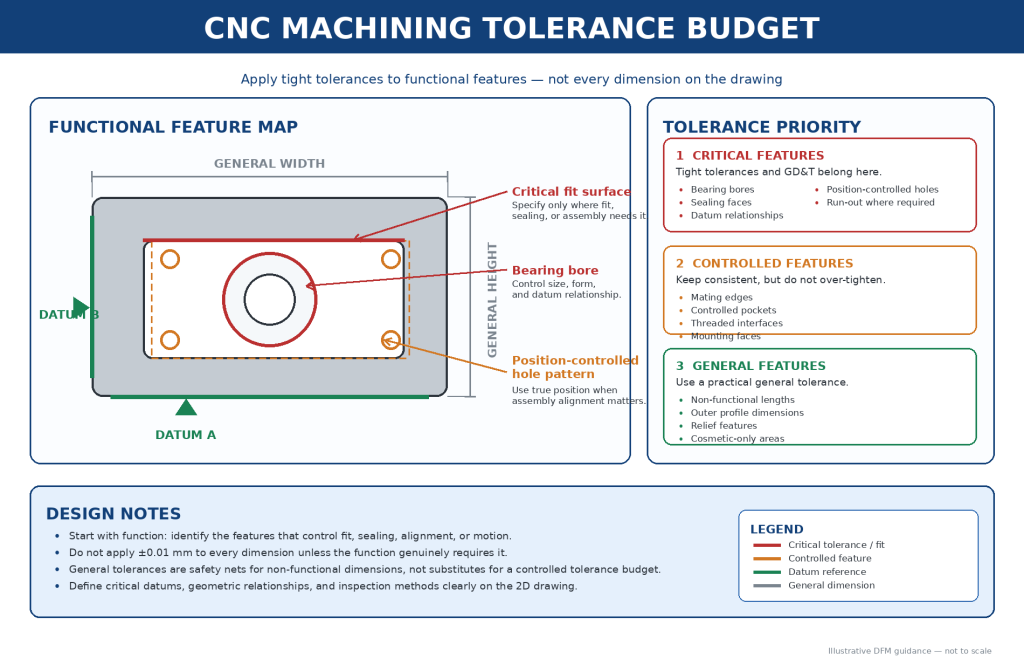
Tight tolerances should be applied to functional features, datum relationships, and mating surfaces—not every dimension on the drawing.
Choose the Simplest Stable Manufacturing Route
The most complex machine is not always the best choice.
A stable process begins with the geometry and functional requirements of the part.
| Part Condition | Manufacturing Route to Review First |
|---|---|
| Rotational geometry | CNC turning |
| Prismatic part with accessible faces | 3-axis CNC milling |
| Multi-side machining with fewer repeated setups | 4-axis CNC machining |
| Angled features or difficult tool access | 5-axis CNC machining |
| Sharp internal corners or inaccessible features | EDM review or structural redesign |
| Thin sheet geometry | Sheet-metal process review |
| Repeat geometry with higher quantities | Fixture, extrusion, casting, or molding review |
The best route should balance:
- Geometry
- Tolerance
- Setup count
- Material behavior
- Surface-finish expectations
- Inspection requirements
- Quantity
- Delivery priorities
For an overview of machining, inspection, finishing, and supporting resources, review our CNC machining equipment and manufacturing capacity page.
Surface Finishing Must Be Planned Early
Surface finishing should not be treated as a decision made after machining is complete.
The finish can influence:
- Dimensional allowance
- Surface appearance
- Corrosion resistance
- Electrical contact
- Thread fit
- Press fit
- Sealing surfaces
- Masking requirements
- Packaging method
Common options may include:
- Anodizing
- Hard anodizing
- Passivation
- Bead blasting
- Polishing
- Plating
- Powder coating
- Painting
- Laser engraving
For aluminum parts, machining marks, bead blasting, anodizing, cosmetic expectations, and dimensional allowances should be reviewed together. Read our surface finish guide for CNC aluminum for a more detailed planning checklist.
For stainless-steel parts, passivation requirements should be confirmed together with cleaning, thread protection, blind-hole handling, surface condition, and corrosion-resistance expectations. Read our guide to stainless steel passivation for CNC parts.
Before production begins, confirm:
- Which surfaces are cosmetic?
- Which surfaces need masking?
- Which holes and threads must remain free of coating?
- Which fits require allowance?
- Which appearance standard should be used?
- Which surfaces need protection during packaging?
Hidden Cost: Finishing Can Expose Earlier Design Decisions
A part may pass machining inspection but still fail after finishing if thread fit, coating allowance, cosmetic surfaces, or handling risks were not reviewed early.
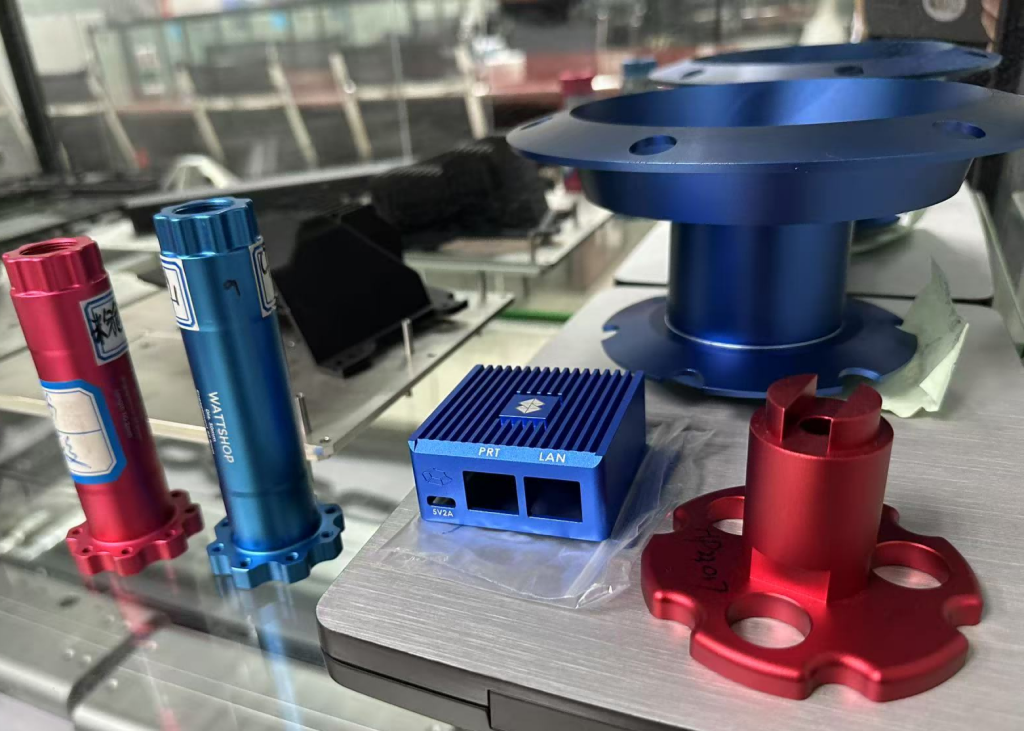
Anodized aluminum CNC components showing why color, appearance, masking areas, threads, and mating surfaces should be confirmed before finishing.
Inspection Planning Should Start Before Production
Inspection is most effective when critical features are identified before machining begins.
Depending on the drawing and project requirements, inspection may include:
- Dimensional checks
- Calipers
- Micrometers
- Height gauges
- Pin gauges
- Thread gauges
- CMM inspection
- Surface checks
- Visual inspection
- Material certificates
- Inspection reports upon request
Not every part requires the same inspection method. The inspection plan should reflect functional risk, tolerance level, material, quantity, and customer requirements.
For more detail on dimensional inspection, thread checks, surface review, reporting, and packaging control, visit our quality assurance for CNC machined parts page.
Drawing Review Checklist Before Quotation
Before requesting a quotation, prepare as much of the following information as possible.
Required Files
- 2D drawing
- 3D CAD file
- Revision number
Material Requirements
- Exact material grade
- Temper or heat-treatment condition where relevant
- Material-certification requirements
Dimensional Requirements
- Critical tolerances
- Datum scheme
- Geometric tolerances
- Fits
- Thread specifications
- Inspection-report requirements
Surface Requirements
- Surface finish
- Roughness requirements
- Cosmetic surfaces
- Masking areas
- Coating-sensitive holes, threads, fits, and sealing faces
Commercial Requirements
- Prototype or production quantity
- Repeat-order expectation
- Packaging requirements
- Delivery destination
- Target schedule
If some details are not yet finalized, send the available files first. A practical DFM review can identify the points that require confirmation before production.
About Rapid Efficient
Rapid Efficient specializes in precision CNC machining for custom metal and engineering-plastic parts.
With 18 years of machining experience, we support prototype development, low-volume production, and repeat manufacturing through coordinated machining, inspection, surface-finishing, packaging, and international-delivery resources.
Our machining capabilities cover aluminum, stainless steel, copper alloys, brass, engineering plastics, and other project-specific materials.
Equipment, machining routes, inspection methods, and finishing requirements are reviewed according to the geometry, tolerance level, production quantity, and intended application of each part.
Upload Your Drawing for DFM Review
Send your 2D drawing, 3D CAD file, material requirement, tolerance notes, surface-finish requirements, expected quantity, and inspection needs.
Rapid Efficient will review the machining route, critical features, production risks, finishing requirements, and delivery conditions before quotation.