
Quick Answer: Should You Choose Aluminum or Brass?
Choose aluminum—often 6061-T6 or 6061-T651—for weight-sensitive housings, brackets, heat sinks, fixtures, and structural parts where a high strength-to-weight ratio, anodizing options, and lower shipping mass are important.
Choose brass—often C360 for free machining or a lead-free grade when required—for compact fittings, valve components, threaded inserts, contact hardware, and decorative parts where clean chip formation, thread quality, plating, polishing, or small turned features matter.
Do not choose from the metal name alone. Aluminum and brass are both alloy families, and their properties change significantly by grade, temper, stock form, and composition.
Also, brass is not automatically more electrically conductive than aluminum. For example, typical 6061-T6 conductivity is about 43% IACS, while C360 free-cutting brass is about 26% IACS. Brass is still widely used for connector hardware because machinability, threads, contact geometry, wear, corrosion behavior, and plating can matter as much as bulk conductivity.
The RFQ should specify the exact alloy, temper, lead or RoHS requirement, stock form, threads, surface finish, service environment, quantity, and inspection requirements.
Hydro lists 6061-T6 at about 43% IACS, while the Copper Development Association lists C360 at 26% IACS. C360 remains highly machinable, but that does not mean it is inherently more electrically conductive than every aluminum alloy.
Aluminum vs Brass Quick Comparison
| Comparison Item | Aluminum | Brass | Buyer Should Check |
|---|---|---|---|
| Common CNC grades | 6061, 7075, 2024, 5052, 6262 | C360, C260, C464, C693 and other lead-free grades | Always specify the exact alloy and condition |
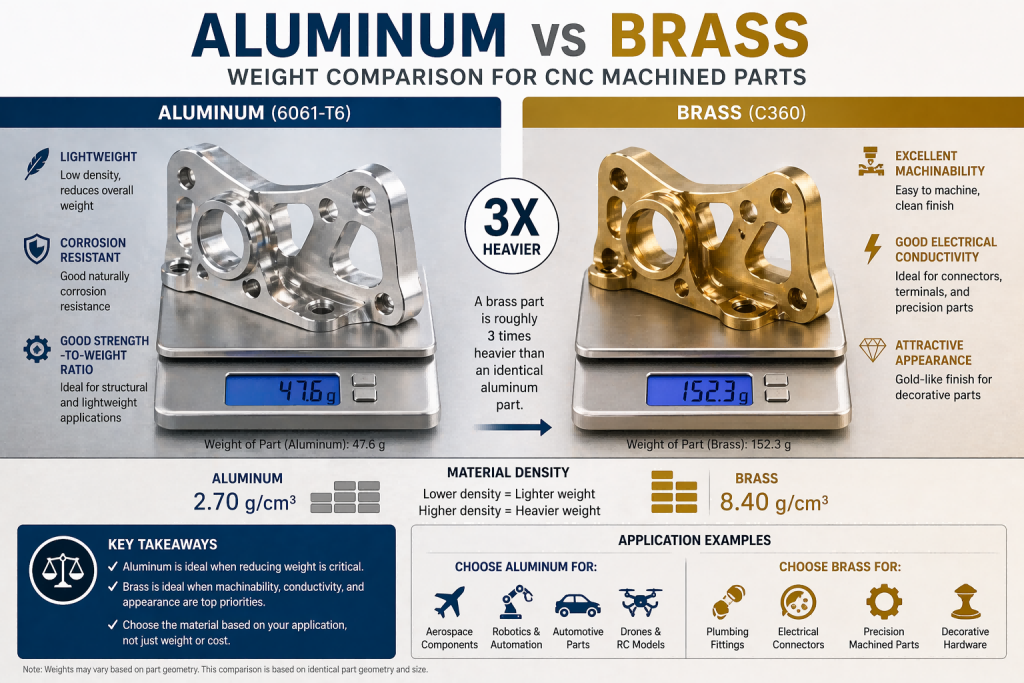
| Density | Around 2.70 g/cm³ for common aluminum alloys | Around 8.3–8.5 g/cm³ for many machining brasses | An identical brass part is roughly three times heavier |
| Strength-to-weight ratio | Usually better | Lower because of higher density | Important for portable and moving assemblies |
| CNC machinability | Good, but chip control varies by alloy | C360 is exceptionally machinable; other brass grades vary | Do not treat all brass or aluminum grades the same |
| Small threads | Possible with suitable engagement or inserts | C360 often produces clean, compact threads | Define torque, engagement, and assembly cycles |
| Electrical conductivity | Alloy-dependent; 6061-T6 is about 43% IACS | Alloy-dependent; C360 is about 26% IACS and C693 about 8% IACS | Do not select by metal family alone |
| Corrosion resistance | Good for many environments; anodizing or coating may help | Grade- and environment-dependent | Check galvanic contact and dezincification risk |
| Surface finish | Anodizing, conversion coating, painting, polishing, and powder coating | Polishing, plating, passivation, lacquer, or natural brass appearance | Define visible surfaces and finish acceptance |
| Lead content | Common 6061 contains no intentional machining lead, but some free-machining grades require review | C360 contains 2.5–3.0% lead; lead-free alternatives are available | Confirm RoHS, potable-water, food-contact, or customer requirements |
| Cost | Often lower for larger, lightweight parts | Higher material mass, but short cycle time can help small turned parts | Compare total finished-part cost, not raw material alone |
| Common fit | Housings, brackets, heat sinks, plates, fixtures, and structural parts | Fittings, threaded inserts, valve bodies, terminals, and decorative hardware | Choose from function and manufacturing route |
C360 has a Copper Development Association machinability rating of 100 and a density equivalent to a specific gravity of about 8.5. Lead-free C693 has a machinability rating of 85, showing that a compliant alternative can still machine well but should not be assumed identical to C360.
Weight Matters
AWeight is one of the clearest differences between aluminum and brass.
Typical density examples are:
- 6061 aluminum: approximately 2.70 g/cm³
- C360 free-cutting brass: approximately 8.5 g/cm³
- C693 lead-free brass: approximately 8.3 g/cm³
For identical part geometry and volume, a brass part is normally a little more than three times as heavy as a 6061 aluminum part.
This affects more than the finished-product weight. It can also change:
- Shipping cost
- Moving mass
- Motor and actuator load
- Support-structure requirements
- Ergonomics
- Inertia in rotating or robotic assemblies
- Raw-material usage by weight
Aluminum is usually the more practical option for large housings, brackets, plates, fixtures, and moving assemblies where low mass matters.
Brass can still be practical for small fittings, inserts, connectors, and valve components where the absolute part weight is limited and compact geometry or machining efficiency matters more.
Hydro gives 6061 a density of 0.098 lb/in³, while Copper.org lists specific gravities of approximately 8.5 for C360 and 8.3 for C693.
Machinability and Surface Finish
Machinability depends on the exact alloy rather than only the metal family.
Brass Machinability
C360 free-cutting brass is a benchmark screw-machine material. Its lead content helps produce short chips, low cutting forces, clean surfaces, and well-defined small features.
It is commonly selected for:
- Turned fittings
- Threaded inserts
- Valve bodies
- Adapters
- Small nuts and fasteners
- Precision contact hardware
- Knurled components
However, not every brass grade machines like C360.
Lead-free brass grades can still machine efficiently, but they may require different tools, chip-control strategies, speeds, feeds, and tool-life expectations. For example, C693 has a machinability rating of 85 compared with C360’s reference rating of 100.
Aluminum Machinability
6061-T6 has adequate machinability for general CNC parts, but turning and drilling chips may be more difficult to break than C360 brass chips.
Aluminum grades developed for machining, such as 6262, can provide improved chip formation compared with general structural grades.
Machining performance also depends on:
- Tool geometry
- Cutting-edge sharpness
- Chip evacuation
- Tool runout
- Coolant or air blast
- Part rigidity
- Alloy temper
- Surface-finish requirement
Surface Appearance
Brass can produce a polished, plated, brushed, or natural gold-tone appearance. Aluminum can be anodized, conversion-coated, bead-blasted, polished, painted, or powder-coated.
The selected finish should be defined before quotation because it may affect:
- Dimensional allowance
- Masking
- Cosmetic inspection
- Handling protection
- Color consistency
- Final cost
For aluminum finish selection, review our aluminum anodizing vs powder coating guide.
The Copper Development Association gives C360 a machinability rating of 100 and C693 a rating of 85. Hydro describes 6061-T6/T6511 machinability as adequate but notes that chips can be difficult to break during turning and drilling; 6262 was developed specifically for improved machining applications.
Threads, Inserts, and Repeated Assembly
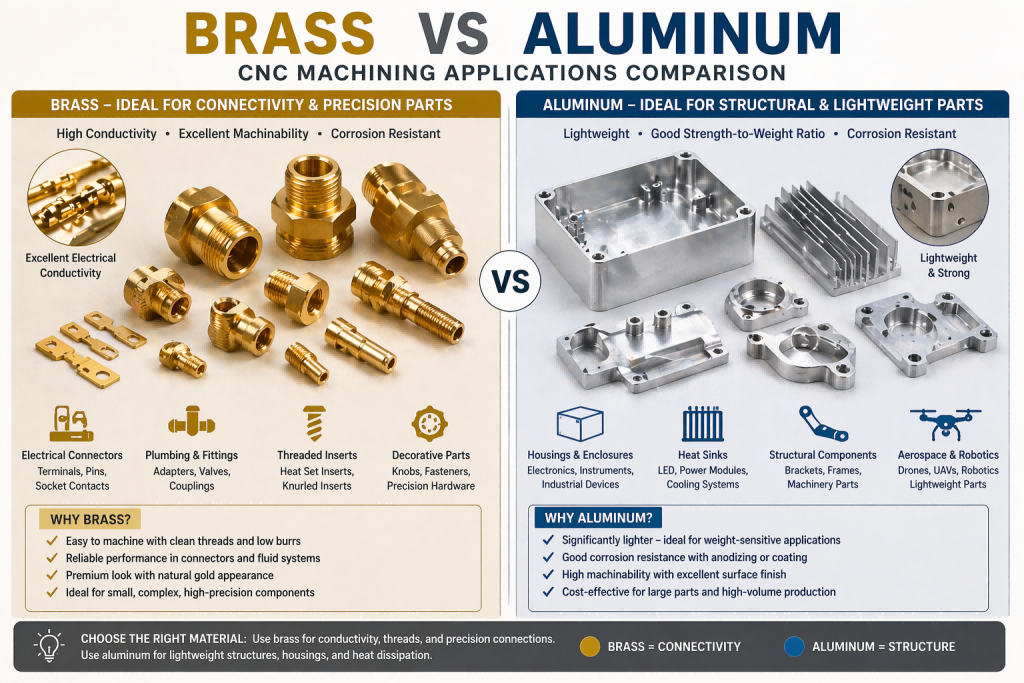
Brass is often selected for small threaded parts because free-machining grades can produce clean thread profiles with relatively low burr formation.
Typical examples include:
- Threaded inserts
- Hose fittings
- Valve components
- Sensor bodies
- Electrical contact hardware
- Small adapters
- Precision nuts
However, brass does not automatically guarantee a stronger thread. Thread performance still depends on:
- Alloy and temper
- Thread size
- Wall thickness
- Engagement length
- Tightening torque
- Assembly frequency
- Operating temperature
- Vibration
- Corrosion environment
Aluminum can also support reliable threads when the engagement length and torque are suitable.
For repeatedly assembled aluminum parts, designers may consider:
- Longer thread engagement
- Larger thread size
- Helical wire inserts
- Solid threaded inserts
- Through-bolts and nuts
- Local wall-thickness increases
- Defined tightening torque
If the drawing includes small or frequently assembled threads, the RFQ should specify the thread size, depth, tolerance class, torque, and expected assembly cycles.
For drawing terminology and thread-callout risks, see our tapped hole vs threaded hole guide.
Copper.org lists threaded inserts, fittings and screw-machine products among typical C360 uses, but the finished thread still depends on geometry, engagement and assembly conditions.
Electrical Conductivity and Contact Hardware
Electrical conductivity must be compared by exact alloy.
Typical examples include:
- 6061-T6 aluminum: approximately 43% IACS
- C360 free-cutting brass: approximately 26% IACS
- C693 lead-free brass: approximately 8% IACS
This means brass is not automatically more electrically conductive than aluminum.
Brass is still commonly used for connectors, terminals, pins, threaded contacts, switch hardware, and fittings because material selection may also depend on:
- Machinability
- Small thread quality
- Contact geometry
- Wear resistance
- Plating
- Soldering or brazing
- Mechanical retention
- Corrosion behavior
- Compact part size
Aluminum may be preferred for larger conductive structures, housings, heat-dissipation parts, or weight-sensitive electrical assemblies. Electrical aluminum grades such as 6101 are specifically used for conductor applications.
For a functional electrical part, the drawing or specification should define:
- Required conductivity
- Contact resistance
- Plating
- Grounding surfaces
- Current and temperature
- Thread requirements
- Corrosion environment
- Applicable material standard
Do not specify only “brass for conductivity” or “aluminum for low weight.” The electrical and mechanical requirements should be reviewed together.
Hydro reports typical 6061-T6 conductivity around 43% IACS, while Copper.org reports 26% for C360 and 8% for C693. Hydro also identifies 6101 as an electrical-conductor alloy.
Lead-Free Brass and RoHS Requirements
C360 is a leaded free-cutting brass.
Its specified composition includes approximately 2.5–3.0% lead, so it should not be described as lead-free.
If the application requires a low-lead or lead-free brass, the drawing and RFQ should specify the exact alloy or compliance requirement. One example is C693, which has a maximum lead content of approximately 0.09% and a machinability rating of 85.
Possible requirements may include:
- RoHS
- REACH declarations
- Potable-water requirements
- Customer restricted-substance lists
- Food-contact requirements
- Automotive material declarations
- Material certificates
- XRF or laboratory testing
RoHS compliance should not be assumed from the alloy name alone.
Under Commission Delegated Directive (EU) 2025/2364, the current RoHS Annex III exemption 6(c) covers copper alloys containing up to 4% lead and expires on June 30, 2027, subject to the exemption’s conditions.
That does not mean every C360 part can simply be marketed as “RoHS compliant.” The buyer and supplier still need to confirm:
- Whether the final equipment is in RoHS scope
- Whether exemption 6(c) applies
- Current exemption wording and expiry
- Product-specific restrictions
- Customer declaration requirements
- Coatings and other homogeneous materials
For drinking-water, food-contact, medical, or child-accessible applications, confirm the relevant material standard and certification separately.
Copper.org identifies C360 as containing 2.5–3.0% lead and C693 as containing no more than 0.09% lead. The current EU delegated directive extends RoHS exemption 6(c), for copper alloys with up to 4% lead, to June 30, 2027 under stated conditions.
Cost and Production Volume
There is no fixed rule that aluminum or brass always produces the cheaper finished part.
Aluminum may be more economical when:
- The part is relatively large
- Weight and shipping cost matter
- Plate, bar, or extrusion is readily available
- High-speed milling removes substantial material
- Anodizing or another standard aluminum finish is required
- The design is part of a lightweight assembly
Brass may be economical when:
- The component is small
- The geometry is mainly turned
- C360 produces short chips and short cycle times
- Threads, knurling, fittings, or compact details dominate the design
- A polished or plated brass appearance is required
- Reduced deburring offsets the higher raw-material cost
The quotation should consider:
- Exact alloy
- Raw-material price and minimum order
- Part volume and material weight
- Material utilization
- Milling or turning cycle time
- Tool life
- Deburring
- Threading
- Surface finishing
- Lead-free or regulatory requirements
- Inspection
- Shipping weight
- Scrap and rework risk
Compare the complete finished-part cost rather than the price per kilogram alone.
Corrosion Resistance and Mixed-Metal Assemblies
Corrosion resistance depends on the exact alloy, surface finish, environment, water chemistry, temperature, and contact with other metals.
6061 aluminum provides good atmospheric corrosion resistance and responds well to anodizing. Coatings may provide additional protection or cosmetic control when correctly specified.
Brass performance varies by grade.
A brass alloy suitable for indoor fittings may not automatically be suitable for:
- Seawater
- Aggressive water chemistry
- Ammonia exposure
- High chloride environments
- Potable-water systems
- Outdoor cosmetic use
- Applications requiring dezincification resistance
When brass and aluminum are assembled together in the presence of moisture or another electrolyte, galvanic corrosion of the aluminum may occur.
The design may require:
- Electrical isolation
- Suitable washers or sleeves
- Sealants
- Coatings
- Controlled drainage
- Compatible fasteners
- Avoidance of trapped moisture
- Environmental testing
The RFQ should state whether brass and aluminum parts will contact each other and describe the service environment.
Hydro identifies good atmospheric and seawater corrosion resistance for 6061 but warns that direct contact with dissimilar metals can cause galvanic corrosion. Copper alloy selection also matters because specific brass grades are identified for dezincification or saltwater resistance rather than those properties applying equally to every brass.
Common Applications
Choose Aluminum For:
- Housings and enclosures
- Structural brackets and mounting plates
- Heat sinks and thermal housings
- Lightweight fixtures
- Automation and robotic components
- Weight-sensitive moving assemblies
- Parts requiring anodizing
- Larger milled components
- Prototype and low-volume structural parts
For a wider comparison of machining grades, see our guide to the best aluminum for CNC machining.
Choose Brass For:
- Turned fittings
- Valve bodies and stems
- Threaded adapters
- Threaded inserts
- Electrical contact hardware
- Terminals and pins
- Small precision nuts
- Knurled parts
- Decorative knobs and hardware
- Parts requiring polishing or plating
Before selecting brass, confirm whether C360 leaded brass, a lead-free brass, a dezincification-resistant grade, or another controlled alloy is required.
Engineer’s Note
A heavier or more expensive material is not automatically the better engineering material.
Aluminum may provide the better result when weight, large part size, structural efficiency, heat dissipation, anodizing, or shipping cost matters.
Brass may provide the better result when compact turned geometry, small threads, fittings, plating, polishing, or short-chip machining matters.
However, buyers should avoid two common assumptions:
- Brass is not automatically more electrically conductive than aluminum.
- C360 free-cutting brass is not lead-free.
The correct choice must be based on the exact alloy, function, manufacturing route, regulation, surface finish, environment, and total part cost.
RFQ Notes for Aluminum and Brass CNC Parts
| RFQ Item | What to Specify | Why It Matters |
|---|---|---|
| Alloy and temper | 6061-T6, 6061-T651, 7075-T6, C360, C693, or another controlled grade | Aluminum and brass are material families, not single specifications |
| Stock form | Plate, bar, rod, tube, extrusion, or forging | Changes cost, grain structure, setup, and material utilization |
| Lead requirement | Leaded brass acceptable, low-lead, lead-free, RoHS, or customer-specific limit | Prevents compliance and material-substitution disputes |
| Weight target | Maximum part or assembly mass | Helps determine whether brass is practical |
| Threads | Size, depth, class, engagement, torque, and assembly cycles | Affects alloy selection and insert requirements |
| Conductivity | Required % IACS, contact resistance, current, or thermal requirement | Prevents choosing brass or aluminum from assumptions |
| Finish | Anodizing, plating, polishing, passivation, lacquer, paint, or as-machined | Affects appearance, dimensions, masking, and cost |
| Corrosion environment | Indoor, outdoor, marine, potable water, chemicals, and mixed-metal contact | Determines alloy and protection requirements |
| Quantity | Prototype and expected repeat volume | Affects setup, material purchasing, and tooling |
| Inspection | Critical dimensions, thread gauges, conductivity, coating, or material reports | Defines acceptance before quotation |
Rapid Efficient can review the alloy, weight, threads, conductivity, lead requirements, surface finish, corrosion risks, inspection points, and production quantity before quotation.
FAQ: Aluminum vs Brass for CNC Parts
Is Brass Stronger Than Aluminum?
It depends on the exact alloys and tempers being compared.
Some brass grades provide higher stiffness, hardness, or tensile strength than common aluminum grades, while high-strength aluminum such as 7075 can exceed many brass alloys in strength-to-weight performance.
Part geometry and weight limits must be considered with the material properties.
Which Is Easier to Machine: Aluminum or Brass?
C360 free-cutting brass is generally easier to machine than common 6061 aluminum, especially for small turned parts and threads.
However, lead-free brass grades, forming brasses, and marine brasses may not machine like C360. Machining aluminum also varies between grades such as 6061, 7075, 2011, 6042, and 6262.
Is Brass More Electrically Conductive Than Aluminum?
Not always.
Typical 6061-T6 aluminum is approximately 43% IACS, while C360 brass is approximately 26% IACS. Brass is often selected for connector hardware because machining, plating, thread quality, contact geometry, wear, and corrosion behavior may matter together with conductivity.
Which Material Is Better for Small Threads?
C360 brass often produces clean small threads with low burr formation.
Aluminum can also support reliable threads when engagement, wall thickness, torque, and assembly frequency are suitable. Thread inserts may be useful for repeated assembly or higher torque.
Is C360 Brass Lead-Free?
No. C360 normally contains approximately 2.5–3.0% lead.
When low-lead, lead-free, RoHS, potable-water, or customer-specific compliance is required, specify the exact brass alloy and required documentation.
Is C360 Brass RoHS Compliant?
Do not assume compliance from the alloy name alone.
The current EU RoHS exemption 6(c) allows copper alloys containing up to 4% lead under specified conditions until June 30, 2027. The product scope, exemption, customer requirements, and declaration must still be reviewed.
Which Material Has Better Corrosion Resistance?
It depends on the alloy and environment.
6061 aluminum performs well in many atmospheric environments and can be anodized. Brass performance varies by alloy, and some water or marine applications require dezincification-resistant or specialized brass grades.
Can Aluminum and Brass Be Used Together?
Yes, but direct contact in a wet or conductive environment may create galvanic corrosion risk for the aluminum.
Isolation washers, coatings, sealants, drainage, compatible fasteners, or other controls may be required.
Which Is More Expensive?
Brass often has a higher material cost and much higher mass for the same volume.
However, C360’s short machining cycle and clean chip formation can make it economical for small turned parts. Compare raw material, cycle time, tooling, finishing, inspection, compliance, and shipping.
Conclusion
Choose aluminum when low weight, large part size, structural efficiency, heat dissipation, anodizing, or lower shipping mass matters.
Choose brass when compact turned geometry, clean small threads, fittings, inserts, plating, polishing, or short-chip machining matters.
The final selection should be based on:
- Exact alloy and temper
- Weight target
- Machining route
- Thread requirements
- Electrical and thermal requirements
- Lead and regulatory requirements
- Surface finish
- Corrosion environment
- Mixed-metal contact
- Quantity
- Total finished-part cost
Do not select brass only because it appears premium, and do not select aluminum only because it is lighter. The correct material is the one that meets the functional and manufacturing requirements with the lowest practical project risk.
Need Help Choosing Aluminum or Brass?
Send the STEP file, 2D drawing, quantity, alloy requirement, threads, conductivity target, surface finish, lead or RoHS requirements, corrosion environment, and inspection notes.
Rapid Efficient can review whether aluminum or brass is more practical before quotation and help identify risks involving weight, machining, threads, conductivity, surface finish, galvanic corrosion, regulatory requirements, and total part cost.
For small turned fittings, adapters, threaded inserts, pins, and rotational components, review our CNC turning services.