
Quick Answer: What Is the Best Aluminum for CNC Machining?
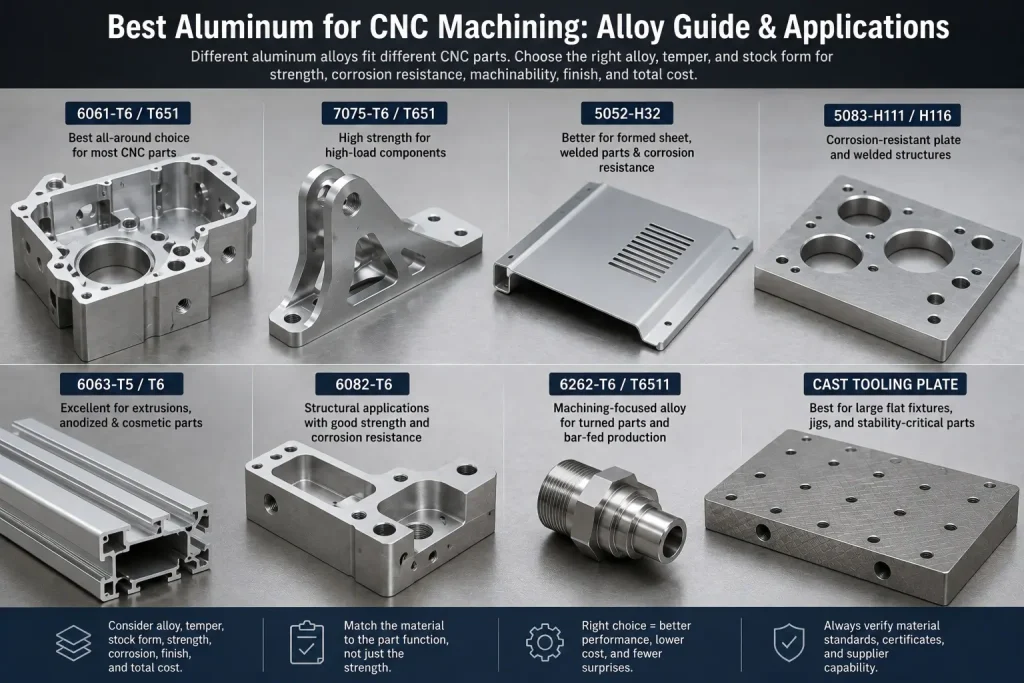
6061-T6 or 6061-T651 is the best all-around starting point for most CNC-machined aluminum parts. It combines broad availability, moderate strength, good corrosion resistance, practical machinability, and reliable surface-finishing options.
Choose 7075-T6 or 7075-T651 when high strength is functionally necessary. Do not specify it only as an upgrade from 6061, because material cost, corrosion behavior, stock availability, and finish requirements may change.
Choose 2024-T3 or 2024-T351 when good machinability, strength, and fatigue performance are important and suitable corrosion protection can be provided.
Choose 5052-H32 primarily for formed or fabricated sheet-metal parts requiring corrosion resistance and weldability. It is only fairly machinable and is not normally the first choice for extensive CNC milling.
Choose 5083 for corrosion-resistant plate and welded structures, 6063 for cosmetic extrusions and anodized profiles, 6082 for structural machined parts where it is readily available, and 6262 for bar-fed or screw-machine components requiring better chip control.
For large flat fixtures, tooling plates, and machine bases, a stress-relieved cast tooling plate may be more suitable than a higher-strength rolled alloy.
The correct choice depends on the exact alloy, temper, stock form, part geometry, strength, corrosion exposure, finish, dimensional stability, quantity, and total finished-part cost.
Quick Selection Guide for CNC Aluminum Alloys
| Part Requirement | Practical Starting Point | Buyer Should Check |
|---|---|---|
| Best overall CNC alloy | 6061-T6 or 6061-T651 | Strength, stock form, welding, anodizing, and critical dimensions |
| High-strength machined part | 7075-T6 or 7075-T651 | Corrosion exposure, stress-corrosion risk, finish, and material cost |
| Better stress-corrosion resistance in a 7075 product | 7075-T73 or 7075-T7351 | Lower strength compared with T6/T651 and actual product availability |
| Strength and fatigue performance with good machining | 2024-T3 or 2024-T351 | Corrosion protection, anodizing appearance, and joining requirements |
| Formed sheet or welded enclosure | 5052-H32 | Extensive milling may be slower and less predictable |
| Corrosion-resistant welded plate | 5083 in the specified temper | Service temperature, stock form, welding, and finish requirements |
| Cosmetic extrusion or visible anodized profile | 6063-T5 or 6063-T6 | Lower strength than 6061 and whether extrusion is suitable |
| Structural 6000-series part | 6082-T6 | Regional availability, plate or extrusion form, and welding |
| Turned fittings and bar-fed parts | 6262-T6 or 6262-T6511 | Material availability, compliance, finish, and exact specification |
| Large flat fixture or tooling plate | Cast tooling plate such as MIC-6 or an approved equivalent | Flatness, strength, coating, thickness, and brand or specification |
| Heat sink or thermal housing | 6061, 6063, or another thermally suitable grade | Conductivity, extrusion or milling route, fin geometry, and finish |
Engineer’s Note
There is no universal “best aluminum” without a defined part requirement.
A stronger alloy can increase material and finishing cost without improving function. A highly machinable alloy can also be unsuitable if corrosion resistance, welding, strength, flatness, or appearance is more important.
Aluminum Alloy Machinability Comparison
Machinability ratings are not universal percentages. They can change with the product form, temper, operation, tooling, coolant, chip-control method, and supplier rating system.
| Aluminum Grade | General Machining Behavior | Main Advantage | Main Limitation |
|---|---|---|---|
| 6061-T6 / T651 | Practical for general milling and turning; drilling and turning chips may require additional control | Balanced performance and wide availability | Not the best grade for maximum strength or the cleanest short chips |
| 7075-T6 / T651 | Fair to good under stable cutting conditions | Very high strength among common aluminum alloys | Higher material cost and only fair general corrosion resistance |
| 2024-T3 / T351 | Good machinability and strong mechanical performance | Strength and fatigue-related applications | Fair corrosion resistance and anodizing response |
| 5052-H32 | Fair machinability; more suitable for forming and fabrication | Corrosion resistance, forming, and welding | Not normally preferred for heavy material removal |
| 5083 | Moderate machining behavior depending on product and temper | Strong corrosion resistance and welded-plate applications | Chip control, stock condition, and distortion still require review |
| 6063-T5 / T6 | Suitable for moderate machining of extrusions | Cosmetic surface and anodizing response | Lower strength and usually selected as an extrusion alloy |
| 6082-T6 | Good machinability for structural components | Strength, corrosion resistance, and structural use | Availability varies by region and stock form |
| 6262-T6 / T6511 | Developed for machining and generally produces better broken chips | Turned parts, fittings, and bar-fed production | Less universally stocked than 6061 |
| Cast tooling plate | Generally stable during large-area machining | Flatness and low residual-stress movement | Lower structural strength than common rolled high-strength plate |
Engineer’s Note
Higher machinability does not automatically mean lower finished-part cost.
The final cost also depends on:
- Rejected-part risk
- Raw-material price
- Stock availability
- Material utilization
- Setup count
- Tool access
- Distortion
- Deburring
- Surface finishing
- Inspection
Why Aluminum Is Widely Used for CNC Machining
Aluminum alloys are widely used for CNC parts because they can combine:
- Low density
- Useful strength-to-weight performance
- Good cutting speeds with suitable tooling
- Broad availability in plate, bar, tube, and extrusion
- Thermal and electrical conductivity
- Corrosion resistance
- Anodizing and other surface-finishing options
- Recyclability
However, aluminum does not always machine faster or cost less than steel.
The result depends on:
- Alloy and temper
- Stock form
- Part size
- Material price
- Tool geometry
- Chip evacuation
- Thin-wall deformation
- Surface finish
- Coating
- Inspection requirements
A large, thin aluminum housing may require more distortion control than a compact steel component. Material selection should therefore be based on the finished part rather than a general metal-family comparison.
6061 Aluminum: The Best Overall Starting Point
6061 is one of the most versatile aluminum alloys for general CNC machining.
It is commonly selected because it offers:
- Moderate strength
- Good atmospheric corrosion resistance
- Broad plate, bar, tube, and extrusion availability
- Practical milling and turning performance
- Good welding capability
- Clear, dyed, and hard-anodizing options
- A moderate and predictable material cost
6061-T6 is common for bar, extrusion, and general products. For machined plate, 6061-T651 is often considered when the specified product requires stress-relieved plate material.
Important Machining Limit
6061 should not be described as having perfect chip control.
During turning and drilling, especially in T6 or T6511 condition, chips can be difficult to break. Chip breakers, suitable feed, peck drilling, coolant, and effective chip evacuation may be required.
Best Fit for 6061
6061 is a practical starting point for:
- Housings
- Brackets
- Plates
- Fixtures
- Motor and equipment components
- Heat sinks
- Electronic enclosures
- Prototype and low-volume mechanical parts
Choose a different alloy when maximum strength, severe marine corrosion, highly cosmetic extrusion surfaces, short-chip turning, or exceptional tooling-plate stability is the main requirement.
Hydro describes 6061 as a versatile medium-to-high-strength alloy with good corrosion and finishing characteristics, while also warning that turning and drilling chips may be difficult to break.
7075 Aluminum: Choose It When High Strength Is Necessary
7075 is one of the highest-strength commonly available aluminum alloys used for machined parts.
It may be considered for:
- Compact high-load brackets
- Highly stressed mechanical components
- Lightweight structural parts
- Precision fixtures requiring higher strength
- Parts where reducing section size is important
Main Advantages
- High tensile and yield strength
- High hardness compared with common 6000-series alloys
- Good strength-to-weight performance
- Availability in several high-strength and stress-corrosion-resistant tempers
Main Trade-Offs
- Higher raw-material cost
- Only fair general corrosion resistance in common T6 and T651 tempers
- Fair machinability rather than universally superior machinability
- More demanding finish and corrosion planning
- Lower weldability than 6061 for most conventional designs
T73 and T7351 tempers can provide better stress-corrosion resistance than T6 or T651, but with lower strength. The required temper should be specified rather than writing only “7075 aluminum.”
For a direct comparison of strength, corrosion, machining, and cost, review our 6061 vs 7075 aluminum guide.
Kaiser lists 7075-T6/T651 as very high strength but gives only fair ratings for machinability and corrosion resistance; T73/T7351 improves stress-corrosion performance at the cost of some strength.
Other Aluminum Alloys Used for CNC Parts
2024 Aluminum: Good Machining and High Mechanical Performance
2024 is a heat-treatable aluminum-copper alloy with good machinability and high strength.
It may be considered for:
- Precision fittings
- High-strength mechanical parts
- Fatigue-loaded components
- Parts where good machining behavior matters
Its main limitation is corrosion resistance. Bare 2024 also has only fair anodizing response, so corrosion protection and cosmetic expectations should be reviewed before quotation.
Do not specify 2024 only by alloy number. Common conditions such as T3, T351, T6, and T851 have different properties and product availability.
5052 Aluminum: Better for Formed Sheet Than Heavy CNC Milling
5052 offers:
- Very good corrosion resistance
- Good weldability
- Good forming performance
- Useful fatigue strength
- Broad sheet and plate availability
It is commonly suitable for covers, panels, enclosures, tanks, and formed components.
However, 5052 is rated only fair for machinability. It should not be presented as the best corrosion-resistant option for every deeply milled CNC component.
5083 Aluminum: Corrosion-Resistant Plate and Welded Structures
5083 is a high-strength, non-heat-treatable aluminum-magnesium alloy used when corrosion resistance and welded-plate performance are important.
It may be considered for:
- Corrosion-resistant plates
- Marine and offshore components
- Welded structures
- Pressure-related equipment
- Large machined plates when the specified product form is suitable
The drawing should identify the exact temper, stock form, service temperature, welding requirements, and post-machining finish.
5052 and 5083 should not be treated as interchangeable merely because both belong to the 5000 series.
6063 Aluminum: Cosmetic Extrusions and Anodized Profiles
6063 is primarily an extrusion and appearance-oriented alloy.
It offers:
- Excellent anodizing response
- Smooth extruded surfaces
- Good corrosion resistance
- Useful formability
- Availability in complex profiles
It is suitable for visible housings, frames, rails, trim, profiles, and some heat-sink extrusions.
It normally has lower strength than 6061 and is not the default choice for heavily loaded machined parts.
6082 Aluminum: Structural 6000-Series Alternative
6082 is widely used for structural plate, bar, and extrusion applications in markets where it is readily available.
It offers:
- Good strength
- Good machinability
- Good corrosion resistance
- Good welding and finishing capability
It can be a practical alternative to 6061, but availability and product standards vary by region.
6262 Aluminum: Machining-Focused Bar Alloy
6262 was developed specifically for machining applications.
It is useful for:
- Turned fittings
- Bar-fed CNC components
- Threaded parts
- Adapters
- Small precision hardware
- Screw-machine production
It generally produces curled or broken chips more readily than 6061, but the buyer should confirm availability, temper, finish, and any material-compliance requirements.
Cast Tooling Plate: Best When Flatness and Stability Matter
Stress-relieved cast tooling plate is useful for:
- Jigs and fixtures
- Large flat plates
- Machine tables
- Vacuum plates
- Inspection fixtures
- Low-load tooling
- Large parts vulnerable to distortion
MIC-6 is a proprietary product name, not a generic aluminum alloy number. Do not write “MIC-6 or equivalent” unless the drawing permits an approved alternative.
Cast tooling plate provides flatness and dimensional stability but should not replace 6061 or 7075 when high structural strength is required.
For precision-machined aluminum parts, specify the alloy, temper, and stock form together. A tight dimensional tolerance does not automatically justify switching from 6061 to 7075. Part geometry, residual stress, balanced stock removal, fixture support, and finishing sequence also affect whether the finished component holds its shape.
For large plates, thin walls, and tight bores, agree on the final inspection condition before production. Clamping can temporarily flatten or distort a part, so measurements taken under fixture load may differ from those after release. State whether critical dimensions apply before or after surface finishing, and evaluate them in the condition required by the drawing. Stress-relieved stock can reduce movement risk, but it does not guarantee a distortion-free part.
Alloy Number Is Not Enough: Temper and Stock Form Matter
The same aluminum alloy can behave differently depending on its temper and product form.
Important examples include:
- 6061-T6 extrusion
- 6061-T651 plate
- 7075-T651 plate
- 7075-T7351 plate
- 2024-T3 sheet
- 2024-T351 plate
- 5052-H32 sheet
- 5083-H111 or H116 plate
The stock form may be:
- Rolled plate
- Sheet
- Extruded bar
- Extruded profile
- Drawn tube
- Forging
- Cast tooling plate
These differences can affect:
- Mechanical properties
- Residual stress
- Grain direction
- Flatness
- Distortion after stock removal
- Surface quality
- Material availability
- Certification
- Cost
The RFQ should not state only “6061,” “7075,” or “marine aluminum.” It should identify the required alloy, temper, stock form, and applicable material standard.
Anodizing and Cosmetic Finish Differences
Aluminum alloys do not produce identical anodized appearance.
General starting points include:
- 6063 is commonly selected when a smooth cosmetic extrusion and strong anodizing response are priorities.
- 6061 generally responds well to clear, dyed, and hard anodizing.
- 7075 can show more color variation depending on temper, alloy chemistry, coating thickness, and surface preparation.
- 2024 may require greater attention to corrosion protection and cosmetic expectations.
- Cast tooling plate may not produce the same anodized appearance as wrought 6000-series material.
Final appearance may also change with:
- Material lot
- Extrusion, plate, or cast surface
- Tool marks
- Bead blasting
- Polishing
- Etching
- Coating thickness
- Dye
- Sealing
- Rack location
- Production batch
For cosmetic assemblies, keep visible components in a controlled material and finishing batch when practical. Use an approved physical sample when color consistency is important.
For a detailed comparison of coating buildup, masking, corrosion, and appearance, review our aluminum anodizing vs powder coating guide.
Hydro describes 6063 as an appearance-oriented alloy with excellent anodizing response, while 6061 also responds well to common anodizing methods but is not always the first choice when cosmetic appearance is the only priority.
Hidden Cost Factors in CNC Aluminum Selection
1. Raw-Material Availability
A commonly stocked 6061 plate may cost less and arrive faster than a less common alloy, temper, thickness, or certified product.
2. Stock Form and Material Utilization
A near-net extrusion, bar, or cast plate can reduce machining time and waste. A poorly matched stock size can increase both raw-material cost and roughing time.
3. Chip Control
6061, 5052, 6262, and 7075 do not create identical chips. Long chips, built-up edge, drilling problems, and manual chip removal can affect cycle time.
4. Distortion and Residual Stress
Large pockets, thin walls, and heavy stock removal may release internal stress. The alloy, temper, plate condition, machining sequence, and clamping strategy must be considered together.
5. Surface Finishing
Anodizing, conversion coating, painting, plating, polishing, and powder coating may require:
- Extra dimensional allowance
- Masking
- Cosmetic inspection
- Rack-mark planning
- Additional packaging
- Approved color samples
6. Certification and Compliance
Material certificates, customer specifications, special tempers, aerospace standards, or controlled alloy sources can increase procurement time and cost.
7. Inspection and Rework
A material that moves after roughing or finishing may require additional stabilization, inspection, offset correction, or re-machining.
Compare the complete finished-part cost rather than assuming that a harder or more expensive alloy always produces a longer cycle time.
Best Aluminum Alloy by Part Type
| Part Type | Practical Starting Point | Main Reason |
|---|---|---|
| General machined housing | 6061-T6 or T651 | Balanced strength, machining, corrosion resistance, availability, and finish |
| Compact high-load bracket | 7075-T6 or T651 | High strength where the design justifies the added cost |
| High-strength fitting with corrosion protection | 2024-T3 or T351 | Good machining and mechanical performance |
| Formed sheet enclosure | 5052-H32 | Formability, welding, and corrosion resistance |
| Corrosion-resistant welded plate | 5083 in the specified temper | Welded structure and marine-environment capability |
| Cosmetic extruded enclosure | 6063-T5 or T6 | Surface appearance and anodizing response |
| Structural plate or profile | 6082-T6 | Strength, machining, corrosion resistance, and welding |
| Turned adapter or fitting | 6262-T6 or T6511 | Better chip formation for machining-focused bar products |
| Large flat fixture plate | Cast tooling plate | Flatness and dimensional stability |
| Heat sink | 6061 or 6063, depending on manufacturing route | Balance of machining, extrusion, thermal design, and finish |
These are starting points, not automatic material specifications. The final decision still depends on geometry, load, environment, surface finish, quantity, and available stock.
Common Aluminum Alloy Selection Mistakes
Specifying Only the Alloy Number
“6061 aluminum” is incomplete when the temper and stock form affect strength, flatness, machining, and certification.
Choosing 7075 Only as a Premium Upgrade
7075 is useful when its strength is required. It may add cost and corrosion-planning requirements without improving a lightly loaded part.
Selecting 5052 for Extensive Milling
5052 is valuable for sheet forming, welding, and corrosion resistance, but it is only fairly machinable and may not be the most economical choice for a deeply pocketed CNC part.
Treating All 5000-Series Alloys as Marine Grade
5052 and 5083 have different strength, product forms, welding behavior, and common applications.
Assuming Every Aluminum Anodizes the Same
Alloy chemistry, temper, surface preparation, coating thickness, and batch conditions can affect color and appearance.
Calling MIC-6 a Standard Alloy
MIC-6 is a proprietary cast tooling-plate product. Specify it by product name or approved specification, not as a generic alloy family.
Ignoring Stock Form
Plate, bar, extrusion, forging, and cast tooling plate can behave differently even when their nominal alloy family appears similar.
Applying Tight Tolerances Before Material Review
Part size, wall thickness, stock condition, machining sequence, surface finish, and inspection temperature can affect achievable dimensional stability.
RFQ Information for CNC Aluminum Parts
| RFQ Item | What to Specify | Why It Matters |
|---|---|---|
| Alloy | 6061, 7075, 2024, 5052, 5083, 6063, 6082, 6262, or approved tooling plate | Aluminum is a family of materials, not one property set |
| Temper | T6, T651, T7351, T351, H32, H111, H116, or another required condition | Changes strength, corrosion, flatness, and machining behavior |
| Stock form | Plate, sheet, bar, tube, extrusion, forging, or cast plate | Affects cost, grain direction, distortion, and material utilization |
| Material standard | ASTM, AMS, EN, customer specification, or supplier standard | Prevents substitution and certificate disputes |
| Quantity | Prototype and expected repeat volume | Affects material purchasing, setup, and process planning |
| Critical dimensions | Fits, flatness, hole position, runout, and mating features | Helps select the correct stock and machining sequence |
| Surface finish | Anodizing, conversion coating, bead blasting, polishing, painting, or as-machined | Affects alloy choice, masking, dimensions, and appearance |
| Service environment | Indoor, outdoor, marine, chemical, temperature, or galvanic contact | Controls corrosion and protection requirements |
| Mechanical requirement | Load, stiffness, fatigue, impact, and maximum weight | Prevents unnecessary use of high-strength alloy |
| Inspection | Standard inspection, CMM report, material certificate, or coating report | Defines acceptance and quotation scope |
Rapid Efficient can review the alloy, temper, stock form, strength requirement, geometry, surface finish, corrosion exposure, dimensional risks, inspection requirements, and quantity before quotation.
FAQ: Best Aluminum for CNC Machining
What Is the Best Aluminum for CNC Machining?
6061-T6 or 6061-T651 is usually the best all-around starting point because it balances strength, corrosion resistance, availability, machinability, surface finishing, and cost.
It is not automatically best when maximum strength, marine corrosion, cosmetic extrusion quality, short-chip turning, or tooling-plate flatness is the main requirement.
Is 7075 Better Than 6061 for CNC Machining?
Not for every part.
7075 provides much higher strength, but 6061 usually offers easier sourcing, lower cost, better welding, and broader corrosion and finishing flexibility. Choose 7075 only when the design benefits from its strength.
Is 5052 Good for CNC Machining?
5052 can be machined, but its machinability is only fair.
It is more commonly selected for formed sheet, welded enclosures, tanks, covers, and corrosion-resistant fabricated parts than for extensive CNC milling.
Which Aluminum Is Best for Precision Machining?
6061-T651, 7075-T651, 2024-T351, and stress-relieved cast tooling plate may all be suitable starting points.
The correct choice depends on strength, part size, stock removal, flatness, residual stress, corrosion, and finish. No alloy automatically guarantees a tight tolerance.
Which Aluminum Is Best for Anodizing?
6063 is often selected for cosmetic extrusions, while 6061 generally provides a reliable anodizing response for machined parts.
Final color still depends on alloy, temper, material lot, surface preparation, anodizing thickness, dye, sealing, and batch conditions.
Which Aluminum Is Best for Marine or Outdoor Parts?
5083 is a common starting point for corrosion-resistant welded plate structures. 5052 is useful for formed sheet and fabricated components.
6061 can also perform well in many outdoor environments when the alloy, finish, drainage, fasteners, and galvanic contact are properly controlled.
What Is the Difference Between 6061 and 6082?
Both are heat-treatable 6000-series structural alloys.
6082 generally provides higher strength in common structural forms, while 6061 is broadly available and widely used in North American machining and extrusion supply chains. Availability and applicable standards should be checked before substitution.
Is MIC-6 an Aluminum Alloy?
MIC-6 is a proprietary precision cast tooling-plate product rather than a standard generic alloy designation.
It is selected mainly for flatness and dimensional stability, not for maximum structural strength.
Which Aluminum Is Best for Turned Parts?
6061 can be used for many turned parts, but 6262 or another machining-focused bar alloy may provide better chip formation for screw-machine and bar-fed production.
The exact choice depends on strength, corrosion, finish, compliance, and material availability.
Conclusion
There is no single aluminum alloy that is best for every CNC-machined part.
6061 is the most practical overall starting point.
7075 is appropriate when high strength is functionally necessary.
2024 combines good machining with strong mechanical performance but requires greater corrosion planning.
5052 is better suited to formed and welded sheet parts than extensive milling.
5083 is useful for corrosion-resistant plate and welded structures.
6063 is selected mainly for visible extrusions and anodized appearance.
6082 is a practical structural alloy where it is readily available.
6262 is useful for machining-focused bar and turned components.
Cast tooling plate is the better choice when flatness and low-distortion machining matter more than high structural strength.
The final selection should consider:
- Alloy
- Temper
- Stock form
- Mechanical load
- Corrosion exposure
- Machining route
- Surface finish
- Dimensional stability
- Certification
- Quantity
- Total finished-part cost
Review Your CNC Aluminum Part
Send the STEP file, 2D drawing, quantity, preferred alloy, temper, stock form, critical dimensions, surface finish, service environment, and inspection requirements.
Rapid Efficient can review whether the specified aluminum is practical and help identify risks involving strength, stock availability, deformation, machining, anodizing, corrosion, tolerance, and cost before quotation.
For custom aluminum housings, brackets, plates, fixtures, heat sinks, and precision components, review our CNC aluminum machining services.