
Fazit zuerst
If your project needs better structural strength, einfachere CNC-Bearbeitung, und starre Präzisionsteile, 6061 Aluminium is usually the better choice.
If your project needs superior corrosion resistance, sheet metal forming, and marine durability, 5052 Aluminium can be the smarter option.
Both alloys are widely used—but they solve different engineering problems.
What Is 5052 Aluminium?
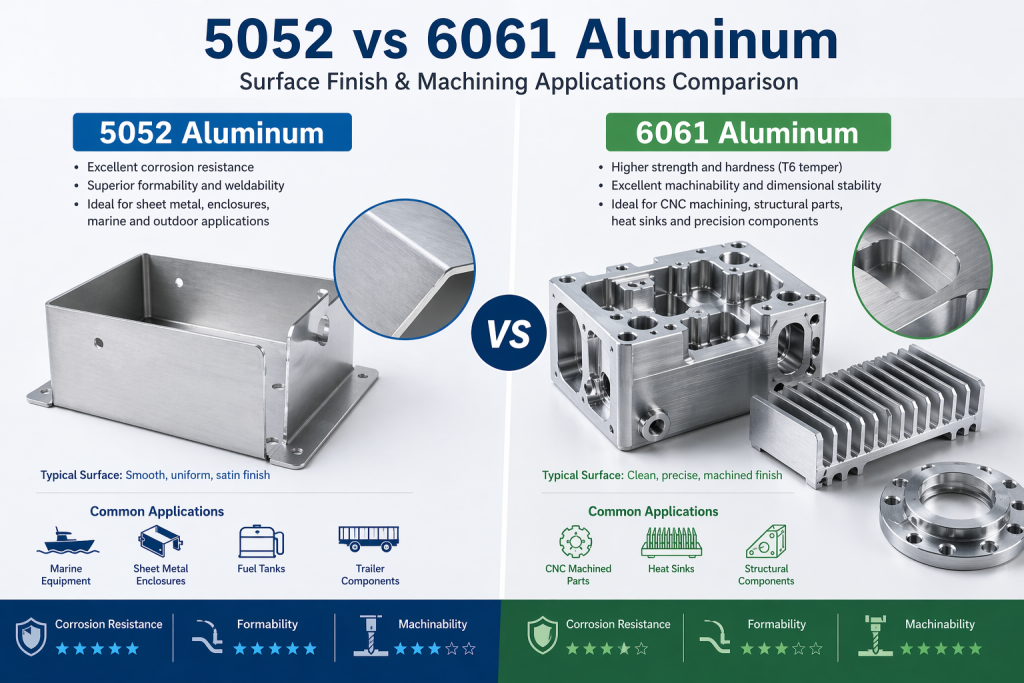
5052 is a magnesium-rich aluminum alloy known for:
- Ausgezeichnete Korrosionsbeständigkeit
- Strong performance in marine environments
- Good weldability
- Excellent bendability and forming performance
- Popular for covers, Panels, tanks, and brackets
It is commonly chosen for sheet metal parts rather than heavily machined components.
What Is 6061 Aluminium?
6061-T6 is one of the most popular engineering aluminum grades because it offers:
- Higher strength than 5052
- Better rigidity
- Gute Bearbeitbarkeit
- Stable anodizing results
- Wide availability in billets, Teller, and bars
It is one of the best all-around materials for CNC machined parts.
For a broader comparison of aluminum alloys, see our guide on the best aluminum for CNC machining.
Quick Comparison Table
| Besonderheit | 5052 Aluminium | 6061 Aluminium | Bessere Wahl |
|---|---|---|---|
| Stärke | Mäßig | Higher | 6061 |
| Korrosionsbeständigkeit | Exzellent | Gut | 5052 |
| CNC Machinability | Fair | Exzellent | 6061 |
| Formability | Exzellent | Mäßig | 5052 |
| Schweißbarkeit | Exzellent | Gut | 5052 |
| Anodizing Appearance | Acceptable | Besser | 6061 |
| Precision Parts | Beschränkt | Exzellent | 6061 |
Alloy choice can also affect machining time, Werkzeugverschleiß, and total project cost. Sehen Sie sich unseren Leitfaden an CNC-Bearbeitungskosten in China for more details.
Strength vs Formability
This is the real trade-off.
5052 bends better and resists cracking during forming.
6061 is stronger and stiffer, making it better for structural machined components.
If your part starts as sheet and needs bending, 5052 is often the smarter path.
If it starts as billet and needs CNC machining, 6061 usually wins.
Anmerkung des Ingenieurs
Many buyers choose stronger material when they actually need better formability.
That often increases cost without solving the real design problem.
CNC Machining Performance
For milled, gebohrt, and tapped parts, 6061 usually wins.
Warum?
Because 6061 cuts cleaner, creates more stable chips, and holds tighter tolerances more consistently.
5052 is softer and more “gummy” than 6061-T6. It tends to smear instead of shear cleanly, which can lead to:
- Burrs
- Built-up edge (BOGEN) on tools
- Surface inconsistency
- Tool loading
- Slower cycle times
That often increases total machining cost even when the raw material price looks attractive.
Chemical Composition Impact
5052 gains its reputation mainly from magnesium-rich chemistry, which supports corrosion resistance and forming performance.
6061 uses magnesium-silicon alloy chemistry that allows heat treatment (T6 temper), giving it better structural rigidity and stronger performance for precision CNC parts.
This is why 6061 is often preferred for machined housings, mounts, and load-bearing components.
Korrosionsbeständigkeit
5052 performs exceptionally well in saltwater and humid environments.
That is why it is common in:
- Marine hardware
- Outdoor enclosures
- Fuel tanks
- Trailer panels
6061 still performs well, Aber 5052 usually has the edge in aggressive environments.
Oberflächenbeschaffenheit & Anodisierung
6061 is generally preferred for cosmetic anodizing.
It usually gives:
- More uniform appearance
- Cleaner machined texture
- Better color consistency
5052 can be anodized, but finish appearance may vary depending on sheet condition and fabrication history.
For premium black or clear anodizing, 6061 is usually the safer choice.
Best Use Cases for 5052
Wählen 5052 für:
- Bent sheet metal covers
- Marine brackets
- Outdoor electrical enclosures
- Fuel or fluid tanks
- Corrosion-critical housings
Best Use Cases for 6061
Wählen 6061 für:
- CNC housings
- Heat sinks
- Mounting plates
- Precision brackets
- Structural machined parts
👉 Learn how we use 6061-T6 in precision CNC heat sink machining projects
Cost Considerations
Material pricing changes by market conditions.
But in many projects:
- 5052 may cost more in machining time
- 6061 may reduce production cost through faster cycle times
- Total cost depends on geometry, Menge, and finish requirements
Cheap material does not always mean cheaper finished parts.
Hidden Engineering Mistake
Some teams select 5052 because it resists corrosion better, then later require:
- tapped holes
- enge Toleranzen
- milled pockets
- cosmetic anodizing
At that point, 6061 often becomes the better total-value option.
FAQ
Ist 5052 stronger than 6061?
NEIN. 6061 is generally stronger and stiffer.
Ist 5052 better for marine use?
Ja, 5052 is widely respected for marine corrosion resistance.
Which is better for CNC machining?
6061 is usually better.
Which is easier to bend?
5052 is easier to form and bend.
Can you weld 6061 Zu 5052?
Ja. It is commonly welded using the correct filler wire and suitable process settings.
Final Thoughts
Wählen 5052 when corrosion resistance and forming matter most.
Wählen 6061 when machining performance, structural strength, and precision matter most.
The best aluminum depends on how the part will be made—not just the alloy name.
Need Help Choosing the Right Aluminum?
Send us your drawings and application details.
We help customers choose the best aluminum grade for CNC machining, Korrosionsbeständigkeit, forming, and total production cost.