
Quick Answer: Should You Choose 6061 or 7075 Aluminum?
Choose 6061-T6 or 6061-T651 for general CNC housings, brackets, plates, fixtures, heat sinks, and enclosures when corrosion resistance, welding, anodizing, material availability, and total cost are important.
Choose 7075-T6 or 7075-T651 when the part requires substantially higher strength and hardness, especially for compact load-bearing components where reducing section size or weight provides a functional advantage.
For typical T6/T651 products, 7075 has much higher yield and tensile strength than 6061. However, their elastic moduli are relatively close, so a 7075 part with the same geometry is not automatically much stiffer or less likely to deflect.
Neither alloy automatically provides:
- Better surface finish
- Lower tool wear
- Tighter tolerances
- Less deformation
- Perfect anodized color
- Lower finished-part cost
The correct choice depends on alloy, temper, stock form, load, corrosion exposure, joining method, surface finish, geometry, quantity, inspection, and total manufacturing cost.
For most general-purpose CNC parts, 6061 is the practical starting point. Choose 7075 only when its higher mechanical strength creates a real design benefit.
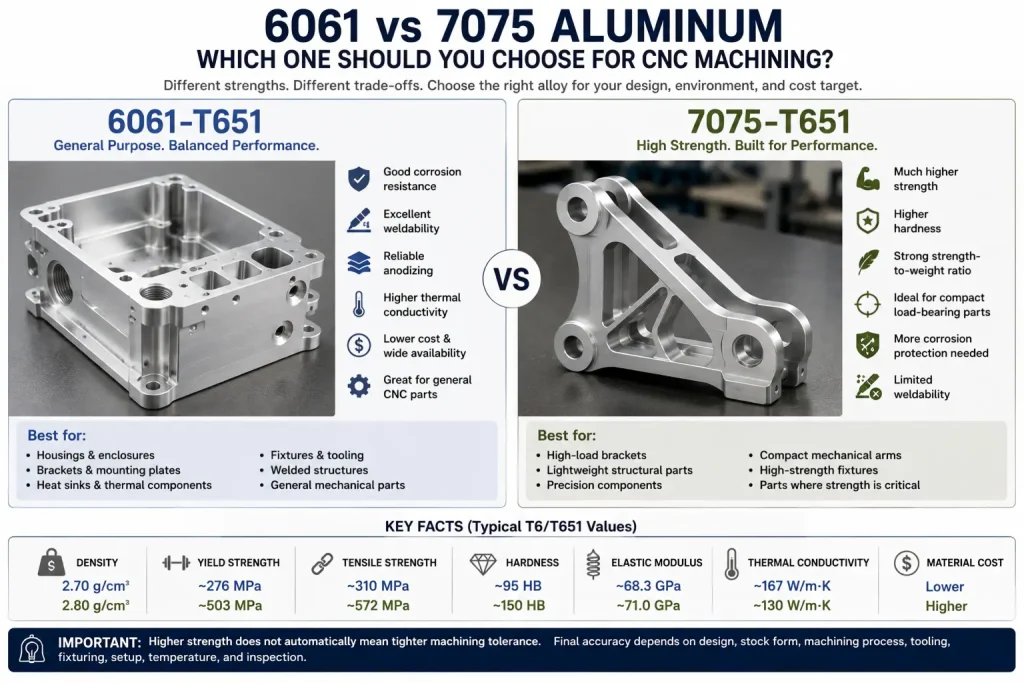
Kaiser’s typical T6/T651 data lists yield strengths of approximately 276 MPa for 6061 and 503 MPa for 7075, while their elastic moduli are approximately 68.3 and 71.0 GPa. That means 7075 is much stronger, but not proportionally stiffer.
6061-T6/T651 vs 7075-T6/T651: Quick Comparison
| Comparison Item | 6061-T6 / T651 | 7075-T6 / T651 | Buyer Should Check |
|---|---|---|---|
| Main alloying system | Magnesium and silicon | Zinc, magnesium, and copper | Confirm the exact material and specification |
| Typical density | Approximately 2.70 g/cm³ | Approximately 2.80 g/cm³ | Weight difference is small compared with the strength difference |
| Typical tensile strength | Approximately 310 MPa | Approximately 572 MPa | Values vary with product form, thickness, and standard |
| Typical yield strength | Approximately 276 MPa | Approximately 503 MPa | 7075 is about 1.8 times stronger in these typical conditions |
| Typical Brinell hardness | Approximately 95 HB | Approximately 150 HB | Higher hardness does not automatically mean tighter tolerance |
| Elastic modulus | Approximately 68.3 GPa | Approximately 71.0 GPa | Stiffness for identical geometry is relatively similar |
| General machinability | Practical for milling and turning, but chips may be difficult to break | Machines well under stable conditions, but higher strength increases cutting load | Tooling, chip control, setup, and operation matter |
| Corrosion resistance | Generally better | Fair in common T6/T651 conditions | Review exposure, coating, and mixed-metal contact |
| Weldability | Generally suitable for common welding processes | Generally poor or limited for conventional fusion welding | Confirm whether welding is part of the design |
| Anodizing | Usually offers a more predictable cosmetic response | Can be anodized, but color and corrosion planning require more control | Approve a sample for visible assemblies |
| Thermal conductivity | Typically higher | Typically lower | 6061 is often the more practical heat-sink material |
| Material cost | Usually lower and more widely stocked | Usually higher | Compare actual grade, thickness, quantity, and certification |
| Best starting point | General housings, brackets, plates, fixtures, and thermal components | Compact high-load and high-strength components | Choose from function rather than material prestige |
The mechanical and physical values above are typical reference values, not guaranteed design or purchasing limits. The final drawing should identify the required alloy, temper, stock form, and applicable material standard.
Kaiser’s 6061 and 7075 data sheets support the typical strength, hardness, modulus, density, corrosion, machinability, anodizing, and weldability distinctions used in this table.
For a broader comparison covering 2024, 5052, 5083, 6063, 6082, 6262, and cast tooling plate, review our guide to the best aluminum for CNC machining.
What Is 6061 Aluminum?
6061 is a heat-treatable 6000-series aluminum alloy based mainly on magnesium and silicon.
It is widely used for CNC machining because it provides a practical combination of:
- Moderate strength
- Good atmospheric corrosion resistance
- Broad plate, bar, tube, and extrusion availability
- Good welding capability
- Reliable anodizing and coating options
- Useful thermal and electrical conductivity
- Moderate material cost
T6, T651, and T6511 Are Not Identical Labels
The temper and stock form should be specified with the alloy.
Common examples include:
- 6061-T6 for general heat-treated products
- 6061-T651 for stress-relieved plate and some bar products
- 6061-T6511 for stretched extrusion and bar products
These conditions may have similar strength levels, but their stock form, residual-stress condition, straightness, flatness, and available specifications can differ.
Machining Behavior
6061 is practical for general milling, drilling, and turning, but it should not be described as having perfect chip control.
During drilling and turning, 6061 may produce:
- Long chips
- Tool wrapping
- Built-up edge
- Scratched surfaces
- Chips trapped in deep holes
Suitable tool geometry, feed, chip breakers, peck drilling, air or coolant delivery, and chip evacuation may still be required.
6061 is usually the better starting point when the project requires general-purpose CNC machining, welding, anodizing, corrosion resistance, or thermal performance rather than maximum mechanical strength.
Kaiser rates 6061-T6/T651 as having strong corrosion resistance, good anodizing response and broad weldability, but only a mid-range relative machinability rating.
What Is 7075 Aluminum?
7075 is a heat-treatable 7000-series aluminum alloy based mainly on zinc, magnesium, and copper.
It is selected primarily for its mechanical performance rather than as a general upgrade from 6061.
Its main advantages include:
- High tensile and yield strength
- Higher hardness than common 6000-series alloys
- Strong strength-to-weight performance
- Good fatigue performance in suitable conditions
- Availability in several strength and stress-corrosion tempers
T6, T651, T73, and T7351
The exact temper matters.
- T6 and T651 provide very high strength.
- T73 and T7351 generally provide improved stress-corrosion resistance with lower strength.
- T651 and T7351 identify stress-relieved conditions used for suitable plate or product forms.
Writing only 7075 aluminum may be incomplete when strength, stress-corrosion resistance, flatness, or certification matters.
Main Trade-Offs
Compared with 6061, 7075 commonly requires more attention to:
- Material cost
- Corrosion protection
- Stress-corrosion exposure
- Welding limitations
- Anodized color consistency
- Stock availability
- Material certification
- Scrap risk for expensive blanks
7075 can be machined successfully and can produce clean precision features, but its higher strength and hardness increase the mechanical load on the tool and fixture.
Kaiser lists 7075-T6/T651 as very high strength while rating its general corrosion resistance and machinability as fair. T73/T7351 sacrifices some strength to improve stress-corrosion behavior.
Key Differences Between 6061 and 7075 in CNC Machining
1. Strength Is the Main Advantage of 7075
For typical T6/T651 products, 7075 provides substantially higher tensile strength, yield strength, and hardness than 6061.
This can allow:
- Smaller cross-sections
- Compact high-load components
- Reduced material around non-critical areas
- Higher resistance to local indentation
- Better performance where mechanical strength limits the design
However, 7075 should not be selected only because it has a higher datasheet strength.
If the part is lightly loaded, the additional material cost and corrosion requirements may provide no useful benefit.
2. Strength and Stiffness Are Different
7075 is much stronger than 6061, but their elastic moduli are close.
For two parts with the same geometry and load, elastic deflection may therefore be relatively similar.
To gain a meaningful weight or stiffness benefit from 7075, the designer may need to change the geometry rather than simply substitute the alloy.
3. Neither Alloy Is Automatically Easier to Machine
The original article’s simple statement that 6061 is always easier to machine and 7075 always creates more wear is not reliable.
6061 may produce long or adhesive chips during turning and drilling.
7075’s greater hardness can support clean edge formation, but its higher strength may increase:
- Cutting force
- Spindle load
- Fixture load
- Tool-edge stress
- Consequences of chatter or instability
Machining performance depends on:
- Exact temper
- Product form
- Tool geometry
- Tool sharpness
- Tool coating
- Tool runout
- Cutting parameters
- Coolant or air delivery
- Chip evacuation
- Tool overhang
- Fixture rigidity
Do not apply a universal 20%–30% tool-wear penalty to 7075.
4. Surface Finish Depends on the Process
6061 does not automatically produce a smoother surface, and 7075 does not automatically produce a rougher one.
Surface finish is affected by:
- Cutting-edge condition
- Built-up edge
- Feed per tooth
- Toolpath direction
- Runout
- Vibration
- Chip recutting
- Coolant or lubrication
- Wall rigidity
- Finishing allowance
Both alloys can produce clean machined surfaces under a stable process.
5. 6061 Usually Has the Corrosion Advantage
6061 generally provides better atmospheric corrosion resistance and is more forgiving in many general industrial and outdoor applications.
7075-T6 and T651 require more attention to:
- Moisture exposure
- Salt or chloride environments
- Faying surfaces
- Dissimilar-metal contact
- Protective coatings
- Stress-corrosion direction and loading
This does not mean every 7075 part must always be coated. The requirement depends on the environment, temper, geometry, load, and service life.
6. Welding Strongly Favors 6061
6061 is widely used in welded structures and fabricated assemblies.
7075 is generally not selected for conventional fusion-welded designs because welding can create cracking and significant changes in the heat-affected region.
If welding is required, the alloy choice should be reviewed before machining.
7. Anodizing Appearance Is More Predictable with 6061
6061 normally provides a more predictable response for clear, dyed, and hard anodizing.
7075 can be anodized, but final appearance may vary with:
- Temper
- Copper and zinc content
- Surface preparation
- Coating thickness
- Dye
- Etching
- Sealing
- Material lot
- Production batch
For visible assemblies, approve a physical sample and define acceptable color variation.
For coating thickness, masking, corrosion, and cosmetic considerations, review our aluminum anodizing vs powder coating guide.
8. 6061 Is Usually Better for Heat Sinks
Typical T6/T651 data gives 6061 higher thermal conductivity than 7075.
For heat sinks and thermal housings, thermal conductivity, fin geometry, airflow, surface finish, contact flatness, and interface material are normally more important than maximum tensile strength.
6061 or 6063 is therefore usually a more practical starting point than 7075 for thermal components.
Official product data confirms 6061’s stronger general corrosion, anodizing and welding profile, while 7075 provides much higher strength but more limited welding and lower typical thermal conductivity.
Hidden Cost Differences Between 6061 and 7075
7075 often produces a higher finished-part price, but not because one fixed tool-wear or cycle-time percentage applies to every project.
| Cost Driver | 6061 | 7075 | Buyer Should Check |
|---|---|---|---|
| Raw material | Generally lower and broadly stocked | Generally higher | Alloy, temper, thickness, minimum order, and certification |
| Scrap risk | Lower-value blank in many common sizes | Higher-value blank | Part complexity and stage at which defects may be found |
| Tooling | Depends on chip control and geometry | Higher strength may increase cutting load | Tool reach, setup stability, and quantity |
| Cycle time | Can be affected by long chips and built-up edge | Can be affected by strength, tool load, and finishing strategy | Actual machining route rather than a universal percentage |
| Surface finishing | Broad standard options | Cosmetic and corrosion requirements may need more control | Coating, masking, sample approval, and inspection |
| Welding and fabrication | Commonly practical | Usually limited | Whether the final assembly requires welding |
| Certification | Common commercial supply is widely available | Controlled or certified stock may add procurement cost | Material standard and certificate requirements |
| Rework | Depends on geometry and process | Higher blank cost increases rework consequences | Inspection timing and first-piece approval |
The correct comparison is the complete finished-part cost, including:
- Material
- Programming
- Setup
- Tooling
- Cycle time
- Finishing
- Inspection
- Scrap
- Packaging
- Shipping weight
- Replacement risk
Do not select 6061 or 7075 from raw-material price alone.
Temper and Stock Form Matter as Much as the Alloy Number
The drawing should not specify only 6061 or 7075.
Useful purchasing information may include:
- 6061-T6 extrusion
- 6061-T651 plate
- 6061-T6511 bar or extrusion
- 7075-T651 plate
- 7075-T7351 plate
- Applicable ASTM, AMS, EN, or customer standard
The stock form may be:
- Rolled plate
- Extruded bar
- Extruded profile
- Tube
- Forging
- Drawn product
Temper and stock form can affect:
- Mechanical properties
- Residual stress
- Grain direction
- Flatness
- Straightness
- Distortion after stock removal
- Surface appearance
- Material availability
- Certification
- Cost
For flatness, thin-wall stability, and stock-removal considerations, review our aluminum alloy selection guide.
When Should You Choose 7075?
Choose 7075 when:
- High mechanical strength is functionally necessary
- The component carries substantial load in a compact space
- Reducing section thickness creates a useful weight benefit
- Higher hardness improves a contact or wear-related feature
- The design cannot meet its load requirement with 6061
- Welding is not required
- Corrosion and surface protection can be properly controlled
- The material cost is justified by the finished-part performance
Typical part types may include:
- Compact high-load brackets
- Highly stressed linkages
- Lightweight structural frames
- High-strength fixtures
- Mechanical arms and supports
- Precision components with heavily loaded contact areas
Do not choose 7075 only because:
- It sounds more premium
- The drawing contains a tight tolerance
- The part is described as high performance
- The component will be anodized
- A competitor used 7075 in a different design
The mechanical load and service conditions should justify the alloy.
When Should You Choose 6061?
Choose 6061 when:
- The part has moderate structural requirements
- General corrosion resistance is important
- Welding or fabrication may be required
- The component requires predictable anodizing
- Thermal conductivity matters
- Material availability and lead time are important
- The project is cost-sensitive
- Prototype and repeat quantities may change
- Maximum 7075 strength would provide no functional benefit
Typical part types include:
- Housings
- Enclosures
- Brackets
- Mounting plates
- Fixtures
- Heat sinks
- Motor and equipment components
- Automation parts
- General structural components
6061 remains the practical starting point for many CNC projects because it balances manufacturing, finishing, joining, corrosion, availability, and cost.
RFQ Information for 6061 and 7075 Parts
| RFQ Item | What to Specify | Why It Matters |
|---|---|---|
| Alloy | 6061 or 7075 | Confirms the basic material family |
| Temper | T6, T651, T6511, T73, or T7351 | Changes strength, stress-corrosion behavior, and stock availability |
| Stock form | Plate, bar, extrusion, tube, or forging | Affects residual stress, grain direction, cost, and machining |
| Material standard | ASTM, AMS, EN, or customer specification | Prevents uncontrolled substitution |
| Mechanical requirement | Load, fatigue, hardness, stiffness, and maximum weight | Determines whether 7075 provides a real benefit |
| Corrosion environment | Indoor, outdoor, marine, chemical, or mixed-metal contact | Affects alloy and coating selection |
| Joining | Welding, fasteners, inserts, or bonding | Strongly affects whether 7075 is practical |
| Surface finish | Anodizing, conversion coating, painting, plating, or as-machined | Affects appearance, dimensions, corrosion, and cost |
| Critical dimensions | Fits, bores, flatness, position, threads, and mating features | Identifies process and inspection priorities |
| Quantity | Prototype and expected repeat volume | Affects material purchasing, tooling, and unit cost |
| Reports | Material certificate, dimensional report, CMM report, or coating certificate | Defines quotation and acceptance scope |
Rapid Efficient can review the alloy, temper, stock form, strength requirement, corrosion exposure, joining method, finish, critical dimensions, inspection, and quantity before quotation.
FAQ: 6061 vs 7075 Aluminum
Is 7075 Stronger Than 6061?
In common T6 and T651 conditions, 7075 provides substantially higher tensile strength, yield strength, and hardness than 6061.
The exact result still depends on temper, stock form, thickness, and material standard.
Is 7075 Stiffer Than 6061?
Only slightly when comparing elastic modulus.
7075 is much stronger, but the elastic moduli of the two alloys are relatively close. A same-size 7075 part does not automatically deflect dramatically less than a 6061 part.
Which Is Easier to CNC Machine: 6061 or 7075?
There is no universal winner.
6061 is widely used for general machining but can produce long or adhesive chips. 7075 can machine cleanly under stable conditions, but its higher strength and hardness increase cutting and fixture loads.
Tooling, geometry, operation, temper, and setup matter more than a simple alloy ranking.
Which Alloy Produces a Better Surface Finish?
Both can produce a good machined finish.
Surface quality depends on tool sharpness, built-up edge, feed, runout, vibration, chip evacuation, finishing allowance, and part rigidity—not only the alloy name.
Which Alloy Has Better Corrosion Resistance?
6061 generally has better natural corrosion resistance.
7075-T6 and T651 may require more careful protection, especially in wet, salt, mixed-metal, or sustained-load environments.
Which Alloy Is Better for Anodizing?
6061 usually provides a more predictable cosmetic anodizing response.
7075 can be anodized, but color and appearance may vary more with temper, chemistry, preparation, coating thickness, dye, and batch conditions.
Can 7075 Aluminum Be Welded?
7075 is generally a poor choice for conventional fusion-welded structures.
When welding is required, 6061 is normally the more practical starting point. The joining process should be reviewed before material selection.
Does 7075 Hold Tighter CNC Tolerances?
Not automatically.
Tolerance depends on geometry, stock condition, residual stress, clamping, tool deflection, machining sequence, temperature, finishing, and inspection.
Higher material strength does not guarantee higher machining accuracy.
Which Alloy Is Better for Heat Sinks?
6061 is generally the better starting point because it offers higher typical thermal conductivity, good corrosion resistance, broad availability, and reliable surface-finishing options.
The final thermal result also depends on geometry, airflow, contact flatness, interface material, and coating.
Is 7075 Worth the Higher Cost?
It is worth considering when its higher strength and hardness enable a smaller, lighter, or more highly loaded part.
For a general housing, cover, fixture, or moderate-load bracket, 6061 may provide the same functional result at a lower total cost., yes.
Conclusion
6061 and 7075 solve different CNC machining requirements.
Choose 6061 when the project prioritizes:
- General-purpose machining
- Corrosion resistance
- Welding
- Anodizing
- Thermal performance
- Material availability
- Lower total cost
Choose 7075 when the project genuinely requires:
- Substantially higher strength
- Higher hardness
- Compact load-bearing geometry
- Reduced section thickness
- High mechanical performance without welding
Do not assume:
- 7075 automatically holds tighter tolerances
- 6061 always machines more easily
- 6061 always produces a better surface finish
- 7075 always creates 20%–30% more tool wear
- Every 7075 part must be coated
- Alloy number alone defines the final result
The correct choice requires the exact alloy, temper, stock form, load, environment, joining method, finish, geometry, inspection, quantity, and finished-part cost.
Review Your 6061 or 7075 CNC Part
Send the STEP file, 2D drawing, quantity, material and temper requirement, stock form, critical dimensions, surface finish, service environment, and inspection requirements.
Rapid Efficient can review whether 6061 or 7075 is more practical and help identify risks involving strength, machining, corrosion, welding, anodizing, dimensional stability, certification, and cost before quotation.
For custom aluminum housings, brackets, plates, fixtures, heat sinks, and high-strength components, review our CNC aluminum machining services.