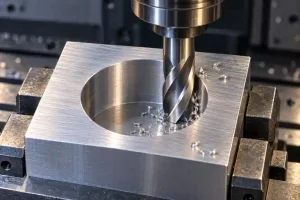

Thin-wall motor housings combine flexible walls, precision bearing features, mounting interfaces, and multi-side machining in one component. A dimension that appears correct while the housing is clamped may move after the fixture is released.
In this project, the main challenge was not simply producing a lightweight aluminum housing. It was maintaining the functional relationship between the bearing seats, mounting references, and released wall geometry.
The component combined a cylindrical thin-wall body, a mounting flange, bearing-seat features, and secondary holes in one machined structure.
Quick Answer
Thin-wall motor housing machining is mainly an alignment and shape-control problem. In this project, RapidEfficient machined a 6061-T6 aluminum housing whose bearing seats, mounting faces, and flexible walls had to remain functionally related after the part was released from the fixture. The process separated roughing from final control, re-established stable references, supported rigid regions instead of flexible wall centers, and matched inspection to bore size, bore form, axis relationship, and the specified part state.
Project Overview
| Project Item | Description |
|---|---|
| Component | Custom thin-wall motor housing |
| Material | 6061-T6 aluminum |
| Application | Precision motor or drive assembly |
| Critical features | Bearing seats, mounting faces, thin housing walls, and related hole features |
| Main risks | Clamp distortion, released wall movement, bore-form error, and datum-transfer error |
| Manufacturing focus | Preserve the relationship between the bearing features and the assembly references |
| Inspection focus | Bore size, bore form, axis relationship, and released part condition |
To protect customer confidentiality, identifying information and selected drawing dimensions are not disclosed.
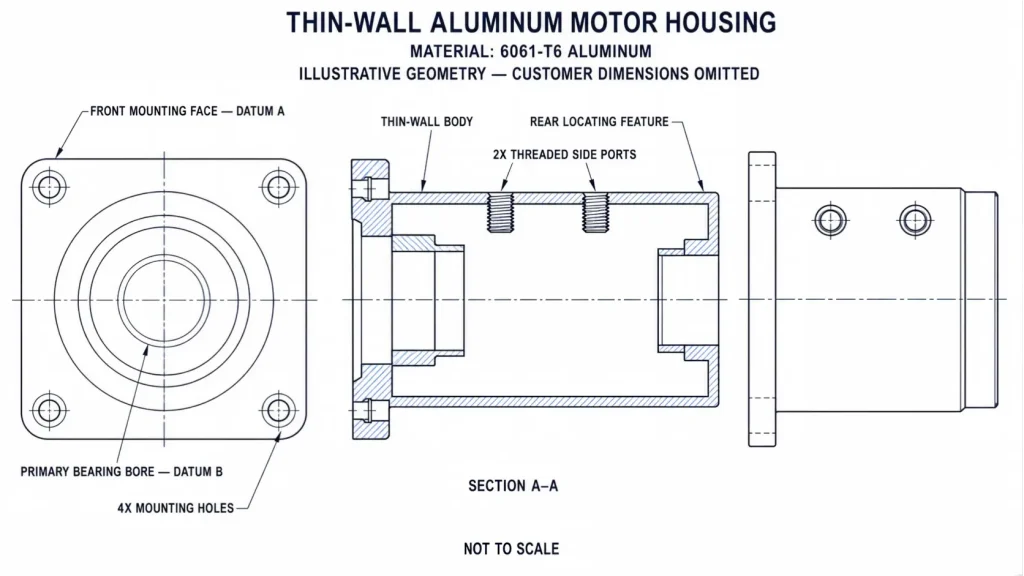
Why a Motor Housing Is More Than a Round Aluminum Part
A motor housing does not rotate, but it establishes the mechanical references that support the rotating system.
The bearing seats must locate the bearings relative to the housing’s functional mounting features. If a bore is within its size limit but its axis is displaced, tilted, out of round, or unstable after unclamping, the assembly may still require correction.
The housing walls introduce another variable. Removing material reduces stiffness, while clamping and cutting forces can temporarily hold the component in a shape that does not remain after release.
Machining can verify the mechanical features defined on the drawing. It cannot by itself guarantee motor noise, vibration, temperature, bearing life, or complete system performance. Those outcomes also depend on the rotor, shaft, bearings, preload, balance, assembly process, and operating conditions.
The Main Manufacturing Risks
| Manufacturing Risk | What Can Happen | Required Control |
|---|---|---|
| Thin-wall clamping | The fixture temporarily pulls the housing into a false shape | Support rigid regions and control clamping force |
| Uneven material removal | Residual stress is redistributed and the housing moves | Separate roughing from final feature control |
| Independent bore setups | Small reference changes alter the relationship between bearing-seat axes | Finish related features from a controlled datum structure |
| Bore size used as the only check | A bore can pass size inspection while remaining out of round or misaligned | Inspect size, form, and axis relationship separately |
| Inspection with excessive support | The inspection fixture hides released distortion | Define the free or restrained acceptance condition |
| Temperature difference | The aluminum part and measuring system are evaluated under different conditions | Stabilize the part and measurement environment when required |
These risks are explained more broadly in the thin-wall aluminum CNC machining guide, but the motor housing required a project-specific datum and bore-control strategy.
The DFM Review Started With the Functional References
The first DFM question was not, “How thin are the walls?”
It was, “Which features establish the motor assembly?”
The review identified:
- the mounting interface used to locate the housing
- the bearing-seat features supporting the rotating system
- the relationship between the bearing features and the mounting reference
- the wall regions most likely to move under clamp or cutting force
- the part condition in which final inspection would be meaningful
- the features that had to remain accessible for finishing and measurement
A nominal bore diameter controls size. It does not automatically control roundness, cylindricity, axis position, orientation, or runout.
The drawing therefore had to separate bore size, bore form, and axis relationship instead of hiding all three inside one general “concentricity” note.
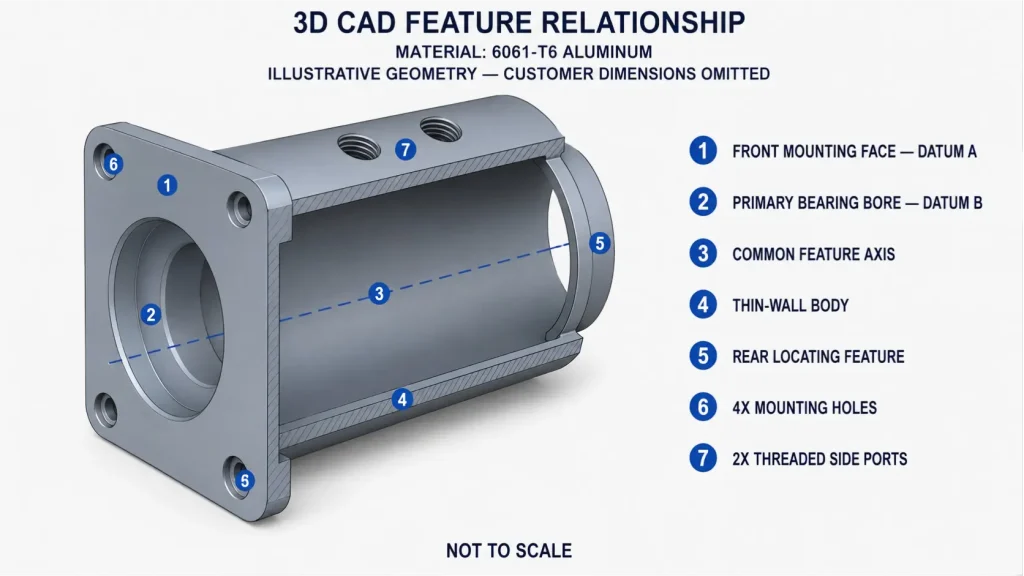
The Machining Route Preserved Stiffness Before Final Control
We Established Stable Manufacturing References First
The initial operations created reference features that could be cleaned, located, and checked during later setups.
Flexible walls were not used as primary locating surfaces when a more stable flange, face, or thicker region was available.
This reduced the risk of locating the housing from a surface that had already moved during rough machining.
We Removed the Main Stock Before Finishing the Bearing Features
Major cavities and relief areas were roughed before the final bearing-seat control.
Enough material was retained around sensitive features to preserve stiffness during the early operations. Final bearing features were not completed while large amounts of material still had to be removed elsewhere.
This separated material-release risk from final feature generation.
We Released and Re-Established the Housing
After the main stock removal, the housing was allowed to return to a consistent released condition.
The next setup referenced the intermediate part rather than assuming that its original clamped shape had remained unchanged.
This step did not eliminate residual stress. It exposed movement that the earlier fixture might have been hiding and allowed the final setup to reference the actual intermediate geometry.
We Used Profile-Matched, Low-Distortion Support
The workholding strategy supported stable regions of the housing and avoided concentrated force on flexible walls.
Clamping force had to be sufficient to resist machining loads without forcing the housing into the nominal CAD shape.
Depending on the accessible geometry, this type of setup may use profile-matched soft support, distributed contact, controlled edge clamping, or a dedicated fixture. The correct method depends on wall stiffness, tool direction, and datum accessibility.
On thin cylindrical housings, localized radial clamping can create a lobed shape that is temporarily held during machining and returns after release. Where this risk is significant, profile-matched segment jaws or axial face clamping can distribute the holding load more evenly. The final choice still depends on the datum structure, available contact area, cutting-force direction, and released-state inspection requirement.
We Controlled the Relationship Between Bearing Features
Where the geometry allowed, related bearing features were finished from a common datum reference without unnecessary re-location.
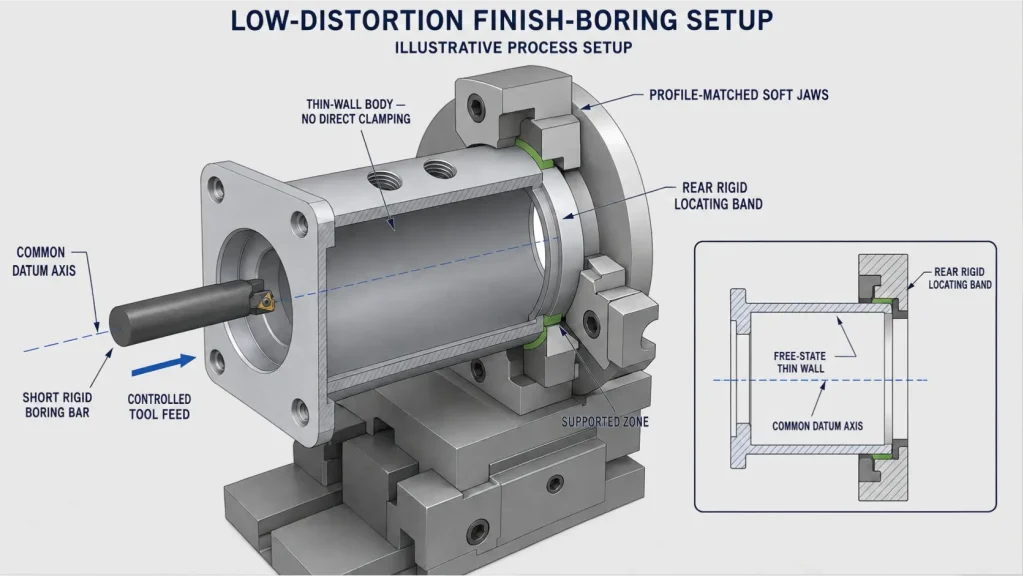
This reduced the number of independent setup errors entering the bearing-seat relationship.
It did not remove the need to inspect each feature separately. Bore size, bore form, and the relationship between axes remained different acceptance questions.
We Protected Thin Edges During Deburring
A thin wall or bore edge can be damaged after machining by aggressive manual deburring.
Deburring therefore focused on removing functional burrs without rolling the edge, changing a bearing-seat entrance, or creating an uncontrolled chamfer.
The required edge condition should come from the drawing rather than from a general instruction such as “break all edges.”
What “Concentricity” Needs to Mean on the Drawing
Buyers often use concentricity informally to describe any requirement involving two circular features. That word alone is not enough to create an inspection plan.
The actual functional requirement may involve several independent controls.
| Functional Requirement | Drawing Control to Review | Inspection Approach |
|---|---|---|
| Bearing fit | Bore size tolerance or specified fit | Bore gauge, air gauge, CMM, or an agreed functional gauge |
| Bore form | Roundness or cylindricity | Roundness equipment or a suitable CMM strategy |
| Bearing-seat axis location | Position relative to a defined datum axis | CMM or another agreed coordinate method |
| Rotation relative to a datum axis | Circular runout or total runout where functionally appropriate | Indicator setup, roundness equipment, or an agreed CMM method |
| Mounting face relative to the bore axis | Perpendicularity, parallelism, or face runout as required | CMM or indicator-based inspection |
| Relationship between multiple bores | Drawing-defined axis relationship | Measurement method agreed from the datum structure |
If an H7 tolerance zone is specified, it must be attached to a nominal diameter. Information about the mating bearing or shaft may also be useful during DFM review, but H7 alone is not a complete bore definition.
The correct control depends on how the housing locates the bearings and how the assembled system functions. The CNC machining tolerances guide explains why size tolerances and geometric requirements must be reviewed separately.
Inspection Had to Match the Feature and Part State
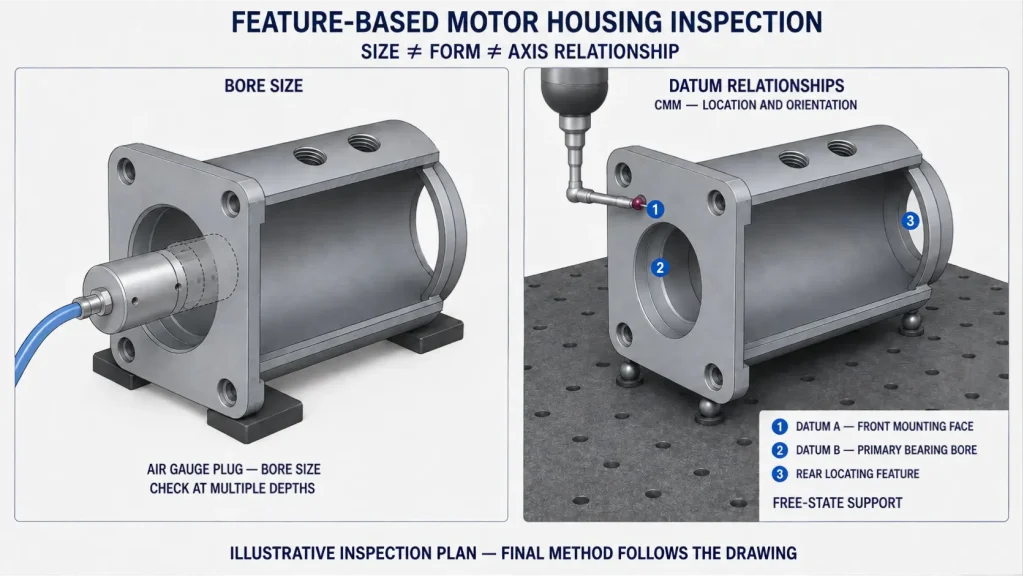
The inspection method was selected according to what each feature controlled.
| Inspection Target | Suitable Inspection Focus | Main Risk to Avoid |
|---|---|---|
| Bearing-seat diameter | Size at relevant depths and directions | Reporting one diameter while missing taper or local variation |
| Bore form | Roundness or cylindricity under an agreed method | Using a few points to represent a complex bore form |
| Axis relationship | Measurement relative to the specified datum structure | Constructing the wrong datum or comparing unrelated local circles |
| Mounting face | Surface form and orientation where specified | Confusing flatness with orientation to another datum |
| Thin housing walls | Released profile, thickness, or specified restrained condition | Forcing the housing into shape during inspection |
| Related holes and faces | Position and orientation from the functional reference system | Inspecting each feature from a convenient but nonfunctional origin |
For a tightly controlled production bearing-seat diameter, a bore gauge or air gauge may be more suitable than a CMM for size control. A CMM is often more useful for feature location, orientation, and datum relationships. The final method depends on bore diameter, tolerance, surface condition, quantity, and reporting requirements.
A CMM can be useful, but the machine name alone does not define the measurement. Probe strategy, point density, feature construction, alignment, support condition, and part temperature can all affect the reported result.
For repeat-production projects, the drawing and inspection plan should also define which features belong in the first article inspection and which require ongoing sampling or functional verification.
Inspection therefore followed the functional relationship between features, not a generic claim that the entire housing was “high precision.”
Project Outcome
The completed motor housings were supplied for customer assembly after inspection against the project drawing.
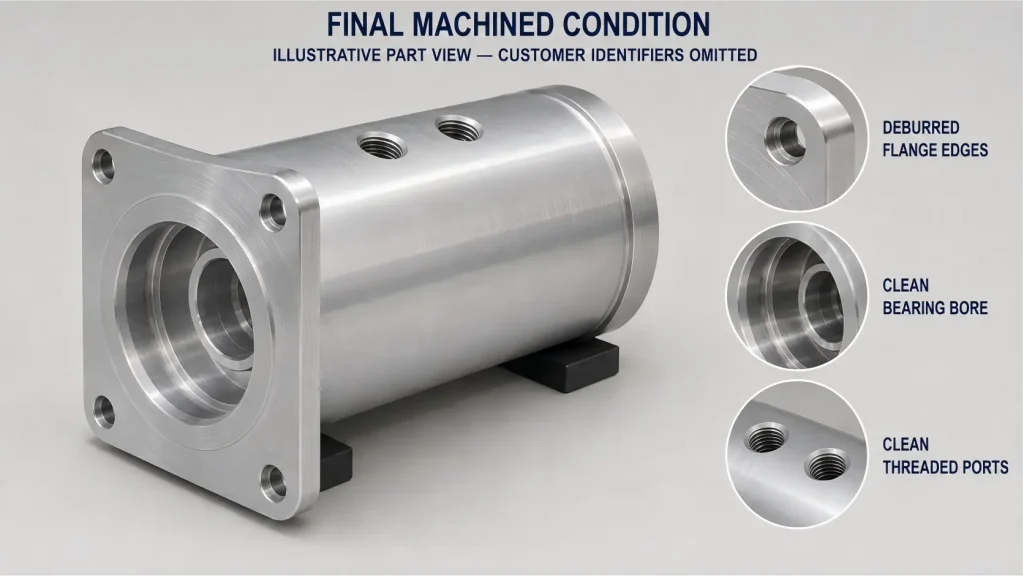
The manufacturing route treated flexible walls, bearing features, and assembly references as one connected system. Roughing, fixture release, datum re-establishment, final bore control, and inspection were planned in that order.
The project did not establish a universal wall-thickness or concentricity capability for every motor housing. Achievable results depend on the housing diameter, unsupported wall length, bearing-seat geometry, stock condition, datum structure, machining access, inspection method, and required part state.
When This Route Is Appropriate
This approach is useful when a motor housing includes:
- flexible cylindrical or pocketed wall sections
- bearing seats that must remain related after unclamping
- multiple machining orientations
- a rigid mounting flange connected to less rigid walls
- tight bore-fit or runout requirements
- inspection requirements affected by support condition
- prototype approval followed by repeat production
A different route may be needed for cast housings, extruded housings, housings with integrated cooling channels, heavily ribbed structures, or components that are intentionally restrained during final assembly.
Buyer Checklist for a Thin-Wall Motor Housing RFQ
Provide the following before quotation:
- 3D CAD and the controlled 2D drawing
- aluminum alloy, temper, and preferred stock form
- nominal bearing-seat diameters and fit requirements
- functional datum structure
- roundness, cylindricity, position, or runout requirements
- minimum wall thickness and major unsupported spans
- free-state or restrained-state acceptance condition
- mating shaft, bearing, or assembly information where relevant
- surface-treatment requirements
- dimensions that apply before or after finishing
- first-article and production-inspection requirements
- prototype and expected production quantities
RapidEfficient can provide precision machining support for motor housings that require coordinated workholding, datum control, bore finishing, and inspection planning.
Review Your Motor Housing Before Quotation
For a useful review, send the drawing package and inspection requirements, including the bearing-seat fits, functional datum structure, wall geometry, finishing condition, and required inspection state.
We will review whether the proposed machining route can maintain the required relationship between the housing walls, bearing features, and assembly references before quotation.