
Conclusion First (Quick Answer)
👉 There is no universal “best” material — the right choice depends on your application.
- Aluminum → Best for cost, weight, and manufacturability
- Copper → Best for maximum thermal conductivity
👉 In real CNC machining projects, aluminum is used in over 90% of heat sink applications due to its balance of performance and cost.
For a foundational understanding, see our
👉 What Is a Heat Sink in CNC Machining
https://rapidefficient.com/what-is-heat-sink-cnc-machining/
📊 Engineering Comparison Matrix
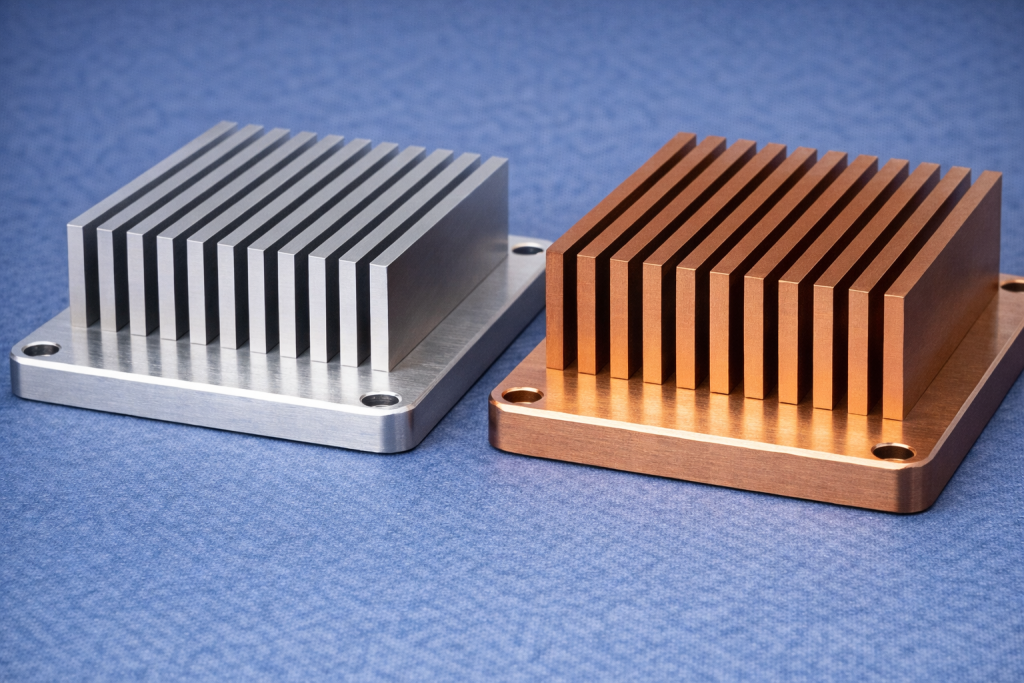
| Feature | 6061 Aluminum | C11000 Copper | Impact |
|---|---|---|---|
| Thermal Conductivity | 167 W/m·K | 391 W/m·K | Copper better for heat flux |
| Density | 2.7 g/cm³ | 8.9 g/cm³ | Aluminum ~70% lighter |
| Machinability | Excellent | Challenging | Lower cost with aluminum |
| Surface Finish | Anodizing | Plating required | Aluminum more flexible |
| Overall Cost | $ | $$$$ | Copper 2–4× higher |
Thermal Performance Comparison
Thermal Conductivity
- Aluminum (6061): ~167 W/m·K
- Copper (C11000): ~391 W/m·K
👉 Copper conducts heat nearly 2× faster than aluminum.
👉 Engineering Insight:
Higher conductivity alone does not guarantee better system cooling — airflow, surface area, and contact quality also matter.
Weight Comparison
- Aluminum density: ~2.7 g/cm³
- Copper density: ~8.9 g/cm³
👉 Copper is more than 3× heavier
Engineering Secret: Specific Thermal Conductivity
While copper has higher absolute conductivity, aluminum provides higher specific thermal conductivity (conductivity per unit weight).
👉 For weight-sensitive applications:
- UAV systems
- Robotics
- Aerospace components
👉 Aluminum can dissipate more heat per gram, making it the preferred choice when both thermal efficiency and lightweight design are required.
CNC Machining Considerations
Aluminum (Preferred)
- Excellent machinability
- Lower tool wear
- Faster cutting speeds
👉 Ideal for complex fin structures and high-volume production.
Copper (Challenging)
- Sticky material behavior
- Slower machining speed
- Higher tool wear
👉 Real Machining Challenge:
Copper is prone to built-up edge (BUE) during cutting.
This leads to:
- Poor surface finish
- Tool adhesion
- Increased tool wear
👉 To control this, machining copper requires:
- Advanced cutting fluids
- Specialized tool coatings
- Precise cutting parameters
👉 This is a key reason why copper machining is significantly more expensive.
Cost Comparison (Hidden Reality)
👉 Material cost:
- Copper: ~2–3× higher than aluminum
👉 Machining cost:
- Tool wear increases by ~25–40%
- Slower cutting speeds increase cycle time
👉 Final impact:
❗Copper heat sinks can cost 2–4× more than aluminum equivalents
Post-Processing Reality
Aluminum
- Supports anodizing (color + hard anodizing)
- Excellent corrosion resistance
- Better visual finish
Copper
- Cannot be anodized
- Requires nickel plating or passivation
- Prone to oxidation and discoloration
👉 Engineering Insight:
For products requiring both performance and appearance, aluminum offers significantly greater flexibility.
When to Choose Aluminum
👉 Best for:
- General electronics
- Industrial equipment
- Automotive systems
👉 Also ideal for:
- Complex CNC heat sink geometries
- Cost-sensitive projects
👉 Example:
👉 CNC aluminum heat sink machining case study
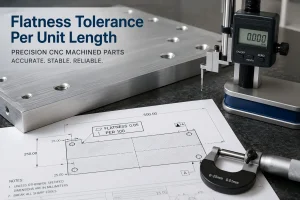
👉 Flatness control plays a critical role in thermal performance.
See how we achieved ≤0.02 mm in a real project above.
When to Choose Copper
👉 Best for:
- High-power CPUs
- Semiconductor equipment
- Extreme heat environments
👉 Use copper when:
- Thermal performance is the top priority
- Cost and weight are secondary
Real Engineering Trade-Off
Choosing between aluminum and copper is not about “which is better” —
it is about balancing thermal performance, weight, manufacturability, and cost.
👉 In advanced designs:
- Aluminum handles bulk heat dissipation
- Copper is used locally (base or inserts)
👉 Hybrid heat sink structures are widely used in high-performance systems.
Engineer’s Insight
The best heat sink design is not defined by material alone —
it is defined by how material selection, geometry, and machining precision work together.
Start Your Heat Sink Project
If you’re selecting a heat sink material:
- Define thermal requirements
- Evaluate weight constraints
- Consider machining feasibility
👉 Our engineering team can help you select the optimal solution based on real production conditions.
FAQ
Is copper always better than aluminum?
No. Copper has higher thermal conductivity, but aluminum is more practical in most applications.
Why is aluminum used more often?
Because it offers the best balance of cost, weight, and machinability.
Can aluminum and copper be combined?
Yes. Hybrid designs are commonly used in high-performance thermal systems.