
Adding solution annealing to a stainless steel CNC order can change the material properties that the design relies on. A part may leave the cycle softer, while its bore and locating faces still need correction. A separate passivation requirement does not resolve either issue.
Before adding the operation, identify what must change in the metal and what must remain acceptable afterward. Starting with certified solution-annealed stock does not automatically require another anneal after machining. If a later operation changes the material condition, however, the original stock report cannot establish all the properties of the finished part.
This discussion concerns wrought austenitic stainless steels such as 304/304L and 316/316L. Their solution-annealing route should not be confused with precipitation hardening of 17-4 PH or heat treatment of aluminum.
Annealing Can Remove Strength the Part Was Meant to Keep
Solution annealing heats the steel to a suitable temperature to dissolve relevant precipitates, such as chromium carbides, back into the metal’s solid solution. The cycle can also soften material strengthened by cold working. Cooling must be controlled to avoid harmful precipitation as the temperature falls.
Cold drawing or rolling can increase the strength of these austenitic grades. Solution annealing can remove that strengthening effect. It is not a quench-hardening treatment for 304 or 316 stainless steel.
The heat-treatment section of Practical Guidelines for the Fabrication of High Performance Austenitic Stainless Steels explains the softening and dissolution mechanisms. Its cooling guidance also distinguishes grade and section size. Do not apply a general slow-furnace-cooling rule from carbon-steel annealing to this process.
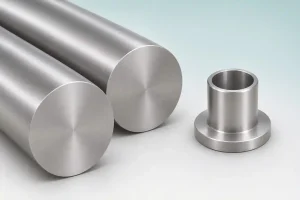
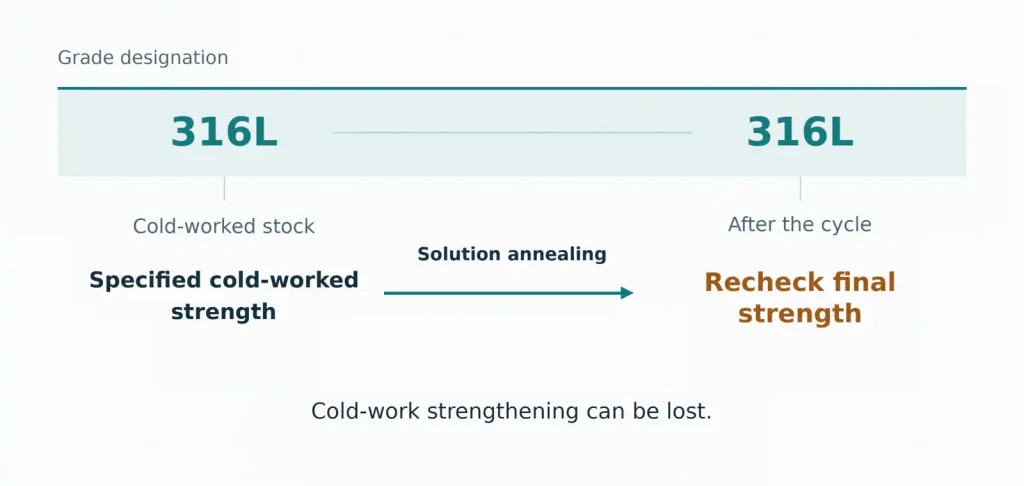
Consider an illustrative 316L sleeve machined from stock with a specified cold-worked strength level. If the sleeve needs that strength in service, adding a full solution anneal requires a new check against the final mechanical requirements. A matching alloy designation and an acceptable bore diameter would not settle the strength question.
The proposed treatment should therefore have a stated purpose. Is it intended to restore ductility after forming, address a metallurgical condition created by earlier processing, or meet an explicit specification? If the only concern is removable surface contamination, establish why a bulk heat treatment is being proposed.
“Stress relieved” also needs its own definition. A lower-temperature stress-relief treatment should not be accepted as proof that the steel has received a full solution anneal.
Read the Stock Condition Before Adding Another Cycle
The same grade name can appear on products with different manufacturing histories. Read the product specification, size, supplied condition and reported properties together. A bright bar surface is not evidence of one particular heat-treatment route.
For example, the heat-treatment section of Alleima’s Sanmac 316/316L bar data sheet lists solution-annealed and in-process-annealed supply routes according to bar size. That is product-specific information. It does not make the two descriptions interchangeable under every customer’s specification.
For the sleeve, distinguish two purchasing instructions:
- The starting bar must meet the specified annealed supply condition. The supplier must source and document suitable stock. This instruction alone does not add a post-machining furnace operation.
- The component must receive solution annealing after a named fabrication operation. The quotation must include that treatment, the required records and any permitted finishing afterward.
Welding or substantial cold forming after stock certification makes the later process history relevant. It does not mean that every welded or formed 316L component automatically needs another solution anneal. The applicable specification, service conditions and required final properties determine that decision.
Keep stock evidence and later process evidence connected. The material certification guide explains how a mill report relates to the material supplied and why its scope matters. If a new heat treatment is required, identify the treatment batch and agree which records or tests establish the condition being accepted. Do not use a typical data-sheet value as a measured result for that batch.
Pickling and Passivation Work on a Different Problem
Solution annealing concerns the metallurgical condition. Pickling and passivation address surface conditions. The processes can belong in the same manufacturing route, but they are not substitutes.
Annealing in air can create oxide scale and a chromium-depleted region immediately beneath it. Removing that affected surface may require descaling and pickling. A controlled protective atmosphere can limit scale formation; the cleanup requirement must follow the actual process and surface condition.
Pickling removes oxide and some underlying metal. Chemical passivation is used to remove surface contamination such as free iron and support the passive surface condition. A passivation record does not demonstrate that grain-boundary carbides have been dissolved throughout the part.
The following distinctions help review a quotation that combines material supply, machining and stainless finishing.
| Operation | Effect relevant to the stainless part | What the operation does not establish |
|---|---|---|
| Cold drawing or rolling | Can raise strength through plastic deformation | That the material remains in the fully solution-annealed condition |
| Solution annealing | Can soften cold-worked material and dissolve relevant precipitates | That the previous cold-worked strength is retained, or that final dimensions are acceptable |
| Pickling | Removes scale and affected surface metal | That the bulk material has received solution annealing |
| Chemical passivation | Addresses the prepared stainless surface and free-iron contamination | That the bulk strength or microstructure meets an annealed-condition requirement |
Outokumpu’s post-fabrication treatment guidance separates thermal treatments from surface cleaning and explains the metal removal involved in pickling. An order that says only “anneal and passivate” may therefore leave the intermediate scale-removal work undefined.
Specify the required surface result without assuming that every part needs every chemical step. For details of contamination, rinsing and finishing requirements, see the stainless steel passivation guide. Surface-treatment acceptance and bulk-material acceptance should remain separate questions.
Leave a Route Back to the Required Bore and Faces
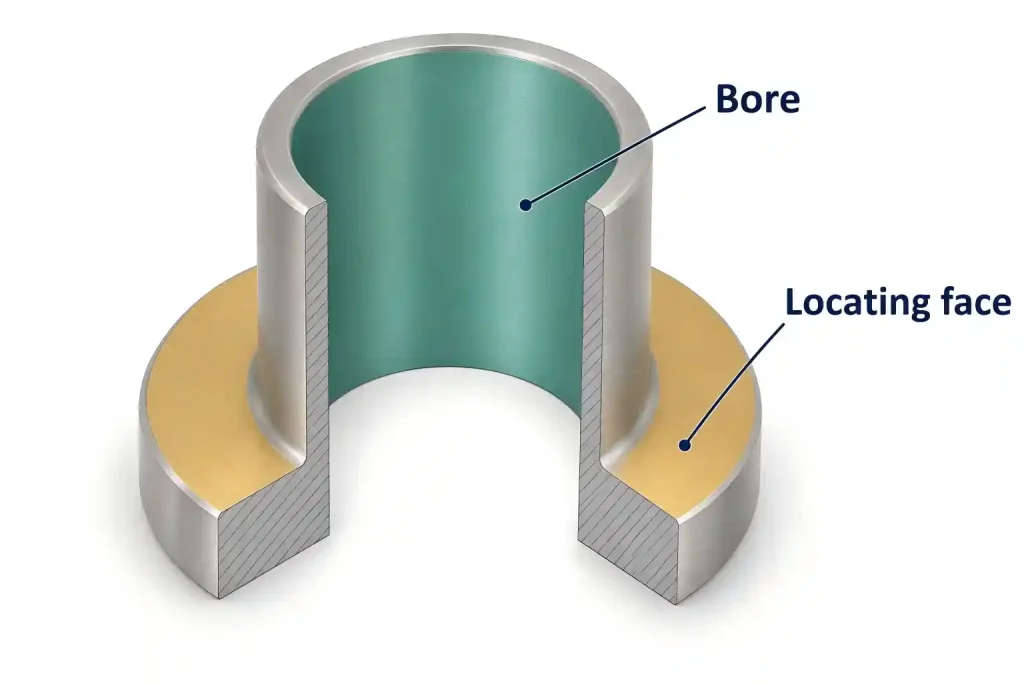
Return to the sleeve, this time with a thin cylindrical wall and a thicker mounting flange. If the component must be annealed after rough machining, the supplier needs a plan for the bore, the flange’s locating face and their geometric relationship after treatment.
Heating and cooling can move the part. Differences in section thickness affect the thermal response, and the cooling method must satisfy the metallurgical requirement as well as account for distortion. Choosing slower cooling solely to protect a close-tolerance bore may compromise the purpose of the treatment.
Leaving finishing stock can help only where the required surface can still be reached and corrected. Extra material on the outside diameter does not provide machining allowance inside a bore. Likewise, enough stock on a flange face does not guarantee that the bore and face can be brought back into their required relationship.
Agree where the heat treatment, scale removal and final cutting occur in the route. If pickling follows a precision machining operation, its metal removal also belongs in the dimensional review. Neither a pre-anneal inspection report nor a pre-pickling measurement demonstrates the dimensions after those operations.
Final cutting introduces its own local surface deformation. If the specification controls the final surface’s metallurgical condition or restricts work after annealing, confirm which finishing operations are permitted. Do not silently interpret “solution anneal after fabrication” as permission to perform unrestricted machining afterward.
For a CNC machining review, provide the supplied stock condition, the required final mechanical properties and the exact operation after which annealing is required. Identify the sleeve’s critical bore, locating faces and any restrictions on later material removal. The quotation should make the treatment stage, surface-cleanup work and final acceptance evidence clear before the route is approved.