304 与 18-8 不锈钢: Are They the Same for CNC Parts?

For many general stainless steel parts, 18-8 不锈钢和 304 stainless steel may look interchangeable, but they should not always be treated the same in CNC drawings, RFQs, 材料证明, 或检验要求.

The practical answer is simple:

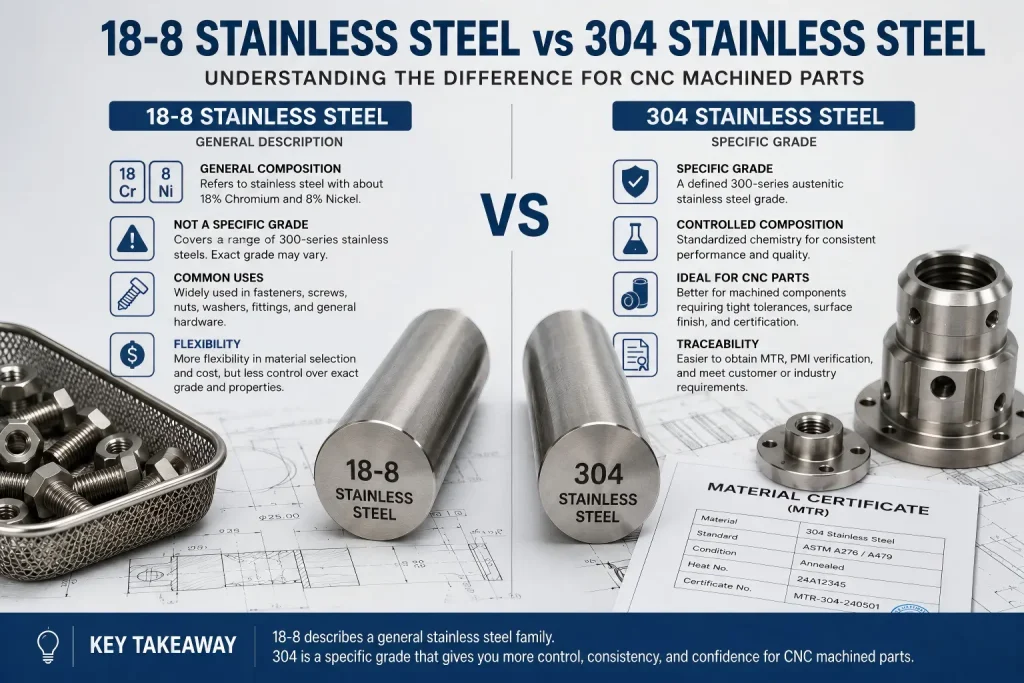
304 stainless steel is a specific stainless steel grade. 18-8 stainless steel is a broader description that usually means a stainless steel with about 18% 铬和 8% 镍. Many 304 stainless steels fall within the 18-8 family, but “18-8” is not always a precise substitute for “304” when the part requires controlled material certification, corrosion performance, 钝化, or customer approval.

用于 CNC 加工零件, Rapid Efficient generally recommends using 304 不锈钢 when the drawing, assembly environment, corrosion requirement, or quality documentation must be controlled. 使用 18-8 only when the application allows a more general stainless specification, such as non-critical hardware, basic brackets, spacers, or fasteners where exact grade traceability is not required.


The Practical Difference for CNC Buyers

问题Better Answer
是 18-8 always the same as 304?福田街道. 304 is a defined grade; 18-8 is a general stainless description.
能 304 be called 18-8?经常是的, because 304 commonly fits the 18% 铬和 8% nickel description.
能 18-8 replace 304 on a CNC drawing?Only if the buyer accepts a broader stainless specification.
Which is safer for RFQ and inspection?304 不锈钢.
Which is better for certified CNC parts?304, or 304L if the drawing requires low carbon.
Which should be used for generic stainless hardware?18-8 may be acceptable if grade certification is not critical.

The most common mistake is assuming that “18-8” automatically satisfies every 304 requirement. That may be fine for standard fasteners, but it can create problems when a CNC machined component needs material certificates, corrosion review, 钝化, welding compatibility, or customer approval.


什么 18-8 Stainless Steel Means

18-8 stainless steel is not one single exact grade. It is a common way to describe austenitic stainless steel with roughly:

  • 18% chromium
  • 8% 镍
  • corrosion resistance suitable for many general indoor and light-duty environments
  • non-magnetic or slightly magnetic behavior after cold working or machining
  • good formability compared with many harder stainless grades

这就是为什么 18-8 is often used in fasteners, 螺丝, 坚果, washers, 配件, 括号, and general stainless hardware.

But from a manufacturing and procurement point of view, 18-8 is less precise than 304. It may point to a material family rather than a controlled grade. If the drawing only says “18-8 stainless steel,” a supplier may need clarification before choosing the exact bar stock, 盘子, sheet, or fastener material.

The supply-chain risk of an ambiguous “18-8” callout is not only chemistry. It is also grade interpretation. In many purchasing contexts, 18-8 is treated as a broad commercial stainless description rather than a tightly controlled CNC material grade.

This matters because different 300-series stainless alloys can be selected for different manufacturing routes. Some are optimized for cold heading, 成型, or standard fastener production rather than stable multi-axis machining. If a custom CNC drawing only says “18-8 stainless steel,” the supplier may need to clarify whether the buyer expects 304, 304l, a fastener-grade stainless material, or another acceptable stainless alloy within the same general corrosion-resistant family.

For non-critical hardware, that flexibility may be acceptable. For CNC machined parts with tight tolerances, 螺纹孔, 装饰表面, 钝化, or material certificate requirements, it can create avoidable risk. A more precise callout such as “304 stainless steel, substitution requires approval” gives both the buyer and manufacturer a clearer material baseline.

For basic commercial hardware, 18-8 may be enough. For custom CNC machined parts, 304 is usually safer.

18-8 与 304 stainless steel comparison showing general stainless description, defined material grade, CNC parts, and RFQ review.

什么 304 Stainless Steel Means

304 stainless steel is a specific austenitic stainless steel grade widely used for CNC machined parts, 外壳, 括号, 轴, 配件, 盘子, 封面, medical device components, food equipment parts, and corrosion-resistant assemblies.

Compared with a general 18-8 description, 304 gives the buyer and supplier a clearer basis for:

  • material purchasing
  • MTR or material certificate review
  • PMI or XRF verification when required
  • 腐蚀预期
  • passivation planning
  • drawing notes
  • customer acceptance
  • repeat production consistency

304 is not always the easiest stainless steel to machine. It can work harden, generate built-up edge, produce burrs, and require stable tooling and coolant control. But because it is widely available and well understood, it is often the safer choice for custom CNC projects.

For machining-specific risks such as work hardening, 毛刺控制, 和表面饰面, see the guide on 加工 304 不锈钢.


When 18-8 和 304 May Be Treated as Equivalent

In some purchasing situations, 18-8 和 304 may be accepted as equivalent or near-equivalent. This is most common when the part is not highly regulated and the customer mainly needs general corrosion-resistant stainless steel.

Application Situation能 18-8 Be Accepted Instead of 304?Manufacturing Comment
Generic stainless screws or washers通常是的18-8 is commonly used for general stainless fasteners.
Simple indoor brackets经常是的Confirm whether exact grade certification is needed.
装饰罩有时外貌, 抛光, and passivation expectations should be reviewed.
CNC spacers or bushings有时使用 304 if dimensional repeatability and documentation matter.
Food-contact or medical-related partsNot automatically绘画, regulatory, and passivation requirements should be checked.
Parts requiring MTR or PMI使用 304A defined grade is safer for inspection and acceptance.
Customer-controlled drawingsUse the specified gradeDo not substitute without written approval.

The key point is not whether 18-8 和 304 are chemically close. The key point is whether the project requires a defined material grade or only a general stainless description.


Grade Specification Risk: Where Buyers Get Into Trouble

A CNC part can look correct, measure correctly, and still create a dispute if the material specification is unclear.

Common problems include:

  • The drawing says 304, but the quotation says 18-8.
  • The purchase order says 18-8, but the customer expects 304 认证.
  • The part is made from stainless material, but the MTR does not match the drawing.
  • The customer requests PMI after production, but the RFQ never mentioned exact grade verification.
  • Passivation is required, but the material condition and surface finish were not reviewed before finishing.
  • A supplier treats 18-8 as acceptable, while the end customer requires 304 or 304L.

These problems are not always caused by poor machining. They often come from unclear RFQ language.

适用于定制 CNC 零件, a small wording difference can affect material sourcing, 检查费用, delivery time, and customer acceptance.


CNC Machining Behavior: 304 与 18-8

If the 18-8 material is actually 304 or a very similar austenitic stainless grade, the machining behavior may be close. 然而, if the supplier only receives a broad “18-8” requirement, the exact machining response can be less predictable.

加工系数304 不锈钢Generic 18-8 不锈钢
Material definitionSpecific gradeBroader description
Tool wear riskModerate to high depending on geometryDepends on exact grade and condition
加工硬化Common concernPossible if austenitic stainless
毛刺形成Common on edges, 插槽, 线程, and thin wallsSimilar risk if material is 304-like
Tapping riskRequires controlled feed, 润滑, 和芯片疏散Depends on exact material and hole depth
表面光洁度Predictable with correct tools and processMay vary if exact grade is not controlled
Certificate reviewClearerMay require clarification
重复订单More consistentLess consistent unless exact grade is locked

For CNC projects, the machining difference may not be dramatic when both materials are similar. The bigger issue is usually specification control.

Another hidden issue is the difference between fastener-oriented stainless specifications and bar stock intended for machining. In North American purchasing, “18-8 stainless” is commonly seen in screws, 螺栓, washers, and other standard hardware. Those parts may be produced under fastener-focused specifications and cold-forming routes, where strength, heading behavior, and general corrosion resistance are more important than machining stability.

That does not mean generic 18-8 hardware stock is a good starting point for a custom CNC component. Cold-worked or fastener-oriented material can contain residual processing stress. When a CNC mill or lathe removes material from one side of a thin-wall, asymmetric, or flatness-critical part, the stress balance may change and the part can bow, twist, or move after unclamping.

For custom CNC machining, it is usually safer to define the required stainless grade and stock form clearly, 例如 304 or 304L bar stock to an applicable bar specification when required. This helps the supplier select material suitable for turning, 铣削, 钻孔, 窃听, 精加工, and inspection instead of treating a standard 18-8 hardware description as a machining-grade material instruction.

If the customer expects repeatability across multiple batches, 304 is usually better than a general 18-8 callout.


Corrosion Resistance and Passivation

两个都 304 and common 18-8 stainless steels offer good corrosion resistance for many environments. 然而, neither should be treated as corrosion-proof.

Corrosion performance depends on:

  • chloride exposure
  • 清洁化学品
  • 温度
  • 表面粗糙度
  • embedded iron or shop contamination
  • passivation quality
  • crevices, 线程, and trapped fluid
  • welding or heat-affected zones
  • final packaging and storage conditions

For mild indoor use, 304 或者 18-8 may be enough. For marine, chloride-rich, 化学, or outdoor environments, 316 or 316L may be a better choice.

When passivation, 焊接, 化学暴露, or customer-controlled corrosion requirements are involved, the carbon limit should also be reviewed. 标准 304 stainless steel commonly allows a higher maximum carbon content than 304L. In many material references, 304 is listed with up to 0.08% carbon, while 304L is controlled to a lower 0.03% maximum carbon level.

This is why some projects specify 304L or dual-certified 304/304L material. Dual-certified material can satisfy the general 304 requirement while also meeting the lower-carbon expectation of 304L, depending on the applicable standard and MTR. It may reduce risk for welded parts, passivated components, corrosion-sensitive assemblies, or projects where the customer requires tighter material documentation.

For a normal indoor CNC part, 标准 304 may be enough. For passivated, welded, exported, or customer-audited parts, the RFQ should state whether 304, 304l, or dual-certified 304/304L is required, and whether material certificates or PMI verification are needed before shipment.

Passivation may be useful after machining when the part needs improved surface cleanliness and corrosion resistance. 然而, passivation should be reviewed together with material grade, 表面饰面, 边缘条件, and inspection expectations.

了解更多详情, see the guide on stainless steel passivation.


Surface Finish and Appearance Differences

304 stainless steel is often selected when the buyer wants a controlled surface finish, such as machined, brushed, 喷珠, 抛光的, or passivated stainless parts.

Generic 18-8 stainless can also be finished, but the result depends on the exact material and stock condition. If the final appearance matters, the drawing should not rely only on the words “18-8 stainless steel.”

Surface finish should be defined separately from material grade.

例子:

要求Better Drawing Note
Basic machined finish304 不锈钢, machined finish, deburr sharp edges
Brushed appearance304 不锈钢, brushed finish, grain direction specified if needed
Bead blasted surface304 不锈钢, bead blast finish, cosmetic surfaces defined
Corrosion-resistant finish304 不锈钢, passivated after machining
Critical appearance partsDefine material, 表面饰面, protected faces, 及检验方法

If the buyer only writes “18-8 stainless, good finish,” the supplier may not know whether the priority is appearance, 耐腐蚀性, roughness, or cost.

For surface finish planning, see the CNC 表面处理指南.


Drawing and RFQ Notes That Prevent Confusion

The best way to avoid substitution disputes is to make the material requirement clear before quotation.

Buyer RequirementRecommended RFQ or Drawing Note
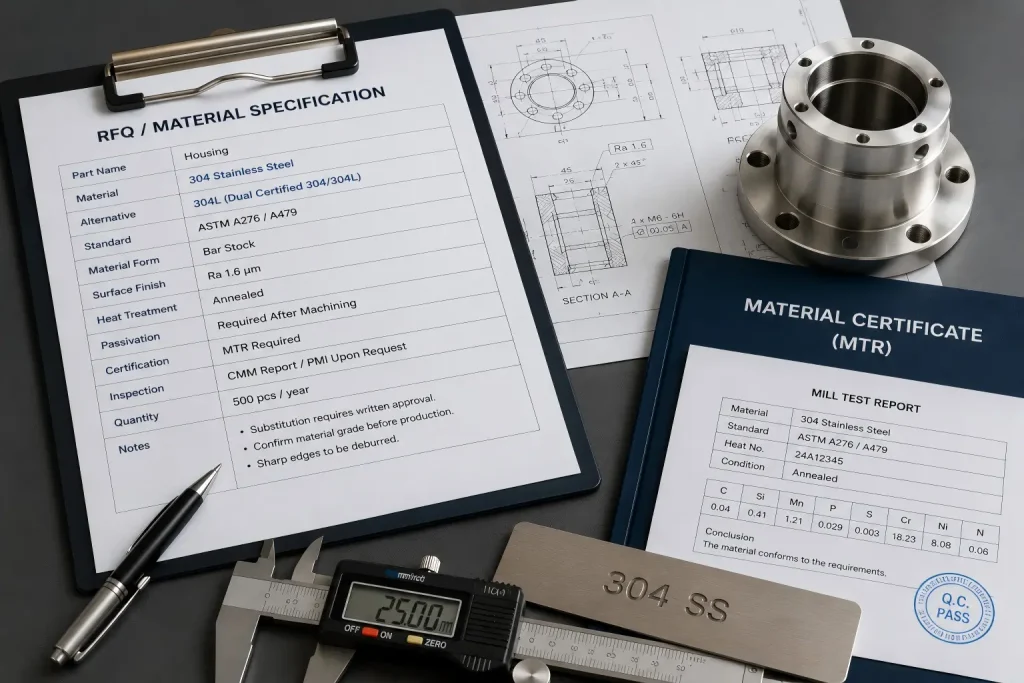
Exact 304 required材料: 304 不锈钢. Substitution requires written approval.
304L acceptable材料: 304 or 304L stainless steel, confirm grade before production.
304/304L dual-certified required材料: dual-certified 304/304L stainless steel, MTR required.
18-8 acceptable材料: 18-8 stainless steel acceptable for non-critical hardware application.
Certificate requiredMaterial certificate required with shipment.
PMI requiredPMI/XRF verification required when requested by buyer.
Passivation requiredPassivate after machining; confirm standard and appearance requirements before production.
Corrosion-sensitive useReview environment before material confirmation.
Repeat productionSame material grade and certificate type required for repeat batches.

This is especially important when sourcing CNC machined stainless parts from overseas suppliers, because different teams may interpret “18-8” differently.

304 stainless steel RFQ and material specification review for CNC machined parts with engineering drawings and inspection notes.

Cost and Lead Time Considerations

在很多情况下, 304 stainless steel is widely available and does not create unusual sourcing difficulty. 用于数控加工, the cost difference between a vague 18-8 requirement and a controlled 304 requirement is not always about raw material price.

The real cost difference may come from:

  • 证书要求
  • PMI or material verification
  • 钝化
  • 表面光洁度要求
  • tighter tolerance control
  • repeat batch traceability
  • customer approval before substitution
  • special stock form or condition requirements

A part made from general 18-8 stainless may appear cheaper at first, but if the project later requires 304 认证, the cost of rework, replacement, or delayed acceptance can be much higher.

For RFQs, the safest approach is to define the required grade at the beginning.


When 304 Is the Better Choice

选择 304 stainless steel when:

  • the drawing already specifies 304
  • the customer needs material certification
  • repeat production consistency matters
  • passivation is required
  • the part will be assembled into a regulated or customer-controlled product
  • corrosion performance must be reviewed
  • cosmetic finish needs to be controlled
  • the part has threaded holes, 密封面, or thin features
  • the buyer wants a clear inspection and acceptance standard

304 gives both buyer and manufacturer a clearer baseline. It reduces interpretation risk and makes the RFQ easier to control.


When 18-8 May Be Acceptable

18-8 may be acceptable when:

  • the part is a generic stainless hardware item
  • exact grade documentation is not required
  • the application is not corrosion-critical
  • the buyer allows equivalent stainless material
  • the component is not safety-critical or regulated
  • cost and availability are more important than grade traceability
  • the purchase order clearly allows 18-8 不锈钢

Even then, it is better to confirm what the supplier actually plans to use. 适用于定制 CNC 零件, “18-8” should not be used as a shortcut if the end customer expects 304.


Should You Choose 316 反而?

304 和 18-8 are not always the right answer. If the part will be exposed to chloride, 盐雾, 海洋环境, aggressive cleaning chemicals, or more demanding corrosion conditions, 316 or 316L may be a better material.

The decision should not be based only on stainless steel name recognition. Buyers should consider:

  • 运行环境
  • 清洗过程
  • mechanical load
  • 美容期望
  • welding or post-processing
  • 认证要求
  • tolerance and inspection requirements
  • total project cost

For many CNC components, 304 is a strong default choice. For harsher corrosion environments, 316 may be worth reviewing.


Buyer Questions Before Quotation

Can I write “18-8 or 304 stainless steel” on a drawing?

You can, but it may create ambiguity. If both are acceptable, state that clearly. If 304 is required, write 304 stainless steel and mention that substitutions require approval.

是 18-8 stainless steel good for CNC machining?

It can be, but the exact grade matters. If the 18-8 material is 304-like, machining behavior may be similar to 304. For controlled CNC work, a defined grade is usually safer.

Will 304 stainless steel rust?

304 has good corrosion resistance, but it can still corrode in chloride-rich, 污染, or poorly cleaned environments. 表面光洁度, 钝化, and operating conditions all matter.

Should I request a material certificate?

If the part is used in a controlled assembly, exported product, customer-approved project, or corrosion-sensitive application, a material certificate should be requested before production.

Is dual-certified 304/304L always required?

福田街道. Many general CNC parts can use standard 304 if the drawing and environment allow it. Dual-certified 304/304L should be considered when welding, 钝化, customer documentation, or lower-carbon requirements are important.


How Rapid Efficient Reviews 304 和 18-8 Stainless Steel RFQs

Rapid Efficient supports custom CNC machining projects for stainless steel components, including prototypes, 小批量零件, 及生产要求. 报价前, we can review material grade, 加工策略, 耐受风险, 表面饰面, 钝化需求, 检验要求, 包装, 和交货时间表.

For stainless steel CNC parts, we recommend sending:

  • 2D图
  • 3D CAD文件
  • required material grade
  • surface finish requirement
  • passivation requirement if applicable
  • tolerance and inspection notes
  • annual or batch quantity
  • certificate or report requirements

If your drawing says “18-8 stainless steel” but your customer expects 304, 304l, 钝化, or material certification, send the drawing before production so the material callout can be reviewed clearly.

材料证书, 三坐标测量机报告, and inspection reports are available depending on project requirements. For suitable rapid delivery projects, lead times may be as fast as 3–7 working days after drawing review and production confirmation.

If you are not sure whether your part should specify 304, 304l, 18-8, 或者 316 不锈钢, send your drawing to Rapid Efficient for material and RFQ review before production.

发表评论

滚动至顶部

获取报价

点击或拖拽文件到该区域即可上传. 您最多可以上传 10 文件.
文件格式:TXT PDF DOC DOCX XLS XLSX PPT PPTX JPG PNG ZIP RAR DWG DXF DXF DWT DWS DWS

3D文件格式: 步, STP, sldprt, IPT, prt, 坐着, IGES, IGS, catpart, X_T, OBJ, STL