铝铣削的切削速度: 实用数控指南

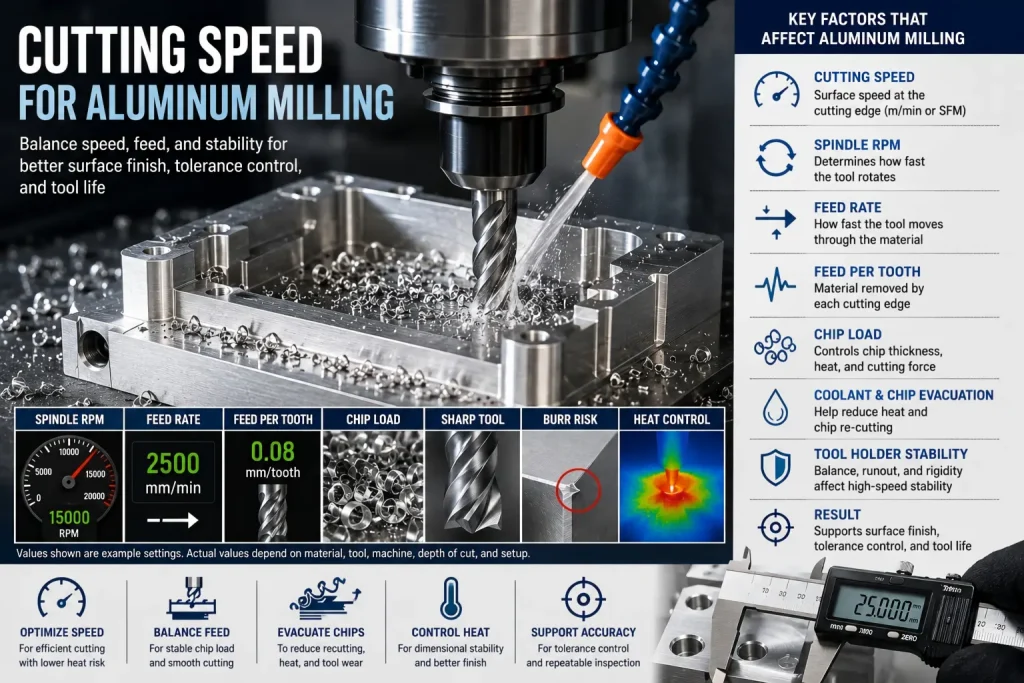
铝铣削的切削速度显示 CNC 立铣刀使用冷却液切削铝零件, 铝屑, 主轴转速, 进给率, 每齿进给量, 芯片负载, 锋利的工具, 毛刺风险, 热控制, 刀架稳定性, 设置示例, 和卡尺检查.

切削速度是人们在铣削铝材时首先询问的数字之一.

但在实际的数控工作中, cutting speed alone does not decide whether the part machines well.

A good aluminum milling result depends on the balance between:

  • 切割速度
  • 主轴转速
  • 进给率
  • 芯片负载
  • cutter diameter
  • flute count
  • tool coating or polish
  • 排屑
  • coolant or air blast
  • 零件刚性
  • 壁厚
  • 宽容
  • 表面光洁度要求

This is why one aluminum part can run clean at high speed, while another part with the same material may show burrs, 喋喋不休, 工具痕迹, or unstable dimensions.

更好的问题不仅是:

What cutting speed should I use for aluminum?

更好的问题是:

What cutting speed, 转速, 喂养, 芯片负载, 工具几何形状, and setup condition can remove chips cleanly without creating heat, 毛刺, 喋喋不休, or dimensional drift?


The Simple Answer: What Is Cutting Speed in Aluminum Milling?

Cutting speed is the surface speed between the cutting edge and the aluminum workpiece.

It is usually expressed as:

Unit意义
米/我的米每分钟
SFMsurface feet per minute

Cutting speed is not the same as spindle RPM.

RPM is how fast the tool rotates. Cutting speed depends on both RPM and cutter diameter.

A larger cutter reaches a higher surface speed at the same RPM. A smaller cutter needs higher RPM to reach the same surface speed.

For aluminum milling, cutting speed must be selected together with feed per tooth, flute count, 切削深度, 冷却剂策略, 和芯片疏散.

If the speed is too low, aluminum may rub instead of cutting cleanly. If the speed is too high for the setup, the tool may overheat, chips may weld to the edge, and surface finish can become unstable.


切割速度, 转速, Feed Rate, and Chip Load Are Not the Same

Many aluminum milling problems happen because these terms are mixed together.

学期What It Means为什么它很重要
切割速度Surface speed at the cutting edgeAffects heat, 刀具磨损, 积屑瘤, and cutting efficiency
转速Tool revolutions per minuteConverts cutting speed into machine spindle speed
饲料率Machine movement per minuteControls how fast the cutter moves through the part
每齿进给量Feed taken by each cutting edgeAffects chip thickness and cutting force
切屑负载Material thickness removed by each cutting edgeHelps prevent rubbing, 过热, and poor finish
Flute countNumber of cutting edgesAffects chip space, 进给率, and evacuation
Radial depth of cutSide engagementAffects tool load and chatter
Axial depth of cutVertical cutting depthAffects cutting force, 偏转, and heat

A high RPM with too little feed can still produce poor results. The tool may rub the aluminum instead of cutting a proper chip.

A high feed rate with poor chip evacuation can also fail. Chips may recut the surface, damage the finish, or stick to the cutting edge.

Good aluminum milling is not about choosing the highest speed. It is about keeping chip formation stable.

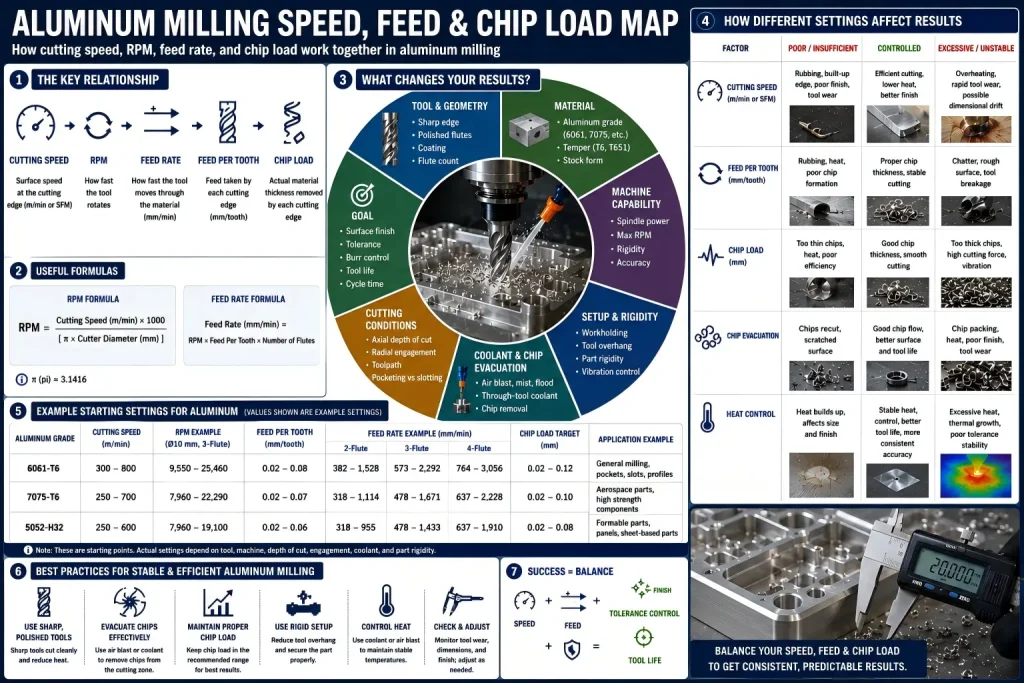
Aluminum milling speed, 喂养, and chip load map showing cutting speed, 主轴转速, 进给率, 每齿进给量, 芯片负载, cutter diameter, flute count, 排屑, tool holder balance, corner engagement, 热控制, example starting settings, and inspection result differences.

Basic Cutting Speed Logic for Aluminum Milling

Aluminum is usually easier to mill than stainless steel or titanium, but it has its own problems.

The common risks are:

  • 积屑瘤
  • chip welding
  • 毛刺
  • smeared surface finish
  • 颤痕
  • tool wear from recutting chips
  • poor hole or slot finish
  • dimensional drift on thin walls
  • poor cosmetic appearance after machining

A practical aluminum cutting speed strategy should consider:

因素Why It Changes the Speed Decision
铝牌号6061, 7075, 2024, 5052, and cast aluminum cut differently
脾气T6, T651, annealed, or soft condition affects chip behavior
刀具直径Small tools need higher RPM for the same cutting speed
刀具几何形状Polished flutes and sharp edges help reduce sticking
Flute count2-flute and 3-flute tools often clear chips better in aluminum
涂层Some coatings help, but a polished, sharp edge is often more important
冷却液 / air blastHelps remove chips and reduce built-up edge
Slotting vs side millingSlotting traps chips and needs more conservative planning
Thin wall featuresAggressive speed and feed may cause vibration or deflection
表面光洁度Finishing passes need stable chip load and low runout
厚度Tight features may need process stability more than maximum speed

For tool selection details, 看看我们的 最佳铝立铣刀 指导.


Why Aluminum Can Still Be Difficult at High Speed

Aluminum has good machinability, but it can become difficult when heat, 芯片负载, and chip evacuation are not controlled.

The main issue is that aluminum chips can stick to the cutting edge. This is called built-up edge.

Built-up edge changes the tool geometry during cutting. 一旦发生这种情况, the tool may stop cutting cleanly. The part may show rough marks, oversized burrs, poor finish, or unstable dimensions.

High speed can help when the tool, machine, 冷却液, and chip evacuation are ready for it. But speed alone does not solve the problem.

ProblemCommon Cause
Burrs on exit edgesDull tool, poor support, wrong feed, weak chip evacuation
Smeared surfaceBuilt-up edge or rubbing
Chatter marks长刀具悬伸, weak fixture, thin wall vibration
刀具装载Chips sticking in flutes
Poor slot finishChips trapped in the slot
Heat marksToo much rubbing or recutting
尺寸漂移刀具偏转, part movement, 热, or unstable finishing pass

For broader high-speed strategy, 看看我们的 高速数控铝切割导轨.


How Cutter Diameter Changes RPM

Cutting speed and RPM are linked.

For the same cutting speed:

  • a small cutter needs higher RPM
  • a large cutter needs lower RPM

This is why a 3 mm end mill and a 12 mm end mill should not use the same RPM just because both are cutting aluminum.

Cutter SituationPractical Risk
Small end millNeeds high RPM; tool is fragile; chip load must be controlled
Large end millLower RPM may reach the same surface speed; machine torque matters
长刀具悬伸Speed may need reduction to avoid chatter
Deep pocket toolChip evacuation becomes more important
Ball nose toolEffective cutting diameter changes with contact point
Corner radius toolActual contact and chip thickness need review
Face millInsert geometry, balance, and spindle power matter

At higher spindle speeds, the balance of the tool holder and tool assembly becomes more important. A small carbide end mill may need high RPM to reach the planned cutting speed, but high RPM also makes vibration, 跳动, and spindle condition more sensitive.

If the tool holder is not suitable for the target speed, small vibrations can affect surface finish, 刀具寿命, cutting edge stability, and dimensional repeatability. This does not mean every aluminum part needs a specially balanced holder. But for high-speed finishing, small tools, 装饰表面, 紧孔, or thin-wall parts, the supplier may review tool-holder balance, tool stickout, 主轴状况, and runout before choosing aggressive RPM.

If the shop only raises RPM without adjusting feed per tooth, the tool may rub. If the shop raises feed without checking chip evacuation, the part may get burrs or surface damage.


Feed Per Tooth Matters More Than Many Buyers Think

Feed per tooth controls how much material each flute removes.

If feed per tooth is too low, the cutting edge may rub the aluminum surface. This can increase heat and cause built-up edge.

If feed per tooth is too high, the tool may deflect, 喋喋不休, or break, especially in small cutters, 薄壁, deep slots, or weak fixtures.

Feed Per Tooth Condition可能的结果
Too lowRubbing, 热, poor finish, 积屑瘤
Too high刀具偏转, 喋喋不休, rough surface, tool breakage
稳定的Clean chips, better finish, controlled cutting force
Unstable during corneringChatter or gouging in internal corners
Not adjusted for tool lengthVibration and dimensional error
Not adjusted for flute countOverfeeding or underfeeding per edge

Feed per tooth also becomes more sensitive in internal corners. When an end mill enters a tight corner, the tool engagement angle can increase quickly. This can raise cutting force, chip thickness, and vibration risk in a small area of the tool path.

If the feed rate is not adjusted, the corner may show chatter marks, gouging, 毛刺, or local dimensional error. For tight internal corners, the process may need CAM toolpath review, feed reduction in corners, trochoidal or adaptive toolpaths, or a slightly larger corner radius if the design allows it.

This is a process planning issue, not only a cutting speed issue. A stable straight-line cut can still become unstable when the tool enters a tight corner.

This is why aluminum milling speed should not be reviewed without feed rate and chip load.


2-Flute vs 3-Flute Tools for Aluminum Speed Planning

Tool geometry changes the safe cutting speed and feed plan.

适用于许多铝制 CNC 零件, 2-flute and 3-flute carbide end mills are common choices.

工具类型Where It HelpsWatch Out For
2-flute end millSlotting, 排屑, small tools, softer aluminumLower feed capacity than more flutes
3-flute end millBalanced speed, 结束, 生产率, general aluminum millingNeeds good chip evacuation
Single-flute toolPlastics or very small tools in some casesNot a default for all aluminum parts
4-flute toolCan work in some finishing or rigid setupsMay pack chips in aluminum if flute space is limited
Polished flute toolHelps reduce sticking and built-up edgeStill needs correct chip load
Coated toolMay help in selected casesCoating cannot fix poor chip evacuation

The best tool depends on the part. A thin-wall housing, a deep slot, a cosmetic face, and a high-volume plate job may need different speed and feed choices.


Cutting Speed for 6061 与 7075 铝

6061 和 7075 aluminum are both common CNC materials, but they do not behave exactly the same.

材料Milling BehaviorSpeed Planning Note
6061-T6Good general machinability, common for prototypes and productionOften forgiving, but can still smear with dull tools
6061-T651More stable plate condition than some stock formsUseful when flatness and stability matter
7075-T6Stronger and harder than 6061Can cut cleanly, but tool wear and stress need review
7075-T651Often used for stronger machined componentsGood for strength-driven parts, not automatically better for every tolerance
5052Better for sheet forming than heavy CNC millingSofter behavior may create burrs or poor chip control
Cast aluminumDepends strongly on silicon content and casting qualityAbrasive particles and porosity can affect tool life

If the article question is mainly about material choice, 看看我们的 6061 与 7075 aluminum CNC machining guide.

This article is focused on cutting speed and machining behavior, not general material selection.


Slotting, Pocketing, and Finishing Need Different Speed Decisions

The same aluminum part may need different cutting conditions in different features.

手术Speed and Feed Risk
Full slottingChips are trapped; heat and recutting risk increase
Adaptive clearingMore stable engagement can allow higher productivity
Side millingRadial engagement changes tool load
精加工通过Surface finish and tool runout become more important
Deep pocket millingChip evacuation and tool overhang are critical
Thin wall millingCutting force can bend the wall
螺纹铣削Tool path and chip evacuation affect thread quality
Face millingInsert geometry, 跳动, and surface speed affect finish
Small hole interpolationTool stiffness and chip load matter
Cosmetic surface millingStable final pass is more important than maximum speed

For side milling and finishing direction choices, 看看我们的 顺铣与传统铣削 指导.


冷却液, Air Blast, and Chip Evacuation

Aluminum milling often benefits from strong chip evacuation.

The exact method depends on machine setup, 零件几何形状, 宽容, and finish requirement.

方法Where It Helps风险
Air blastClears chips from open pockets and slotsMay not control heat enough in all cases
Mist coolantHelps lubrication and chip controlRequires stable machine setup
Flood coolantHelps cooling and chip removalCan still fail if chips are trapped
Through-tool coolantUseful for deeper features when availableDepends on tool and machine capability
干切削Possible in some setupsBuilt-up edge risk must be reviewed

Chips should leave the cutting zone quickly. If chips stay in the pocket or slot, the tool may recut them. Recut chips can scratch the surface, wear the tool, and create burrs.

For more on failure signs, 看看我们的 铝加工中的刀具磨损 指导.


Cutting Speed and Surface Finish

A higher cutting speed does not always create a better surface finish.

Surface finish depends on:

  • tool sharpness
  • 刀具跳动
  • 每齿进给量
  • cutter path
  • 排屑
  • 精加工津贴
  • 夹具稳定性
  • wall rigidity
  • coolant condition
  • 刀具磨损
  • final inspection method

For cosmetic aluminum parts, the finishing pass should be planned separately from roughing.

A roughing pass can focus on material removal. A finishing pass should focus on stable engagement, clean chip flow, low vibration, and controlled tool marks.

If the part will later be anodized, 喷珠, 镀, or polished, the machining marks before finishing can still matter.

For finish planning, 看看我们的 CNC 表面处理指南.


Cutting Speed and Tolerance Stability

Cutting speed can affect tolerance indirectly.

It may change:

  • heat in the cutting zone
  • tool wear rate
  • 积屑瘤
  • 切削力
  • 刀具偏转
  • part vibration
  • final surface condition
  • burr size
  • inspection repeatability

A tight aluminum tolerance is not achieved by speed alone. It also depends on stock condition, tool path, roughing and finishing sequence, 夹具设计, 温度, 及检验方法.

这对于:

特征Why Speed Planning Matters
薄壁Heat and cutting force can move the wall
Long flat surfacesResidual stress and clamping can affect flatness
精密孔Tool deflection and finish pass stability matter
轴承座Surface finish and size must be controlled together
螺纹孔Burrs and chip control affect gauge fit
化妆品面孔Tool marks may remain visible after finishing
压接区域Coating or anodizing may change final size

Aluminum expands noticeably with heat. During high-speed milling, 摩擦, 刀具磨损, 切屑再切削, or unstable cooling can transfer heat into the workpiece. If a tight feature is measured while the part is still warm, the size may look acceptable during machining but change after the part cools.

This matters for thin walls, 精密孔, 轴承座, long flat surfaces, 和紧身功能. For tolerance-sensitive aluminum parts, the supplier may review stable cooling, roughing and finishing sequence, part relaxation time, and final inspection temperature. The goal is not only to cut fast, but to measure the final part under a condition that matches the drawing requirement.

For dimensional planning, 看看我们的 CNC加工公差指南.


Buyer RFQ Checks Before Aluminum Milling

Buyers do not need to provide the final cutting speed. That is usually the supplier’s process responsibility.

But buyers should provide the information that affects speed, 喂养, 工装, and inspection decisions.

RFQ Check提供什么
铝牌号6061, 7075, 5052, 2024, cast aluminum, or other
脾气 / 库存形式T6, T651, 盘子, 挤压, 酒吧, 铸件
关键尺寸Mark features that truly need tight control
表面光洁度Ra value, cosmetic surface, tool mark limit, or post-finish
薄壁Wall thickness and unsupported height
财力雄厚口袋深度, 拐角半径, and chip evacuation risk
Small toolsMinimum radius, small slots, micro features
毛刺控制边缘, 孔, 插槽, 线程, and cosmetic boundaries
后处理阳极氧化, 喷砂, 电镀, 抛光, or painting
检验要求CMM, 螺纹量规, surface roughness report, or visual standard
数量原型, 低音量, 或重复生产
Delivery targetHelps balance speed, risk, 和检查计划

The goal is not to tell the CNC shop exactly what cutting speed to use. The goal is to give enough information so the shop can choose a stable process instead of guessing.

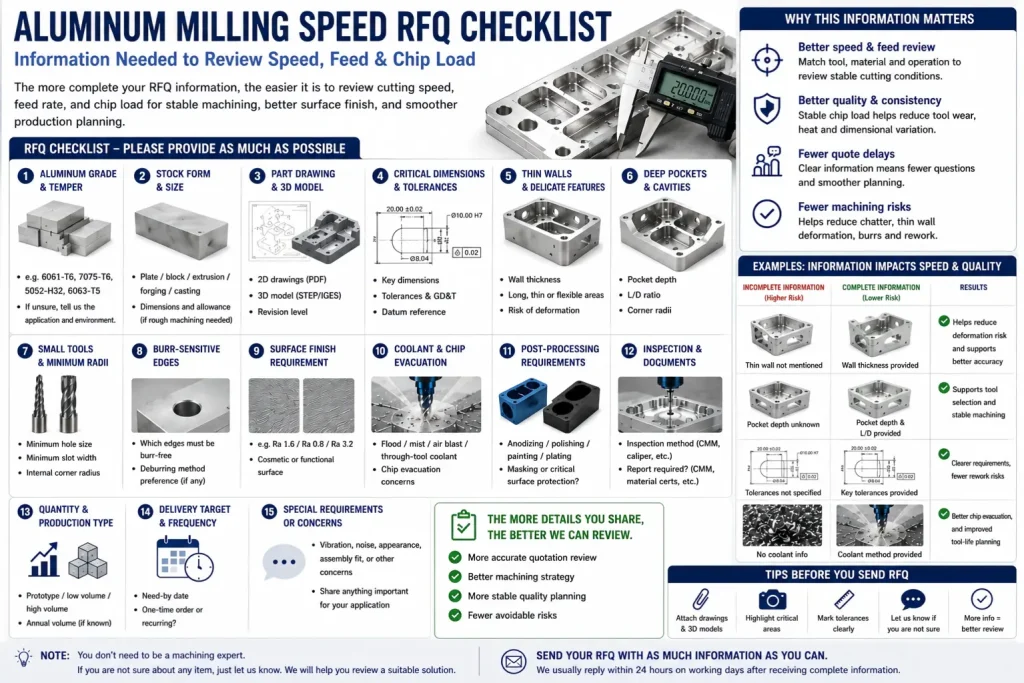
RFQ checklist for aluminum milling speed planning showing aluminum grade, 脾气, 库存形式, part drawings, 关键尺寸, 公差, 薄壁, 财力雄厚, small tools, 毛刺敏感边缘, 表面饰面, 冷却剂策略, 后处理, 检查方法, 数量, delivery target, and special requirements.

Practical Drawing Notes for Aluminum Milling

例子 1: Cosmetic Aluminum Face

Visible face requires controlled tool marks. Final finishing pass required. Supplier to review cutter path and surface finish before production.

This note helps prevent roughing marks from being left on the cosmetic surface.

例子 2: Thin-Wall Aluminum Housing

Thin wall area shown in red. Supplier to review machining sequence, tool engagement, and inspection after stress-relief or final finishing if required.

This helps reduce deformation and tolerance drift.

例子 3: Burr-Sensitive Slot

Slot edges must be free from loose burrs. Deburring method must not round functional edge beyond drawing requirement.

This links speed and chip control to final edge quality.

例子 4: Tight Bore After Milling

Bore diameter applies after final machining. Check with suitable gauge or inspection method. Burrs at entry and exit edges must be removed.

This prevents cutting speed decisions from ignoring final inspection.

例子 5: Anodized Aluminum Part

Dimensions marked as critical apply after machining and before anodizing unless otherwise stated. Supplier to review coating allowance for tight-fit areas.

This avoids confusion when machining tolerance and finishing thickness interact.


Common Mistakes When Setting Aluminum Milling Speed

错误 1: Using the Same RPM for Every Tool

A small end mill and a large end mill should not use the same RPM simply because both cut aluminum.

错误 2: Increasing RPM Without Increasing Feed Correctly

If RPM rises but feed per tooth becomes too low, the tool may rub instead of cut.

错误 3: Ignoring Chip Evacuation

Aluminum chips can stick, recut, and scratch the part. Chip evacuation is often as important as speed.

错误 4: Using Too Many Flutes in Deep Slots

More flutes can reduce chip space. In aluminum slotting, this can cause chip packing and tool loading.

错误 5: Treating Roughing and Finishing the Same

Roughing and finishing usually need different priorities. Roughing removes material. Finishing controls surface quality and final dimensions.

错误 6: Chasing Maximum Speed on Weak Parts

薄壁, long tool overhang, weak clamping, and deep pockets may need a more conservative process.


Rapid Efficient Support for Aluminum Milling Review

Rapid Efficient can review aluminum CNC parts that require stable milling speed, good surface finish, 毛刺控制, tight tolerance, 薄壁稳定性, or post-finish planning.

We do not need the buyer to provide final machine parameters. 反而, 我们审查图纸, 材料, 零件几何形状, 完成要求, 数量, 以及报价前的检验需求.

将您的 STEP 文件发送给我们, 2D图, aluminum grade, 表面光洁度要求, 关键尺寸, 数量, and post-processing needs.

For aluminum CNC projects, 看看我们的 CNC铝加工服务CNC加工设计指南.


Buyer Questions About Aluminum Milling Speed

What is the best cutting speed for aluminum milling?

There is no single best cutting speed for all aluminum parts. It depends on aluminum grade, cutter diameter, flute count, 工具几何形状, machine RPM, 芯片负载, 冷却液, fixture rigidity, and part features.

Is higher RPM always better for aluminum?

福田街道. Higher RPM can help in the right setup, but it can also cause rubbing, 热, tool loading, 喋喋不休, or poor finish if feed and chip evacuation are not controlled.

Why does aluminum stick to the cutter?

Aluminum can form built-up edge when heat, 芯片负载, tool sharpness, 涂层, or chip evacuation is not controlled. This changes the cutting edge and can damage surface finish.

Should aluminum milling use 2-flute or 3-flute tools?

两者都可以工作. 2-flute tools help with chip evacuation, especially in slots and smaller tools. 3-flute tools often give a good balance of speed, 结束, and productivity in many aluminum milling jobs.

Does cutting speed affect burrs?

是的, but indirectly. Burrs are affected by tool sharpness, 喂养, 速度, 排屑, exit direction, 支持, 刀具磨损, and material condition.

Should buyers specify cutting speed on drawings?

Usually no. Buyers should specify material, 宽容, 表面饰面, burr limits, 后处理, 及检验需求. The supplier should choose the cutting speed and feed strategy based on the actual process.

发表评论

滚动至顶部

获取报价

点击或拖拽文件到该区域即可上传. 您最多可以上传 10 文件.
文件格式:TXT PDF DOC DOCX XLS XLSX PPT PPTX JPG PNG ZIP RAR DWG DXF DXF DWT DWS DWS

3D文件格式: 步, STP, sldprt, IPT, prt, 坐着, IGES, IGS, catpart, X_T, OBJ, STL