结论第一
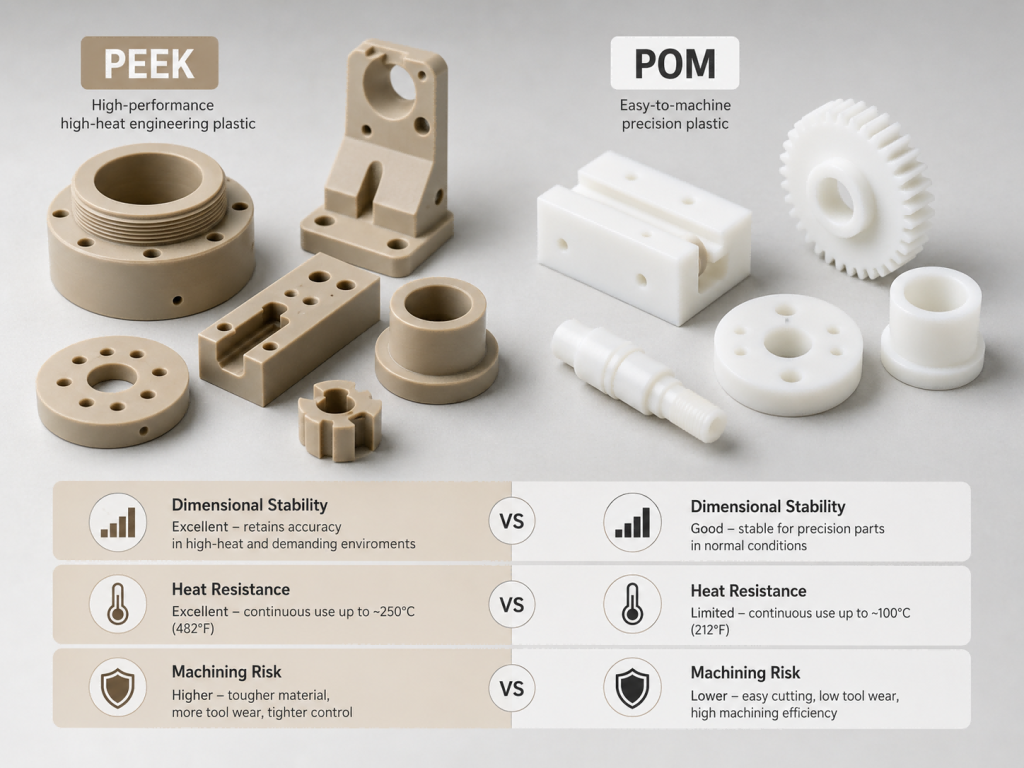
For most precision mechanical applications, 聚甲醛 / 德尔林 is usually the more cost-effective choice. 机器干净利落, holds dimensions well, offers low friction, and is suitable for gears, 衬套, sliders, 固定装置, and general precision plastic parts.
窥视, 然而, is the premium choice when the application requires high temperature resistance, 耐化学性, strength-to-weight performance, or long-term dimensional stability in demanding environments. It is commonly used in aerospace, 医疗的, 半导体, and high-performance industrial components.
快速地, we do not simply “cut” plastic parts. We manage material behavior—thermal expansion, clamping deformation, internal stress, and inspection timing—to help both POM and PEEK parts remain stable after machining.
快速解答: PEEK vs POM
| 要求 | Better Choice | 为什么 |
|---|---|---|
| General precision plastic parts | 聚甲醛 | Easier to machine, 稳定的, 并且具有成本效益 |
| 耐高温 | 窥视 | Maintains strength at much higher temperatures |
| Low friction parts | 聚甲醛 | Excellent natural lubricity and smooth sliding behavior |
| 耐化学性 | 窥视 | Better resistance in harsh environments |
| 成本敏感型项目 | 聚甲醛 | Much lower material and machining cost |
| Aerospace or medical parts | 窥视 | Better long-term stability and high-performance properties |
| Tight tolerance plastic parts | POM or PEEK | Both can work, depending on geometry and process control |
面对面的比较: PEEK vs POM
| 特征 | 聚甲醛 / 德尔林 | 窥视 | Practical Winner |
|---|---|---|---|
| 机械加工性 | 出色的 | 好的, but more demanding | 聚甲醛 |
| 尺寸稳定性 | Very good | 出色的 | 窥视 |
| 耐热性 | 缓和 | Very high | 窥视 |
| 耐化学性 | 好的 | 出色的 | 窥视 |
| Friction performance | 出色的 | 好的 | 聚甲醛 |
| 材料成本 | Low to medium | Very high | 聚甲醛 |
| 刀具磨损 | 低的 | 更高 | 聚甲醛 |
| High-performance applications | 有限的 | 出色的 | 窥视 |

1. What Is POM / 德尔林?
聚甲醛, also known as Delrin or acetal, is one of the most widely used engineering plastics for CNC machining. It is strong, rigid, low-friction, and dimensionally stable compared with many general-purpose plastics.
POM is often selected when engineers need a plastic part that behaves predictably during machining and assembly.
Common POM CNC applications include:
- 齿轮
- Bushings
- Rollers
- Precision sliders
- Low-friction mechanical parts
- Jigs and fixtures
- Positioning blocks
- Small functional components
聚甲醛 / Delrin is often the safest starting point for precision plastic machining because it cuts cleanly, holds dimensions well, and behaves more predictably than softer plastics.
工程师注意事项
POM is easier to machine than many plastics, but it is not “risk-free.” Thin walls, deep pockets, press-fit holes, and long unsupported sections can still move after machining. For tight-tolerance POM parts, 锋利的工具, balanced material removal, and proper inspection timing are important.
2. What Is PEEK?
PEEK is a high-performance engineering plastic used when standard plastics are not enough. It offers excellent heat resistance, 耐化学性, mechanical strength, and long-term dimensional stability.
PEEK is much more expensive than POM, but it is often the right choice when failure risk is high or the working environment is demanding.
Common PEEK CNC applications include:
- 航空航天零部件
- 医疗器械零件
- Surgical instrument components
- 半导体设备零件
- High-temperature fixtures
- Chemical-resistant parts
- Electrical insulation components
- Precision high-performance mechanical parts
PEEK is especially valuable in semiconductor, 航天, and medical applications because it can maintain performance under heat, chemical exposure, and strict functional requirements.
加工注意事项
PEEK is harder and more abrasive than POM. 刀具磨损, heat buildup, and internal stress must be controlled carefully. If the cutting strategy is too aggressive, the part may develop stress-related movement after machining. Stable fixturing, sharp carbide tools, controlled coolant strategy, and staged machining are important.
相关案例研究: CNC加工PEEK零件: 公差控制
3. When Should You Choose POM?
Choose POM when the part needs good dimensional stability, 低摩擦, clean machining, and reasonable cost.
POM is usually a strong choice for:
- Sliding parts
- 齿轮
- Bushings
- Rollers
- Low-friction mechanical assemblies
- Cost-sensitive precision parts
- Functional prototypes
- Small-batch production parts
POM is especially useful when the part works in a normal temperature environment and does not require extreme chemical resistance.
最佳用例
If your part operates below high-temperature conditions, does not face aggressive chemicals, and needs smooth motion or stable dimensions, POM is often the better choice than PEEK.
4. When Should You Choose PEEK?
Choose PEEK when the part must survive demanding environments where POM may not be enough.
PEEK is the better choice when the part requires:
- 耐高温
- Strong chemical resistance
- Better long-term dimensional stability
- 高强度重量比
- Medical or aerospace performance
- Semiconductor equipment compatibility
- Resistance to creep under load
PEEK is not selected because it is easy or cheap. It is selected because the application demands higher performance.
最佳用例
If your part is used in aerospace, 医疗的, 半导体, 化学加工, or high-temperature equipment, PEEK may be worth the higher material and machining cost.
5. CNC Machining Risk Control: PEEK vs POM
| 加工系数 | Risk in POM | Risk in PEEK | 工程控制 |
|---|---|---|---|
| 热量积聚 | Moderate dimensional movement | Internal stress or surface damage | 锋利的工具, light finishing cuts, 受控冷却剂 |
| 锁模力 | Local deformation on thin features | Stress concentration on rigid sections | Soft jaws, custom fixtures, low-pressure clamping |
| 刀具磨损 | Usually low | Higher due to abrasive behavior | Use sharp carbide or PCD tools where needed |
| 内应力 | Possible springback | Possible post-machining movement | Balanced roughing and finishing strategy |
| 检查时机 | Size may shift after heat release | Final dimensions may stabilize after rest time | Allow parts to stabilize before final inspection |
6. 公差控制: Can PEEK and POM Achieve Tight Tolerances?
Both POM and PEEK can achieve tight tolerances when the part geometry, 加工策略, 夹具, and inspection environment are properly controlled.
然而, tight tolerance on plastic parts should never be judged by material alone. The real factors include:
- 壁厚
- Part length
- Hole depth
- Flatness requirement
- Clamping method
- Cutting heat
- Tool sharpness
- 检查时机
- Workshop temperature
Many engineering plastics have a much higher thermal expansion coefficient than metals. For tight-tolerance plastic parts, even small temperature changes can affect final dimensions.
For tight assemblies, dimensional stability should be reviewed together with tolerance stack-up. 请参阅我们的指南 CNC machining tolerance stack-up for a deeper explanation of how small errors can become assembly problems.
7. 隐性成本: PEEK vs POM
PEEK is much more expensive than POM, but raw material price is only one part of the total cost.
| Cost Driver | 聚甲醛 | 窥视 |
|---|---|---|
| 原材料成本 | 降低 | Much higher |
| Machining time | 快点 | Slower |
| 刀具磨损 | 降低 | 更高 |
| Inspection requirement | 缓和 | Often stricter |
| Application risk | Lower for general parts | Higher-value critical applications |
| Best value point | Cost-effective precision parts | High-performance parts where failure is expensive |
If the part does not need high temperature resistance, 耐化学性, or extreme performance, POM may provide better value.
If the part works in a demanding environment where failure would be costly, PEEK may be the safer long-term choice.
Because material choice, 宽容, machining time, and inspection all affect the final quote, it is useful to review the full cost structure before production. 请参阅我们的指南 中国CNC加工成本 for more details.
8. Deformation and Fixturing Considerations
Plastic parts can deform during machining even when the material seems rigid. POM can spring back after cutting, while PEEK can develop internal stress if heat and tool pressure are not controlled.
Common deformation risks include:
- Over-clamping
- Thin-wall movement
- Uneven material removal
- 热量积聚
- Poor support under the part
- Measuring too soon after machining
For POM, excessive clamping pressure can distort holes, 平整度, or roundness. For PEEK, aggressive cutting can create stress that appears later during inspection or assembly.
For more strategies on controlling clamping distortion and dimensional movement, 请参阅我们的指南 CNC加工时如何减少变形.
工程师注意事项
在我们店里, POM and PEEK are not treated as simple “plastic parts.” They require different machining logic.
POM rewards clean cutting, sharp tools, and stable fixturing. It is often the best balance of cost, 机械加工性, and dimensional stability.
PEEK requires more process discipline. 刀具磨损, heat control, 压力释放, and inspection timing must be planned before production. For high-value aerospace, 医疗的, or semiconductor parts, this process control is often more important than machining speed.
The right material is not always the strongest one. It is the one that matches the real working condition, 公差要求, and cost target.
PEEK vs POM: Final Selection Guide
Choose 聚甲醛 如果:
- The part is used in normal temperature conditions.
- Low friction is important.
- Cost control matters.
- The part needs good dimensional stability.
- The application is mechanical but not extreme.
Choose 窥视 如果:
- The part is exposed to high temperature.
- Chemical resistance is critical.
- The part is used in aerospace, 医疗的, or semiconductor equipment.
- Long-term dimensional stability is required.
- The cost of failure is higher than the cost of the material.
For a broader comparison of plastic materials, 看看我们的 Best Plastics for CNC Machining Guide.
常问问题: CNC 加工中的 PEEK 与 POM
Is PEEK better than POM?
PEEK is better for high-temperature, chemical-resistant, 航天, 医疗的, and semiconductor applications. POM is usually better for general precision parts because it is easier to machine, 成本更低, and excellent for low-friction mechanical components.
Is POM cheaper than PEEK?
是的. POM is much cheaper than PEEK in most projects. It also machines faster and usually causes less tool wear, which further reduces total machining cost.
Which is easier to CNC machine, PEEK or POM?
POM is easier to CNC machine. It cuts cleanly, produces good surface quality, and is easier to control than PEEK. PEEK requires more careful tooling, heat control, and inspection planning.
Can PEEK and POM achieve tight tolerances?
是的. Both PEEK and POM can achieve tight tolerances when the part design, 夹具, cutting strategy, 温度控制, and inspection timing are properly managed.
Which material is better for gears, PEEK or POM?
POM is usually better for gears and low-friction sliding parts because it offers excellent lubricity, clean machining, and good dimensional stability at a lower cost.
Which material is better for semiconductor equipment?
PEEK is usually better for semiconductor equipment because it offers high heat resistance, 耐化学性, and better long-term performance in demanding environments.
Should I choose PEEK if I only need a precision plastic part?
Not always. If the part does not require high temperature resistance, 耐化学性, or extreme mechanical performance, POM is often a better and more cost-effective choice.
结论
PEEK and POM are both excellent CNC machining plastics, but they serve different purposes.
聚甲醛 / Delrin is the better choice for most cost-effective precision mechanical parts. 机器干净利落, offers low friction, and provides reliable dimensional stability for many gears, 衬套, sliders, and functional components.
PEEK is the premium option for demanding applications. It should be selected when heat resistance, 耐化学性, long-term stability, or aerospace, 医疗的, and semiconductor performance are required.
快速地, we help customers choose the right plastic based on function, 宽容, 成本, and working environment. Send us your drawing or 3D model, and our engineers can review material selection, machining risk, and inspection requirements before production.