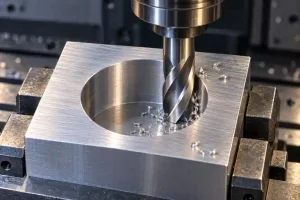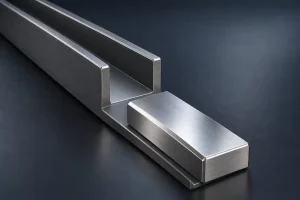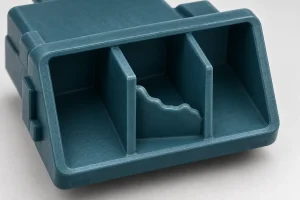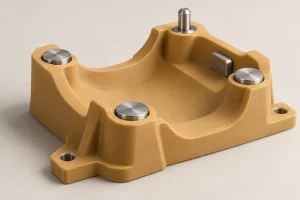
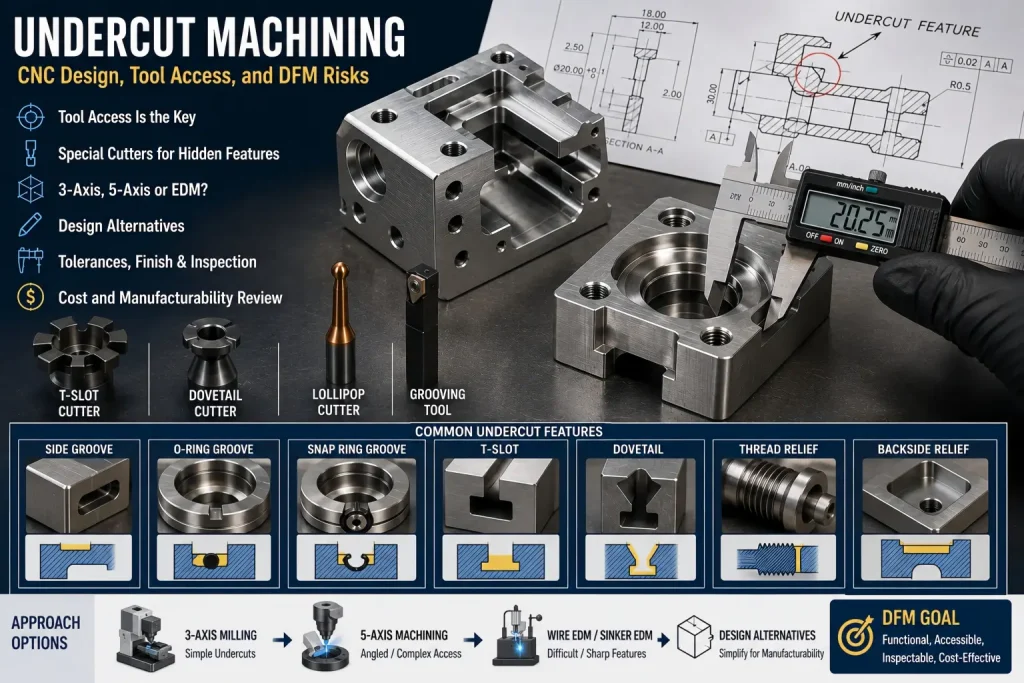
底切加工不仅仅是一个刀具问题.
这是一个工具访问问题.
A CNC part may look simple from the outside, but if a feature is hidden behind a wall, below an overhang, inside a groove, or on the reverse side of a shoulder, a standard end mill may not be able to reach it directly.
That is when undercut machining becomes important.
An undercut can affect:
- 加工路线
- cutter selection
- setup direction
- 夹具设计
- 3-axis vs 5-axis decision
- 电火花加工审查
- 毛刺控制
- 表面饰面
- inspection access
- machining cost
- 交货时间
- part redesign options
The key question is not only:
Can this undercut be machined?
A better question is:
Can this undercut be machined reliably, inspected clearly, and justified by the part function?
What Is an Undercut in CNC Machining?
在数控加工中, an undercut is a feature that cannot be reached by a standard straight cutting tool from the main machining direction.
This usually happens when material must be removed behind an edge, below a lip, inside a recessed groove, around a shoulder, or on a side surface that is blocked by nearby geometry.
Common undercut examples include:
- side grooves
- internal grooves
- O 形圈凹槽
- snap-ring grooves
- relief grooves
- T-slots
- dovetail features
- hidden pockets
- recessed side features
- reverse-facing shoulders
- tool clearance reliefs
- small backside cuts
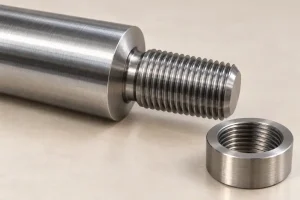
- undercut thread reliefs
An undercut is not automatically bad.
Some undercuts are necessary for sealing, 集会, tool clearance, locking, or mechanical function.
The risk begins when the undercut is added without thinking about cutter access, inspection access, 和成本.
Not Every Recess Is an Undercut
Many buyers use “undercut” loosely.
That can create confusion during quotation.
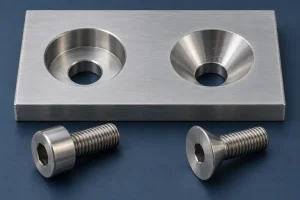
A recessed pocket is not always an undercut. A counterbore is not always an undercut. A slot is not always an undercut.
The difference is tool access.
| 特征类型 | Is It Usually an Undercut? | 原因 |
|---|---|---|
| Open pocket from top | 福田街道 | A standard end mill can reach it from above |
| Straight slot on top face | 福田街道 | Tool access is open |
| Counterbore | Usually no | Standard drilling or boring tools can reach it |
| Side groove behind a wall | 是的 | Tool must cut sideways behind material |
| Internal O-ring groove | 经常是的 | Tool access may require a grooving tool or turning setup |
| Dovetail slot | 是的 | Shape cannot be cut with a standard end mill |
| T-slot | 是的 | Requires T-slot cutter or special tool path |
| Thread relief groove | 有时 | Depends on part geometry and tool access |
| Backside pocket | 有时 | May need second setup or 5-axis access |
| Hidden corner relief | 有时 | May need lollipop cutter, 电火花加工, or redesign |
Before deciding the process, the supplier should identify whether the feature is truly blocked from standard tool access.
For broader DFM review, 看看我们的 CNC加工设计指南.
Why Undercuts Increase CNC Machining Cost
Undercuts often increase cost because they interrupt the normal machining route.
A standard 3-axis milling process usually works best when tools can approach the part from simple directions.
Undercuts may require:
- special cutters
- longer tools
- smaller tools
- side milling tools
- T-slot cutters
- dovetail cutters
- lollipop cutters
- 定制固定装置
- extra setups
- 5-axis positioning
- 电火花加工
- manual deburring
- special inspection tools
The cost increase usually comes from the whole process, not only from the tool.
| 成本动因 | 为什么它很重要 |
|---|---|
| Special cutter | May not be standard stock tooling |
| Tool rigidity | Undercut tools can be weaker or longer |
| Slow cutting | Small or special tools may need conservative cutting |
| Extra setup | Part may need to be rotated or refixtured |
| Fixture access | Workholding must leave room for the tool |
| 检查通道 | Hidden features can be hard to measure |
| 毛刺去除 | Backside burrs may be difficult to reach |
| 报废风险 | Tool breakage or poor access can damage expensive parts |
| 交货时间 | Tool ordering or process review may add time |
A simple undercut may be easy.
A deep, narrow, hidden, tight-tolerance undercut can become a major manufacturing risk.
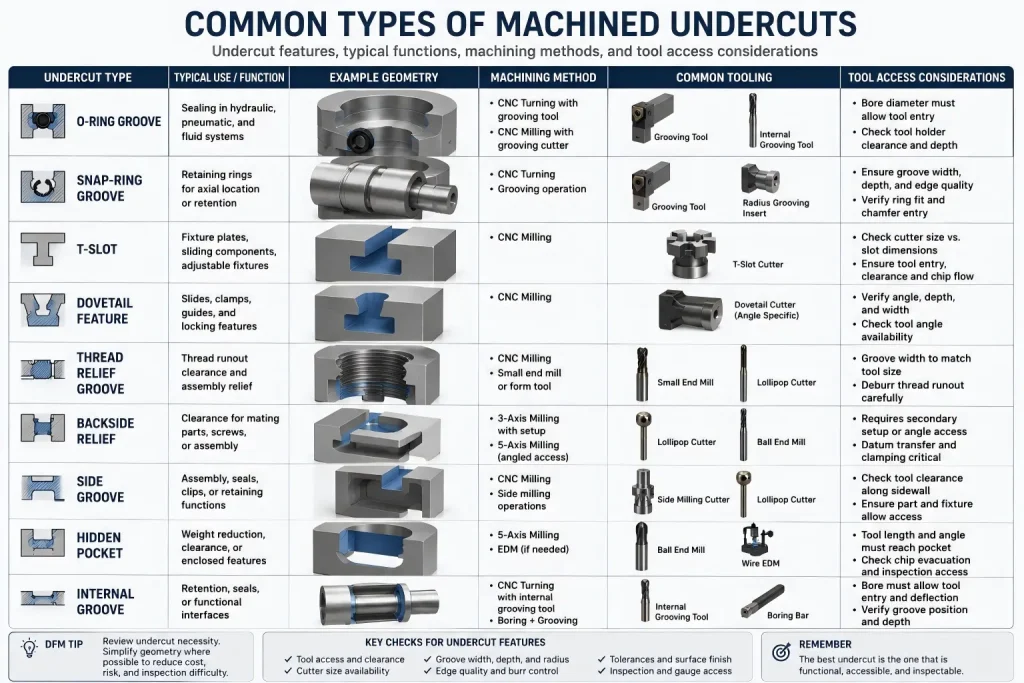
Common Types of Machined Undercuts
Different undercuts need different machining strategies.
A buyer should not assume one tool can handle all undercut geometry.
| Undercut Type | 典型用途 | Machining Review |
|---|---|---|
| O型圈槽 | Sealing parts, fluid systems | Groove width, 深度, radius, 表面饰面, 检查 |
| Snap-ring groove | Retaining rings, 轴, 钻孔 | Groove position, edge quality, ring fit |
| T-slot | 夹具板, sliding blocks | T-slot cutter size, 排屑, 拐角半径 |
| Dovetail | Slides, 夹子, locking features | Dovetail angle, 工具可用性, 表面饰面 |
| Thread relief | Thread runout, assembly clearance | Tool width, groove depth, 毛刺控制 |
| Backside relief | Clearance for mating part | Setup direction, datum transfer, 检查 |
| Side groove | 集会, clip, 海豹, or retaining function | Tool access and cutter diameter |
| Hidden pocket | Weight reduction or clearance | 5-axis access, 电火花加工, or design split |
| Internal groove | Bore sealing or retention | 车削, grooving, bore access |
| Undercut radius | Stress relief or assembly clearance | Cutter radius and geometry match |
A useful drawing should identify which undercut is functional.
If the undercut is only for clearance, it may be possible to simplify it.
If the undercut controls sealing, retention, or motion, it needs more careful machining and inspection planning.

Tool Access Is the First Question
The first undercut review is simple:
Can a cutter physically reach the feature?
The answer depends on:
- 特征位置
- nearby walls
- groove depth
- groove width
- opening size
- cutter diameter
- tool shank clearance
- tool holder clearance
- required corner radius
- part orientation
- fixture clearance
- machine axis access
A drawing may show a perfect undercut shape, but the real cutter needs room to enter, 切, retract, and avoid collision.
Tool access should be checked before confirming cost, 宽容, or lead time.
For complex multi-face access review, 看看我们的 five-axis CNC machining service 页.
Standard End Mills Cannot Cut Many Undercuts
A standard end mill cuts mainly from its side and bottom.
It can machine pockets, 简介, 插槽, 孔, and many open features.
But it cannot cut material that is hidden behind a lip or underneath an overhang if the tool cannot approach that area.
This is why undercut features may need special tools.
Common undercut tools include:
| 工具类型 | 典型用途 | 主要限制 |
|---|---|---|
| T-slot cutter | T-slots, side grooves, retaining features | Needs enough entry space and chip clearance |
| Dovetail cutter | Angled dovetail slots and sliding features | Fixed angle limits design flexibility |
| Lollipop cutter | Backside chamfers, hidden radii, small undercuts | Tool rigidity and access are limited |
| Woodruff cutter | Keyseat-style grooves and side reliefs | Size and depth must match tool |
| Internal grooving tool | Bore grooves, O 形圈凹槽, retaining grooves | Bore diameter must allow tool access |
| Custom form cutter | Special profiles | Higher cost and lead time |
| EDM electrode / wire EDM | Hard-to-reach profiles in conductive materials | Not suitable for every material or geometry |
Beyond tool shape, cutter rigidity is also important in undercut milling. Tools such as T-slot cutters, Woodruff cutters, and lollipop undercutting end mills often need neck clearance behind the cutting head so the tool can reach hidden or reverse-facing surfaces.
This reduced neck area can make the tool less rigid than a standard solid end mill of similar head size. If feed rate, radial depth of cut, 刀具悬伸, or tool engagement is too aggressive, the undercut cutter may be more sensitive to deflection, 振动, 喋喋不休, and surface marks.
For deep, narrow, or tight-tolerance undercuts, the supplier may review light multi-pass cutting, conservative finishing parameters, shorter tool reach where possible, and suitable cutter size before confirming the machining route.
The tool should be selected for the feature, not the other way around.
If a custom cutter is needed for one small detail, the buyer should ask whether that detail is truly necessary.
Undercuts in 3-Axis CNC Milling
Some undercuts can be machined on a 3-axis mill.
This usually works when:
- the undercut is shallow
- the tool has enough side access
- the part can be held securely
- the feature does not require complex angle control
- the cutter can enter and exit without collision
- inspection is possible after machining
例子包括:
- simple side grooves
- T-slots with enough entry space
- dovetail slots with standard cutter angles
- relief grooves on accessible sides
- backside chamfers reachable with lollipop cutters
- open undercut features near an edge
然而, 3-axis undercut machining can become risky when the feature is deep, narrow, hidden, or close to thin walls.
A long cutter or small cutter may create:
- 喋喋不休
- 刀具偏转
- 表面光洁度差
- oversized groove width
- 工具痕迹
- broken cutters
- 毛刺
- inconsistent depth
- inspection variation
For standard milling support, 看看我们的 数控铣削服务 页.
When 5-Axis Machining Helps an Undercut
5-axis machining may help when the feature requires tool access from an angle.
It can reduce the need for multiple setups and may allow a shorter, more rigid tool to reach difficult areas.
5-axis review may be useful for:
- angled grooves
- backside features
- complex housings
- multi-face undercuts
- angled clearance reliefs
- impeller-style geometry
- organic curved parts
- aerospace-style lightweight structures
- parts where datum relationships matter across faces
But 5-axis is not automatically the answer.
A simple undercut may be cheaper with a T-slot cutter or a second setup.
A deep internal groove may be better handled by turning or EDM.
A non-functional undercut may be better removed by design change.
The process should be selected by geometry, 宽容, 数量, and function.
用于工艺比较, 看看我们的 5-axis vs 3-axis CNC machining guide.
When EDM Is Better Than Milling
Some undercuts are difficult or inefficient to mill.
EDM may be reviewed when the material is conductive and the feature is hard to reach with a rotating cutter.
EDM may be useful for:
- sharp internal profiles
- 窄槽
- hardened steel features
- small internal reliefs
- difficult corners
- tool steel components
- 模具插入
- deep profiles with limited tool access
然而, EDM is not always better.
It may add cost, 设置时间, surface texture considerations, and electrode or wire access limits.
A buyer should not request EDM only because a feature looks complex.
The supplier should review whether milling, 转动, 电火花加工, 5-轴加工, or design revision gives the most practical route.
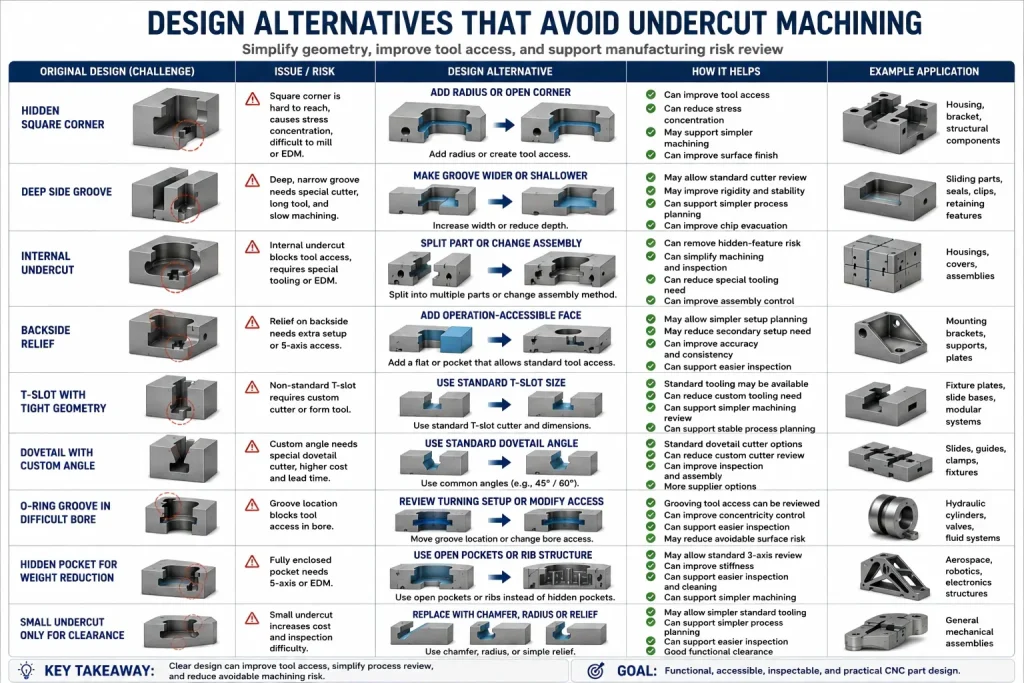
Design Alternatives That Avoid Undercut Machining
Some undercuts are functional.
Others are accidental.
If an undercut is not required for assembly, 密封, retention, or clearance, it may be better to remove it from the design.
Common design alternatives include:
| Original Design Issue | Possible Alternative |
|---|---|
| Hidden square corner | Add radius or open the corner |
| Deep side groove | Make the groove wider or shallower |
| Internal undercut | Split the part into two components |
| Backside relief | Add a second setup-accessible face |
| T-slot with tight geometry | Use a standard T-slot cutter size |
| Dovetail with custom angle | Use a standard dovetail angle |
| O-ring groove in difficult bore | Review turning setup or modify bore access |
| Hidden pocket for weight reduction | Use open pockets or ribs |
| Small undercut only for clearance | Replace with chamfer, radius, or local relief |
| Tight undercut tolerance | Define only functional surfaces tightly |
A small design change can sometimes reduce cost more than negotiating the machining price.
The best undercut is the one that is functional, accessible, and inspectable.

Undercut Tolerance Needs Extra Review
Undercut tolerance should not be copied from normal open features.
A hidden groove or backside feature may be harder to control and inspect than an open pocket.
Tolerance depends on:
- 工具类型
- tool rigidity
- 刀具磨损
- setup direction
- cutter access
- groove depth
- groove width
- 材料
- 毛刺控制
- 检查方法
- 数据结构
- 表面光洁度要求
When spherical or lollipop cutters are used for curved undercuts, the effective cutting condition changes across the tool radius. Near the center of a spherical cutting edge, surface speed can become very low, so the tool may push or rub the material more than it cuts cleanly.
This can affect small radii, curved undercut profiles, 密封面, and tight profile tolerances. For complex 3D undercuts, the supplier may review tool tilt angle, stepover, cutter contact point, 精加工津贴, and inspection method before confirming the tolerance plan.
The goal is not to avoid spherical undercut tools. The goal is to avoid assuming that every point on the cutter behaves the same during finishing.
例如:
- a wide side groove may be easy to hold
- a narrow internal groove may need special tooling
- a deep T-slot may create chatter or chip issues
- a backside relief may need datum transfer
- a hidden sealing groove may need special inspection planning
The drawing should define which undercut dimensions are functional.
Do not apply tight tolerance to every surface inside the undercut unless it is truly needed.
For broader tolerance planning, 看看我们的 CNC加工公差指南.
Surface Finish Inside Undercuts
Surface finish inside an undercut can be difficult to control.
This is especially true when the cutter is small, long, or cutting with limited chip evacuation.
Surface finish problems may include:
- 工具痕迹
- chatter lines
- 毛刺
- poor corner blending
- inconsistent groove bottom
- rough sidewalls
- witness marks from multiple setups
- polishing access problems
Toolpath strategy can directly affect surface finish inside enclosed undercuts. If a cutter enters or exits directly against a functional wall, it may leave subtle witness marks, dwell marks, or local texture changes on the surface.
For critical O-ring grooves, 密封面, or sliding undercuts, the supplier may review tangential entry and exit, lead-in and lead-out location, finishing pass direction, and whether the tool should avoid stopping on the functional surface.
Chip evacuation should also be reviewed in blind or deep internal grooves. Trapped chips can be recut during finishing and may scratch the groove wall or affect surface consistency. Air blast, coolant direction, chip clearance, and a separate finishing pass may help reduce this risk depending on material and geometry.
If the undercut is used for sealing, 滑动, 或组装, surface finish should be defined clearly.
A note that only says “smooth surface” may not be enough.
Better notes may say:
- which undercut surface is functional
- whether tool marks are acceptable
- whether burrs must be removed
- whether Ra value applies inside the groove
- whether the surface must be checked after finishing
- whether the feature mates with an O-ring, retaining ring, or sliding part
For finish planning, 看看我们的 CNC 表面处理指南.
Burrs Are Often Hidden in Undercuts
Undercuts can create burrs in places that are hard to see and hard to remove.
Burrs may appear at:
- groove edges
- tool exit points
- internal corners
- backside reliefs
- thread relief grooves
- T-slot edges
- O-ring groove edges
- cross-hole intersections
- retaining-ring grooves
Hidden burrs can affect:
- 集会
- 密封
- sliding motion
- ring fit
- 螺纹配合
- inspection results
- customer acceptance
Undercut deburring should be planned before production.
If the feature is hard to reach for cutting, it may also be hard to reach for deburring.
For more edge-quality guidance, 看看我们的 What Is Deburring? CNC Edge Quality, Burr Removal, 及检验 指导.
Inspection Access Can Be Harder Than Machining Access
A feature is not finished only because it was machined.
It must also be inspectable.
Undercut inspection can be difficult because the feature may be hidden, narrow, 深的, or blocked by nearby geometry.
Inspection may require:
- 针规
- 孔径计
- depth gauges
- optical inspection
- CMM probes
- custom gauges
- sectioned first article samples
- functional fit checks
- O-ring fit checks
- retaining ring checks
Common inspection problems include:
| Undercut Feature | Inspection Challenge |
|---|---|
| Internal groove | Standard calipers cannot measure it directly |
| T-slot | Width and depth may need special gauge access |
| Dovetail | Angle and width can be hard to verify |
| Backside relief | Datum transfer may affect measurement |
| O型圈槽 | Width, 深度, radius, and surface finish all matter |
| Snap-ring groove | Ring fit may be more important than simple dimension |
| Hidden pocket | Visual inspection and burr check can be difficult |
| Small relief groove | Tool marks and burrs may be hard to detect |
For critical undercuts, the inspection method should be reviewed before machining.
For CMM-related planning, 看看我们的 CMM inspection for CNC parts 指导.
Material Changes the Undercut Strategy
The same undercut geometry may behave differently in different materials.
| 材料 | Undercut Machining Concern |
|---|---|
| 铝 | 毛刺, thin-wall deflection, 阳极氧化厚度, cosmetic marks |
| 不锈钢 | 刀具磨损, 加工硬化, 毛刺, galling, slow cutting |
| 黄铜 | Usually clean cutting, but alloy and thread quality still matter |
| 铜 | Stickiness, 毛刺, soft surface damage, 工具痕迹 |
| 钛 | 热, 刀具磨损, slow cutting, expensive scrap risk |
| 钢 | 热处理, rust prevention, 刀具磨损, 失真 |
| 聚甲醛 / 德尔林 | 毛刺, snap-fit root stress, 线程, inspection force |
| ptfe | 夹紧变形, 蠕变, soft features, measurement pressure |
| 窥视 | 热, 刀具磨损, 毛刺, 尺寸稳定性, 材料成本 |
An undercut that is simple in aluminum may be expensive in titanium.
An internal groove that works well in brass may need extra burr control in copper.
A plastic undercut may need different edge and inspection planning from a metal undercut.
For material selection, 看看我们的 CNC milling metals guide.
Drawing Notes That Help Undercut Machining
A useful drawing note can prevent quoting and production confusion.
例子 1: O-Ring Groove
O-ring groove is functional. Supplier to review groove width, 深度, radius, 表面饰面, 毛刺控制, 以及生产前的检验方法.
This is better than only giving groove dimensions.
例子 2: T-Slot
T-slot to fit standard cutter size if possible. Supplier to review cutter access, 排屑, and burr removal before quotation.
This can reduce custom tooling risk.
例子 3: Dovetail Feature
Dovetail angle is functional. Supplier to review available cutter angle, tool clearance, 及检验方法.
This prevents angle mismatch.
例子 4: Hidden Backside Relief
Backside relief is clearance-only. Supplier may suggest design simplification if feature increases setup or inspection risk.
This allows practical DFM feedback.
例子 5: Thread Relief
Thread relief groove is required for assembly. Supplier to review groove width, 工具访问, and burr control at thread runout.
This helps avoid assembly problems.
When Buyers Should Send the Part for DFM Review
Send the design for undercut review when the part has:
- side grooves
- internal grooves
- deep recesses
- hidden pockets
- O 形圈凹槽
- T-slots
- dovetails
- backside reliefs
- thread relief grooves
- snap-ring grooves
- tight undercut tolerance
- sealing or sliding undercut surfaces
- hard-to-reach burr-sensitive edges
- complex multi-face geometry
- expensive material
- short lead time
The review should happen before the drawing is locked.
A small change to groove width, radius, 访问方向, or tolerance can sometimes make the part easier to machine and inspect.
What to Send for an Undercut Machining Quote
When a part includes undercuts, the supplier needs more than a 3D model.
Send:
| 物品 | 为什么它很重要 |
|---|---|
| 2D图 | Shows tolerances, 日期, 关键尺寸, and notes |
| 3D型 | Helps identify tool access and collision risk |
| 材质等级 | Affects cutter choice, 毛刺, 刀具磨损, 并完成 |
| 数量 | Affects custom cutter and fixture decisions |
| 功能表面 | Shows which undercut surfaces matter |
| 凹槽尺寸 | Width, 深度, radius, angle, 和位置 |
| Mating parts | O-ring, snap ring, screw, shaft, pin, or sliding part |
| 表面光洁度 | Important for sealing, 滑动, or retention features |
| Burr requirement | Hidden burrs may affect assembly |
| 检验要求 | Some undercuts need special gauges or CMM planning |
| 后处理 | 涂层, 阳极氧化, 钝化, 热处理, 或抛光 |
| Delivery target | Helps review tooling and setup time |
A good undercut RFQ does not only ask for a price.
It explains why the undercut exists and which features must be controlled.
Rapid Efficient Support for Undercut CNC Parts
Rapid Efficient can review custom CNC parts with undercuts according to geometry, 工具访问, 材料, 宽容, 结束, 及检验需求.
We can review:
- side grooves
- O 形圈凹槽
- snap-ring grooves
- relief grooves
- T-slots
- dovetail features
- internal grooves
- backside reliefs
- hidden pockets
- undercut threads
- 毛刺敏感边缘
- sealing or sliding features
- 3-axis vs 5-axis access
- EDM or design revision options
- inspection method and reporting needs
If your part includes hidden grooves, backside cuts, T-slots, dovetails, O 形圈凹槽, or hard-to-reach reliefs, send the 2D drawing, 3D型, 材料, 数量, 关键特征, and application notes before quotation. We can review the design and suggest a suitable machining route.
Buyer Questions About Undercut Machining
What is an undercut in CNC machining?
An undercut is a feature that cannot be reached directly by a standard straight cutting tool from the main machining direction. It often requires a special cutter, extra setup, 5-axis access, 电火花加工, or design change.
Are undercuts bad for CNC machined parts?
Undercuts are not always bad. Some are required for sealing, retaining rings, tool relief, or assembly clearance. The issue is whether the undercut can be machined, 去毛刺, 检查, and justified by the part function.
Can a 3-axis CNC machine cut undercuts?
Some undercuts can be machined on a 3-axis CNC mill using T-slot cutters, dovetail cutters, lollipop cutters, or side-access tooling. Deeper or more hidden features may require another setup, 5-轴加工, 电火花加工, or design revision.
Why do undercuts increase machining cost?
Undercuts can require special tools, 较慢的切割, extra setups, custom fixturing, harder deburring, and special inspection. The cost comes from the whole process, not only the cutter.
How can I reduce undercut machining cost?
You can reduce cost by widening grooves, using standard cutter sizes, adding access clearance, relaxing non-critical tolerances, splitting the part, replacing hidden pockets with open pockets, or confirming which undercut surfaces are truly functional.
What files should I send for undercut machining?
Send a 2D drawing, 3D型, 材料等级, 数量, 关键尺寸, groove details, mating parts, 表面光洁度注释, burr requirements, 检查需要, and any application condition that explains why the undercut is needed.