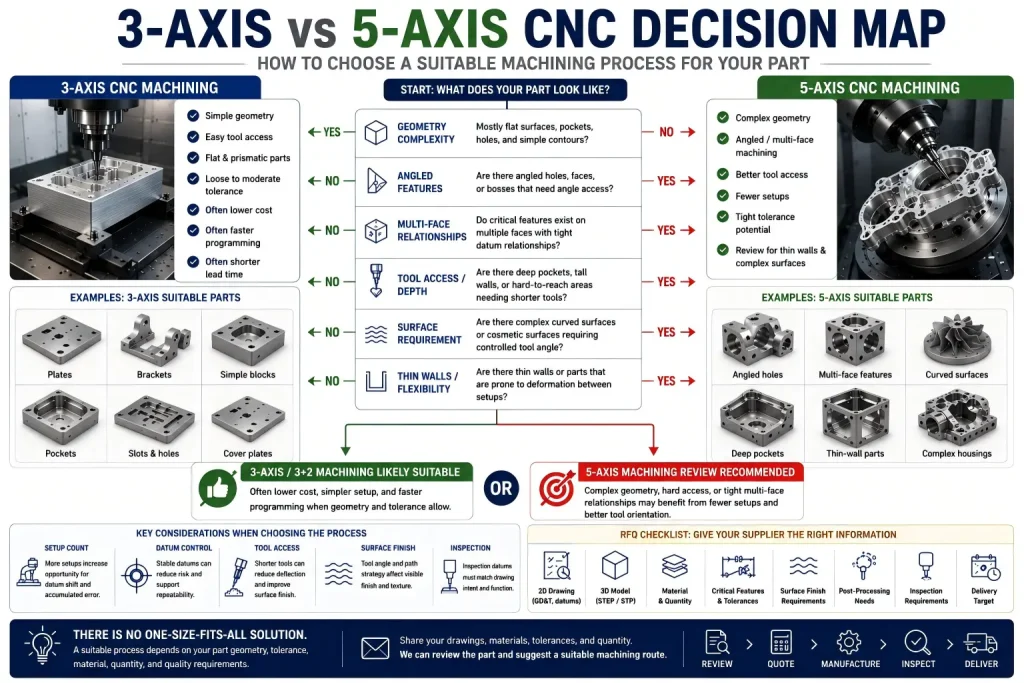
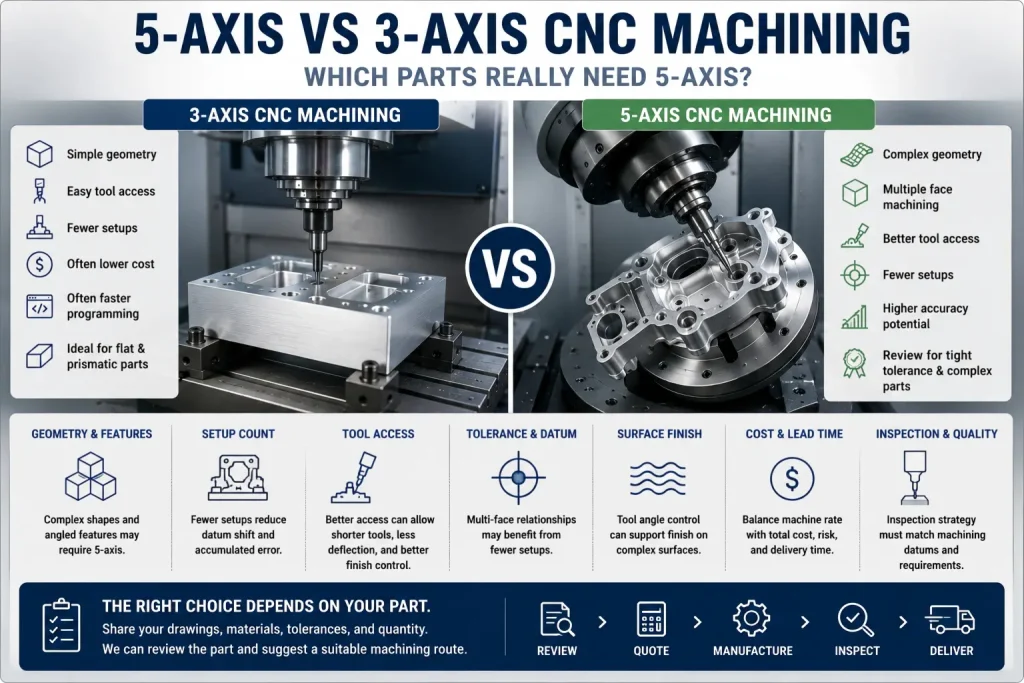
5-轴数控加工不会自动更好地适合每个零件.
3-axis CNC machining is still the right choice for many plates, 括号, blocks, 口袋, 插槽, 孔, and simple precision surfaces.
The real question is not:
Is 5-axis CNC more advanced than 3-axis CNC?
更好的问题是:
Does this part geometry, 数据结构, 工具访问, 公差要求, 表面饰面, and production quantity actually need 5-axis machining?
A part may need 5-axis CNC when it has:
- 斜孔
- multiple critical faces
- complex curved surfaces
- 难以使用工具
- deep features that require shorter tools
- setup-sensitive datum relationships
- tight position tolerance across different faces
- features that are hard to machine accurately after repeated repositioning
- cosmetic surfaces where tool angle and surface continuity matter
A part may not need 5-axis CNC when it is mostly flat, prismatic, easy to access from one side, and can be machined accurately in one or two simple 3-axis setups.
The best machining method is the one that controls the part risk without adding unnecessary cost.
The Simple Difference: 3-Axis vs 5-Axis CNC
3-axis CNC machining moves the cutting tool along three linear axes:
- X axis
- Y axis
- Z轴
This is suitable for many flat, prismatic, and block-like parts.
5-axis CNC machining adds two rotary movements. Depending on the machine design, the tool or the workpiece can tilt and rotate, allowing the cutter to reach the part from more directions.
| Machining Type | Basic Motion | Practical Meaning |
|---|---|---|
| 3-轴数控加工 | X, 是, Z linear movement | Good for flat faces, 口袋, 孔, 插槽, simple contours |
| 3+2 加工 | Tool or part is indexed to an angle, then cut with 3-axis motion | Good for angled features and multiple face machining without full simultaneous motion |
| 5-轴联动加工 | Linear and rotary axes move together during cutting | Good for complex surfaces, curved geometry, 难以使用工具, and continuous tool angle control |
对于买家, the most important point is this:
5-axis does not only mean more axes. It means fewer repositioning steps, better tool access, and more control over tool angle when the part truly needs it.
For service capability, 看看我们的 five-axis CNC machining service 页.
When 3-Axis CNC Is Usually Enough
3-axis CNC machining is often enough when the part has simple access and stable geometry.
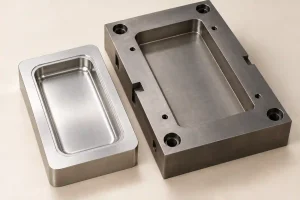
Common 3-axis suitable parts include:
| 零件类型 | Why 3-Axis May Be Enough |
|---|---|
| Flat plates | Most features are accessible from top or simple side setups |
| Simple brackets | 洞, 插槽, and pockets are usually easy to machine |
| Rectangular housings | If features are mostly on one or two faces |
| Simple pockets | Cutter access is direct |
| Basic cover plates | Surface finish and holes can often be controlled in 3-axis |
| Non-critical prototypes | Speed and cost may matter more than reducing setups |
| Simple aluminum blocks | Stable material and easy access reduce risk |
| Parts with loose tolerances | Repositioning may not create functional problems |
| Parts with one critical face | Datum control is easier |
| Parts with simple drilling | Holes are perpendicular to accessible faces |
3-axis machining can be accurate, repeatable, and cost-effective when the design supports it.
Do not choose 5-axis only because it sounds more advanced.
For many standard CNC parts, a clean 3-axis setup with good fixturing, 锋利的工具, and proper inspection can be the better manufacturing choice.

When 5-Axis CNC Starts to Make Sense
5-axis CNC machining becomes valuable when geometry, 设置计数, or tool access creates real manufacturing risk.
Typical 5-axis candidates include:
| Part Feature | Why 5-Axis May Help |
|---|---|
| Angled holes | The tool can approach at the required angle |
| Multi-face features | Fewer repositioning steps may protect datum relationships |
| Curved surfaces | Tool angle can follow the surface more smoothly |
| 财力雄厚 | Shorter tools may reduce chatter and deflection |
| Undercut-like access areas | Tilting can improve reach, depending on geometry |
| Impeller-style surfaces | Continuous tool orientation may be needed |
| Complex medical-style housings | Multiple precision surfaces may need fewer setups |
| Aerospace-style brackets | Angled bosses, 口袋, and weight-reduction features can be difficult on 3-axis |
| Optical or sensor mounts | Datum relationships and surface angle may matter |
| Precision aluminum housings | Fewer setups may reduce accumulated positioning error |
5-axis is not valuable because the machine is impressive.
It is valuable when it reduces a real risk:
- setup error
- 刀具偏转
- 长刀具到达范围
- poor surface transition
- difficult angle access
- datum transfer error
- repeated clamping distortion
- inconsistent inspection reference
If none of these risks exist, 3-axis machining may still be the better option.
The Most Important Question: How Many Setups Are Needed?
Setup count is often the biggest difference between 3-axis and 5-axis CNC machining.
A simple 3-axis part may need only one setup.
A more complex part may need several setups:
- Machine top side
- Flip the part
- Machine bottom side
- Re-clamp for side holes
- Re-clamp for angled features
- Re-check datums
- Inspect each critical relationship
Every setup can introduce variation.
That does not mean multiple setups are bad. Good shops control them every day.
But each setup adds possible risk:
- clamping error
- 基准平移
- part rotation error
- stack-up between faces
- fixture repeatability issue
- burrs or damage during handling
- extra inspection time
- higher labor cost
- longer lead time
5-axis CNC can reduce setup count when more faces or angles can be reached in one fixture.
The key question is:
Does reducing setup count protect a critical dimension, or does it only make the process look more advanced?
If the answer is “protect a critical dimension,” 5-axis review may be worthwhile.
5-Axis Is Not Always More Accurate
A common mistake is assuming 5-axis machining always means higher accuracy.
That is not true.
5-axis machining can improve process control in some cases, but accuracy still depends on:
- 机器状况
- rotary axis calibration
- fixture quality
- tool length
- toolholder runout
- cutter rigidity
- CAM strategy
- operator setup
- part material
- clamping distortion
- 检查方法
- 数据结构
Multi-axis machining can also introduce error sources that are less obvious in simple 3-axis setups. Rotary axis calibration, center-of-rotation setting, pivot distance, machine warm-up condition, and volumetric compensation can all affect where the cutting tool actually contacts the part.
If these factors are not controlled, features machined at steep angles or far from the rotary center may show small position differences. This is one reason why 5-axis machining should not be treated as an automatic accuracy upgrade.
For some precision parts, a well-planned 3-axis process with stable fixturing and clear datum control may be more suitable than a poorly maintained or poorly programmed 5-axis process. The right choice depends on the part geometry, 机器状况, 校准, 夹具, 和检查计划.
A poorly planned 5-axis process can still produce bad parts.
A well-planned 3-axis process can produce very accurate parts.
The question is not whether 5-axis is “more precise” in a general sense.
The question is whether 5-axis reduces the specific risks created by this part geometry.
用于公差规划, 看看我们的 CNC加工公差指南.
Datum Transfer Error: The Hidden Cost of Multiple Setups
Datum transfer error happens when the part is moved from one setup to another and the reference system changes slightly.
This matters when features on different faces must align.
例子:
| Feature Relationship | Risk in Multiple Setups |
|---|---|
| Hole pattern on top face and side face | Position may shift after re-clamping |
| Bore and angled mounting face | Datum reference may not match real assembly |
| Two opposite precision faces | Flip setup may create parallelism or thickness variation |
| Dowel holes across multiple faces | Small setup changes may affect assembly |
| Sealing face and side port | Face relationship may affect leakage or fit |
| Optical mount and sensor hole | Angle and position relationship may be hard to recover |
| Thin-wall housing with side holes | Clamping can move the wall between setups |
5-axis machining may reduce datum transfer risk by machining more features in one clamping.
But this only helps if the fixture, 刀具路径, and inspection method are planned correctly.
If the part still needs multiple setups, 5-axis alone does not remove the need for datum control.
For drawing and datum planning, 回顾我们的 CNC加工设计指南.
Tool Access Can Decide the Process
Sometimes the reason to use 5-axis CNC is not tolerance. It is tool access.
A 3-axis machine may reach a feature only with a long tool.
Long tools can create:
- 喋喋不休
- 偏转
- 表面光洁度差
- tapered walls
- low feed rate
- tool breakage risk
- 排屑不良
- higher machining time
- reduced repeatability
A 5-axis machine may allow the tool to tilt and reach the feature with a shorter, more rigid cutter.
This can help with:
- 财力雄厚
- 高墙
- angled faces
- side features
- complex ribs
- undercut-like access zones
- curved surfaces
- small internal radii in difficult areas
But tool access must be reviewed carefully.
Not every difficult-looking part needs simultaneous 5-axis machining. Some parts only need 3+2 indexing, simple angled fixtures, or better DFM changes.
3+2 Machining Is Often the Middle Ground
Many buyers think there are only two options:
3-axis or full 5-axis simultaneous machining.
现实中, 3+2 machining is often a practical middle ground.
In 3+2 加工, the machine indexes the tool or part to a fixed angle. Then it cuts using normal 3-axis motion.
This can be useful for:
- 斜孔
- angled faces
- multiple side features
- machining several faces in one setup
- reducing custom fixtures
- improving tool access
- avoiding long tool stickout
3+2 may be more practical than full simultaneous 5-axis when the part does not require continuous tool movement around a complex surface.
| 要求 | Possible Process |
|---|---|
| Simple top pockets | 3-轴 |
| Side holes on a block | 3-axis with second setup, 4-轴, 或者 3+2 |
| Angled holes | 3+2 or angled fixture |
| Multiple faces with datum concerns | 3+2 or 5-axis review |
| Continuous curved surface | 5-axis simultaneous review |
| Deep pocket with access issue | 3+2 or 5-axis review |
| Complex impeller-style geometry | 5-axis simultaneous |
3+2 machining can also be useful when surface finish consistency matters. During a 3+2 切, the rotary axes are indexed to a fixed angle before cutting, so the cutting pass can behave more like a rigid 3-axis operation.
Full simultaneous 5-axis machining is valuable for complex surfaces, but the rotary and linear axes must move together during the cut. If acceleration, feed control, tool orientation, or machine dynamics are not well managed, the surface may show local dwell marks, small texture changes, or visible toolpath variation.
This does not mean 3+2 is always better. It means the supplier should review whether the part needs fixed-angle machining, full simultaneous motion, or a simpler 3-axis setup based on surface geometry, 宽容, 工具访问, and cosmetic requirements.
The best process depends on geometry, 宽容, 数量, 和成本目标.
成本: 5-Axis Can Reduce or Increase Total Cost
5-axis machining often has a higher machine hourly rate than standard 3-axis machining.
But total cost is not only machine rate.
Total cost may include:
- 设置时间
- fixture cost
- 编程时间
- 加工时间
- 检查时间
- 报废风险
- tool cost
- part handling
- rework risk
- 交货时间
- batch repeatability
5-axis may reduce total cost when it reduces setups, 固定装置, 返工, 或检验纠纷.
5-axis may increase total cost when the part is simple and does not benefit from multi-axis access.
| 情况 | Cost Direction |
|---|---|
| Simple flat part | 3-axis usually more cost-effective |
| One-sided prototype | 3-axis often faster and cheaper |
| Multi-face tight tolerance part | 5-axis may reduce setup and inspection risk |
| Complex curved surface | 5-axis may be necessary |
| Small quantity but complex geometry | 5-axis may reduce fixture time |
| High-volume simple part | 3-axis or dedicated fixture may be better |
| Deep features needing long tools | 5-axis may reduce chatter and tool issues |
| Cosmetic surface with complex angle | 5-axis may improve process stability |
A good RFQ should not ask only:
How much is 5-axis machining?
It should ask:
Which process gives the lowest total risk for this part?
表面处理: Tool Angle Matters
Surface finish is not only about Ra value.
It can also depend on tool orientation, 刀具啮合, 工具痕迹, 振动, and how the tool transitions across a surface.
5-axis CNC may help surface finish when the part has:
- curved surfaces
- 倾斜表面
- blended faces
- deep cavity walls
- complex cosmetic surfaces
- areas where long tools would chatter
- surfaces where tool angle must be controlled
然而, 5-axis does not automatically create a perfect surface.
Surface finish still depends on:
- cutter type
- 进给率
- 刀具路径策略
- 刀具磨损
- fixture rigidity
- 材料等级
- 精加工津贴
- 检验标准
- polishing or post-processing after machining
For finish planning, 看看我们的 CNC 表面处理指南.
Thin Walls and 5-Axis Machining
Thin-wall parts need special review regardless of axis count.
5-axis access may reduce some risks, but thin walls can still move because of:
- 锁模力
- 切削力
- 热
- 工具压力
- residual stress release
- material removal sequence
- 振动
- inspection pressure
A 5-axis machine may help by reducing setup changes or improving tool access.
But if the wall is weak, unsupported, or poorly clamped, 5-axis machining can still create deformation.
用于薄壁零件, the supplier should review:
| 评论项目 | 为什么它很重要 |
|---|---|
| 壁厚 | Controls deflection risk |
| Unsupported height | Tall thin walls move more easily |
| Fixture contact | Poor support can distort the wall |
| Roughing sequence | Uneven material removal can release stress |
| Final pass direction | Can affect wall finish and burr direction |
| 检验条件 | Part may measure differently after unclamping |
| 表面光洁度 | Tool marks may become visible after anodizing or polishing |
| 数量 | Repeat production needs stable process control |
5-axis is not a cure for weak geometry. It is a tool that may help when the process is planned correctly.
材料: Axis Choice Changes with Material Behavior
The same geometry may behave differently in aluminum, 不锈钢, 钛, 铜, 黄铜, 或工程塑料.
| 材料 | Process Concern |
|---|---|
| 铝 | 良好的机械加工性, 但墙很薄, 喋喋不休, and cosmetic tool marks need control |
| 不锈钢 | 热, 加工硬化, 刀具磨损, and burrs may affect setup planning |
| 钛 | Heat and tool wear make tool access and rigidity important |
| 铜 | Softness, 涂抹, and burrs can affect surface and edges |
| 黄铜 | Machines well, but burrs, small features, and threads still need review |
| 窥视 | Thermal movement and stress relief can affect dimensions |
| 尼龙 | Moisture and flexibility can affect inspection |
| ptfe | Softness and creep can limit tight tolerance results |
5-axis may reduce tool reach or setup count, but material behavior still controls the process risk.
A 5-axis strategy that works well for aluminum may not be suitable for stainless steel or engineering plastic.
Inspection Must Match the Machining Strategy
When a part is machined with multiple axes, inspection planning becomes important.
The inspection method should match the feature relationship.
| 特征 | Inspection Concern |
|---|---|
| Angled hole | Angle and position relative to datum |
| Multi-face hole pattern | Datum relationship across faces |
| Curved surface | Profile tolerance or surface deviation |
| 密封面 | 平整度, roughness, and scratches |
| Precision bore | 尺寸, 圆度, and location |
| Thin-wall feature | Measurement after unclamping |
| Cosmetic surface | Visual standard and tool marks |
| Post-finish feature | Final size after anodizing, 电镀, 或涂层 |
A common RFQ problem appears when machining and inspection do not use the same datum logic. A part may be machined in one 5-axis setup, but the CMM program still needs a stable and functional alignment strategy to verify the critical features correctly.
If the inspection alignment uses a weak cosmetic surface, an unimportant face, or a datum structure that does not match the drawing intent, the report may show apparent position variation caused by measurement setup rather than the machining process itself.
For multi-face features, 斜孔, and true-position requirements, the RFQ should define the functional datums, inspection basis, and whether the CMM report should follow the drawing datum structure or an agreed inspection fixture strategy.
A CMM report may be useful for complex geometry, but the inspection plan must define what features are checked and from which datums.
For inspection planning, 看看我们的 CMM inspection for CNC parts 指导.
When 5-Axis Is Overkill
5-axis CNC machining may be unnecessary when:
- the part is mostly flat
- all features are accessible from one side
- tolerances are loose
- no angled features exist
- no critical multi-face relationship exists
- tool access is not a problem
- surface finish is not demanding
- the part quantity does not justify programming complexity
- a simple fixture can solve the problem
- 3-axis machining can meet the drawing requirement reliably
A 5-axis quote may still be possible, but it may not give the buyer better value.
对于简单零件, the buyer may get faster quoting, 成本更低, and easier repeatability with 3-axis machining.
When 5-Axis Should Be Reviewed Early
5-axis CNC machining should be discussed early when the part has:
- 斜孔
- complex curved surfaces
- 深腔
- 高墙
- 难以使用工具
- multi-face datum relationships
- precision features on several faces
- cosmetic surfaces with complex geometry
- expensive material
- 薄壁区域
- tight position tolerance
- limited allowance for rework
- high cost of scrap
- post-processing that may reveal tool marks
在这些情况下, waiting until after the quote may cause delays.
The supplier may need to review:
- machining approach
- fixture plan
- CAM strategy
- 数据结构
- 检查方法
- 工具访问
- 终点路线
- delivery target
The earlier these points are reviewed, the easier it is to choose between 3-axis, 3+2, 和5轴加工.
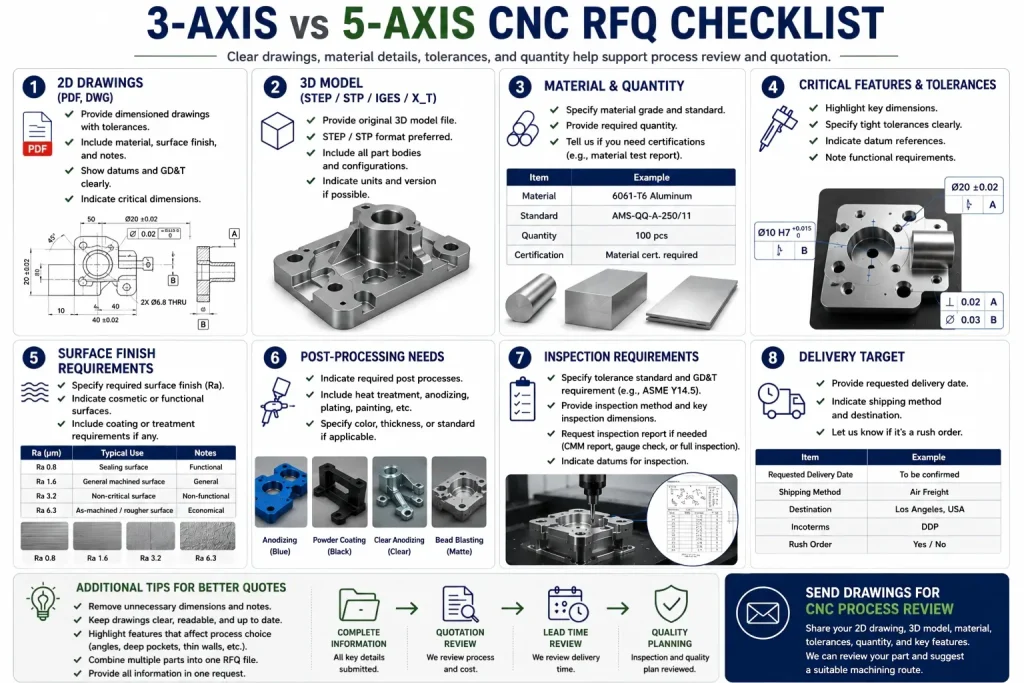
Buyer RFQ Checklist for 3-Axis vs 5-Axis Decision
Before requesting a 5-axis CNC machining quote, provide information that helps the supplier review the real process need.
| 询价项目 | 提供什么 |
|---|---|
| 2D图 | 方面, 公差, GD&时间, 基准参考, 完成笔记 |
| 3D型 | 步 / STP / IGES / X_T file |
| 关键特性 | Mark which features truly matter |
| 材质等级 | 铝, 不锈钢, 钛, 铜, 黄铜, 塑料, or alloy |
| 数量 | 原型, 低音量, 或重复生产 |
| Angled features | 洞, 面孔, 老板们, 插槽, or ports that need angle access |
| Multi-face relationships | Features that must align across different faces |
| 财力雄厚 | 口袋深度, wall height, 拐角半径, bottom finish |
| 薄壁 | 壁厚, 无支撑高度, final inspection condition |
| 表面光洁度 | Ra target, 化妆品标准, or visible surfaces |
| 后处理 | 阳极氧化, 电镀, 钝化, 抛光, 涂层, 或热处理 |
| Inspection needs | 三坐标报告, 仪表, 首件检验, or functional check |
| Mating parts | Assembly components, 针脚, 轴承, 密封, or reference parts |
| Delivery target | Helps review process route and fixture needs |
The supplier does not need the buyer to choose the machine first.
The supplier needs enough information to choose the process that controls the part risk.

Practical Drawing Notes for 5-Axis Review
例子 1: Angled Hole
Angled hole location and angle are function-critical. Supplier to review 3+2 or 5-axis machining approach before quotation.
This tells the supplier that the angle is not cosmetic.
例子 2: Multi-Face Datum Relationship
Hole pattern on side face must be controlled relative to datum A and B. Setup method and inspection plan to be confirmed before production.
This warns that datum transfer may matter.
例子 3: Deep Pocket
Deep pocket wall finish and bottom radius are functional. Supplier to review tool access, tool length, and chatter risk before machining.
This avoids forcing a long weak tool without review.
例子 4: Complex Surface
Curved surface profile must be inspected against 3D model. Supplier to confirm toolpath and inspection method before production.
This connects machining strategy with inspection.
例子 5: Thin-Wall Housing
Thin-wall areas require process review after roughing and before final finishing. Final inspection condition to be confirmed after unclamping.
This helps prevent measurement disputes.
Rapid Efficient Support for 3-Axis and 5-Axis CNC Review
Rapid Efficient can review custom CNC machined parts and help determine whether 3-axis, 3+2, or 5-axis machining is suitable for the project.
We can review:
- 零件几何形状
- 材料等级
- 关键特征
- 斜孔
- multi-face datum relationships
- 薄壁
- 财力雄厚
- 表面光洁度需求
- 后处理
- 检查方法
- 数量
- delivery target
对于复杂的几何形状, 有角度的特征, and setup-sensitive parts, 看看我们的 five-axis CNC machining service 页.
For broader production support, 回顾我们的 CNC加工设备及制造能力 页.
If you are not sure whether your part needs 5-axis machining, send the STEP file, 2D图, 材料等级, 公差注释, 和数量. We can review the part before quotation and suggest a suitable process route.
Buyer Questions About 5-Axis vs 3-Axis CNC
Is 5-axis CNC always better than 3-axis CNC?
福田街道. 5-axis CNC is useful when geometry, 工具访问, 设置计数, or datum relationships create real risk. For simple flat or prismatic parts, 3-axis CNC may be more cost-effective.
Does 5-axis CNC always improve tolerance?
福田街道. Tolerance depends on machine condition, fixture quality, tool length, 物质行为, CAM strategy, 及检验方法. 5-axis can help reduce setup-related risk, but it is not an automatic accuracy guarantee.
When should I choose 5-axis CNC machining?
Review 5-axis CNC when the part has angled holes, 复杂表面, 财力雄厚, multi-face datum relationships, 难以使用工具, or critical features that would require several 3-axis setups.
有什么区别 3+2 and 5-axis simultaneous machining?
In 3+2 加工, the tool or part is indexed to a fixed angle and then cut with 3-axis motion. In simultaneous 5-axis machining, rotary and linear axes move together during cutting. Many parts need 3+2, not full simultaneous 5-axis.
Is 5-axis CNC more expensive?
It often has a higher machine rate and programming requirement, but it may reduce total cost if it reduces setups, 固定装置, 报废风险, 以及检验问题. 对于简单零件, 3-axis is often more cost-effective.
What files should I send for 5-axis CNC review?
Send a 3D model, 2D图, 材料等级, 关键特征, 公差注释, 表面光洁度要求, post-processing needs, 数量, 及检验要求.