CNC加工零件的铝铣刀选择

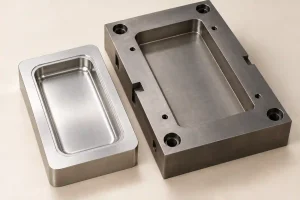
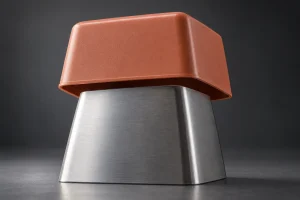
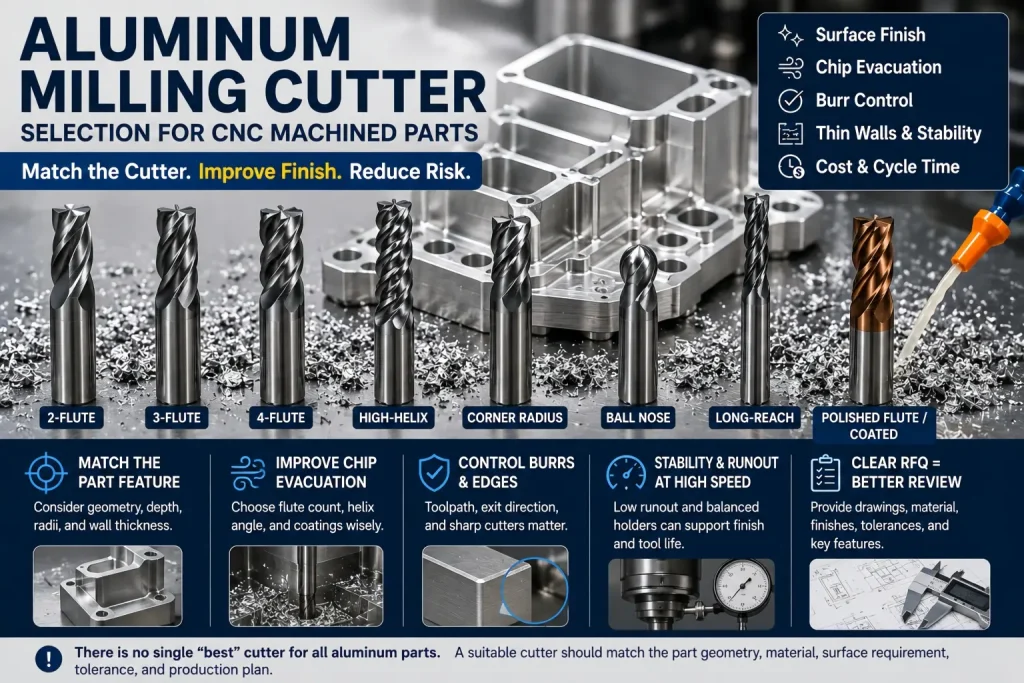
显示 2 刃 CNC 加工零件的铝铣刀选择, 3-flute, 4-长笛, 高螺旋, 角半径, 球鼻, 长距离, 抛光槽和带有铝屑的涂层刀具, 冷却液, 表面饰面, 排屑, 毛刺控制, 薄壁稳定性, 跳动, 和询价审核说明.

选择铝铣刀不仅仅是工具室的决定.

适用于 CNC 加工铝制零件, the cutter can affect chip evacuation, 毛刺形成, 表面饰面, 薄壁稳定性, 公差控制, 刀具磨损, 周期, and final inspection results.

A buyer usually does not need to specify the exact cutter brand.

But the buyer should understand when cutter choice becomes important.

The question is not only:

Which cutter is best for aluminum?

更好的问题是:

Which cutter geometry, flute count, 涂层, 直径, 拐角半径, and toolpath condition can protect this specific aluminum part from burrs, 喋喋不休, chip welding, 失真, and poor finish?

This guide explains how aluminum milling cutters are selected for CNC machined parts and what buyers should include in an RFQ when tooling affects part quality.


Aluminum Milling Cutter Selection Starts with the Part

There is no single cutter that works best for every aluminum part.

A cutter that works well for one simple 6061 plate may fail on a thin-wall housing, deep pocket, cosmetic cover, small internal radius, or high-speed production part.

Cutter selection should start with the feature.

Part FeatureCutter Selection Concern
Deep slotChip evacuation and flute space
Thin wall切削力, 振动, and finishing pass control
Cosmetic face工具痕迹, 跳动, 和整理策略
Small internal cornerCutter diameter and corner radius
Deep pocket工具范围, 刚性, chip removal, and chatter
Bearing boreSize control, 刀具磨损, 和精加工津贴
Threaded hole area毛刺, 边缘断裂, and thread protection
Anodized visible surfacePre-finish tool marks and burrs may remain visible
High-volume part工具寿命, 重复性, and cost per part
Prototype partPractical cutter availability and short setup time

Why Aluminum Needs Different Cutter Thinking

Aluminum is easier to cut than many steels, but it creates its own machining problems.

The common problems are:

  • 积屑瘤
  • chip welding
  • 毛刺形成
  • 排屑不良
  • surface smearing
  • chatter on thin walls
  • tool marks on visible faces
  • dimensional drift from tool wear
  • rough finish after chip re-cutting
  • edge defects before anodizing or polishing

Aluminum chips can stick to the cutting edge if the tool geometry, 芯片负载, 冷却液, or air blast is wrong.

When chips weld onto the edge, the cutter no longer cuts cleanly. It starts tearing, rubbing, or smearing the surface.

This can create:

  • rougher surface finish
  • larger burrs
  • unstable cutting force
  • poor wall finish
  • cosmetic defects
  • tool breakage
  • more deburring work
  • inconsistent dimensions

For aluminum machining problems related to cutting speed and chip load, 看看我们的 cutting speed for aluminum milling 指导.


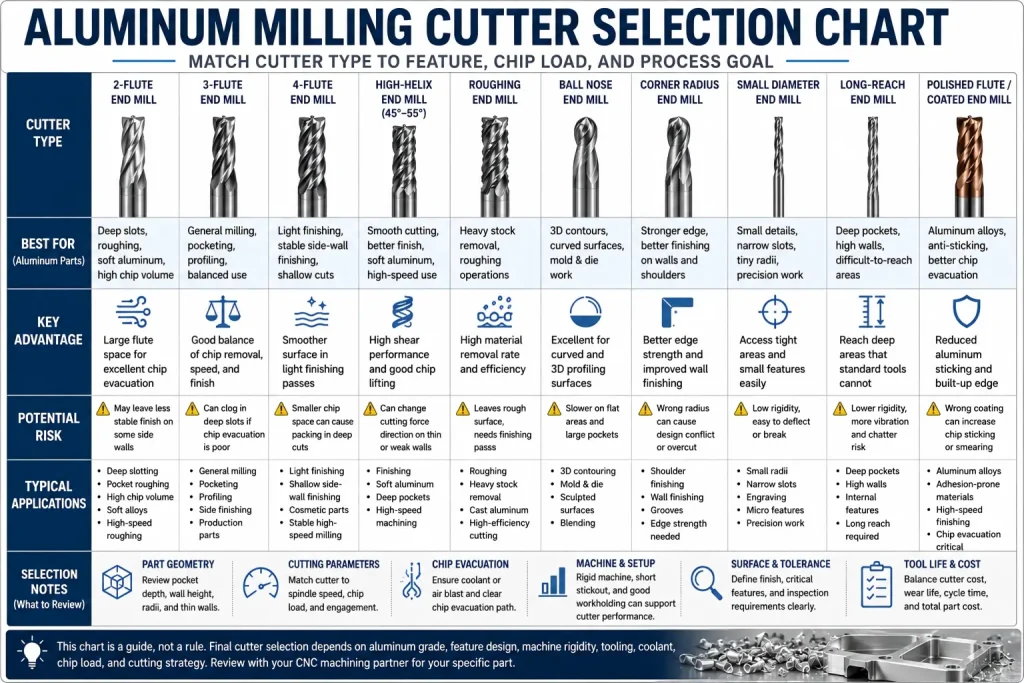
Quick Aluminum Milling Cutter Selection Chart

This chart gives a practical starting point.

Cutter TypeUsually Better For主要风险
2-flute end millDeep slots, roughing, softer aluminum, high chip volumeMay leave less stable finish on some side walls
3-flute end millGeneral aluminum milling, balanced speed and finishNeeds good chip evacuation and correct feed
4-flute end millLight finishing and stable side-wall finishingCan clog in deep slots if chip space is too small
High-helix cutterSmooth cutting action, better finish, softer aluminumCan pull thin walls if setup is weak
Roughing cutterHeavy stock removalMay leave rougher surface for finishing
Ball nose cutter3D contours and curved surfacesSlower on flat areas
Corner radius end millStronger edge, better finishing on selected featuresCorner radius must match part design
Small diameter cutterSmall corners, 窄槽, small featuresDeflection, breakage, and chatter risk
Long-reach cutterDeep pockets and tall wallsLower rigidity and more vibration
Polished flute cutterAluminum chip evacuation and anti-sticking performanceStill needs correct chip load and setup
Coated aluminum cutterSelected production use, wear or anti-sticking supportWrong coating can increase chip sticking

This chart should not be treated as a fixed rule. Final cutter selection depends on material grade, 特征几何, 机器刚性, 冷却液, 排屑, 宽容, and surface requirement.

Aluminum milling cutter selection chart comparing 2-flute, 3-flute, 4-长笛, 高螺旋, roughing, 球鼻, 角半径, small diameter, 长距离, polished flute, and coated cutters for CNC aluminum parts with chip evacuation, 表面饰面, 毛刺控制, 薄壁稳定性, tool rigidity, and process review notes.

2-Flute Cutters for Aluminum

A 2-flute aluminum milling cutter has fewer cutting edges and more open flute space.

This is useful when chip evacuation is the main concern.

2-flute cutters are often reviewed for:

  • deep slotting
  • pocket roughing
  • high chip volume cuts
  • soft aluminum
  • small machines with limited chip control
  • parts where chip packing is a risk
  • deep cuts where chips need more room to escape

The advantage is simple:

More flute space helps chips leave the cutting zone.

The risk is that fewer flutes may reduce finishing stability in some conditions. A 2-flute cutter can remove aluminum efficiently, but the final surface may still need a controlled finishing pass.

A 2-flute cutter may be a good roughing choice, but not always the best final finishing choice.


3-Flute Cutters for Aluminum

A 3-flute cutter is often a strong general-purpose choice for aluminum CNC machining.

It gives a balance between:

  • 排屑
  • 切割速度
  • tool strength
  • 进给率
  • 表面饰面
  • 生产率

For many CNC aluminum parts, 3-flute polished carbide end mills are commonly reviewed because they can run faster than 2-flute tools while still leaving enough flute space for aluminum chips.

3-flute cutters are often used for:

  • general milling
  • pocketing
  • profiling
  • side finishing
  • moderate slotting
  • production aluminum parts
  • cosmetic aluminum parts before finishing
  • balanced roughing and finishing strategies

But 3-flute does not automatically solve everything.

If the slot is deep, the tool stickout is long, the coolant is poor, or chip packing occurs, a 3-flute cutter can still clog or create built-up edge.

The cutter must match the toolpath and chip evacuation plan.


4-Flute Cutters for Aluminum

A 4-flute cutter can work in aluminum, but it should be reviewed carefully.

More flutes can help with a smoother side-wall finish during light finishing cuts, but the smaller chip space can become a problem in deep slots, heavy roughing, or gummy aluminum.

4-flute cutters may be considered for:

  • light finishing
  • shallow side-wall finishing
  • stable high-speed machining
  • selected hard aluminum alloys
  • low chip-load finishing passes
  • parts where surface texture matters more than chip volume

They may be risky for:

  • deep slotting
  • gummy aluminum
  • 冷却剂流动不良
  • heavy roughing
  • long tool stickout
  • small machines with weak chip evacuation

The buyer does not need to write “use 4-flute cutter” on the drawing unless there is a special reason.

It is usually better to define the required surface finish, 宽容, burr condition, and visible face. The CNC shop can then select the cutter that supports those requirements.


Cutter Material: 碳化物, HSS, and Special Tools

Most production aluminum milling uses carbide cutters because carbide provides stiffness, 戴阻力, and better high-speed stability.

Cutter Material实际使用
碳化物Most CNC aluminum production, 精加工, high-speed milling, repeat work
HSSLight-duty work, 手动加工, low-speed use, simple prototypes
PCD / diamond toolingHigh-volume production, abrasive aluminum alloys, selected non-ferrous applications
Special form cuttersCustom radii, 凹槽, 倒角, or profile features

Carbide is not automatically perfect, but it is usually the practical baseline for CNC aluminum milling.

For very high-volume production, tool life may matter more than tool price. A more expensive cutter can reduce burrs, 停机时间, 工具更改, and rework.

For one prototype, the shop may choose a practical cutter already available if it still meets the drawing requirement.


Coating Choice for Aluminum Cutters

Tool coating is important, but the wrong coating can make aluminum problems worse.

Aluminum often needs a cutter surface that reduces sticking and supports chip evacuation.

Common cutter options include:

Cutter SurfacePractical Meaning
Polished uncoated carbideOften good for aluminum because chips slide more easily
ZrN coatingSometimes used for aluminum and non-ferrous materials
DLC coatingCan help reduce sticking in selected applications
氮化钛 / steel-focused coatingsMay not be ideal for aluminum if chip welding increases
PCD cutting edgeUsed for selected high-volume or abrasive aluminum work

Aluminum sticking is not only a mechanical friction problem. Under high pressure and cutting heat, aluminum can adhere to the cutting edge and form built-up edge, especially when chip evacuation, edge sharpness, 涂层选择, or lubrication is not well controlled.

Polished flutes can help chips slide away from the cutting zone, while aluminum-friendly coatings such as DLC or ZrN may help reduce adhesion in selected applications. 然而, coating choice should still be reviewed with the aluminum grade, 切割速度, coolant or air blast, 工具几何形状, 和生产数量.

A more advanced coating does not automatically create a better aluminum finish. The cutter surface must support clean shearing, stable chip evacuation, and predictable tool wear for the specific part.

The key is not “coated or uncoated.”

The key is whether the cutter edge, flute polish, 涂层, and chip evacuation support clean aluminum cutting.

If the coating increases aluminum sticking, the finish may become worse even if the cutter looks more advanced.


Tool Geometry Matters More Than Buyers Expect

Flute count is only one part of cutter selection.

Tool geometry also includes:

  • 螺旋角
  • rake angle
  • edge sharpness
  • flute polish
  • core diameter
  • cutter diameter
  • 拐角半径
  • neck relief
  • cutting length
  • tool stickout
  • runout control
  • balance at high RPM

At the elevated spindle speeds often used in aluminum milling, cutter and toolholder condition becomes more important. Small tool runout, poor clamping, or imbalance can make one flute cut more than the others.

This uneven chip load can create vibration, micro-chatter, uneven tool wear, and visible finish variation on cosmetic or tolerance-sensitive aluminum surfaces. For parts with strict appearance, 钻孔, wall, 或平整度要求, the supplier may review toolholder quality, collet condition, tool stickout, runout control, and balanced tooling for high-speed finishing.

The goal is not to require special holders for every aluminum part. The goal is to avoid treating a high-speed finishing cut as only a cutter selection issue.

用于铝, a sharp cutting edge and polished flute are often very important.

A dull or poorly polished cutter can rub and smear aluminum instead of cutting cleanly.

这对于:

  • cosmetic parts
  • 薄壁
  • fine finishing passes
  • anodized visible parts
  • small pockets
  • 毛刺敏感边缘
  • soft aluminum alloys
  • 高速加工

A good aluminum milling cutter should help the chip leave the cut. If the chip stays near the edge, the tool may re-cut chips and damage the surface.


Cutter Diameter and Internal Corner Radius

The cutter diameter controls what internal corner radius can be machined.

A common drawing mistake is designing a sharp internal corner or a very small radius without considering the cutter.

例如:

设计特点Cutter Concern
Small internal cornerRequires smaller cutter
Deep pocket with small corner radiusSmall cutter may need long reach, increasing chatter
Narrow slotCutter diameter and chip evacuation become critical
Thin rib between pocketsCutting force may bend or vibrate the rib
Small bottom radiusMay require ball nose or corner-radius cutter
High wall with small cornerTool deflection and finish variation increase

A smaller cutter can reach smaller details, but it is usually weaker.

Small cutters may have:

  • lower rigidity
  • higher breakage risk
  • more deflection
  • slower feed
  • longer machining time
  • more chatter risk
  • harder chip evacuation

A design with slightly larger internal radii can often reduce machining risk and cost.

For drawing-level design review, 看看我们的 CNC加工设计指南.


Long-Reach Cutters and Deep Pockets

Deep pockets often force the shop to use longer tools.

A long-reach cutter has less rigidity than a short cutter. This can create:

  • 喋喋不休
  • tapered walls
  • 糟糕的完成
  • dimensional variation
  • 刀具偏转
  • 较慢的切割
  • higher burr risk
  • 减少工具寿命

The problem is not only depth. It is depth combined with cutter diameter, pocket width, 拐角半径, 壁厚, and material behavior.

A deep pocket with a large radius may be manageable. A deep pocket with a tiny internal corner may require a small long-reach cutter, which increases risk.

For RFQs, buyers should clearly mark:

  • 口袋深度
  • 拐角半径
  • required wall finish
  • tolerance on pocket walls
  • whether tool marks are acceptable
  • whether the pocket is visible or functional
  • whether the bottom surface needs a controlled finish

The cutter selection is part of the manufacturability review, not only a tool choice.


Thin-Wall Aluminum Parts Need Controlled Cutter Strategy

Thin-wall aluminum parts are sensitive to cutter force.

A cutter can push, pull, vibrate, or heat the wall during machining.

Thin walls may move because of:

  • 切削力
  • 锁模力
  • tool engagement
  • residual stress release
  • poor roughing sequence
  • aggressive finishing passes
  • long tool stickout
  • weak support near the wall

For thin-wall aluminum, cutter selection should review:

物品为什么它很重要
Sharp edgeReduces cutting force
Cutter diameterAffects stiffness and access
Flute countAffects chip evacuation and force balance
Helix angleCan affect pulling force on the wall
Radial engagementControls side pressure
精加工余量Helps stabilize final wall size
刀具跳动Can mark or push the wall unevenly
Final pass directionCan affect burr direction and wall finish

Tool geometry also interacts with local part stiffness. High-helix aluminum cutters can shear material cleanly and help lift chips out of pockets, but they can also change the direction of cutting force on thin or unsupported features.

If a thin vertical wall has weak support, long free height, or poor damping, the cutter may pull, vibrate, or deflect the wall during finishing. This can lead to wall thickness variation, 颤痕, or a final shape that changes after unclamping.

For thin-wall aluminum features, the supplier may review helix angle, radial engagement, axial depth of cut, 精加工津贴, toolpath direction, support strategy, and lighter final passes before confirming the process.

A thin-wall part may need a different cutter and toolpath from a solid block part, even if both are made from 6061 铝.

For high-speed aluminum process planning, 看看我们的 high-speed CNC aluminum cutting guide.


Cutter Selection and Surface Finish

The cutter can strongly affect the final surface finish.

Surface finish problems may come from:

  • dull cutting edge
  • poor flute polish
  • chip re-cutting
  • 积屑瘤
  • 刀具跳动
  • poor tool balance
  • wrong feed per tooth
  • excessive stickout
  • weak fixture
  • 喋喋不休
  • wrong toolpath direction
  • worn finishing tool

A clean aluminum surface often needs more than a smooth cutter.

It needs a stable cutting process.

For visible aluminum parts, the RFQ should define:

  • 可见表面
  • acceptable tool marks
  • roughness target if needed
  • anodizing or painting after machining
  • 毛刺敏感边缘
  • packaging requirement
  • cosmetic inspection standard

A machined surface that looks acceptable before anodizing may look different after anodizing. 工具痕迹, 划痕, and burrs can become more visible after finishing.

For finish planning, 看看我们的 CNC 表面处理指南.


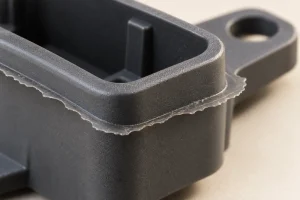
Cutter Selection and Burr Control

Burrs are one of the most common quality problems in aluminum milling.

A cutter may create more burrs when:

  • the edge is dull
  • feed is too low
  • chip load is unstable
  • tool runout is high
  • the part wall is thin
  • the exit edge is unsupported
  • the cutter rubs instead of cuts
  • chip evacuation is poor
  • the final pass direction pushes burrs toward a critical edge

Burr control is not only a deburring problem. It is also a cutter and toolpath problem.

For burr-sensitive parts, the drawing should mark:

  • edges that must be burr-free
  • edges that can have normal break edge
  • cosmetic edges
  • sealing edges
  • 螺纹孔
  • cross-hole intersections
  • user-contact surfaces
  • areas that cannot be over-rounded

更好的询价说明是:

Burr-sensitive edges marked on drawing. Supplier to review cutter direction, deburring access, and final edge inspection before production.

For edge quality planning, 看 What Is Deburring? CNC Edge Quality, Burr Removal, 及检验.


Aluminum Grade Changes Cutter Behavior

Different aluminum alloys do not machine exactly the same.

Aluminum MaterialCutter Selection Concern
6061-T6Usually machines well; cutter choice focuses on finish, 毛刺, and productivity
7075-T6Stronger material; 刀具磨损, 热, and finishing stability need review
5052更柔软、更有延展性; burrs and smearing can be more difficult
6063Often used for extrusions; surface quality and cosmetic finish may matter
Cast aluminumPorosity, silicon content, and variable structure may affect tool wear
Hard-anodized aluminum after machiningPre-finish dimensions and masking must be reviewed
Thin extruded aluminum featuresClamping and wall movement may matter more than cutting speed

For material comparison, 回顾我们的 6061 与 7075 aluminum CNC machining guide.

Cutter selection should not be copied from one aluminum alloy to another without review.

A setup that cuts 6061 cleanly may create burrs or tool wear problems in another grade or stock form.


Cutter Choice and Cutting Speed Work Together

A good aluminum milling cutter can still fail if the cutting speed, 进给率, and chip load are wrong.

The cutter must work with:

  • 主轴速度
  • 进给率
  • 每齿进给量
  • radial depth of cut
  • axial depth of cut
  • coolant or air blast
  • 机器刚性
  • 夹具稳定性
  • tool stickout
  • chip evacuation path

If feed per tooth is too low, the cutter may rub instead of cut.

If feed is too high for the setup, the cutter may chatter, break, or leave poor finish.

If RPM is high but chip evacuation is weak, aluminum may weld to the cutting edge.

This is why cutter selection and cutting parameters should be reviewed together.

For parameter planning, 看看我们的 cutting speed aluminum milling 指导.


Tool Wear and Cutter Replacement Matter in Production

A cutter may work well at the start of production and then slowly create problems as it wears.

Tool wear can cause:

  • larger burrs
  • dull surface
  • poor wall finish
  • size drift
  • higher heat
  • more chatter
  • chip welding
  • inconsistent holes or pockets
  • more deburring time
  • more rejected cosmetic parts

生产中, the question is not only which cutter is selected. The supplier also needs a plan for tool life and cutter replacement.

Important production checks include:

查看为什么它很重要
Tool wear limitPrevents running a dull tool too long
首件检验Confirms process before full batch
过程中检查Catches dimensional drift
Burr monitoringShows when cutter edge is degrading
Surface finish checkHelps protect cosmetic or functional faces
Tool change intervalSupports repeatability across the batch
Batch documentationHelps repeat the same result later

了解更多详情, 看看我们的 tool wear in aluminum machining guide.


Climb Milling, Conventional Milling, and Cutter Exit Direction

The same cutter can create different burrs and surface finish depending on cutting direction.

Climb milling and conventional milling change chip thickness, cutting force direction, burr direction, and surface behavior.

用于铝, climb milling is often useful on stable CNC machines, but it is not automatic.

The process should review:

  • cutter sharpness
  • fixture rigidity
  • backlash control
  • thin wall support
  • 排屑
  • burr direction
  • finishing pass direction
  • 表面光洁度要求
  • whether the cutter exits into a critical edge

If the cutter exit pushes material toward a sealing edge or visible edge, the part may need extra deburring or a different finishing path.

For cutting direction strategy, 看看我们的 climb milling vs conventional milling guide.


When Buyers Should Not Specify the Cutter

Most buyers should not over-specify the exact cutter unless there is a functional reason.

Avoid writing detailed cutter requirements when:

  • the cutter brand is not important
  • the part only needs standard machining
  • the supplier can meet the drawing with normal tooling
  • the buyer does not understand the process limit
  • the cutter note may block a better manufacturing method
  • the requirement is copied from another supplier without review

Instead of writing:

Use 3-flute polished carbide end mill

A safer note may be:

Visible face requires clean machined finish. Burrs on marked edges not acceptable. Supplier to review cutter, 刀具路径, and deburring method.

This gives the supplier freedom to choose the right cutter while keeping the quality requirement clear.

Buyers should specify the result, not force the tool, unless the tool choice is part of a validated process.


When Cutter Requirements Should Be Discussed Before Quoting

Cutter selection should be discussed when the part has:

  • 薄壁
  • 财力雄厚
  • 窄槽
  • small corner radii
  • tight tolerance surfaces
  • visible cosmetic faces
  • high burr sensitivity
  • anodizing after machining
  • 大批量生产
  • long continuous cutting time
  • special surface finish needs
  • difficult chip evacuation
  • expensive material or high scrap cost
  • high-speed machining requirement

在这些情况下, cutter selection affects cost, risk, 和交货.

A good RFQ does not need to tell the supplier every cutter detail. But it should give enough information for the supplier to select the cutter properly.


RFQ Checklist for Aluminum Milling Cutter Review

Before quoting aluminum CNC milled parts, send clear information about the features that affect cutter selection.

询价项目提供什么
铝牌号6061, 7075, 5052, 6063, cast aluminum, or other grade
库存形式盘子, 酒吧, 挤压, 锻造, 铸件, or billet
2D图方面, 公差, 表面饰面, datum notes
3D型步 / STP / IGES / X_T if available
关键特性博雷斯, 插槽, 薄壁, 口袋, 基准面, visible faces
财力雄厚Depth, wall height, 拐角半径, bottom finish
Internal radiiMinimum radius and whether it is functional or cosmetic
薄壁壁厚, 无支撑高度, final inspection condition
表面光洁度Ra target, cosmetic expectation, 可见表面
Burr-sensitive edgesMark edges that cannot have raised burrs
后处理阳极氧化, 绘画, 喷砂, 抛光, 或涂层
数量原型, 低音量, 或重复生产
Inspection needsCMM, 仪表, 表面粗糙度, visual standard, or report
Delivery targetHelps plan tooling, 设置, and production route

The supplier can use this information to review cutter diameter, flute count, 工具范围, 精加工通过, 排屑, and inspection risk.
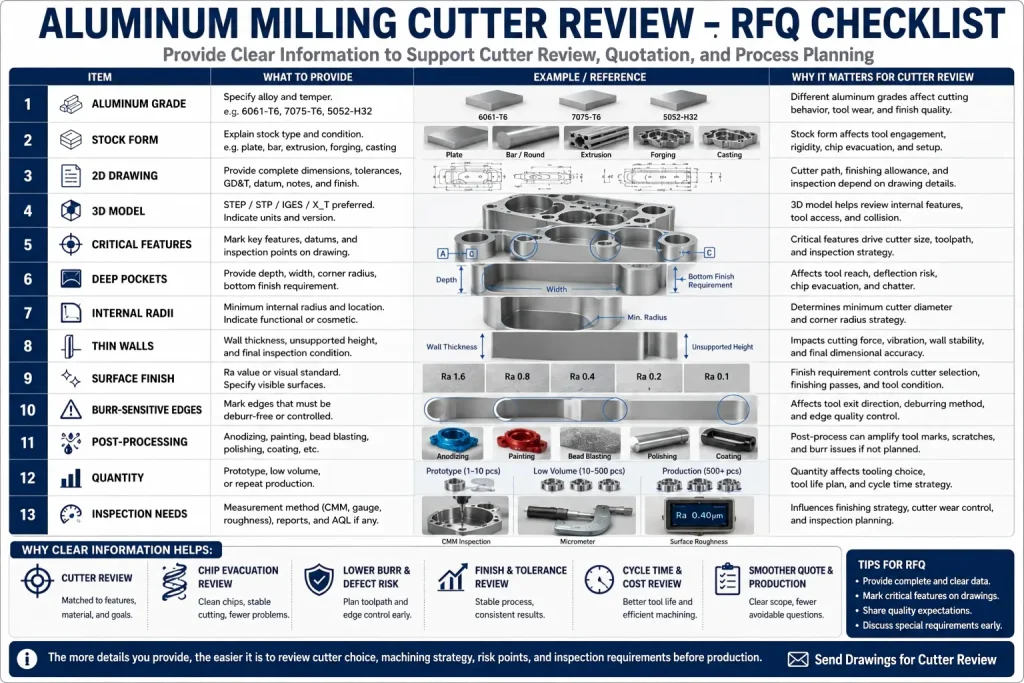
RFQ checklist for aluminum milling cutter review showing aluminum grade, 库存形式, 2D图, 3D型, 关键特征, 财力雄厚, internal radii, 薄壁, 表面饰面, 毛刺敏感边缘, 后处理, 数量, 检查需要, cutter review, 排屑, finish control, and machining strategy planning.

Practical Drawing Notes for Aluminum Milling Cutter Risk

例子 1: Thin Wall

Thin wall area marked on drawing. Supplier to review cutter engagement, 夹紧, and final finishing pass before production.

This helps prevent wall movement and chatter.

例子 2: Cosmetic Face

Visible surface requires clean machined finish. Tool marks acceptable only within approved sample or agreed visual standard.

This prevents confusion between functional machining and cosmetic acceptance.

例子 3: Small Internal Radius

Minimum internal radius shown is functional. Supplier to confirm cutter access and machining risk before quotation.

This helps avoid using a weak small cutter without review.

例子 4: Burr-Sensitive Edge

Marked edges must be free of raised burrs after machining and deburring. Do not over-round sealing edge.

This protects function while allowing controlled deburring.

例子 5: Post-Anodizing Surface

Visible machined surfaces will be anodized after machining. Supplier to review pre-anodizing tool marks, 毛刺, and masking needs.

This avoids cosmetic surprises after finishing.


Common Aluminum Milling Cutter Mistakes

Many aluminum milling problems come from small tooling mistakes.

Common mistakes include:

  • using a steel-focused cutter on aluminum
  • choosing too many flutes for deep slotting
  • using a dull tool to finish visible surfaces
  • using too much tool stickout
  • ignoring tool runout
  • using a cutter too small for a deep pocket
  • designing tiny internal radii without reason
  • using low feed until the cutter rubs
  • re-cutting chips in pockets
  • not marking burr-sensitive edges
  • polishing or anodizing over poor tool marks
  • not replacing tools during repeat production
  • assuming one cutter works for every aluminum grade

对于买家, the safest approach is simple:

Define the part function, surface requirement, burr condition, 宽容, and final finish. Let the supplier review the cutter and process needed to meet those requirements.


Rapid Efficient Support for Aluminum Milling Cutter Review

Rapid Efficient can review aluminum CNC milled parts before quotation and help identify whether cutter selection may affect part quality.

We can review:

  • aluminum grade
  • 零件几何形状
  • 薄壁
  • 财力雄厚
  • 小内半径
  • 毛刺敏感边缘
  • 可见表面
  • 表面光洁度要求
  • anodizing or coating after machining
  • tolerance and inspection needs
  • prototype or production quantity
  • packaging requirement

Depending on the part, cutter selection may involve 2-flute, 3-长笛, 高螺旋, polished flute, 角半径, 长距离, or finishing cutters.

For aluminum part production support, 看看我们的 CNC铝加工服务 页.

将您的 STEP 文件发送给我们, 2D图, aluminum grade, 关键特征, 完成要求, 数量, 及检验需求.


Buyer Questions About Aluminum Milling Cutters

What cutter is best for aluminum milling?

There is no single best cutter for every aluminum part. 2-flute cutters often help with chip evacuation, 3-flute cutters are common for balanced aluminum milling, and 4-flute cutters may be used for light finishing. The best choice depends on feature geometry, chip removal, 机器刚性, and surface requirement.

Is a 2-flute or 3-flute cutter better for aluminum?

A 2-flute cutter gives more chip space and can help with deep slots. A 3-flute cutter often gives a good balance of speed, 结束, 和芯片疏散. The feature and toolpath matter more than the flute count alone.

Can I use a 4-flute end mill for aluminum?

是的, in some light finishing conditions. But 4-flute cutters can trap chips more easily in deep slots or heavy roughing, so chip evacuation must be reviewed.

Should aluminum cutters be coated?

有时. Polished uncoated carbide, ZrN, DLC, or other aluminum-friendly options may work depending on the part. The wrong coating can increase chip sticking, so coating should be selected for aluminum behavior, not just wear resistance.

Why do aluminum cutters create burrs?

Burrs can come from dull edges, low chip load, 排屑不良, 刀具跳动, weak support, or cutter exit direction. Burr control should be planned before machining, not only after machining.

Does cutter choice affect anodized aluminum appearance?

是的. 工具痕迹, 毛刺, 划痕, and uneven surface texture before anodizing can remain visible or become more noticeable after anodizing. Visible surfaces should be marked clearly before quotation.

What should I send for aluminum milling cutter review?

Send a 2D drawing, 3D型, aluminum grade, 关键特征, 口袋深度, minimum internal radius, 薄壁区域, 表面光洁度要求, 毛刺敏感边缘, post-processing requirement, 数量, 及检验需求.

发表评论

滚动至顶部

获取报价

点击或拖拽文件到该区域即可上传. 您最多可以上传 10 文件.
文件格式:TXT PDF DOC DOCX XLS XLSX PPT PPTX JPG PNG ZIP RAR DWG DXF DXF DWT DWS DWS

3D文件格式: 步, STP, sldprt, IPT, prt, 坐着, IGES, IGS, catpart, X_T, OBJ, STL