聚四氟乙烯数控加工: 设计, 厚度, 和询价风险

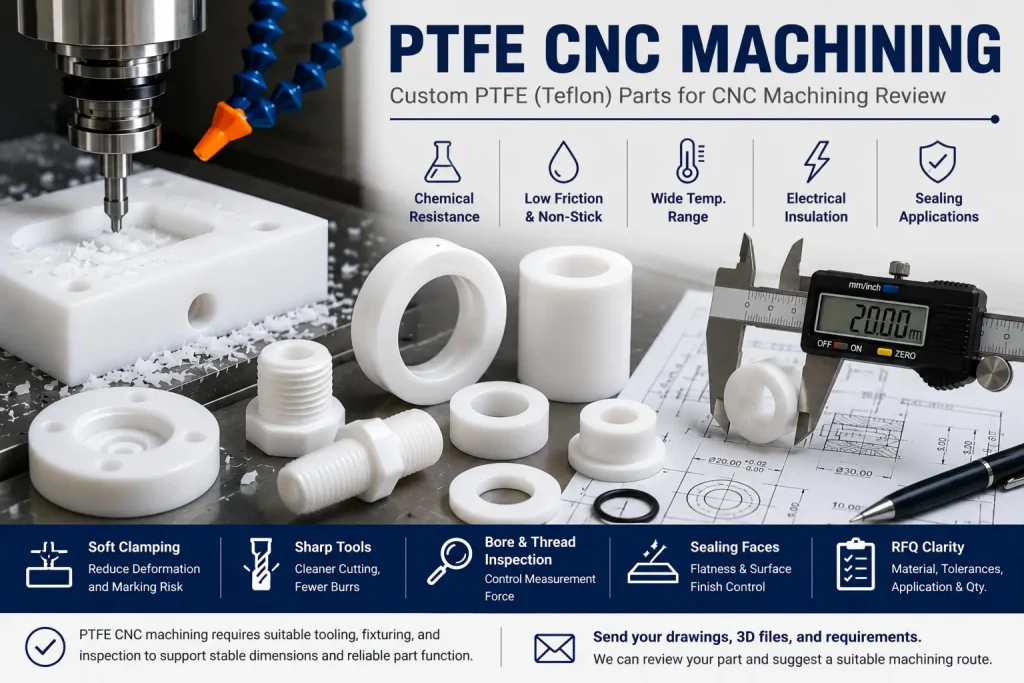
PTFE CNC machining for custom plastic parts showing white PTFE stock, machined bushings, 袖子, 密封, 螺纹零件, soft clamping, 锋利的工具, bore and thread inspection, 密封面, 卡尺测量, 工程制图, 和询价审核说明.

PTFE CNC加工并不难,因为材质较硬.

这很困难,因为 PTFE 很软, 滑, 灵活的, and easy to deform during clamping, 切割, 检查, 和组装.

A metal part may stay stable after machining. A PTFE part may move slightly when it is held, released, measured, pressed into assembly, or exposed to temperature change.

This is why PTFE CNC parts need a different review process from aluminum, 不锈钢, 黄铜, or PEEK parts.

A good PTFE machining plan should review:

  • 材料等级
  • 壁厚
  • part stiffness
  • 夹紧方式
  • 工具锋利度
  • 毛刺控制
  • thread design
  • bore tolerance
  • 密封面
  • 表面饰面
  • 检查方法
  • final application
  • quantity and repeatability

PTFE is often selected for low friction, 耐化学性, 密封, 绝缘, and non-stick behavior. But those same properties can also make machining, 夹具, and inspection more sensitive.

The goal is not to avoid PTFE.

The goal is to design PTFE machined parts in a way that matches the real behavior of the material.


What Is PTFE CNC Machining?

PTFE CNC machining is the process of cutting PTFE stock into custom parts using CNC milling, 数控车削, 钻孔, 无聊的, 窃听, grooving, or secondary machining operations.

PTFE is also commonly searched as Teflon, although Teflon is a brand name. In RFQs, buyers may write:

  • PTFE parts
  • Teflon parts
  • PTFE machined parts
  • PTFE CNC machining
  • CNC Teflon machining
  • PTFE bushings
  • PTFE seals
  • PTFE insulating parts
  • PTFE spacers
  • PTFE sleeves
  • PTFE valve seats

PTFE can be machined into many custom parts, but it does not behave like a rigid engineering plastic.

Compared with POM, 尼龙, 丙烯酸纤维, or PEEK, PTFE usually needs more attention to clamping pressure, 尺寸稳定性, 螺纹强度, and inspection condition.

For a broader material comparison, 看看我们的 最适合 CNC 加工的塑料 指导.


Why PTFE Machines Differently from Metals

Many CNC machining problems come from one simple mistake:

The buyer or supplier treats PTFE like aluminum.

That can create problems.

PTFE is much softer and more flexible than most metals. It can move under clamping force, spring back after cutting, and deform under measurement pressure.

PTFE BehaviorMachining Effect
低刚度Thin walls and long features can bend during cutting
低摩擦Workholding can be less stable if clamping is not planned
Soft cutting behaviorBurrs and edge deformation can occur if tools are dull
高灵活性Measured dimensions may change after unclamping
Thermal sensitivityDimensions may shift with machining heat or inspection temperature
Low surface energy涂层, bonding, or marking may need special review
Creep under load压配合, 线程, and loaded features need caution
Excellent chemical resistanceGood for seals, 绝缘体, 流体接触部件, and chemical equipment

PTFE stock produced by molding or extrusion may contain internal stress from the stock manufacturing process. When a machining process removes material unevenly, especially during heavy roughing, deep pocketing, or one-sided milling, the stress balance inside the part can change.

This can cause long, 薄的, or asymmetrical PTFE features to move slightly after unclamping or after a stabilization period. The part may look acceptable during machining, but the final shape may shift before final inspection or assembly.

For complex or tight-tolerance PTFE parts, the supplier may review balanced material removal, staged roughing and finishing, a short stabilization period, or stress-relief conditioning when required. This is especially important for thin sleeves, long strips, 大口袋, 密封面, and parts with uneven wall thickness.

PTFE can produce excellent custom parts, but the process must respect the material.

For general CNC material and process support, 看看我们的 数控加工服务 页.


When PTFE Is a Good CNC Material

PTFE is often a good choice when the part needs low friction, 耐化学性, 电绝缘, or sealing behavior.

Common PTFE machined parts include:

零件类型Why PTFE May Be Used
衬套Low friction and wear behavior in selected applications
袖子Good sliding and insulating behavior
密封件Chemical resistance and sealing function
Valve seatsChemical resistance and low friction
SpacersElectrical insulation and chemical stability
WashersLow friction and non-stick behavior
垫片Sealing and chemical compatibility
Lab equipment parts耐化学性
Semiconductor fixture partsInsulation and chemical resistance, depending on application
Fluid system partsResistance to many chemicals
Electrical insulating componentsHigh insulation value
耐磨垫Low friction in selected contact conditions

PTFE is useful when the part function depends on the material itself.

It is less suitable when the main requirement is high stiffness, sharp thin features, very tight threads, or rigid press-fit behavior.


When PTFE May Not Be the Best Choice

PTFE is not always the best engineering plastic.

Before choosing PTFE, the buyer should check whether the application really needs its low friction, 耐化学性, or temperature behavior.

PTFE may need extra review when the part has:

  • very thin walls
  • long unsupported features
  • tight press fits
  • 小内螺纹
  • 锋利的边缘
  • high clamping load
  • high assembly force
  • tight positional tolerance
  • small deep holes
  • cosmetic surface requirements
  • 承重特点
  • mating parts that apply continuous pressure
  • inspection requirements similar to metal parts

在某些情况下, 聚甲醛, 窥视, 尼龙, 聚乙烯亚胺, 聚苯硫醚, or another engineering plastic may be more suitable.

例如, POM may be better for many general precision plastic parts, while PEEK may be better for demanding temperature, 力量, or stability needs. For more context, 看看我们的 PEEK vs POM CNC machining comparison.


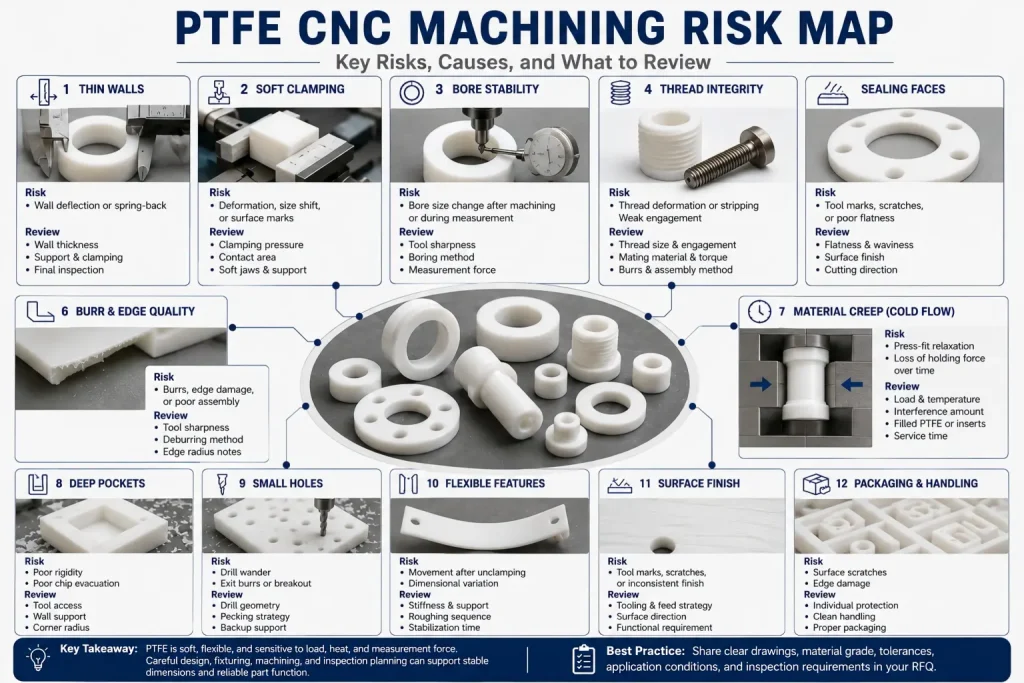
PTFE Machining Risk Map

PTFE machining risk usually appears in a few feature types.

特征主要风险回顾什么
薄壁Wall deflection or spring-back壁厚, 支持, 锁模压力, 最终检验
小孔径Size shift after machining刀具锋利度, boring method, inspection pressure
线程数Weak or distorted thread form螺纹尺寸, engagement length, mating part, assembly load
压配合Creep and deformation加载, 温度, 装配力, long-term contact
密封面Tool marks or waviness平整度, 表面饰面, cutting direction, 检查方法
财力雄厚Poor rigidity and chip control工具访问, wall support, 拐角半径
Long sleevesOvality or taper软爪, 支持, turning setup, inspection location
尖角Burrs and edge damageEdge radius, deburring method, functional edge notes
小孔Drill wander or burrs孔深, drill geometry, pecking, backup support
化妆品表面Handling marks包装, glove handling, 表面保护

This risk map helps prevent a common RFQ mistake: asking for metal-like tolerances without explaining how the PTFE part will be held, used, and measured.

PTFE CNC machining risk map showing thin walls, soft clamping, bore stability, thread deformation, 密封面, burr and edge quality, material creep, cold flow, 财力雄厚, 小孔, flexible features, 表面饰面, inspection pressure, and packaging protection.

Tolerance Planning for PTFE CNC Parts

PTFE tolerance should be reviewed more carefully than aluminum or stainless steel tolerance.

A tight number on the drawing does not always mean the part will hold that number in real use.

Tolerance depends on:

  • 零件尺寸
  • 壁厚
  • 材料等级
  • 库存状况
  • machining heat
  • 锁模压力
  • 工具锋利度
  • inspection temperature
  • measurement force
  • feature stiffness
  • final application
  • quantity and repeatability

小的, thick, well-supported PTFE features are usually easier to control than thin, 灵活的, long, or unsupported features.

A bore in a thick PTFE block may be more stable than a thin PTFE sleeve with the same nominal diameter.

A flat sealing face may be easier to control when the part is well supported during machining and inspection.

对于一般公差规划, 看看我们的 CNC加工公差指南.


Clamping and Fixturing Are Critical

PTFE can deform if clamping force is too high.

This is one of the biggest differences between PTFE and metal machining.

If the part is squeezed during machining, the cutter may machine the compressed shape. After the part is released, it can recover slightly and the final measured dimension may change.

Common clamping risks include:

Clamping Issue可能的结果
Too much vise pressurePart distortion or size shift after release
Small contact areaLocal dents or surface marks
Poor support under thin areas喋喋不休, 墙运动, or uneven thickness
Unstable round stock holdingOvality or taper
Hard jaws on soft materialVisible clamping marks
Over-tightened internal mandrelBore distortion
No backup support during drillingExit burrs or breakout

对于聚四氟乙烯零件, 软颚, 定制固定装置, light clamping, larger contact areas, and staged machining may be needed.

The fixture does not need to be complicated for every project. But it should match the part stiffness and tolerance requirement.


Tooling for PTFE Machining

PTFE usually cuts best with sharp tools and a controlled cutting strategy.

Dull tools can push the material instead of cutting it cleanly. This can create burrs, rough edges, poor size control, or surface tearing.

Tooling review may include:

  • sharp cutting edges
  • polished tool surfaces
  • suitable rake angle
  • controlled tool engagement
  • proper chip clearance
  • 轻加工切削
  • reduced heat buildup
  • stable tool support
  • correct drilling strategy
  • deburring method

The goal is not maximum cutting speed.

The goal is clean cutting with minimal pushing, dragging, 热, 和扭曲.

For milled PTFE parts with pockets, 插槽, 孔, and machined faces, 看看我们的 CNC milling services 页.


CNC Turning PTFE Parts

PTFE is often turned into bushings, 袖子, 戒指, 垫圈, 垫片, 密封, and valve seats.

Turning PTFE can look simple, but round parts can still have issues:

  • ovality
  • 锥度
  • poor bore stability
  • 薄壁变形
  • thread distortion
  • surface marks from jaws
  • parting burrs
  • inspection variation

For PTFE rings and sleeves, the supplier should review the relationship between outer diameter, 内径, 壁厚, and clamping method.

If the wall is thin, the part may need soft jaws, light chuck pressure, internal support, or a modified process route.

For custom rotational parts, 看看我们的 数控车削服务 页.


Threads in PTFE Need Extra Review

PTFE threads need more caution than metal threads.

The material is softer, so small internal threads, short engagement length, or high assembly force can create problems.

Possible PTFE thread issues include:

  • thread deformation
  • loose engagement
  • cross-threading risk
  • burrs at thread start
  • weak thread crests
  • poor repeatability after repeated assembly
  • size change after tapping
  • damage from metal mating parts

Thread design should consider:

Thread Factor为什么它很重要
螺纹尺寸Very small threads may be fragile
啮合长度Short threads may not hold load well
Mating materialMetal screws can damage PTFE threads if over-tightened
Assembly torqueHigh torque can deform the thread
插入要求Some designs may need metal inserts instead of direct PTFE threads
检查方法Thread gauges may apply force and affect results
毛刺控制Entry and exit burrs can affect assembly

If a PTFE part needs repeated assembly, 生产前应审查设计.

A metal insert, larger thread, longer engagement, or design change may be more reliable than forcing a small direct thread into PTFE.


PTFE Bores, 袖子, and Bushings

PTFE bores and sleeves are common, but they can be sensitive.

A PTFE bushing may look simple on the drawing, but machining and inspection can be affected by:

  • 壁厚
  • chuck pressure
  • bore depth
  • length-to-diameter ratio
  • 工具压力
  • material relaxation
  • measurement force
  • final assembly fit
  • temperature condition

Another mechanical behavior to review is cold flow, also known as creep under sustained load. PTFE can slowly deform under continuous clamping, compression, or assembly pressure, even when the part is used at normal room temperature.

This matters for PTFE bushings, 袖子, valve seats, 密封, and press-fit features. If a PTFE bushing is pressed tightly into a metal housing, the material may relax over time and the holding force or bore size may change.

For applications with sustained load, tight press fits, 或重复组装, the supplier may review filled PTFE grades, longer engagement length, reduced interference, metal inserts, or a different plastic material. The best choice depends on load, 温度, mating material, service time, 及检验要求.

For bushings, the buyer should define whether the bore is:

  • a clearance bore
  • a sliding bore
  • a sealing bore
  • a bearing surface
  • a press-fit feature
  • a guide feature
  • an insulation feature

These different functions need different tolerance and surface review.

A tight bore tolerance may be reasonable for a thick, short bushing. The same tolerance may be risky for a long, thin sleeve.


Sealing Faces and Surface Finish

Many PTFE parts are used as seals, valve seats, 垫片, or fluid-contact components.

对于这些部分, the sealing face may matter more than the overall appearance.

A sealing face should be reviewed for:

  • 平整度
  • waviness
  • 工具痕迹
  • 划痕
  • 毛刺
  • edge damage
  • surface direction
  • mating surface
  • compression load
  • final cleaning
  • packaging protection

Surface finish notes should be realistic.

A drawing note that only says “smooth surface” is not enough for a sealing feature.

Better drawing notes may include:

  • which face is sealing
  • whether scratches are acceptable
  • whether tool marks must be controlled
  • whether surface roughness is required
  • whether flatness is functional
  • whether the part will be compressed in assembly
  • whether leak testing or functional checking is needed

For broader finish planning, 看看我们的 CNC 表面处理指南.


Thin Walls and Flexible PTFE Features

Thin PTFE walls can move during machining.

They may also move after the part is released from the fixture.

这会影响:

  • 壁厚
  • 平整度
  • 圆度
  • 孔径
  • 孔位置
  • sealing face contact
  • visual surface quality
  • 装配配合

For thin-wall PTFE parts, the supplier should review:

评论项目为什么它很重要
壁厚Thin PTFE walls are more likely to deflect
Unsupported heightTall features can vibrate or bend
Clamping positionPoor support can distort the feature
Roughing sequenceUneven material removal can release stress
精加工余量A light final cut may improve size control
检查时机The part may relax after unclamping
Measurement forceSoft material can deform under contact measurement
包装Soft surfaces can be marked during shipment

A thin-wall PTFE part may still be machinable, but the tolerance should match the feature stiffness.


Filled PTFE vs Virgin PTFE

Not all PTFE materials machine or perform the same way.

Some PTFE grades include fillers such as glass fiber, carbon, graphite, 青铜, or other additives.

Filled PTFE may be selected to improve wear resistance, 刚性, thermal behavior, 或尺寸稳定性, 取决于申请.

然而, filled PTFE can also affect:

  • 刀具磨损
  • 表面饰面
  • edge quality
  • burr behavior
  • 颜色
  • friction behavior
  • 检查稳定性
  • 材料成本
  • mating surface wear

The RFQ should clearly state whether the part requires virgin PTFE or a filled PTFE grade.

Do not assume the supplier can choose the grade only from the word “Teflon.”

A material note should include the exact grade, 颜色, 填料, 证书要求, and any application condition that affects material choice.


PTFE Machining and Heat

PTFE can be sensitive to heat during machining and inspection.

Machining heat may come from:

  • tool friction
  • 钝的切削刃
  • poor chip removal
  • heavy tool pressure
  • continuous cutting
  • insufficient cooling strategy
  • aggressive drilling or tapping

PTFE also has high thermal expansion compared with many common CNC materials, and its dimensional behavior can be affected by temperature changes near normal room conditions. Some PTFE grades may show small dimensional changes around room-temperature transition ranges, so inspection temperature can matter more than buyers expect.

If a precision PTFE feature is machined in a warm shop environment and then measured immediately in a cooler inspection area, the measured size may shift slightly after the part stabilizes. For tight-tolerance PTFE features, the supplier may review whether the part needs cooling time, temperature stabilization, or final inspection under a consistent measurement condition.

The goal is not to make every PTFE project complicated. The goal is to avoid accepting a dimension that only looks correct under a temporary thermal condition.

Heat can make dimensional control more difficult.

A part may measure one way immediately after cutting and another way after it returns to a stable condition.

For tight PTFE features, the supplier may review whether the part needs cooling time before final inspection.

The goal is not to make every PTFE project slow.

The goal is to avoid accepting a dimension that only looks correct under a temporary machining condition.


Inspection Challenges for PTFE CNC Parts

PTFE inspection can be tricky because the material is soft.

The measurement method itself can affect the result.

Inspection issues may include:

Inspection Issue可能出现的问题
High contact forceSoft feature may compress during measurement
Thin-wall bore measurementBore may deform under gauge pressure
Flexible part handlingShape may change depending on support
Immediate inspection after machiningHeat or stress may not be stable
Different inspection setupsResults may vary between shop and customer
Thread gauge forceThread may deform during checking
Surface scratch sensitivityHandling can create marks after inspection
Unclear datum referencesSoft part may be hard to align consistently

For critical PTFE parts, the drawing should define what dimensions are critical and how they should be inspected.

A CMM report may be useful for some features, but contact pressure, 支持, 日期对齐, and inspection condition still need review.

For inspection planning, 看看我们的 CMM inspection for CNC parts 指导.


PTFE Machining Tolerance Should Match Function

Not every PTFE dimension needs the same tolerance.

A good PTFE drawing separates:

  • functional dimensions
  • reference dimensions
  • cosmetic edges
  • 密封面
  • clearance holes
  • flexible walls
  • assembly-critical features
  • non-critical external shapes

This helps the supplier focus machining and inspection effort where it matters.

特征类型公差审查
密封面平整度, 表面状况, and compression behavior matter
Clearance holeMay not need tight tolerance
Press-fit featureNeeds caution due to creep and deformation
线Needs engagement and assembly review
Bushing bore圆度, measurement force, and final fit matter
薄壁Tolerance should reflect stiffness
化妆品边缘Burr and handling control may matter more than dimension
Insulation spacerFunction may depend on thickness and hole location

Do not apply tight tolerances across the whole drawing unless every feature truly needs them.

This can increase cost and inspection difficulty without improving part function.


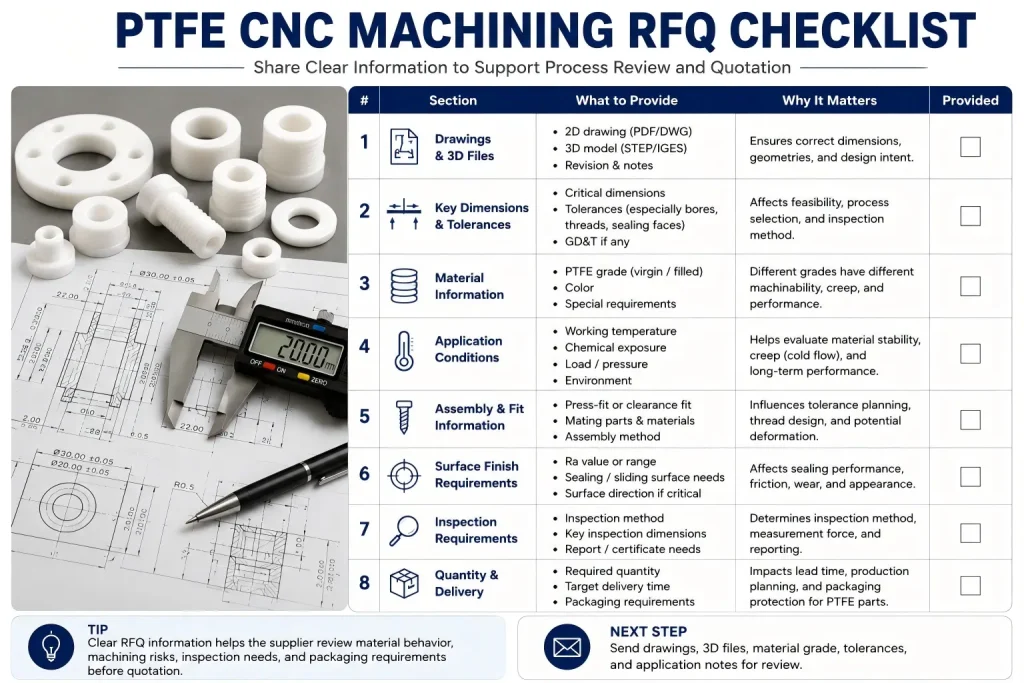
RFQ Checklist for PTFE CNC Machining

Before requesting a PTFE CNC machining quote, provide information that helps the supplier review material behavior and process risk.

询价项目提供什么
2D图方面, 公差, 日期, notes, 表面饰面, and critical features
3D型步 / STP / IGES / X_T file
材质等级Virgin PTFE or filled PTFE grade
颜色Natural white, 黑色的, or specified color if required
数量原型, low-volume batch, 或重复生产
关键特性博雷斯, 线程, 密封面, 薄壁, 压配合, or sliding surfaces
Mating partsShaft, screw, 住房, metal insert, 海豹, or assembly contact
表面光洁度Ra value, visual standard, sealing face requirement, or scratch limit
Thread requirement螺纹尺寸, engagement length, 配合螺丝, and assembly torque if known
Fit requirement清除, sliding fit, 压配合, or functional gap
检验要求CMM, gauge, bore measurement, 螺纹量规, visual inspection, or report
Application conditionChemical exposure, 温度, 加载, 摩擦, 密封, or insulation
后处理打扫, 去毛刺, marking, 包装, 或组装
Delivery targetHelps review process route and inspection timing

A good RFQ does not only say “PTFE part.”

It explains which features must function correctly after machining, 检查, 船运, 和组装.

RFQ checklist for PTFE CNC machining showing 2D drawing, 3D型, PTFE material grade, virgin or filled PTFE, 关键尺寸, 公差, 钻孔, 线程, 密封面, application conditions, 装配配合, 表面饰面, 检查方法, 数量, delivery target, 和包装要求.

Practical Drawing Notes for PTFE Parts

例子 1: 密封面

Marked face is functional sealing surface. Supplier to review flatness, 工具痕迹, 划痕, and packaging protection before production.

This is better than only writing “smooth finish.”

例子 2: Thin-Wall Sleeve

Thin-wall sleeve requires light clamping and final bore inspection after unclamping. Supplier to review roundness and measurement method.

This helps reduce disagreement between machining and inspection results.

例子 3: PTFE Thread

Internal thread is for light assembly only. Supplier to review thread engagement, 毛刺控制, and mating screw before machining.

This avoids treating PTFE threads like metal threads.

例子 4: Filled PTFE Grade

材料: carbon-filled PTFE, 黑色的. Supplier to confirm exact grade, 证书要求, and machining allowance before production.

This prevents grade substitution.

例子 5: Press-Fit Feature

Press-fit area requires application review. PTFE creep and assembly load should be confirmed before final tolerance selection.

This is important because PTFE can deform under long-term pressure.


Packaging and Handling for PTFE Machined Parts

PTFE surfaces can be marked or scratched during handling.

Packaging should be reviewed when the part has:

  • 密封面
  • 装饰表面
  • polished or smooth areas
  • 薄边
  • 小螺纹
  • 精密孔
  • soft contact surfaces
  • cleanroom or fluid-contact requirements

Possible packaging steps include:

  • individual wrapping
  • soft separators
  • protective bags
  • clean handling
  • edge protection
  • avoiding heavy stacking
  • marking orientation for critical surfaces
  • separating metal and plastic parts

Packaging does not improve machining accuracy, but it helps protect the condition achieved during machining and inspection.


Rapid Efficient Support for PTFE CNC Machining

Rapid Efficient can review custom PTFE CNC machined parts according to material grade, 几何学, 宽容, surface requirement, 及检验需求.

We can review:

  • PTFE material grade
  • virgin or filled PTFE requirement
  • CNC milling or turning route
  • thin-wall risks
  • bore and sleeve stability
  • thread design
  • 密封面
  • 夹紧方式
  • 毛刺控制
  • 表面饰面
  • 检查方法
  • 包装需求
  • prototype or low-volume production plan

For prototype and small-batch custom parts, 看看我们的 low-volume CNC machining services 页.

If your PTFE part has threads, 薄壁, 密封面, 紧孔, or press-fit features, send the 2D drawing, 3D型, 材料等级, 数量, and application notes before quotation. We can review the part and suggest a suitable machining route.


Buyer Questions About PTFE CNC Machining

PTFE容易数控机加工吗?

PTFE can be cut with CNC equipment, but it is not always easy to control. The material is soft and flexible, so clamping, 工具锋利度, 毛刺控制, and inspection method matter.

Is PTFE the same as Teflon?

PTFE is the material name. Teflon is a well-known brand name often used in search and buyer RFQs. For manufacturing, the drawing or RFQ should specify the exact PTFE grade, 填料, and certificate requirement if needed.

Can PTFE hold tight tolerances?

PTFE can hold controlled dimensions on suitable features, but tight tolerance depends on part geometry, 壁厚, 夹紧, 材料等级, machining heat, 及检验方法. Thin or flexible features need extra review.

Can PTFE parts have threads?

是的, PTFE parts can have threads, but thread size, engagement length, 配合螺丝, 装配扭矩, and repeated assembly should be reviewed. Small or highly loaded PTFE threads may need design changes or inserts.

Is PTFE good for bushings and sleeves?

PTFE can be used for bushings and sleeves when low friction, 耐化学性, or insulation is needed. 缸径, 圆度, 壁厚, and inspection pressure should be reviewed carefully.

What files should I send for PTFE CNC machining?

Send a 2D drawing, 3D型, 材料等级, filler requirement, 数量, 关键特征, 公差注释, 表面光洁度要求, mating parts, application conditions, 及检验需求.

发表评论

滚动至顶部

获取报价

点击或拖拽文件到该区域即可上传. 您最多可以上传 10 文件.
文件格式:TXT PDF DOC DOCX XLS XLSX PPT PPTX JPG PNG ZIP RAR DWG DXF DXF DWT DWS DWS

3D文件格式: 步, STP, sldprt, IPT, prt, 坐着, IGES, IGS, catpart, X_T, OBJ, STL