Stainless Steel CNC Machining: 304, 316, and 17-4PH Production Risks

Stainless steel is not one machining material.

一个 304 stainless steel housing, 一个 316 medical fitting, and a 17-4PH high-strength shaft may all be called “stainless steel CNC machined parts,” but they do not behave the same way in production.

The wrong process assumption can create tool wear, 加工硬化, poor thread quality, 毛刺, dimensional drift, surface contamination, passivation problems, or inspection disputes.

That is why stainless steel CNC machining should start with one question:

Which stainless steel grade controls the function of this part?

304 is often selected for general corrosion resistance and availability.

316 is often selected when chloride exposure, 医疗的, 海军陆战队, 化学, or more demanding corrosion conditions matter.

17-4PH is usually selected when higher strength and heat-treated performance are required.

Each material can be CNC machined, but each one creates different risks around cutting strategy, 热, 刀具磨损, 毛刺控制, 表面饰面, 钝化, tolerance inspection, 和交付计划.

Rapid Efficient supports custom stainless steel CNC machining projects for prototypes, 小批量零件, 及生产要求. 报价前, we review the drawing together with the stainless steel grade, 公差注释, hole and thread requirements, 表面饰面, passivation needs, 检查方法, packaging needs, 和交货时间表.


Start with the Stainless Grade, Not the Machine

Many RFQs simply say “stainless steel part.”

That is not enough.

A machining supplier still needs to know whether the part is 304, 316, 17-4PH值, 303, 420, 440C, duplex stainless steel, 或其他年级.

The grade affects:

  • 工装
  • 切割速度
  • Work-hardening risk
  • 毛刺形成
  • Thread quality
  • 表面光洁度
  • Passivation route
  • 热处理
  • 检查方法
  • Material certificate requirement
  • Cost and lead time

For broader material planning across stainless steel, 铝, 铜, 黄铜, 塑料, and other CNC materials, 回顾我们的 CNC加工材料指南.


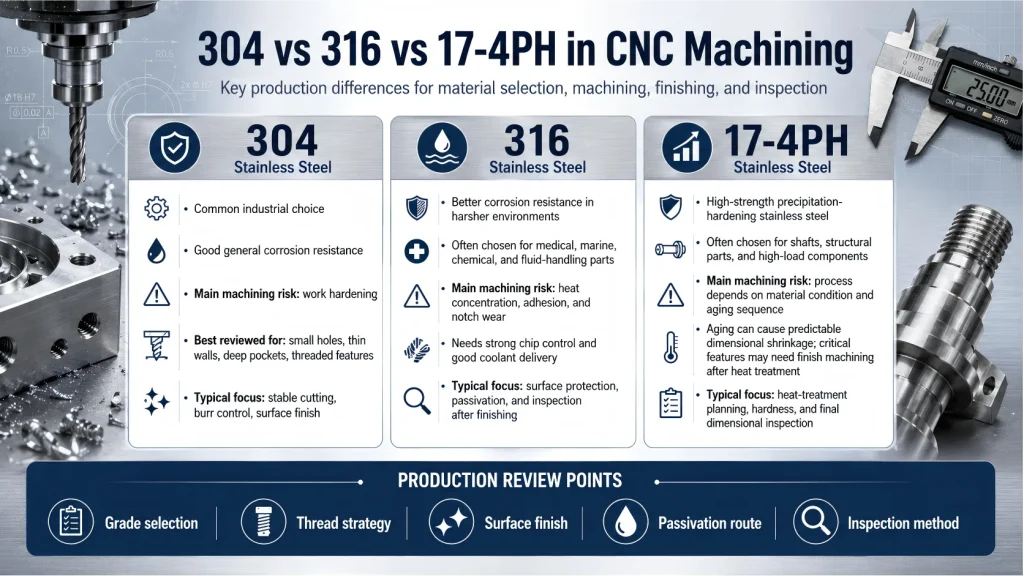
Stainless Steel CNC Machining Decision Map

``
Part Requirement 304 不锈钢 316 不锈钢 17-4PH不锈钢 Production Risk to Review
General corrosion resistance Common choice for many industrial parts. Better when chloride or harsher corrosion exposure matters. Depends on material condition and application. Grade selection, 钝化, exposure environment.
Medical or sanitary parts Possible when the application allows. Often preferred for more demanding corrosion needs. Used in selected high-strength applications. 表面光洁度, 打扫, 钝化, 文档.
高强度 Moderate strength for general stainless parts. Not mainly selected for strength. Higher strength after precipitation hardening. Heat-treated condition, 硬度, 刀具磨损.
Threaded features Work hardening can affect tapping. Tougher cutting behavior may increase thread risk. Machining behavior depends on condition and hardness. Pilot hole, tap/thread mill route, gauge inspection.
严格的公差 Possible with stable process planning. Heat, 刀具磨损, and burrs must be controlled. Requires review before and after aging or heat treatment. 三坐标检测, datum control, sequence planning.
Cosmetic finish Good with controlled machining and finishing. 好的, but handling and passivation should be planned. Finish depends on condition, 硬度, and process route. 划痕, tool marks, contamination, 钝化.
Thin-wall parts Work hardening and deflection risk. Similar or higher cutting difficulty than 304. Strength helps, but machining stress still matters. Fixture support, tool pressure, finishing passes.
后处理 钝化, 抛光, 喷砂, 或涂层. 钝化, 抛光, or electropolishing when required. Heat treatment and passivation route must be defined. Sequence, dimensional change, surface contamination.

This decision map is not a replacement for the drawing. It helps connect material choice with function, 加工路线, 和检查计划.

比较 304, 316, and 17-4PH stainless steel CNC machining considerations including corrosion resistance, 力量, 工装, 精加工, 和检查.

304 不锈钢: Common, Useful, but Easy to Underestimate

304 stainless steel is one of the most common stainless grades used for CNC machined components.

It is often selected for:

  • General industrial parts
  • 外壳
  • 括号
  • Mounting components
  • Food-related equipment parts
  • 自动化组件
  • Medical-related non-implant components
  • 通讯设备零件
  • Custom precision hardware

304 is widely used because it offers a good balance of corrosion resistance, formability, 可用性, 和成本.

But machining 304 stainless steel is not the same as machining aluminum or free-cutting brass.

The main risk is work hardening.

If the tool rubs instead of cutting cleanly, the material surface can become harder. Once this happens, the next cutting pass may face higher cutting force, faster tool wear, worse burrs, and poorer surface finish.

This risk becomes more serious around:

  • Small holes
  • 薄壁
  • 财力雄厚
  • 螺纹孔
  • Finishing passes
  • Interrupted cuts
  • Tool changes
  • Programmed pauses
  • 排屑不良

A stable 304 machining process should maintain cutting action, avoid dwell, control heat, and prevent rubbing.

For parts involving heavy material removal, finishing-pass rubbing, 工具更改, or programmed pauses, review our targeted breakdown of 加工 304 不锈钢 to understand how work hardening starts and how the cutting zone should be protected.


316 不锈钢: Corrosion Advantage with Machining Penalty

316 stainless steel is often selected when corrosion resistance is more important than lowest machining cost.

It contains molybdenum, which improves corrosion resistance in many chloride-containing or harsh environments.

316 is commonly considered for:

  • Medical-device components
  • Marine-related parts
  • Chemical equipment parts
  • Food and beverage equipment
  • Laboratory components
  • Fluid-handling parts
  • Corrosion-sensitive fittings
  • Custom industrial parts exposed to moisture or chemicals

然而, 316 can be more demanding to machine than many buyers expect.

It can be tough, 延展性的, and prone to work hardening if cutting conditions are poor.

Compared with easier-machining metals, 316 may require more careful control of:

  • 刀具锋利度
  • 工具压力
  • 切削热
  • 排屑
  • Coolant strategy
  • Burr removal
  • 表面划痕
  • Thread quality
  • Passivation preparation
  • Inspection after finishing

One reason 316 is difficult is its poor heat dissipation during cutting.

316 stainless steel has much lower thermal conductivity than aluminum, 铜, or free-cutting brass. 加工时, heat can concentrate near the cutting edge and work-hardened surface instead of leaving the cutting zone easily.

This can accelerate:

  • Tool-edge softening
  • 内置边缘
  • Adhesion
  • Notch wear near the depth-of-cut line
  • Poor chip control
  • Torn surface finish
  • 毛刺形成
  • Thread quality problems

为了 316 部分, it is risky to blindly reuse the same cutting assumptions as 304.

The process plan should review:

  • Sharp and suitable stainless-steel tooling
  • Stable chip load
  • Reduced rubbing
  • Controlled tool engagement
  • Coolant delivery to the cutting zone
  • Chip breaking and chip evacuation
  • Tool wear monitoring
  • Finishing allowance
  • Surface finish inspection

When the geometry and equipment support it, precision coolant or high-pressure coolant may help improve chip control and tool life. But coolant alone does not solve a poor cutting strategy.

The machining route still needs the correct tool geometry, 切削参数, setup rigidity, 和检查计划.

为了 316 部分, the machining plan should not only ask whether the shape can be cut.

It should ask whether the part can be cut, deburred, cleaned, passivated, 检查, and packaged without damaging the surfaces that matter.


17-4PH不锈钢: Strength Changes the Process Plan

17-4PH stainless steel is a precipitation-hardening stainless steel.

It is often selected when the part needs higher strength, good corrosion resistance, and controlled mechanical performance.

Typical applications may include:

  • Pins
  • Structural precision parts
  • Aerospace-related hardware where applicable specifications allow
  • 自动化组件
  • High-load mechanical parts
  • 精密治具
  • Pump and valve components
  • Custom industrial components

The key issue is condition.

17-4PH machining behavior depends strongly on whether the material is supplied and machined in a solution-treated, aged, or hardened condition.

Unlike conventional quenched hardening routes that may create more unpredictable distortion, 17-4PH is often controlled through solution treatment and aging.

用于精密 CNC 加工零件, this matters because aging can create a small but measurable dimensional shrinkage. Typical reference data for 17-4PH shows approximately 0.05% shrinkage for H900 and approximately 0.10% shrinkage for H1150.

This does not mean every part will move in the same way.

Part size, 几何学, 库存状况, machining stress, heat-treatment route, fixture support, and tolerance scope still matter. But the shrinkage is predictable enough that it should be considered during process planning instead of discovered after final inspection.

For 17-4PH parts with tight bearing seats, 密封槽, precision shafts, or datum-related features, the machining plan should clarify:

  • Whether the material is supplied in Condition A, H900, H1025, H1150, or another required condition
  • Whether rough machining occurs before aging
  • Whether final machining occurs after aging
  • Which dimensions are critical after heat treatment
  • Whether finishing stock should be left for post-aging machining
  • Whether hardness inspection is required
  • Whether CMM inspection is required after final machining

A practical route may include rough machining in a softer or solution-treated condition, controlled aging, and final finishing of critical features after heat treatment.

The important point is not simply “17-4PH may move.”

The important point is that heat-treatment condition and final inspection dimensions must be defined before quotation.

This affects:

  • Cutting force
  • 刀具磨损
  • 毛刺形成
  • 表面光洁度
  • 尺寸稳定性
  • Heat-treatment sequence
  • Final hardness
  • Inspection plan

For 17-4PH, the RFQ should clarify:

  • Required material condition
  • Whether machining occurs before or after aging
  • Required hardness or mechanical property range
  • Critical dimensions after heat treatment
  • Surface finish requirement
  • Passivation or finishing requirement
  • Inspection-report requirement

If heat treatment occurs after rough machining, dimensional change must be reviewed.

If final machining occurs after hardening, 工装, cycle time, and inspection strategy may change.

17-4PH can be an excellent engineering material, but it should not be quoted as if it behaves like ordinary 304.


Tooling Strategy Must Prevent Rubbing

Stainless steel machining rewards stable cutting and punishes rubbing.

A tool that lightly skims the surface without cutting cleanly may create work hardening.

Once work hardening starts, the next tool or next pass may face a harder surface than expected.

This can lead to:

  • Faster tool wear
  • Chatter
  • 毛刺
  • Poor thread quality
  • Torn surface finish
  • Broken drills
  • Tap failure
  • Oversized or inconsistent features
  • Rework after inspection

A stainless steel CNC process should review:

  • Tool edge sharpness
  • Tool coating selection
  • Tool overhang
  • Rigidity of setup
  • Cutter engagement
  • Chip load
  • 冷却剂输送
  • 切削热
  • Entry and exit strategy
  • Finishing allowance

The goal is not only to cut the shape.

The goal is to keep each cutting pass stable enough that the part remains machinable until final inspection.


洞, 线程数, and Burrs Are High-Risk Features

Many stainless steel CNC parts fail not because of the outside shape, but because of small features.

洞, 线程, 插槽, and cross-drilled features often create the highest risk.

Small Holes

Small holes in stainless steel require careful drilling strategy.

The risk increases when the hole is:

  • Deep
  • Blind
  • Close to a wall
  • Used for a press-fit pin
  • Later tapped
  • Located on a curved or angled surface
  • Required to hold tight position tolerance

Chip evacuation and drill wear matter more than they may seem.

A small drill that rubs or packs chips can create heat, 加工硬化, size variation, and poor hole quality.

Threaded Holes

Threading stainless steel requires more control than threading aluminum or brass.

Thread risk depends on:

  • Pilot-hole size
  • Tap or thread mill selection
  • 螺纹深度
  • Blind-hole clearance
  • 润滑
  • 排屑
  • 材质等级
  • 刀具磨损
  • Thread-gauge requirement
  • Post-finish inspection

For expensive stainless steel parts, thread milling may sometimes reduce broken-tap scrap risk compared with tapping, especially on difficult features or high-value components.

For a detailed process comparison, review our guide on thread milling vs tapping.

Burrs and Edge Quality

Stainless steel burrs can be harder to remove than aluminum burrs.

Aggressive deburring can also create new problems:

  • Rounded functional edges
  • Scratched surfaces
  • Damaged threads
  • Uneven chamfers
  • Changed hole edges
  • Contaminated surfaces before passivation

The drawing should identify which edges require controlled deburring and which edges affect sealing, 集会, 安全, or appearance.

适用于薄壁, small holes, 财力雄厚, chamfers, thread entrances, and deburring access, manufacturability should be reviewed before cutting begins. For drawing-level feature design and DFM planning, 看看我们的 CNC加工设计指南.


Surface Finish Is Not Only Cosmetic

用于不锈钢零件, surface finish affects appearance, corrosion behavior, 打扫, 摩擦, 密封, 和检查.

A part may require:

  • 加工完成
  • 抛光
  • 刷牙
  • 珠光喷砂
  • 电解抛光
  • 钝化
  • Coating
  • Laser marking
  • Controlled cleaning
  • Protective packaging

A surface finish requirement should define more than “nice appearance.”

It should clarify:

  • Required Ra value when applicable
  • Visible surfaces
  • Functional surfaces
  • 密封面
  • Contact areas
  • Threaded features
  • Areas that should not be rounded
  • Areas that require masking
  • Post-finish inspection requirement

For more post-processing options and risks, 回顾我们的 CNC 表面处理指南.


Passivation Requires Clean Machining and Clean Handling

Passivation is often used to improve the corrosion resistance of stainless steel parts by removing free iron and supporting the formation of a protective passive layer.

But passivation does not fix every machining problem.

It does not remove deep scratches.

It does not correct poor burr control.

It does not repair damaged threads.

It does not replace correct material selection.

It also cannot fully solve contamination if the process route has already introduced avoidable foreign iron or poor cleaning.

Before passivation, 审查:

  • Stainless steel grade
  • Surface condition
  • Burr removal
  • Cleaning method
  • Foreign iron contamination risk
  • Shared abrasive tools
  • Threaded features
  • Masking requirement
  • Inspection after passivation
  • Packaging after finishing

For more detail, review our article: 什么是不锈钢钝化以及数控零件什么时候需要它?.


Tolerances Need a Process Plan, Not Just a Number

A stainless steel drawing may call for tight tolerances, but the machining plan determines whether those tolerances are realistic.

Tolerance risk increases when the part includes:

  • 薄壁
  • 财力雄厚
  • 长轴
  • Small holes
  • 螺纹孔
  • Flat sealing faces
  • Multiple datum references
  • Post-machining heat treatment
  • Post-processing after machining
  • Large material-removal volume

Stainless steel can hold precise dimensions, but cutting heat, 刀具磨损, 压力释放, and finishing sequence must be controlled.

对于关键尺寸, 审查:

  • Which features are functional
  • Which dimensions are inspection-critical
  • Whether tolerances apply before or after finishing
  • Whether CMM inspection is required
  • Whether thread gauges or pin gauges are required
  • Whether flatness, 垂直度, or position tolerance is specified
  • Whether the part must be inspected after passivation, 抛光, or heat treatment

For drawing tolerance planning, measurement uncertainty, and inspection limits, 回顾我们的 CNC加工公差指南.


Inspection Should Match the Grade and Function

Inspection for stainless steel CNC parts should match the part’s function.

A simple bracket and a corrosion-sensitive medical fitting should not use the same inspection plan.

Possible inspection items include:

  • Material certificate review
  • Dimensional inspection
  • 三坐标检测
  • Surface finish inspection
  • Thread-gauge inspection
  • Pin-gauge inspection
  • 目视检查
  • 毛刺检查
  • Hardness check for selected 17-4PH requirements
  • Passivation documentation when required
  • Packaging inspection

A stainless steel part may pass dimensional inspection but still fail if the surface is scratched, contaminated, improperly deburred, or not prepared correctly for passivation.

For CMM reports, inspection documentation, 材料证明, and shipment quality review, 看看我们的 质量保证流程.

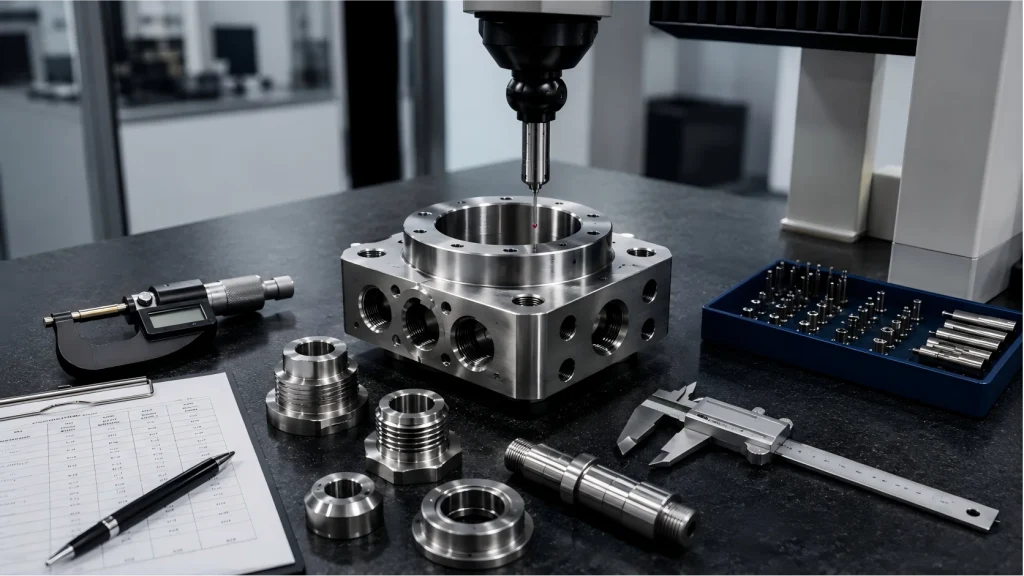
Inspection of stainless steel CNC machined parts for dimensions, 线程, 表面饰面, and delivery quality review.

RFQ Checklist for Stainless Steel CNC Machined Parts

Before requesting a quote, 准备:

  • 2D图
  • 3D CAD文件
  • Stainless steel grade
  • Required material condition
  • 数量
  • 关键尺寸
  • Tight tolerance features
  • Hole sizes and depths
  • 螺纹规格
  • Surface finish requirement
  • Passivation requirement
  • Heat-treatment requirement
  • Hardness requirement when applicable
  • Burr-control notes
  • Cosmetic surface notes
  • Functional surface notes
  • Inspection-report requirement
  • Material-certificate requirement
  • Packaging requirement
  • 目标交货时间表

If the grade is not final, explain the function of the part.

Useful RFQ notes include:

  • “This part will be exposed to chloride environment.”
  • “This part requires passivation after machining.”
  • “This thread must pass gauge inspection.”
  • “This surface is visible after assembly.”
  • “This face is used for sealing.”
  • “Final dimensions apply after heat treatment.”
  • “Material certificate is required.”
  • “CMM report is required for critical dimensions.”

These notes help the supplier choose a safer machining route before production begins.


Stainless Steel CNC Machining Questions Buyers Usually Ask

Is stainless steel harder to machine than aluminum?

是的, in most CNC machining situations.

Stainless steel generally creates higher cutting force, more heat, more tool wear, and greater work-hardening risk than aluminum.

The exact difficulty depends on the grade, 零件几何形状, 公差要求, 工装, 和表面饰面.

Which stainless steel is easiest to CNC machine?

Free-machining stainless grades are usually easier than common austenitic grades such as 304 或者 316.

然而, the easiest machining grade is not always the right grade for corrosion resistance, 力量, compliance, or customer specification.

Material selection should follow the function of the part.

是 316 stainless steel harder to machine than 304?

316 is often more demanding than 304 because it can be tougher, less forgiving during cutting, and more corrosion-focused.

Both 304 和 316 can work harden if the tool rubs instead of cutting cleanly.

用于数控加工, the difference should be reviewed together with part geometry, 孔深, thread requirements, 表面饰面, 及检验方法.

Can stainless steel parts be passivated after CNC machining?

是的.

Many stainless steel CNC machined parts can be passivated after machining, but the surface should be properly cleaned and free from avoidable contamination.

Passivation should be planned together with deburring, 打扫, 表面饰面, 及检验要求.

Do stainless steel CNC parts need CMM inspection?

Not every stainless steel part needs CMM inspection.

CMM inspection is more useful when the part has tight tolerances, datum-related features, position tolerance, 复杂的几何形状, or critical assembly relationships.

Other features may require thread gauges, 针规, surface inspection, or visual inspection.


Upload Your Stainless Steel Part Drawing for Review

发送您的 2D 绘图, 3D CAD文件, stainless steel grade, 数量, 公差注释, thread requirements, 表面饰面, passivation needs, 检验要求, 及交付目标.

Our team will review material behavior, 加工策略, burr-control risk, finishing sequence, 检查方法, packaging needs, 以及报价前的交货时间表.

号召性用语按钮: Upload Your Drawing


关于快速高效

Rapid Efficient 支持原型的定制 CNC 加工项目, 小批量零件, 及生产要求.

和 18 多年高精度CNC加工经验, 我们的团队审查物质行为, 加工策略, 耐受风险, 后处理要求, 检查方法, 包装条件, 和报价前的交货时间表.

我们的可用功能包括 4 轴, 5-轴, 和多轴数控加工, 连同CMM等检测设备, 投影仪, 和光谱仪.

根据实际零件和项目要求, 加工精度低至 0.01 毫米 和检查精度低至 0.001 毫米 可用.

快速高效已获得 ISO 9001ISO 14001 认证.

我们支持跨医疗设备的项目, 通讯设备, 光学元件, 无人机, 智能机器人, 汽车应用, 办公自动化, 和其他定制制造要求.
发表评论

滚动至顶部

获取报价

点击或拖拽文件到该区域即可上传. 您最多可以上传 10 文件.
文件格式:TXT PDF DOC DOCX XLS XLSX PPT PPTX JPG PNG ZIP RAR DWG DXF DXF DWT DWS DWS

3D文件格式: 步, STP, sldprt, IPT, prt, 坐着, IGES, IGS, catpart, X_T, OBJ, STL