
1018 is often a practical choice for machined parts that need welding, forming, or general mechanical service without a demanding hardening requirement. 1045 deserves closer consideration when a shaft or pin needs a stronger heat-treatment response or a locally hardened wear surface. The useful purchase decision includes the supplied condition, treatment route, and finished dimensions—not just the grade number.
Both are plain-carbon steels. Neither a higher grade number nor a harder surface proves that a finished component will meet its load, wear, or life requirement. A quotation for an untreated 1045 pin is also a different offer from one for an induction-hardened, finish-ground 1045 pin.
For a 1018 vs 1045 comparison, first decide which result the additional processing must deliver. Then compare the cost of getting each suitable option to that same acceptance point.
Decide Whether the Part Needs Strength, a Wear Surface, or a Weld
A pin can perform several jobs at once. Its body carries load, its outside diameter may slide against a bushing, and its end may be retained mechanically or attached to a fabrication. Those requirements do not necessarily favor the same material route.
Niagara LaSalle’s steel-grade summaries distinguish low-carbon 1018, including its case-hardening and welding uses, from medium-carbon 1045, which responds to conventional quenching and is used for induction hardening. These are useful selection directions, not finished-part performance guarantees.
| What the part must do | Where 1018 deserves consideration | Where 1045 deserves consideration | What must be established before purchase |
|---|---|---|---|
| Serve as a spacer, sleeve, or lightly loaded pin | When the supplied condition meets the mechanical requirements without added hardening | When a defined strength or hardness requirement justifies the different grade or condition | Required properties and whether heat treatment is actually needed |
| Provide a hard surface against sliding contact | A carburized and hardened surface may suit the application | An induction-hardened contact region may suit the application | Surface hardness, effective hardened depth, core requirements, and mating conditions |
| Form part of a welded assembly | Its lower carbon content generally provides a more favorable welding starting point | It may be suitable with an appropriate welding procedure and property review | Joint geometry, restraint, initial condition, and properties after welding |
| Carry bending or torsional load | It remains a candidate if verified properties and geometry satisfy the load case | A specified heat-treated condition may provide useful strength | Section size, loading, fatigue requirements, and the final material condition |
Strength and stiffness also need separate checks. If a shaft bends too far while remaining elastic, changing from 1018 to 1045 generally provides little change in elastic modulus. Diameter, unsupported length, and support arrangement may be more effective design variables. A higher yield strength can delay permanent deformation without producing a comparable reduction in elastic deflection.
Neither grade provides stainless-steel corrosion resistance. If moisture or chemicals drive the selection, assess protection and the service environment separately. Increasing hardness does not solve a corrosion requirement.
Choose the grade for the property the part needs, then specify the condition that provides it.
1018 and 1045 Reach a Hard Surface Differently
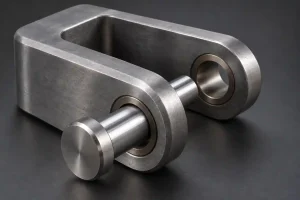
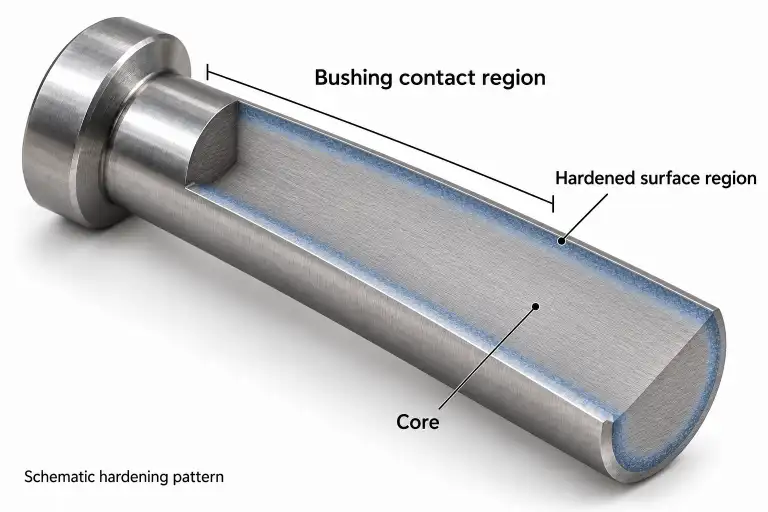
Consider an illustrative pivot pin running in a bushing. This is a design example, not a reported customer project. Assume the contact surface needs hardening, while the pin must also carry load through its core.
For 1018, carburizing is a possible route. Carbon is introduced into the surface before hardening, allowing a hard outer case to develop around a lower-carbon core. Simply quenching untreated 1018 should not be expected to produce the same result. The carburizing, hardening, and tempering requirements belong in the process definition.
For 1045, induction hardening is a possible route. Local heating followed by quenching can harden a selected region using the carbon already present in the steel. Bodycote’s heat-treatment glossary explains this distinction between carburizing and induction hardening. The processes should not be treated as interchangeable notes on a quotation.
A common surface-hardness requirement does not make the two finished pins equivalent. The hardened depth, transition into the core, core properties, and permitted treatment pattern can differ. The engineering review must establish whether either route meets the actual contact and loading conditions.
For the pin, identify where the bushing runs and where that contact ends. Also identify nearby shoulders, grooves, cross holes, and threads. A broad instruction to “harden the pin” leaves the supplier to guess which areas need treatment and which must remain suitable for later operations.
Specify the hardened region and its required depth in the final finished condition. If the journal will be ground after treatment, the remaining hardened layer must still meet the requirement after that material is removed. A hardness result taken on an unrelated end face does not establish the condition of the journal.
1045 can also be quenched and tempered for strength, but this does not establish uniform properties through every section size. When core properties are important, agree on the required result and how it will be verified. If the section or loading calls for an alloy-steel route, the 4130 vs 4140 comparison addresses a separate selection decision.
Name the Supplied Condition Before Comparing Machining Cost
“1018” and “1045” identify grades, not complete machining conditions. Ask whether the quotation assumes hot-rolled, cold-drawn, annealed, normalized, or quenched-and-tempered stock, as applicable to the product being offered.
Cold drawing changes mechanical properties as well as dimensions. Turning or grinding a bar to size is a different operation. The label “cold finished” therefore needs enough detail to identify what has actually been supplied.
This matters when comparing strength data. A cold-drawn value for one grade and an annealed or hot-rolled value for the other do not isolate the effect of grade. Published typical values also should not be copied into an acceptance specification without checking the product standard, size range, and test conditions.
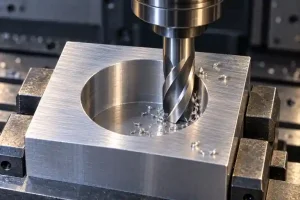
For machining, avoid the assumption that lower hardness automatically gives the lowest finished-part cost. Chip control, burr removal, stock surface condition, workholding, and required finish still affect the cycle. Both 1018 and 1045 can be CNC machined in suitable conditions. Neither grade name supplies a universal cutting speed or tool-life prediction.
A tighter supplied bar diameter may reduce roughing on a simple pin. That advantage becomes smaller if most of the outside diameter must be removed or if the journal must later be ground after hardening. Confirm which supplied surfaces can remain on the finished part before paying for precision stock.
Welding changes the comparison again. 1018 is generally more accommodating, while 1045 requires closer attention to weld-zone hardening and cracking risk. Preheat, consumables, heat input, cooling, and any later treatment must follow the applicable procedure. Do not assume that replacing a welded 1018 component with 1045 preserves the original welding plan or final properties.
For either grade, critical fits should be accepted after the operations that can change them. The shaft machining sequence guide explains how turning, secondary features, heat treatment, and grinding fit into a manufacturing plan.
Compare Finished-Part Quotes, Not Bar Prices
There is no dependable fixed price premium for choosing 1045 over 1018. Bar size, supplied condition, available quantity, processing, and order volume can change the comparison. A current quotation for the required stock and finished part is more useful than a general price-per-kilogram ranking.
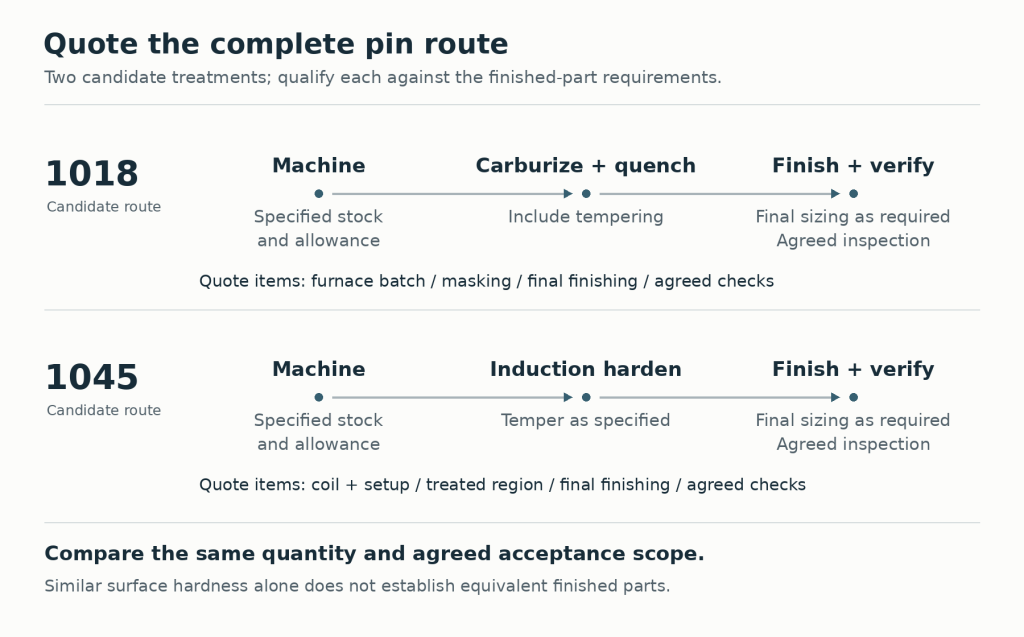
Return to the pivot pin. Suppose engineering has identified two potentially acceptable options: carburized 1018 and induction-hardened 1045. The next step is to price and verify those specific routes. This does not assume that they have already been approved as equivalent.
| Quote item for the hardened pivot pin | 1018 carburizing route | 1045 induction-hardening route |
|---|---|---|
| Starting material | Identify bar specification, condition, and machining allowance | Identify bar specification, condition, and machining allowance |
| Treatment scope | Define carburized surfaces, any protected areas, hardening, and tempering | Define the heated band, hardening pattern, quench requirements, and tempering where specified |
| Treatment setup and batch charges | Confirm furnace-batch charges and any masking or handling work | Confirm coil or setup charges and whether existing tooling suits the pin geometry |
| Final journal sizing | Include finishing that leaves the required case depth | Include finishing that preserves the required hardened depth and pattern |
| Acceptance evidence | Define case-depth, surface-hardness, core-property, and dimensional checks as required | Define hardened-depth, surface-hardness, core-property, and dimensional checks as required |
Compare the cost per accepted, finished pin at the same order quantity and inspection scope. A quote that stops after turning cannot be compared directly with one that includes treatment, grinding, and the required reports.
For a small order, minimum treatment charges or dedicated induction setup may matter more than the material-price difference. On repeat orders, clarify which setup costs recur, whether tooling remains available, and whether a change in pin diameter requires a new review. Do not assume that the first-order price and repeat-order price contain the same cost items.
The original acceptance requirement should remain visible beside any lower-cost alternative. If a supplier proposes deleting grinding, changing the hardened depth, or supplying untreated material, record the change explicitly. Those proposals change the delivered part rather than merely reducing the price of the same work.
If the pin does not need a hard wear surface, omit these treatment routes from the comparison. Adding heat treatment to both options just to make the quotation look comprehensive creates cost without establishing a functional benefit.
Approve the Material Substitution with the Finished Condition
A purchase instruction such as “1018 or 1045, whichever is available” leaves a significant design choice unresolved. If both are permitted, state the separate conditions and requirements under which each option is acceptable.
Likewise, a proposed regional substitute should be checked against its governing specification. A cross-reference label does not by itself establish matching chemistry limits, product form, supplied condition, or mechanical properties. Obtain approval for the actual substitution before production.
For a hardened pin, acceptance should connect the material record to the finished component and the specified treated region. Agree on hardness-test locations, depth verification where required, and the dimensions that apply after treatment and finishing. A material certificate does not prove that a later hardening operation produced the required case, and a surface-hardness reading alone does not prove its depth.
For a CNC turning quotation, send the pin or shaft drawing with its mating bushing, loaded span, wear-contact region, welding requirements, and proposed material condition. Identify any required hardened depth and which diameters must be finished after treatment. RapidEfficient can review the machining and secondary-processing scope so that 1018 and 1045 options are quoted against clearly stated finished-part requirements.