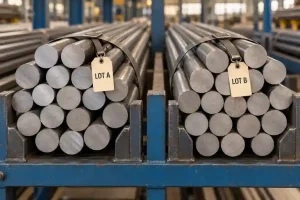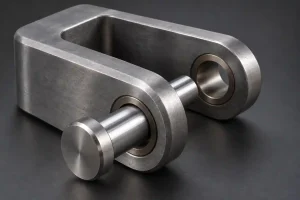

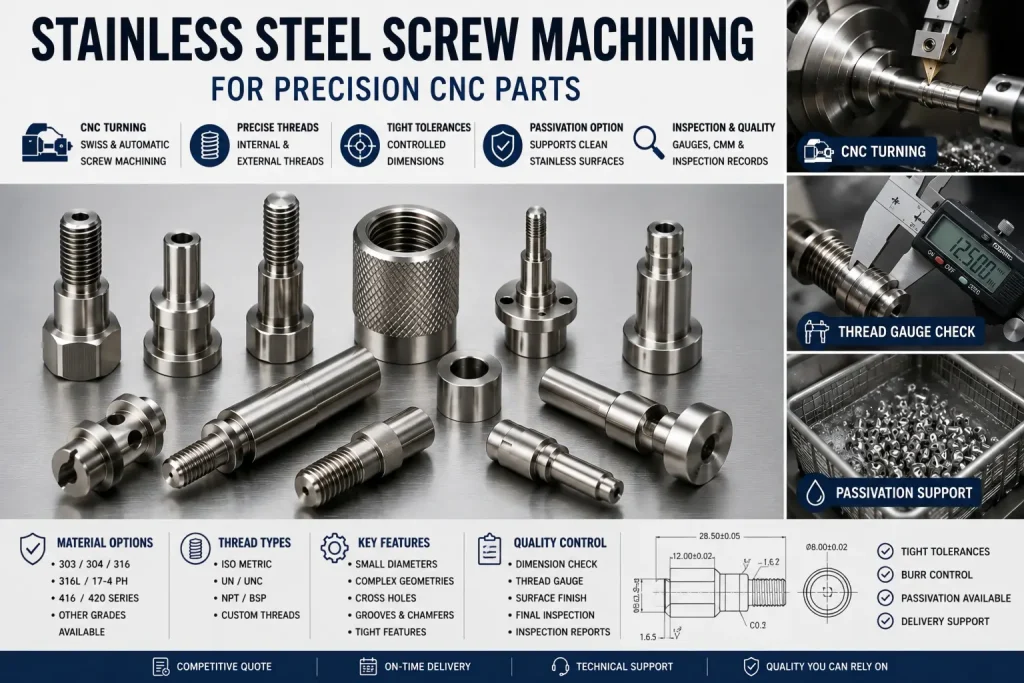
Stainless steel screw machining is often used for small turned parts, threaded components, shafts, pins, sleeves, inserts, spacers, connectors, and precision hardware.
But the word screw machining can be confusing.
It does not only mean “making screws.” In many manufacturing discussions, screw machining means producing small parts from bar stock using turning, drilling, threading, grooving, chamfering, and sometimes secondary milling operations.
For buyers, the important question is not only:
Can this part be made from stainless steel?
The better question is:
Can the stainless grade, thread design, burr control, surface finish, passivation, and inspection method support repeatable production?
What Screw Machining Means for Stainless Steel Parts
Screw machining usually refers to repeatable production of small precision parts, often from round bar stock. The process may use CNC turning, Swiss-type turning, automatic screw machines, live tooling, cross drilling, tapping, thread milling, thread turning, parting, and secondary deburring.
For stainless steel parts, this process can work very well, but small details matter.
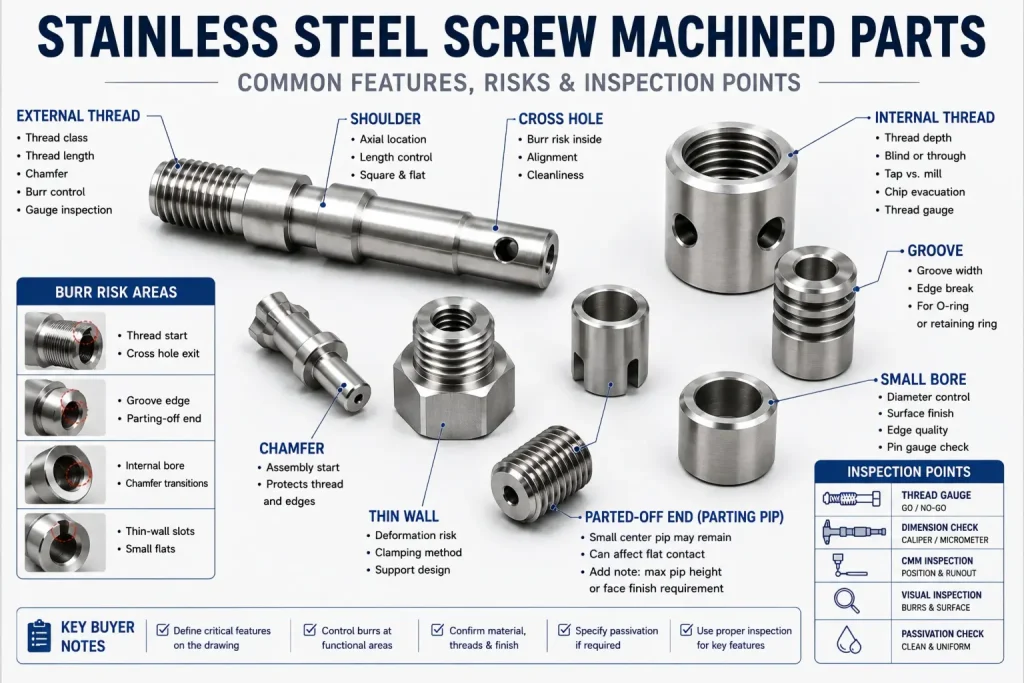
A simple-looking part may include several functional features:
| Feature | Why It Matters |
|---|---|
| External thread | Controls assembly, torque, fit, and gauge acceptance |
| Internal thread | Can fail from chip packing, tap breakage, or poor thread depth |
| Small bore | May need tight diameter control and clean edges |
| Shoulder | Controls axial location or mating part position |
| Groove | May hold an O-ring, clip, seal, or retaining feature |
| Cross hole | Creates burr risk inside the part |
| Chamfer | Helps assembly and protects thread starts |
| Thin wall | Can deform during clamping or cutting |
| Small pin diameter | May bend or run out if unsupported |
| Parted-off end | Often needs burr control and finish review |
One small feature to review is the parted-off end. When a small pin, spacer, shaft, or insert is cut from bar stock, a tiny center mark or small material nub can sometimes remain on the end face. This is often called a parting pip.
For many general parts, this small mark may not matter. But if the end face must sit flat against another component, the pip can create rocking, poor contact, or slight assembly misalignment.
The drawing does not need to explain the lathe tool path. However, when flat contact matters, buyers can add a simple note such as maximum allowed pip height, flush end face, or secondary facing required. This helps the supplier decide whether standard parting is enough or whether an extra facing operation is needed.
The key point is that screw machining is about repeatable small-part production, not only about making screws.
Stainless Steel Is Useful, but It Is Not Always Easy to Machine
Stainless steel is selected when the part needs corrosion resistance, strength, appearance, cleanliness, heat resistance, or long service life.
But stainless steel can also create machining problems, especially on small parts with threads, grooves, tight bores, or thin features.
Common production risks include:
| Risk | What Happens in Production |
|---|---|
| Work hardening | The surface becomes harder if the tool rubs instead of cutting cleanly |
| Heat buildup | Tool life drops and dimensions may drift |
| Long chips | Chips can wrap around small features or damage threads |
| Burrs | Edges, holes, threads, and grooves may need controlled deburring |
| Tool wear | Thread quality and surface finish can change across a batch |
| Galling | Stainless threads may seize during assembly if fit or finish is poor |
| Passivation marks | Poor cleaning before passivation can leave stains or inconsistent finish |
| Small-part handling damage | Threads and cosmetic surfaces can be scratched during tumbling or packing |
Stainless steel screw machining is practical when the material grade, toolpath, thread method, edge break, and inspection plan are reviewed together. It becomes risky when the drawing only says “stainless steel part” without explaining the functional features.
For general stainless material behavior, see our stainless steel CNC machining guide.
Choosing the Stainless Grade Before Machining
The stainless grade should be selected before the quote is finalized. Different grades behave differently in machining, threading, corrosion resistance, passivation, and cost.
| Stainless Grade | Typical Use in Screw Machined Parts | Main Buyer Check |
|---|---|---|
| 303 stainless steel | Easy-machining small turned parts, fittings, spacers, inserts | Good machinability, but confirm corrosion and welding needs |
| 304 stainless steel | General corrosion-resistant hardware and small CNC parts | More common, but can work harden and form burrs |
| 316 stainless steel | Marine, medical, chemical, or higher corrosion applications | Harder to machine than 303/304 in many cases |
| 316L stainless steel | Parts needing low carbon and corrosion-related control | Confirm passivation and documentation needs |
| 17-4 PH stainless steel | Stronger parts, pins, shafts, high-load components | Heat treatment condition matters |
| 416 stainless steel | Free-machining martensitic stainless parts | Confirm corrosion and mechanical requirements |
| 420 / 440 series | Wear or hardness-focused parts | Heat treatment and grinding may be needed |
For 303 stainless steel, machinability and corrosion expectations should be reviewed together. 303 is easier to machine because it contains sulfur, which helps chips break more cleanly during cutting. This can be useful for high-volume screw machined parts.
The trade-off is that sulfur-related inclusions can sometimes affect corrosion behavior and surface appearance after cleaning or passivation. In some cases, small local pits, staining, or cosmetic marks may appear, especially when the part is used in humid or appearance-sensitive environments.
This does not mean 303 stainless steel is a bad choice. It means the buyer should confirm whether easy machining, low cost, cosmetic appearance, corrosion resistance, or passivation quality is more important for the part. If both high machinability and strict cosmetic corrosion resistance are needed, the RFQ should say so before the supplier selects the stainless grade and finishing route.
If the part is mainly about easy machining and cost, 303 may be considered. If corrosion resistance, cleaning, welding, or general availability matters more, 304 or 316 may be better. If high strength is needed, 17-4 PH may be reviewed.
Do not choose the stainless grade only by price. For screw machined parts, grade choice affects chip control, burr formation, thread quality, passivation, inspection, and lead time.
For stronger stainless applications, see our 17-4 PH stainless steel machining article.
External Threads Need More Than a Thread Size
Many screw machined parts include external threads. These may be made by single-point turning, thread rolling, die threading, thread milling, or another process depending on the part, material, quantity, and supplier setup.
For CNC precision parts, external thread quality is affected by:
| Item | Why It Matters |
|---|---|
| Thread size and pitch | Defines the basic fit and mating hardware |
| Thread class | Controls fit tightness and gauge acceptance |
| Thread length | Affects usable engagement |
| Shoulder relief | Gives the tool a safe place to end the thread |
| Entry chamfer | Helps assembly and protects the first thread |
| Burr control | Prevents thread start damage and poor assembly |
| Surface finish | Affects feel, friction, and galling risk |
| Passivation or coating | May slightly affect thread surface condition |
| Inspection gauge | Confirms thread acceptance method |
| Mating part | Helps decide whether fit should be loose, standard, or controlled |
A thread note such as M6 × 1.0 or 1/4-20 UNC is not always enough. If the thread must pass a gauge, hold torque, avoid galling, or mate with a customer component, the drawing should define the thread class, thread length, chamfer, and inspection requirement.
If external threads are made by thread rolling instead of cutting, the blank diameter before rolling becomes very important. Thread rolling does not remove material in the same way as single-point cutting. It forms the thread by displacing material with rolling dies.
This can reduce cutting burrs and may be useful for high-volume threaded hardware, but it also requires good control of the pre-thread diameter. If the blank diameter is too small, the thread crest may not fully form. If it is too large, rolling force, thread shape, or gauge fit may become difficult to control.
Buyers do not need to choose the thread-making method in every case. But for high-volume stainless threaded parts, it is useful to state whether rolled threads are acceptable, whether cut threads are required, and how the thread will be inspected. This helps the supplier plan bar preparation, tooling, and gauge checks early.
For internal threading choices, review our thread milling vs tapping guide.
Internal Threads, Blind Holes, and Tap Breakage Risk
Internal threads in stainless steel need special attention. Small holes, deep threads, blind holes, and tough stainless grades can increase risk.
Tapping may be efficient for many small internal threads. Thread milling may be safer for some larger threads, blind holes, expensive parts, difficult materials, or parts where broken taps would create costly scrap.
| Threading Situation | Buyer Concern |
|---|---|
| Small tapped hole | Tap breakage or poor chip evacuation |
| Deep blind thread | Chip packing and incomplete thread depth |
| Thread close to bottom | Need enough drill depth and clearance |
| Thread in 304 or 316 | Work hardening and tool wear risk |
| Thread after passivation | Cleaning and finish condition should be controlled |
| Critical thread | GO / NO-GO gauge or thread report may be needed |
| Thin-wall threaded area | Distortion or breakout risk |
| Cross hole near thread | Burrs may interfere with assembly |
The drawing should show whether the thread is blind or through, the full thread depth, the drill depth if blind, the thread class, and the inspection method.
For basic terminology, see our tapped hole vs threaded hole article.
Burrs Are a Major Risk on Small Stainless Parts
Small stainless steel parts can look clean from a distance but still fail because of burrs.
Burrs can appear at:
| Burr Location | Possible Problem |
|---|---|
| Thread start | Poor assembly or gauge failure |
| Cross hole exit | Scratches mating shaft or blocks fluid path |
| Groove edge | Damages O-ring, seal, or retaining clip |
| Parting-off end | Sharp edge or cosmetic issue |
| Internal bore | Interferes with pin, shaft, or flow |
| Chamfer transition | Uneven assembly feel |
| Thin-wall slot | Distortion or edge cracking |
| Small flat milled on round part | Raised edge affects contact |
Deburring stainless steel is not only about making the part look better. It can affect fit, sealing, safety, cleanliness, and assembly.
The buyer should mark critical burr-free edges on the drawing. If all edges must be broken, the drawing should say so, but very aggressive edge breaking can also change small dimensions.
For broader burr control planning, see our what is deburring guide.
Work Hardening and Tool Wear Can Change Batch Consistency
Stainless steel can work harden if the cutting edge rubs instead of cutting cleanly. This is especially important for small turned features, threads, grooves, and second operations.
In repeat production, tool wear can change the part gradually across the batch.
For example:
| Production Change | Possible Result |
|---|---|
| Tool edge becomes dull | More heat, burrs, and poor finish |
| Insert wears during turning | Diameter may drift |
| Tap starts to wear | Thread quality becomes inconsistent |
| Chip evacuation gets worse | Scratches, broken tools, or poor thread finish |
| Coolant access is poor | Heat buildup and unstable cutting |
| Part support is weak | Runout or chatter marks |
| Small feature is cut too lightly | Rubbing and work-hardened surface |
This does not mean stainless steel screw machining is unreliable. It means the process needs stable tooling, sharp cutting edges, correct feeds, coolant, chip control, and inspection at the right points in the batch.
For repeat orders, buyers may ask the supplier to define critical dimensions, gauge checks, and sampling requirements before production.
Passivation and Cleaning Should Be Planned Early
Many stainless steel parts need passivation after machining. Passivation helps remove free iron and surface contaminants so the stainless surface can maintain better corrosion resistance.
But passivation is not a magic repair step. It does not fix burrs, scratches, tool marks, thread damage, or poor cleaning inside blind holes.
Before passivation, the part should be properly cleaned. Small screw machined parts may have cutting oil, chips, polishing residue, burr particles, or thread contamination.
| Passivation Check | Why It Matters |
|---|---|
| Stainless grade | Different grades may need different treatment review |
| Free-machining grade | 303 may need corrosion review because of sulfur content |
| Blind holes | Fluids may be trapped if cleaning is poor |
| Internal threads | Residue can remain in root areas |
| Small bores | Cleaning and drying should be controlled |
| Cosmetic surfaces | Staining or uneven finish may be unacceptable |
| Critical corrosion use | Testing or certification may be requested |
| Packaging after passivation | Poor packing can recontaminate the surface |
If passivation is required, the RFQ should state the standard, test requirement, cosmetic expectation, and whether the part must be cleaned, dried, and packed in a controlled way.
For stainless passivation basics, see our stainless steel passivation article.
Tolerances for Screw Machined Stainless Parts
Small screw machined parts often include several tolerances on one part: diameter, length, thread, concentricity, runout, groove width, bore size, chamfer, and surface finish.
The tightest tolerance is not always the most important tolerance.
A small shaft may need good diameter control. A threaded insert may need thread gauge acceptance. A sleeve may need bore size and concentricity. A connector may need burr-free cross holes and clean contact surfaces.
| Feature | Common Tolerance Concern |
|---|---|
| Turned outside diameter | Fit, sliding, press fit, or bearing contact |
| Internal bore | Pin fit, flow path, or assembly alignment |
| Thread | Gauge acceptance and engagement |
| Shoulder length | Axial location |
| Groove width | Seal or retaining ring fit |
| Overall length | Assembly stack-up |
| Concentricity / runout | Rotational performance |
| Chamfer | Assembly start and edge safety |
| Cross hole position | Pin or fastener alignment |
| Surface finish | Sliding, sealing, cosmetic, or contact behavior |
Do not apply tight tolerances everywhere. Define the features that actually control fit, sealing, sliding, or assembly.
For tolerance planning, see our CNC machining tolerances guide.
Inspection Should Match the Part Function
Inspection for stainless steel screw machined parts should match the feature that creates risk.
A cosmetic spacer does not need the same inspection plan as a medical connector, pressure fitting, precision shaft, or threaded insert.
| Inspection Item | When It Helps |
|---|---|
| Caliper or micrometer | General diameter and length checks |
| Pin gauge | Small bore or hole acceptance |
| Thread GO / NO-GO gauge | Internal or external thread acceptance |
| CMM inspection | Position, concentricity, complex geometry, or reported dimensions |
| Optical inspection | Small burrs, slots, grooves, and cosmetic areas |
| Surface roughness tester | Sliding, sealing, or visible machined surfaces |
| Passivation test | Corrosion-related or customer-controlled stainless parts |
| Material certificate | Grade confirmation and compliance |
| First article inspection | New production part or critical batch |
| Sampling report | Repeat production and batch consistency |
The inspection method should be agreed before production. If a buyer needs a thread gauge report, material certificate, passivation confirmation, or CMM report, it should be included in the RFQ.
For inspection and documentation support, see our quality assurance page.
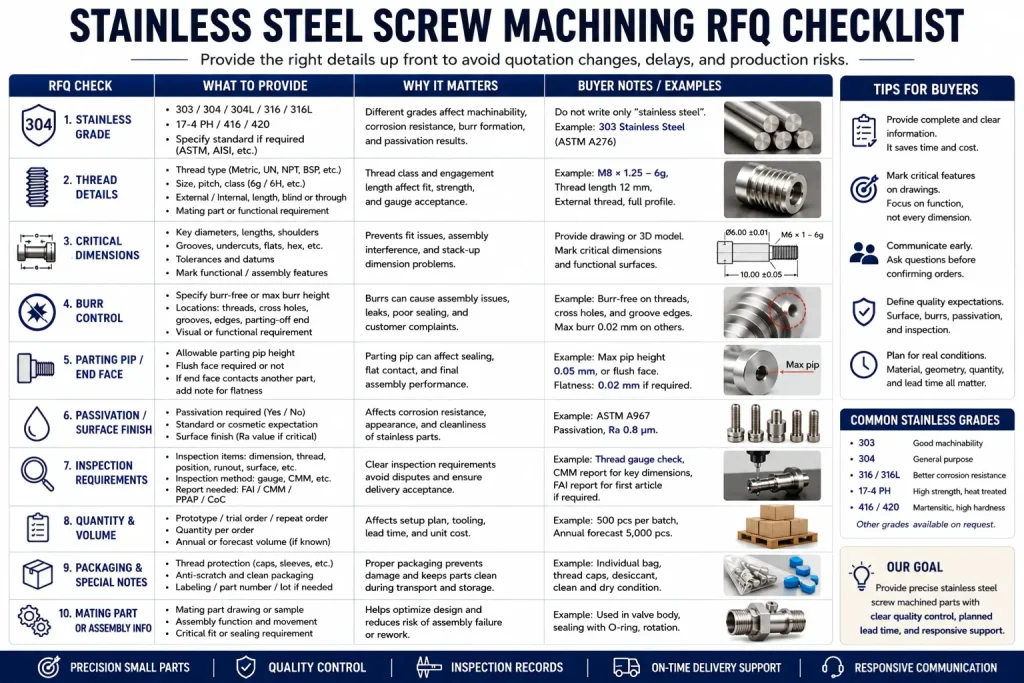
Buyer RFQ Checks for Stainless Steel Screw Machined Parts
Before sending an RFQ, check whether the drawing and part information are complete enough for stable quotation.
| RFQ Check | What to Provide |
|---|---|
| Stainless grade | 303, 304, 316, 316L, 17-4 PH, 416, or another controlled grade |
| Stock form | Bar, rod, tube, or customer-specified material |
| Thread details | Size, pitch, thread class, thread length, blind or through |
| Critical dimensions | Diameters, bores, shoulders, grooves, or lengths that affect fit |
| Burr control | Edges, holes, threads, grooves, and cross holes that must be clean |
| Surface finish | Ra/Rz or cosmetic requirement if needed |
| Passivation | Standard, test, cosmetic expectation, and packaging needs |
| Inspection | Gauge, CMM, material certificate, FAI, or sampling report |
| Quantity | Prototype, low-volume batch, or repeat production |
| Mating parts | Threaded nut, shaft, bearing, seal, pin, connector, or customer part |
| Packaging | Thread protection, scratch prevention, cleanliness, and labeling |
The goal is not to send more information than needed, but to remove the hidden details that usually cause scrap, rework, or quotation changes.
Practical Examples
Example 1: Stainless Threaded Spacer
A threaded spacer may look simple, but the thread class, burr control, overall length, and end-face flatness can affect assembly.
Useful RFQ notes:
| Item | Suggested Detail |
|---|---|
| Material | 303 or 304 stainless steel, as required |
| Thread | Internal or external thread size and class |
| Edge condition | Deburr both ends and thread starts |
| Inspection | Thread gauge and key length check |
| Finish | Clean machined finish or passivation if required |
Example 2: 316 Stainless Connector Pin
A connector pin may need corrosion resistance, clean surface finish, and controlled diameter.
Useful RFQ notes:
| Item | Suggested Detail |
|---|---|
| Material | 316 or 316L stainless steel |
| Diameter | Mark critical fit diameter |
| Surface finish | Define if sliding or contact surface matters |
| Passivation | Required if corrosion resistance is important |
| Inspection | Micrometer, gauge, or CMM depending on feature |
Example 3: 17-4 PH Stainless Small Shaft
A 17-4 PH shaft may need strength, hardness, and stable final dimensions.
Useful RFQ notes:
| Item | Suggested Detail |
|---|---|
| Material | 17-4 PH stainless steel |
| Heat treatment | H900, H1025, H1150, or required condition |
| Critical diameter | Define final tolerance after heat treatment if needed |
| Runout | Add if rotational performance matters |
| Inspection | CMM or runout check for critical parts |
Example 4: Cross-Drilled Stainless Sleeve
A sleeve with a cross hole often has burr risk inside the bore.
Useful RFQ notes:
| Item | Suggested Detail |
|---|---|
| Bore | Define diameter and finish if functional |
| Cross hole | Mark internal burr-free requirement |
| Edge break | Specify controlled deburring |
| Inspection | Pin gauge, visual inspection, or borescope if critical |
| Cleaning | Remove chips and burr particles before packing |
Common Buyer Mistakes
Mistake 1: Only Writing “Stainless Steel”
“Stainless steel” is not a material specification. The drawing or RFQ should state the grade, such as 303, 304, 316, 316L, 17-4 PH, or another required alloy.
Mistake 2: Ignoring Thread Class
A thread size alone may not define the required fit. Add thread class, thread length, and inspection requirement when the thread is functional.
Mistake 3: Treating Burrs as Cosmetic Only
On small stainless parts, burrs can block assembly, damage seals, scratch mating parts, or cause thread gauge failure.
Mistake 4: Asking for Passivation Without Cleaning Details
Passivation works best when the part is clean before treatment. Oil, chips, burr particles, and trapped residue can create problems.
Mistake 5: Applying Tight Tolerances Everywhere
Tight tolerance should be used where function requires it. Over-controlling non-critical dimensions can increase cost and lead time.
Rapid Efficient Support for Stainless Steel Screw Machining
Rapid Efficient can support stainless steel screw machined parts, CNC turned components, threaded inserts, shafts, pins, sleeves, connectors, spacers, and small precision hardware.
We can review stainless grade, thread requirements, small features, burr control, passivation needs, surface finish, tolerance, inspection method, and packaging before quotation.
Send us your STEP file, 2D drawing, stainless grade, thread notes, critical dimensions, quantity, passivation requirement, and inspection needs. Our team can review the machining route and provide feedback before production.
For turning-related part planning, see our CNC turning parts guide.
FAQ
What does stainless steel screw machining mean?
Stainless steel screw machining usually means producing small precision parts from stainless bar stock using turning, threading, drilling, grooving, chamfering, and related operations. It does not only mean making screws.
Which stainless steel is best for screw machining?
303 stainless steel is often easier to machine, but 304, 316, 316L, 17-4 PH, 416, and other grades may be better depending on corrosion resistance, strength, passivation, welding, hardness, and application needs.
Is 304 stainless steel good for screw machined parts?
304 stainless steel can be used for many screw machined parts, but it may work harden and form burrs if the process is not controlled. It is common when general corrosion resistance and availability matter.
Is 316 stainless steel harder to machine than 304?
316 stainless steel is often more difficult to machine than 304 because it is tougher and more prone to heat and work-hardening issues. It is usually selected for higher corrosion resistance, not for easy machining.
Why do stainless steel threads fail?
Stainless steel threads may fail from burrs, poor chip evacuation, tap wear, wrong thread class, poor chamfer design, galling, work hardening, or missing inspection requirements.
Should stainless steel screw machined parts be passivated?
Passivation is useful when corrosion resistance and cleanliness matter. It should be defined in the RFQ together with the stainless grade, cleaning condition, acceptance requirement, and packaging needs.
What is a parting pip on screw machined parts?
A parting pip is a small center mark or material nub that can remain on the cut-off end of a turned part. It may not matter for general parts, but it should be controlled when the end face must sit flat against another component.
Are rolled threads better than cut threads?
Rolled threads and cut threads both have uses. Rolled threads can reduce cutting burrs and may suit high-volume hardware, but they require good blank diameter control. Cut threads may be better for some CNC precision parts, low-volume work, or special geometries.
What should I include in an RFQ for stainless steel screw machined parts?
Include the stainless grade, 2D drawing, STEP file, thread details, critical dimensions, burr-free areas, surface finish, passivation needs, inspection method, quantity, and packaging requirements.
Can Rapid Efficient make small stainless threaded parts?
Yes. Rapid Efficient can review and support custom stainless steel CNC turned parts, threaded inserts, shafts, spacers, sleeves, connectors, and other small precision components based on your drawing and production requirements.