
Quick Answer: Aluminum or Stainless Steel for CNC Machining?
Choose aluminum—often 6061-T6 or 6061-T651—when the part requires low weight, high thermal conductivity, practical machining, anodizing options, broad material availability, or a lower total finished-part cost.
Choose stainless steel when the part requires greater stiffness, higher tensile strength, harder wear surfaces, repeated load capacity, stronger thread engagement, or corrosion resistance suited to the specified environment.
Do not choose from the metal family alone.
Aluminum and stainless steel both include many grades:
- 6061 is a common general-purpose CNC aluminum.
- 7075 provides much higher strength than 6061.
- 303 stainless steel is selected when improved machinability is acceptable.
- 304 and 304L are common general corrosion-resistant grades.
- 316 and 316L provide better resistance to pitting and crevice corrosion in chloride-containing environments.
- 17-4PH is used when higher stainless-steel strength is required.
Aluminum is approximately one-third the density of common austenitic stainless steel. Stainless steel is approximately three times as stiff by elastic modulus. These differences affect weight and deflection, but they do not automatically decide strength, tolerance, surface finish, or finished-part cost.
The correct choice depends on the exact alloy or grade, temper or material condition, geometry, load, environment, joining, finish, quantity, inspection, and total manufacturing cost.
6061 has a density of approximately 2.70 g/cm³, while common 304L and 316L stainless grades are about 7.9–8.0 g/cm³. Their elastic moduli are roughly 69 GPa and 200 GPa respectively.
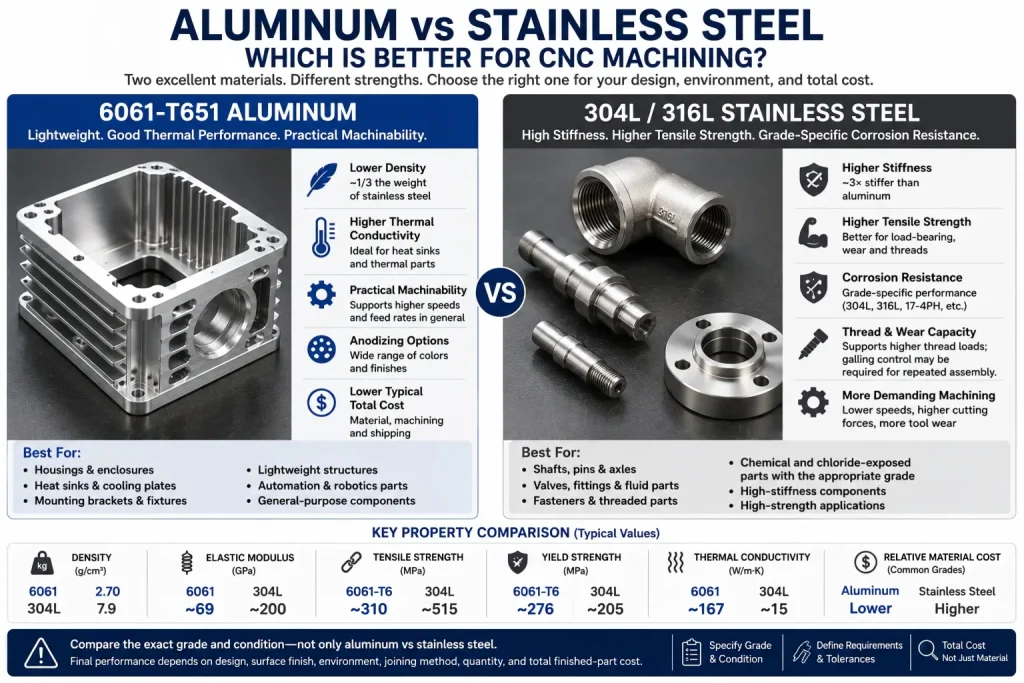
Aluminum vs Stainless Steel CNC Machining Comparison
| Comparison Item | Aluminum | Stainless Steel | Buyer Should Check |
|---|---|---|---|
| Common CNC grades | 6061, 7075, 2024, 5052, 6082, 6262 | 303, 304/304L, 316/316L, 17-4PH, 416, 420, duplex grades | Always specify the exact grade and condition |
| Density | Around 2.70–2.80 g/cm³ for many common alloys | Around 7.8–8.0 g/cm³ for many common grades | Stainless parts of the same volume are normally nearly three times heavier |
| Elastic modulus | Around 69–72 GPa | Around 190–215 GPa depending on grade | Stainless steel is significantly stiffer for the same geometry |
| Mechanical strength | Highly grade- and temper-dependent | Highly grade- and condition-dependent | Do not compare only “aluminum” with “stainless steel” |
| Machining behavior | Often supports higher material-removal rates, but chip adhesion and burrs still occur | 304/316 can work harden and create high cutting loads; 303 is easier to machine | Tooling and grade matter as much as material family |
| Thermal conductivity | Relatively high; 6061 is about 167 W/m·K | Common 304/316 grades are around 15–16 W/m·K | Aluminum is usually better for heat sinks and thermal housings |
| Corrosion resistance | Good in many atmospheric conditions; anodizing or coating may help | Grade-specific; 316 generally provides better chloride resistance than 304 | No material is immune in every environment |
| Welding | Many aluminum grades can be welded, but heat may reduce local strength | 304L and 316L are commonly selected for welded corrosion-resistant assemblies | Grade, filler, distortion, and post-weld condition matter |
| Surface finishing | Anodizing, conversion coating, bead blasting, painting, powder coating | Passivation, polishing, brushing, electropolishing, plating, bead blasting | Finish affects dimensions, masking, appearance, and cost |
| Threads and wear | Softer aluminum threads may need longer engagement or inserts | Stainless threads can support higher loads but may gall during assembly | Define torque, lubrication, engagement, and assembly cycles |
| Finished-part cost | Often lower for larger or heavily machined components | Often higher because of material, cutting time, tool wear, and weight | Compare the complete quote, not raw material alone |
| Typical fit | Housings, brackets, heat sinks, plates, fixtures, lightweight structures | Shafts, fittings, valve parts, fasteners, fluid-contact parts, high-stiffness components | Choose from part function and environment |
The stainless-steel family includes machinability-focused, corrosion-focused and high-strength grades. For example, Outokumpu identifies improved-machinability versions of 304L and 316L, while 17-4PH serves a different higher-strength requirement.
Weight and Shipping Impact
Weight is one of the clearest differences between aluminum and stainless steel.
Typical density examples are:
- 6061 aluminum: approximately 2.70 g/cm³
- 304L stainless steel: approximately 7.9 g/cm³
- 316L stainless steel: approximately 8.0 g/cm³
- 17-4PH stainless steel: approximately 7.8 g/cm³
For identical geometry and volume, an austenitic stainless-steel component is normally close to three times as heavy as a 6061 aluminum component.
This can affect:
- Shipping cost
- Moving mass
- Motor and actuator load
- Rotational inertia
- Ergonomics
- Support structures
- Portable equipment
- Overall assembly weight
Aluminum is usually the practical starting point when weight reduction is a primary design requirement.
Stainless steel may still be preferable when the part is small or when stiffness, corrosion performance, thread strength, wear, or service life is more important than mass.
The density values are consistent with published 6061, 304L, 316L and 17-4PH material data.
Strength, Stiffness, and Hardness Are Different
Do not use the word “stronger” without defining the required property.
A material comparison may involve:
- Yield strength
- Tensile strength
- Fatigue performance
- Hardness
- Impact toughness
- Wear resistance
- Elastic modulus
- Thread strength
Common annealed 304 or 316 stainless plate generally has much higher tensile strength than 6061-T6 aluminum, but its minimum yield strength may be similar to or lower than 6061-T6.
High-strength aluminum such as 7075-T6/T651 can exceed annealed 304 or 316 in yield strength.
High-strength stainless grades such as 17-4PH can exceed common aluminum alloys by a wide margin when used in an appropriate condition.
Stiffness
Stainless steel’s elastic modulus is approximately three times that of aluminum.
For two parts with identical geometry and load, stainless steel will normally deflect less elastically.
However, changing from aluminum to stainless steel also increases weight substantially. Designers should therefore compare geometry, stiffness, strength, and mass together.
Wear and Impact
Stainless steel is often harder and more resistant to indentation than common 6061 aluminum, but wear performance still depends on:
- Grade
- Heat treatment
- Surface finish
- Lubrication
- Contact pressure
- Sliding speed
- Contamination
- Counterface material
Austenitic stainless steel can also gall or seize during sliding contact or threaded assembly.
Outokumpu lists 304L plate at a minimum yield strength around 200 MPa and 316L plate around 220 MPa, with tensile-strength ranges near 500–700 MPa. The values vary by product form and condition, so the drawing must specify the grade and standard.
Machining Time and Finished-Part Cost
Aluminum often supports higher cutting speeds and material-removal rates than common 304 or 316 stainless steel, but that does not mean every aluminum alloy is automatically easy to machine.
Possible aluminum-machining problems include:
- Built-up edge
- Chip welding
- Long chips
- Burrs
- Thin-wall deformation
- Scratching from chip recutting
- Difficult chip breaking during drilling and turning
Possible stainless-steel machining problems include:
- Work hardening
- High cutting force
- Heat concentrated near the tool
- Notch wear
- Built-up edge
- Long or difficult chips
- Burrs
- Thread galling
- Higher tool and fixture loads
Finished-part cost may include:
- Raw material
- Material weight
- Cutting time
- Tool consumption
- Tool changes
- Deburring
- Cleaning
- Surface finishing
- Inspection
- Scrap risk
- Packaging
- Shipping
Stainless steel is often more expensive for heavily machined parts, but the final difference depends on the selected stainless grade, feature geometry, quantity, finish, and inspection requirements.
6061 itself is only described as having adequate machinability, and its chips can be difficult to break during drilling and turning. Machinability-enhanced stainless products also exist, so one fixed speed or cost ratio should not be used.
Work Hardening and Tool-Wear Risks
Austenitic stainless steels such as 304 and 316 can work harden when the tool rubs, dwells, or repeatedly cuts a previously deformed surface.
Common causes include:
- Feed that is too low
- A dull cutting edge
- Excessive tool runout
- Tool dwelling
- Repeated light finishing passes
- Poor chip evacuation
- Unstable workholding
- Long tool overhang
- Inadequate or inconsistent coolant delivery
Possible results include:
- Rapid tool wear
- Notch wear
- Chipping
- Poor surface finish
- Burr formation
- Dimensional drift
- Hard spots affecting a later operation
A stable process should maintain positive cutting action and avoid rubbing.
Useful controls may include:
- Suitable carbide grade and geometry
- Short practical tool overhang
- Rigid workholding
- Stable feed
- Consistent engagement
- Effective chip evacuation
- Controlled coolant delivery
- Planned tool replacement
Reducing every cutting parameter is not automatically the correct solution. Very low feed can worsen rubbing and work hardening.
Sandvik’s machining guidance treats stainless work hardening, cutting force, toolpath and chip control as related process issues rather than problems solved only by lower spindle speed.
Surface Finish and Post-Processing
Aluminum Finishes
Common aluminum finishing options include:
- As-machined
- Bead blasting
- Clear or colored anodizing
- Hard anodizing
- Chemical conversion coating
- Powder coating
- Painting
- Polishing
- Plating for selected applications
Anodizing changes the surface and affects dimensions. Threads, bores, electrical contacts, thermal faces, sealing surfaces, and close fits may require masking or allowance.
Stainless-Steel Finishes
Common stainless-steel finishing options include:
- As-machined
- Brushed finish
- Mechanical polishing
- Mirror polishing
- Bead blasting
- Passivation
- Electropolishing
- Plating for selected requirements
- Heat tint removal after welding when required
Passivation does not turn the wrong stainless grade into a corrosion-proof material. It should be planned with cleaning, contamination control, blind holes, threads, surface condition, and service environment.
Cosmetic Comparison
Aluminum provides a wide range of anodized and painted colors.
Stainless steel provides durable metallic, brushed, polished, and electropolished appearances.
Neither material automatically produces a better cosmetic part. Final appearance depends on:
- Raw material
- Tool marks
- Surface preparation
- Finish specification
- Visible-surface definition
- Batch control
- Handling
- Packaging
For finish selection, masking, dimensional allowance, passivation, polishing, anodizing, and coating risks, review our surface finishes for CNC machined parts.
6061 responds well to common anodizing routes, while stainless finishing routes include passivation, polishing and other surface treatments chosen according to grade and service conditions.
Common Stainless-Steel Grades for CNC Machining
303 Stainless Steel
Choose 303 when improved machinability is important and the application can accept lower corrosion resistance and poorer welding performance than 304 or 316.
Common uses may include:
- Turned fittings
- Bushings
- Fasteners
- Shafts
- Pins
- Threaded components
304 and 304L Stainless Steel
304 is a common general-purpose corrosion-resistant grade.
304L has lower carbon content and may be preferred for welded components or controlled specifications where sensitization risk matters.
Typical uses include:
- Housings
- Brackets
- Fittings
- General industrial components
- Food-processing equipment parts
- Fluid-handling components
316 and 316L Stainless Steel
316 contains molybdenum and generally provides better resistance than 304 to pitting and crevice corrosion in chloride-containing environments.
It is not completely immune to chloride attack, crevice corrosion, or stress-corrosion cracking.
Typical uses include:
- Marine-related hardware
- Chemical-processing components
- Valve and pump parts
- Fluid-contact fittings
- Outdoor parts exposed to salt or aggressive cleaning
17-4PH Stainless Steel
17-4PH is a precipitation-hardening stainless steel selected when the project requires a stronger combination of strength and corrosion resistance than common annealed 304 or 316.
The drawing must specify the heat-treatment condition because machining behavior and final properties change with condition.
For grade-specific tooling, work-hardening, burrs, passivation, heat treatment, and inspection risks, review our stainless steel CNC machining guide.
316 generally provides better pitting and crevice-corrosion resistance than 304 in chloride environments, while 303 trades some corrosion and weldability for machinability.
Thermal Conductivity and Heat-Sink Design
Thermal conductivity is one of aluminum’s clearest advantages over common austenitic stainless steel.
Typical reference values are:
- 6061 aluminum: approximately 167 W/m·K
- 304 stainless steel: approximately 15–16 W/m·K
- 316 stainless steel: approximately 15 W/m·K
This makes 6061 roughly ten times more thermally conductive than common 304 or 316 stainless steel.
Aluminum is normally the more practical material for:
- Heat sinks
- Thermal housings
- Cooling plates
- Electronics enclosures
- Components where heat must spread quickly
However, the complete thermal result also depends on:
- Wall and fin geometry
- Contact flatness
- Thermal-interface material
- Airflow
- Surface finish
- Coating thickness
- Mounting pressure
- Operating temperature
Stainless steel may still be chosen where corrosion, pressure, structural stiffness, hygiene, or high-temperature service is more important than rapid heat spreading.
Published data gives common 304L and 316L thermal conductivity near 15 W/m·K, versus approximately 167 W/m·K for 6061.
Aluminum and Stainless Steel in the Same Assembly
Aluminum and stainless steel can be used in the same assembly, but direct contact in a wet or conductive environment may create galvanic-corrosion risk for the aluminum.
The risk depends on:
- Moisture or electrolyte exposure
- Contact area
- Coating condition
- Fastener material
- Drainage
- Trapped liquid
- Operating temperature
- Service life
Possible controls include:
- Insulating washers or sleeves
- Suitable coatings
- Sealants
- Compatible fasteners
- Drainage and ventilation
- Avoiding trapped moisture
- Protecting damaged coating areas
- Environmental testing
The RFQ should state whether aluminum and stainless-steel components will contact each other in the final assembly.
Hydro specifically warns that direct contact between aluminum and dissimilar metals can cause galvanic corrosion.
Common CNC Applications
| Part Requirement | Practical Starting Point | Why |
|---|---|---|
| Lightweight housing or enclosure | 6061 aluminum | Low density, broad availability, machining, and finishing options |
| Heat sink or thermal housing | 6061 or 6063 aluminum | Much higher thermal conductivity |
| Large machined plate or fixture | 6061-T651 or suitable tooling plate | Lower weight and practical material removal |
| Compact high-strength aluminum bracket | 7075-T651 | High aluminum strength where welding is not required |
| General corrosion-resistant fitting | 304 or 304L stainless steel | Broad availability and corrosion performance |
| Chloride-exposed fitting or valve part | 316 or 316L stainless steel | Better pitting and crevice-corrosion resistance than 304 |
| Machinability-focused stainless turned part | 303 stainless steel | Improved chip control and machining productivity |
| High-strength stainless shaft or support | 17-4PH in the specified condition | Higher strength with stainless corrosion characteristics |
| Repeatedly assembled threaded part | Depends on load and environment | Aluminum may need inserts; stainless may need anti-galling control |
| Same-volume stiffness-critical component | Stainless steel | Much higher elastic modulus |
These are starting points rather than automatic specifications. The final choice still depends on grade, condition, geometry, load, finish, environment, and quantity.
Hidden Cost Factors
| Cost Driver | Aluminum | Stainless Steel |
|---|---|---|
| Raw material | Often lower for common CNC grades | Grade and alloy content may increase cost |
| Shipping weight | Lower for the same volume | Nearly three times heavier than common aluminum |
| Material removal | Often supports higher cutting speed and removal rate | Often requires lower cutting speed and higher cutting force |
| Tooling | Adhesion, burrs, and chip control still require suitable tools | Tool wear, work hardening, heat, and chipping may increase cost |
| Deburring | Aluminum burrs can be soft and smeared | Stainless burrs may be tough and difficult to remove |
| Threads | May require inserts or increased engagement | Can support higher load but galling may require control |
| Finishing | Anodizing and masking may add cost | Passivation, polishing, electropolishing, or heat-tint removal may add cost |
| Inspection | Thin or large aluminum parts may move after unclamping | Stiff parts may be stable, but machining heat and tool wear still affect dimensions |
| Scrap | Lower material value does not eliminate scrap risk | Higher blank and machining value can make late-stage scrap expensive |
| Lead time | Depends on stock, geometry, tooling, finish, and reports | Depends on grade, tool availability, process time, finish, and reports |
Compare the complete finished-part quotation rather than assuming that one material is always cheaper.
How to Choose Between Aluminum and Stainless Steel
Choose aluminum when the project prioritizes:
- Low weight
- High thermal conductivity
- General-purpose CNC machining
- Anodized colors
- Lower shipping mass
- Large housings or plates
- Moderate structural requirements
- Lower total cost
Choose stainless steel when the project prioritizes:
- Greater stiffness
- High tensile strength
- Stronger wear or contact surfaces
- Higher thread load
- Fluid or chemical exposure
- Chloride resistance with the correct grade
- Repeated mechanical loading
- Metallic brushed or polished finish
Do not choose stainless steel only “to be safe.”
A material upgrade may create unnecessary cost when the design does not require its weight, stiffness, strength, corrosion performance, or finishing route.
Do not choose aluminum only because it is easier to machine.
A poorly supported thin-wall aluminum part may be more difficult to hold dimensionally than a compact stainless component.
RFQ Information for Aluminum and Stainless-Steel CNC Parts
| RFQ Item | What to Specify | Why It Matters |
|---|---|---|
| Exact material | 6061-T651, 7075-T651, 303, 304L, 316L, 17-4PH, or another grade | Material families do not define exact properties |
| Material condition | Aluminum temper or stainless heat-treatment condition | Controls strength, residual stress, machining, and certification |
| Stock form | Plate, bar, extrusion, tube, forging, or casting | Affects geometry, grain direction, cost, and distortion |
| Mechanical requirement | Load, stiffness, fatigue, hardness, wear, and maximum weight | Prevents unnecessary material upgrades |
| Environment | Indoor, outdoor, chloride, marine, chemical, high-temperature, or food-contact | Controls material and finishing decisions |
| Joining method | Welding, fasteners, inserts, brazing, or bonding | Aluminum and stainless grades have different joining limits |
| Threads | Size, depth, torque, engagement, and assembly cycles | Helps plan inserts, galling control, and inspection |
| Surface finish | Anodizing, passivation, brushing, polishing, coating, or as-machined | Affects dimensions, appearance, and cost |
| Mixed-metal contact | Whether aluminum and stainless will touch in service | Helps assess galvanic-corrosion risk |
| Critical dimensions | Fits, flatness, bores, threads, position, and mating features | Defines process and inspection priorities |
| Quantity | Prototype and expected repeat volume | Affects stock purchasing, tooling, and unit cost |
| Reports | Material certificate, dimensional report, CMM report, or finish certificate | Defines acceptance and quotation scope |
Rapid Efficient can review material grade, condition, geometry, environmental exposure, threads, finishing, inspection, quantity, and packaging before quotation.
FAQ: Aluminum vs Stainless Steel CNC Machining
Is Aluminum Cheaper to CNC Machine Than Stainless Steel?
Often, but not always.
Aluminum commonly has a lower material weight and supports higher machining productivity. The final cost still depends on grade, stock form, geometry, tool access, tolerances, finishing, inspection, and quantity.
Is Stainless Steel Stronger Than Aluminum?
It depends on the grades and the property being compared.
Common 304 and 316 stainless steels normally have higher tensile strength and stiffness than 6061 aluminum. High-strength 7075 aluminum may have higher yield strength than annealed 304 or 316, while 17-4PH stainless can be much stronger than common aluminum alloys.
Is Stainless Steel Stiffer Than Aluminum?
Yes.
Common stainless steels have an elastic modulus around 200 GPa, compared with approximately 69 GPa for many aluminum alloys. A same-geometry stainless part normally deflects less but weighs much more.
Which Material Is Easier to CNC Machine?
Common aluminum alloys are often faster to machine, but they can still create built-up edge, burrs, long chips, and thin-wall deformation.
304 and 316 stainless steel are generally more demanding because of work hardening, cutting force, heat, and chip control. Machinability-focused 303 stainless steel is easier than 304 or 316.
Which Material Has Better Corrosion Resistance?
It depends on the alloy and environment.
6061 aluminum performs well in many atmospheric conditions. 304 stainless is suitable for many general environments, while 316 generally provides better chloride resistance. None is automatically suitable for every chemical or marine condition.
Which Material Is Better for Heat Dissipation?
Aluminum is normally better.
6061 has approximately ten times the thermal conductivity of common 304 or 316 stainless steel, making it a more practical starting point for heat sinks and thermal housings.
Which Material Is Better for Threads?
Stainless steel normally supports higher thread loads, but austenitic grades can gall.
Aluminum threads can work well with suitable engagement and torque. Repeated assembly or higher loads may require helical or solid thread inserts.
Can Aluminum and Stainless Steel Be Used Together?
Yes, but direct contact in a wet environment may create galvanic-corrosion risk for the aluminum.
The design may require isolation, coatings, sealants, drainage, or compatible fasteners.
Which Material Is Better for Outdoor Parts?
Both can be suitable when correctly specified.
The decision depends on aluminum or stainless grade, coating, drainage, chloride exposure, galvanic contact, cosmetic requirements, load, and service life.
Does Stainless Steel Hold Tighter CNC Tolerances?
Not automatically.
Its higher stiffness may reduce elastic deflection, but final tolerance still depends on geometry, tool wear, cutting heat, fixturing, setup count, finishing, temperature, and inspection.
Conclusion
Aluminum and stainless steel solve different CNC machining requirements.
Choose aluminum when low weight, thermal conductivity, broad machining options, anodizing, and lower total cost are the main priorities.
Choose stainless steel when stiffness, tensile strength, wear, thread load, corrosion performance, or demanding service conditions justify its additional weight and machining cost.
The final decision should consider:
- Exact grade
- Temper or material condition
- Stock form
- Weight target
- Strength and stiffness
- Corrosion environment
- Thermal requirements
- Threads and wear
- Joining method
- Surface finish
- Inspection
- Quantity
- Total finished-part cost
Do not compare only “aluminum” with “stainless steel.” Compare the actual grades and conditions shown on the drawing.
Review Your Aluminum or Stainless-Steel Part
Send the STEP file, 2D drawing, quantity, required material grade, condition, critical dimensions, surface finish, service environment, joining method, and inspection requirements.
Rapid Efficient can review whether aluminum or stainless steel is more practical and help identify risks involving weight, stiffness, machining, work hardening, corrosion, threads, finishing, inspection, packaging, and cost before quotation.
For custom metal and engineering-plastic components, review our CNC machining services.