
Conclusion First
6061-T6/T651 is a practical choice for CNC-machined heat-sink bases and cooling housings that need strength, threads, and mounting features. The final choice should also consider thermal conductivity, geometry, and the manufacturing route.
If maximum thermal conductivity is the only priority, 1050 / 1070 pure aluminum grades can outperform stronger alloys.
If you need extruded profiles and decorative cooling parts, 6063 aluminum is often the smart option.
The best alloy depends on how the part will be made—not just conductivity numbers.
Why Aluminum Is Used for Heat Dissipation
Aluminum remains one of the best cooling materials because it combines:
- High thermal conductivity
- Low density
- Good corrosion resistance
- Easy machining or extrusion
- Competitive cost
Compared with copper, aluminum offers much lower weight and lower material cost.
That is why aluminum dominates:
- LED heat sinks
- Motor housings
- EV electronics cooling plates
- Power supplies
- CNC thermal enclosures
Quick Comparison Table
| Alloy | Thermal Conductivity | Strength | Machinability | Best Use Case |
|---|---|---|---|---|
| 1050 | Excellent | Low | Fair | Maximum heat transfer |
| 1070 | Excellent | Low | Fair | Electrical / cooling sheet |
| 5052 | Good | Medium | Fair | Corrosion resistant cooling parts |
| 6061 | Good | High | Excellent | CNC heat sinks |
| 6063 | Very Good | Medium | Good | Extruded heat sink profiles |
Typical Thermal Conductivity Values
- 1050 / 1070: approximately 230 W/(m·K), depending on the grade and temper.
- 6063-T6: approximately 201 W/(m·K) at 20°C.
- 6061-T6 / T651: approximately 167 W/(m·K) at 20°C.
- 5052-O: approximately 138 W/(m·K) at 20°C.
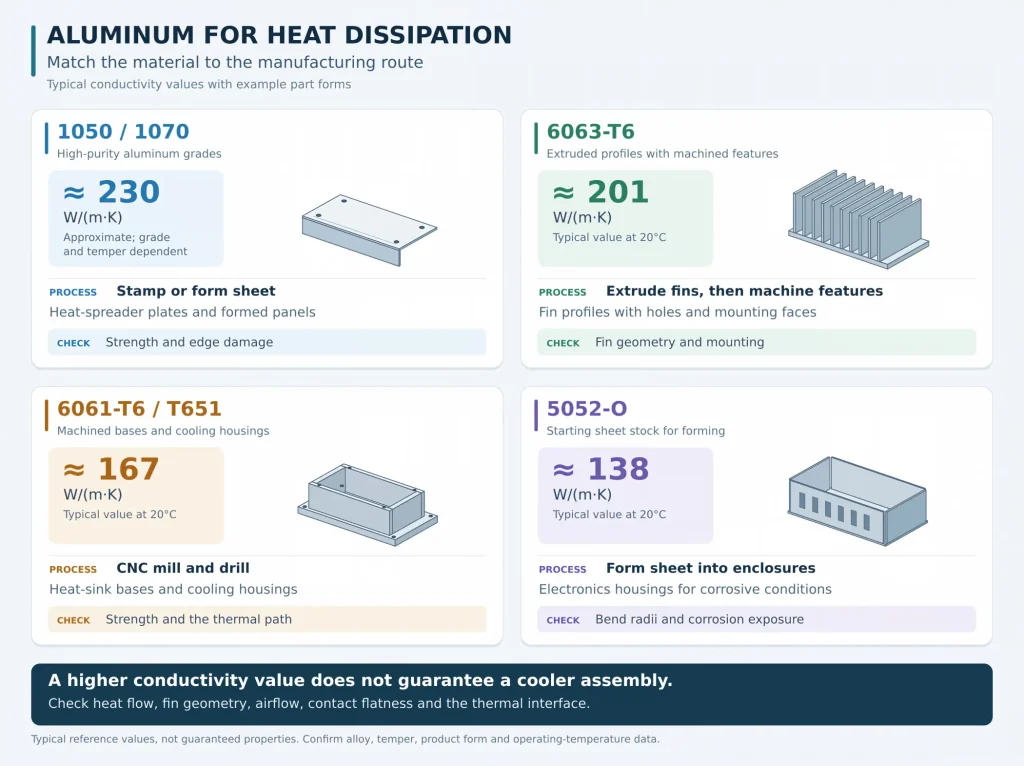
These are typical reference values, not guaranteed properties for every product form or material condition. For thermal design, confirm the supplied alloy, temper, product form, and thermal conductivity at the intended operating temperature.
Why 6061 Works Well for CNC Cooling Parts
6061-T6/T651 is a practical option when a cooling component also needs strength and machined mounting features.
Why?
Because cooling parts also need:
- threads
- mounting holes
- flat bases
- structural rigidity
- anodizing compatibility
6061 offers strong thermal performance while still machining cleanly and holding tolerances.
Engineer’s Note
Many buyers chase maximum conductivity numbers but ignore manufacturing reality.
A softer alloy that warps, burrs, or bends easily may perform worse in production than a slightly lower-conductivity alloy with stable geometry.
When Pure Aluminum Wins
Grades like 1050 and 1070 offer excellent conductivity.
They are useful when:
- strength is less important
- the part is stamped or formed
- heat spreading is the only mission
- lightweight electrical cooling panels are needed
But pure aluminum is softer and less ideal for precision CNC machining.
6063 for Extruded Heat Sinks
Many commercial heat sinks are made from 6063 aluminum.
Why?
Because 6063 extrudes beautifully into:
- thin fin profiles
- long heat sink rails
- LED cooling bodies
- architectural cooling shapes
It also anodizes well.
6063 is well suited to extruded heat-sink profiles and can also be machined to add holes, threads, and mounting faces. 6061-T6/T651 is a useful option for machined bases and housings with higher strength requirements.
5052 for Harsh Environments
5052 is not the first alloy people think of for cooling, but it can be useful when corrosion resistance matters.
Examples:
- marine electronics boxes
- outdoor control cabinets
- humid industrial enclosures
It gives solid thermal performance with better environmental durability than many alternatives.
Thermal Conductivity vs Real Cooling Performance
This is where many buyers make mistakes.
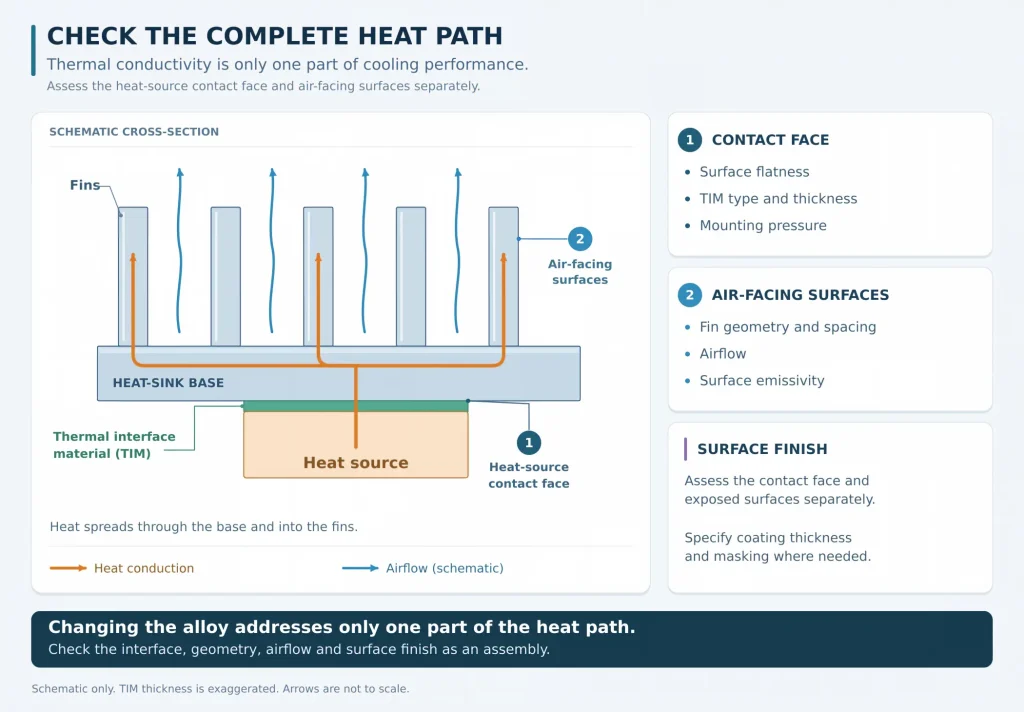
A higher conductivity alloy does not always mean a cooler final product.
Because total cooling performance also depends on:
- fin design
- airflow path
- surface flatness
- coating choice
- mounting pressure
- thermal interface material (TIM)
In many real assemblies, thermal contact resistance at the interface is a bigger bottleneck than alloy conductivity.
A flatter mounting base often matters more than chasing the highest conductivity alloy.
A poorly designed pure aluminum heat sink may lose to a well-machined 6061 design.
Aluminum vs Copper Heat Sinks
Copper generally provides higher thermal conductivity, while aluminum provides much lower weight and is often easier to manufacture into large housings, bases, fins, and integrated cooling structures.
The correct choice depends on more than conductivity alone:
| Design Priority | More Practical Starting Point |
|---|---|
| Maximum heat spreading in a compact area | Copper or a copper insert |
| Low weight | Aluminum |
| Large CNC-machined cooling housing | 6061 aluminum |
| Extruded fin profile | 6063 aluminum |
| High local heat flux with lower total weight | Copper base or insert with aluminum fins |
| Cost-sensitive repeat production | Aluminum |
| Electrical and thermal conductivity together | Copper, depending on the design |
A copper heat sink does not automatically produce a lower operating temperature. Final performance also depends on:
- Contact flatness
- Thermal-interface material
- Fin geometry
- Airflow or liquid flow
- Mounting pressure
- Heat-source size
- Surface treatment
- Total part mass and available space
Use grade-specific material data rather than comparing generic “aluminum” with generic “copper.” The quotation should also consider material grade, part size, quantity, machining time, tool access, finishing, and inspection requirements.
Hybrid structures may use copper only near the heat source and aluminum for the larger body or fins. This can provide a better balance of local heat spreading, total weight, manufacturability, and cost.
Surface Finish Matters Too
Anodizing can increase surface emissivity and improve radiative cooling, especially in natural-convection or low-airflow designs. Black dye alone does not prove better thermal performance; clear anodizing can have similar emissivity.
Assess the heat-source contact face separately from the surfaces exposed to air. At the contact face, coating thickness and conductivity can affect thermal resistance. On exposed surfaces, emissivity and airflow also matter.
Compare anodizing and powder coating for the actual coating thickness, contact conditions, and airflow. Specify any required masking at the heat-source contact face, and include the coating and thermal interface material in the thermal-resistance assessment.
Using 6061 for CNC Heat Sink Projects
6061-T6/T651 is a practical option for CNC-machined cooling parts with structural and mounting requirements.
It balances:
- cooling performance
- machining speed
- appearance
- dimensional stability
- total cost
Hidden Engineering Mistake
Some teams choose ultra-soft pure aluminum for better conductivity, then later need:
- threaded holes
- precision flatness
- cosmetic anodizing
- structural mounting
That often creates manufacturing headaches.
FAQ
What aluminum has the best thermal conductivity?
Pure aluminum grades such as 1050 or 1070 generally outperform structural alloys.
Is 6061 good for heat sinks?
Yes. 6061-T6/T651 is suitable for many machined heat sinks, especially when strength, threads, and mounting features matter.
Is 6063 better than 6061 for cooling?
6063-T6 typically has higher thermal conductivity than 6061-T6. However, the final operating temperature also depends on the heat-sink geometry, airflow, and thermal interface.
Is 6061 better than 6063 for CNC heat sinks?
Not always. 6061-T6 generally provides higher strength, while 6063-T6 generally has higher thermal conductivity. Both can be machined. Select the alloy based on the load, geometry, available stock, and thermal requirements.
Is copper better than aluminum?
For CNC-machined heat sinks and housings that need strength and mounting features, consider 6061-T6/T651.
Final Thoughts
If you need the best practical choice, choose 6061.
If you need maximum conductivity, consider 1050 / 1070.
If you need extruded fin profiles, consider 6063.
The best aluminum for heat dissipation depends on design, process, and total manufacturing reality.
Need Help Choosing the Right Cooling Alloy?
Send us your drawing or project details.
Rapid Efficient can review your drawing, material requirement, surface finish, tolerance, and application needs to help select a suitable aluminum grade for CNC heat sinks, cooling housings, and thermal management parts.