316 与 316L 不锈钢对比: 数控加工, 钝化, 和选择风险

316 对于大多数买家来说,316L 不锈钢看起来几乎一样.

他们也以类似的方式加工.

That is why many RFQs treat them as interchangeable.

But for corrosion-sensitive parts, welded assemblies, medical-device components, fluid-contact fittings, passivated surfaces, or customer-controlled material specifications, the difference can matter.

The main difference is not color, 外貌, or basic CNC machineability.

The main difference is carbon content.

316L is the low-carbon version of 316 不锈钢. Lower carbon helps reduce the risk of carbide precipitation and sensitization in certain welded or heat-affected conditions.

For a purely machined part with no welding, no thermal exposure, no customer-controlled specification, and no special corrosion risk, the practical difference may be small.

For a welded, 钝化的, chloride-exposed, 医疗的, laboratory, or fluid-handling part, the difference may affect material approval, corrosion review, 证书要求, 和检查计划.

Rapid Efficient 支持原型的定制不锈钢 CNC 加工项目, 小批量零件, 及生产要求. 报价前, 我们一起审查图纸和不锈钢牌号, material certificate requirement, machining features, 钝化需求, 表面饰面, 检查方法, 包装需求, 和交货时间表.


The Short Answer

316L is usually selected when lower carbon content matters.

316 is often acceptable when the drawing, 环境, and customer specification do not require the low-carbon grade.

用于 CNC 加工零件, the machining behavior of 316 and 316L is usually very close. Both are austenitic stainless steels. Both can work harden. Both require sharp tooling, stable chip load, good coolant delivery, and careful burr control.

The real selection question is:

Does the application require low-carbon 316L for welding, corrosion control, 文档, 或客户规格?

如果是, use 316L or confirm whether dual-certified 316/316L material is acceptable.

If no, 316 may be suitable when it meets the drawing and service requirements.


316 vs 316L: What Actually Changes?

The “L” in 316L means low carbon.

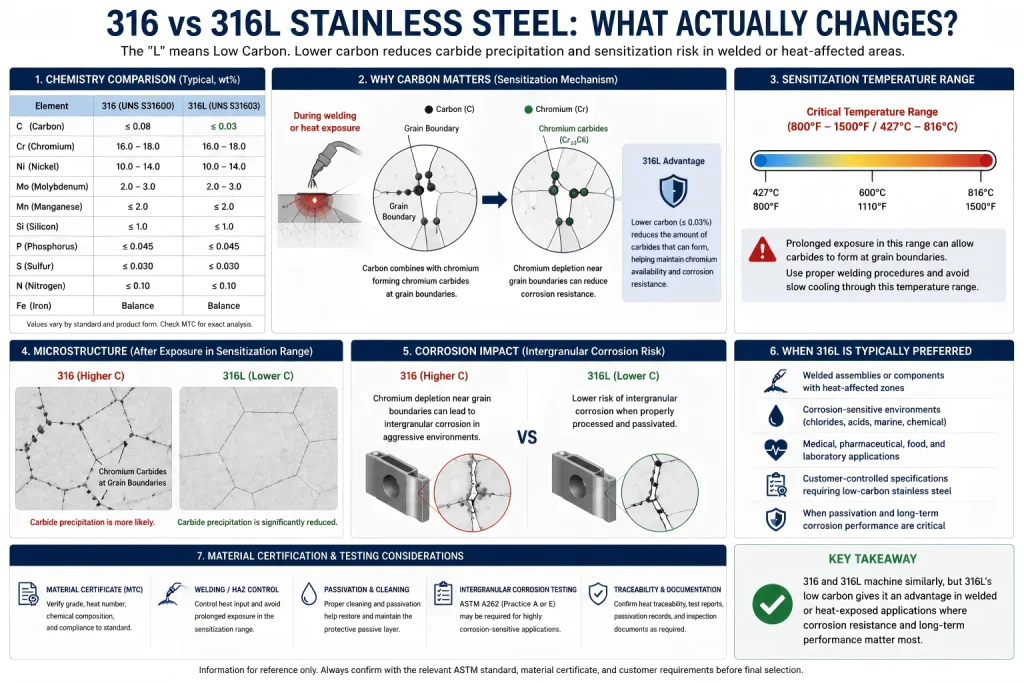
Commonly, 316 stainless steel may allow higher carbon content than 316L. 316L is typically specified with a lower maximum carbon content, 经常在周围 0.03% max carbon, while standard 316 is commonly specified up to about 0.08% max carbon, depending on the standard and product form.

This lower carbon content helps reduce chromium carbide precipitation during welding or thermal exposure.

This risk is most important when stainless steel spends enough time in the sensitization temperature range.

For austenitic stainless steels, chromium carbide precipitation is commonly associated with exposure around 800°F to 1500°F or approximately 427°C to 816°C. Some references may express the range slightly differently, but the practical concern is the same: 焊接, slow cooling, or certain thermal cycles can allow carbon and chromium to form carbides near grain boundaries.

When chromium is tied up at the grain boundary, the nearby region may lose some corrosion resistance. This can create a path for intergranular corrosion in aggressive environments.

316L reduces this risk because its carbon content is lower.

然而, 316L does not make thermal history irrelevant. 焊接工艺, heat input, section thickness, cooling rate, post-weld treatment, surface cleaning, and service environment still matter.

For welded or heat-affected parts, the RFQ should confirm:

  • Whether 316L is required
  • Whether dual-certified 316/316L material is acceptable
  • Welding or heat-exposure information
  • 钝化要求
  • 材料证明要求
  • Whether intergranular corrosion testing is required

Why does this matter?

Stainless steel depends on chromium to form a protective passive layer.

If chromium combines with carbon near grain boundaries during thermal exposure, the surrounding region may become less corrosion resistant. This is often discussed as sensitization.

316L helps reduce that risk because it contains less carbon.

That does not mean 316L is automatically better for every machined part.

It means 316L is often safer when the part will be welded, exposed to heat, passivated after machining, or used in corrosion-sensitive applications.

For broader stainless steel material planning, 回顾我们的 stainless steel CNC machining guide.

Diagram comparing 316 and 316L stainless steel carbon content, sensitization temperature range, welding risk, 钝化, corrosion review, and material certificate requirements.

Selection Triggers: When 316L Matters More

Selection TriggerWhy 316L May Be Preferred报价前要确认什么
Welded assemblyLower carbon reduces sensitization risk in heat-affected zones焊接工艺, post-weld treatment, certificate requirement
Medical or laboratory componentCustomer may specify 316L for corrosion or documentation reasons年级, 表面饰面, 钝化, inspection report
Fluid-contact partCorrosion behavior and cleaning route may matterFluid type, chloride exposure, 清洁化学品
Passivated partSurface chemistry and contamination control matterPassivation standard, cleaning route, inspection after passivation
Customer-controlled drawingThe drawing may explicitly call out 316L精确的材料等级, 标准, certificate wording
Heat-exposed featureThermal history can affect corrosion behaviorHeat exposure, 焊接, stress relief, 整理顺序
Polished or cosmetic partSurface defects may become visible after finishing可见表面, polishing route, 包装
Threaded stainless fittingThreads must remain clean and corrosion-safe after finishingThread class, 钝化, 量规检查
Export or regulated projectDocumentation may matter as much as machiningMaterial certificate, 可追溯性, compliance requirements

This table is not a claim that 316L is always required.

It shows where the low-carbon grade becomes more important.


When 316 May Be Acceptable

316 stainless steel is still a strong and useful material.

It may be acceptable when:

  • The drawing specifies 316
  • The part is not welded
  • The part is not exposed to high thermal cycles
  • The service environment is not especially aggressive
  • The customer does not require 316L
  • Material certificate requirements are clear
  • Passivation and cleaning requirements are controlled
  • Mechanical properties meet the application

For many CNC machined industrial parts, 316 can provide good corrosion resistance and stable performance when the application allows it.

The key is not to downgrade or substitute without approval.

If the drawing calls for 316L, do not quote 316 unless the customer approves the change.

If the drawing calls for 316, do not assume 316L is automatically acceptable without checking the project requirements.

Material substitution should be confirmed before production.

For CNC material comparison across stainless steel, 铝, 铜, 黄铜, and plastics, 回顾我们的 CNC加工材料指南.


Dual-Certified 316/316L Material: Useful but Still Needs Review

In many supply chains, stainless steel stock may be dual-certified as 316/316L.

This means the material chemistry and mechanical properties may meet the requirements of both grades under a given standard.

Dual-certified stock can be useful because it helps simplify procurement while supporting low-carbon requirements.

But buyers should not assume every 316 or 316L material is dual-certified.

报价前, 确认:

  • Required standard
  • Required grade wording
  • 材料证明要求
  • Whether dual-certified material is acceptable
  • Product form
  • Heat number traceability
  • Customer-specific approval rules
  • Whether the part requires passivation or post-processing documentation

This is especially important when the part is used in medical equipment, 实验室系统, fluid-handling components, food-related hardware, marine-related equipment, or customer-controlled assemblies.

A material certificate can be just as important as the machined dimensions.


机械加工 316 and 316L: The Difference Is Usually Not the Main Problem

用于数控加工, 316 and 316L are often similar.

Both can be difficult compared with aluminum, 黄铜, or free-machining steels.

The machining challenge usually comes from the stainless steel family behavior, not only the carbon difference.

两个都 316 and 316L may show:

  • 加工硬化风险
  • High cutting heat
  • 刀具磨损
  • 内置边缘
  • 毛刺形成
  • Poor chip breaking
  • Threading difficulty
  • 表面划痕
  • Passivation preparation sensitivity
  • Higher cost than easier-machining materials

The machining process should focus on:

  • Sharp stainless-steel tooling
  • 稳定的切屑负载
  • Avoiding rubbing
  • Controlled coolant delivery
  • 排屑
  • 精加工余量
  • Burr-control route
  • Thread inspection
  • Surface finish protection
  • Post-machining cleaning

A buyer should not choose 316L expecting easier machining.

There can be small machining-behavior differences between 316 and 316L, but they should not be overstated.

Because 316L has lower carbon content, it may behave slightly more ductile or “gummy” in some fine finishing, 线程, or sealing-face operations. In these cases, a worn or poorly prepared cutting edge can increase the risk of surface tearing, 积屑瘤, or burr formation.

同时, 标准 316 is not automatically easier or harder in every case.

Both grades are austenitic stainless steels. Both can work harden. Both can generate heat, 刀具磨损, chip-control problems, and poor surface finish if the process relies on rubbing instead of clean shearing.

用于数控加工, the process plan should focus on:

  • Sharp cutting edges
  • Proper rake and edge preparation
  • Stainless-steel-suitable tool coating when appropriate
  • 稳定的切屑负载
  • Avoiding dwell and rubbing
  • 冷却剂输送
  • 刀具磨损监测
  • 螺纹量规检查
  • 表面光洁度检查

The practical machining difference is usually less important than grade documentation, welding exposure, 钝化, and corrosion requirements.

For related work-hardening behavior in another common austenitic grade, review our targeted article on 加工 304 不锈钢.


The Heat-Affected Zone Is the Real Reason 316L Exists

The biggest reason to choose 316L is not CNC cutting.

It is what happens when stainless steel sees heat.

During welding or certain thermal cycles, carbon can combine with chromium and form chromium carbides near grain boundaries. When this happens, chromium may be reduced in the surrounding area, lowering local corrosion resistance.

316L reduces that risk because the carbon level is lower.

This is most relevant when the part is:

  • Welded after machining
  • Machined before welding
  • Part of a welded assembly
  • Exposed to thermal cycles
  • Used in corrosion-sensitive conditions
  • Required to pass customer corrosion expectations
  • Passivated after fabrication
  • Inspected with material traceability requirements

If the part will never be welded or exposed to significant heat, the low-carbon advantage may be less important.

But if welding or heat exposure is part of the process route, 316L should be reviewed early.


Passivation Does Not Replace Material Selection

Passivation can support the corrosion resistance of stainless steel parts by removing free iron and helping the passive layer form correctly.

But passivation does not turn 316 into 316L.

It does not erase the carbon-content difference.

It does not repair poor material selection.

It does not fix deep scratches, poor deburring, damaged threads, or severe contamination.

为了 316 and 316L machined parts, passivation should be reviewed together with:

  • 材质等级
  • 表面状况
  • 毛刺去除
  • 清洗方法
  • 外来铁污染风险
  • 共用磨具
  • 螺纹特征
  • Welded areas
  • Customer specification
  • 钝化后检查
  • 完成后包装

For a deeper passivation explanation, 回顾我们的文章: 什么是不锈钢钝化以及数控零件什么时候需要它?.


Surface Finish and Cleaning Matter More Than Buyers Expect

316 and 316L are often chosen for corrosion-sensitive parts.

That makes surface condition important.

A machined stainless part may require:

  • 加工完成
  • 抛光
  • 刷牙
  • 珠光喷砂
  • 电解抛光
  • 钝化
  • 受控清洁
  • 保护性包装

For corrosion-sensitive or medical-related parts, surface finish is not only about appearance.

It may affect:

  • Cleanability
  • Corrosion behavior
  • Fluid contact
  • Residue retention
  • Surface contamination
  • Scratch visibility
  • Thread cleanliness
  • 装配配合
  • Inspection acceptance

If the drawing only says “316L stainless steel” but does not define surface finish or cleaning requirements, the manufacturing route may still be incomplete.

For surface finish selection, 钝化, electropolishing, 抛光, and masking risks, 回顾我们的 CNC 表面处理指南.


线程数, 洞, and Burrs Are Still High-Risk Features

316 and 316L are often used for fittings, fluid components, medical device housings, 连接器, and corrosion-resistant assemblies.

Many of these parts include threads, 小孔, cross holes, or sealing features.

These features can create quality risk.

Common issues include:

  • Burrs at thread starts
  • Work hardening during tapping
  • Poor chip evacuation in blind holes
  • Damaged first threads
  • Oversized or undersized holes
  • Burrs near sealing faces
  • Surface scratches after deburring
  • Contamination before passivation
  • Gauge failure after finishing

对于昂贵的不锈钢零件, 与攻丝相比,螺纹铣削有时可以降低丝锥断裂报废的风险, especially for blind holes, hard-to-rework features, or high-value components.

For process comparison, 查看我们的指南 螺纹铣削与攻丝对比.

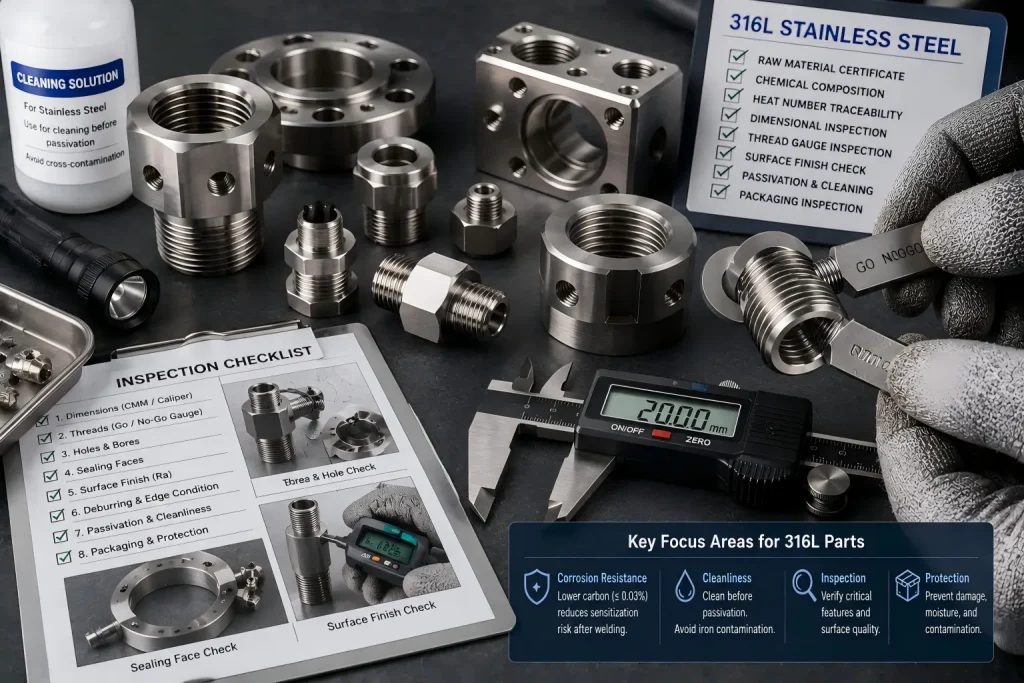
Inspection of stainless steel machined threads, 孔, 密封面, and burr-sensitive features before delivery.

Tolerances Should State Before or After Finishing

为了 316 and 316L stainless parts, finishing can affect inspection.

Passivation may not add meaningful thickness like plating, but polishing, 喷砂, electropolishing, 涂层, or mechanical finishing can change surfaces, edges, and functional dimensions.

The drawing should clarify:

  • 关键尺寸
  • Datum features
  • 螺纹要求
  • Hole tolerances
  • Surface finish requirements
  • 毛刺控制注意事项
  • Whether dimensions apply before or after finishing
  • 检查方法
  • 材料证明要求
  • Passivation documentation requirement

这对于:

  • 密封面
  • 螺纹孔
  • Press-fit areas
  • Flat datum surfaces
  • Small bores
  • 化妆品表面
  • Medical or laboratory parts
  • Fluid-contact components

For tolerance planning, measurement boundaries, and inspection review, 看看我们的 CNC加工公差指南.


RFQ Notes That Prevent 316 vs 316L Mistakes

在请求报价之前, 准备:

  • 2D图
  • 3D CAD文件
  • Required stainless steel grade
  • Required standard
  • Whether 316/316L dual certification is acceptable
  • 材料证明要求
  • Welding or heat exposure information
  • 数量
  • 关键尺寸
  • 螺纹要求
  • 表面光洁度
  • 钝化要求
  • Cleaning requirement
  • 检查报告要求
  • 包装要求
  • 目标交货时间表

有用的询价说明包括:

  • “316L required; material certificate required.”
  • “Dual-certified 316/316L material is acceptable.”
  • “Part will be welded after machining.”
  • “Passivation required after machining.”
  • “This surface is used for sealing.”
  • “Threads must pass gauge inspection.”
  • “Final dimensions apply after electropolishing.”
  • “CMM report required for marked features.”
  • “No foreign iron contamination allowed.”
  • “Intergranular corrosion testing required by order specification.”

Clear grade and documentation notes prevent quotation mistakes.

They also prevent confusion when the material looks correct but the certificate does not match the customer requirement.


Inspection and Certification for Corrosion-Sensitive 316L Parts

For general CNC machined parts, material certificate review and dimensional inspection may be enough.

对于腐蚀敏感, welded, 医疗的, laboratory, 海军陆战队, 化学, or fluid-handling components, inspection may need to go further.

Possible inspection and documentation items include:

  • Material certificate verification
  • Heat number traceability
  • 尺寸检验
  • CMM inspection for datum-related features
  • Surface roughness inspection when required
  • Thread fit verification with calibrated go/no-go gauges
  • Visual inspection after deburring and cleaning
  • Passivation specification review
  • 需要时提供钝化文件
  • Packaging inspection to prevent contamination or surface damage

For highly corrosion-sensitive parts, the order specification may also require testing for susceptibility to intergranular attack, 例如 ASTM A262. This standard includes multiple practices, including Practice A and Practice E, for evaluating intergranular corrosion susceptibility in austenitic stainless steels.

This testing should not be assumed by default.

If ASTM A262 or another corrosion test is required, the RFQ should state it clearly before quotation.

Buyers should confirm:

  • Required test standard
  • Practice method
  • Acceptance criteria
  • Sample requirement
  • Whether testing applies to raw material, welded coupons, or finished parts
  • Documentation format
  • Delivery schedule impact

This prevents a part from being quoted only as a machined 316L component when the real order requires corrosion-test documentation.


316 vs 316L Questions Buyers Usually Ask

What is the main difference between 316 and 316L stainless steel?

The main difference is carbon content.

316L is the low-carbon version of 316 不锈钢. Lower carbon helps reduce sensitization risk in welded or heat-affected conditions.

Is 316L harder to machine than 316?

通常, the machining difference is not the main issue.

两个都 316 and 316L are austenitic stainless steels and can be demanding to machine. 工装, chip load, coolant delivery, 几何学, 毛刺控制, and work-hardening risk usually matter more than the carbon difference.

In some fine finishing or threading operations, 316L may behave slightly more ductile or gummy, so tool sharpness and chip control still need attention.

Is 316L always better than 316?

福田街道.

316L may be better when welding, heat exposure, corrosion sensitivity, or customer specification requires a low-carbon grade.

For non-welded parts where the drawing allows 316, 标准 316 may be acceptable.

能 316 replace 316L?

Only if the customer and application allow it.

If the drawing specifies 316L, or if the part is welded or corrosion-sensitive, substitution should be approved before production.

Does passivation make 316 the same as 316L?

福田街道.

Passivation helps clean the stainless surface and support corrosion resistance, but it does not change the carbon content or make 316 equivalent to 316L.

Do 316 and 316L need material certificates?

For many industrial parts, 是的, especially when the grade is customer-controlled.

Material certificates are important when the application requires traceability, corrosion performance, medical or laboratory use, fluid-contact service, or regulated supply-chain documentation.

Is ASTM A262 required for every 316L part?

福田街道.

ASTM A262 or other intergranular corrosion testing is usually required only when the order specification, customer standard, or service environment demands it.

If this testing is required, it should be stated clearly in the RFQ before quotation.


Upload Your 316 or 316L Stainless Steel Drawing for Review

发送您的 2D 绘图, 3D CAD文件, 不锈钢等级, 数量, material certificate requirement, welding or heat exposure information, 公差注释, 螺纹要求, 表面饰面, 钝化需求, 检验要求, 及交付目标.

Our team will review whether 316, 316l, or dual-certified 316/316L material is suitable for your CNC machined component.

号召性用语按钮: 上传您的绘图


关于快速高效

Rapid Efficient 支持原型的定制 CNC 加工项目, 小批量零件, 及生产要求.

和 18 多年高精度CNC加工经验, 我们的团队审查物质行为, 加工策略, 耐受风险, 后处理要求, 检查方法, 包装条件, 和报价前的交货时间表.

我们的可用功能包括 4 轴, 5-轴, 和多轴数控加工, 连同CMM等检测设备, 投影仪, 和光谱仪.

根据实际零件和项目要求, 加工精度低至 0.01 毫米 和检查精度低至 0.001 毫米 可用.

快速高效已获得 ISO 9001ISO 14001 认证.

发表评论

滚动至顶部

获取报价

点击或拖拽文件到该区域即可上传. 您最多可以上传 10 文件.
文件格式:TXT PDF DOC DOCX XLS XLSX PPT PPTX JPG PNG ZIP RAR DWG DXF DXF DWT DWS DWS

3D文件格式: 步, STP, sldprt, IPT, prt, 坐着, IGES, IGS, catpart, X_T, OBJ, STL