金属弯曲有哪三种类型?

快速解答: 金属弯曲有哪三种类型?

对常见金属弯曲方法进行分组的实用方法是:

  1. Air bending
  2. 底部弯曲
  3. Roll bending

Air bending and bottom bending are press-brake processes used mainly to create straight bends and flanges in sheet or plate.

Roll bending uses three or four rolls to form large radii, 气缸, cones, and curved sections.

This is not the only possible classification. In press-brake terminology, coining, hemming, 折叠式的, and panel bending may also be treated as separate processes. Bottom bending and coining should not be treated as the same method.

The correct process depends on the material, 厚度, 脾气, bend length, inside radius, angle tolerance, surface requirement, 生产数量, and available machine capacity.

TRUMPF separately defines air bending, 底部弯曲, folding and hemming, while plate-roll manufacturers provide both three-roll and four-roll systems. 所以, the original article’s three-method grouping is useful for buyers, but it should not be presented as the only universal classification.

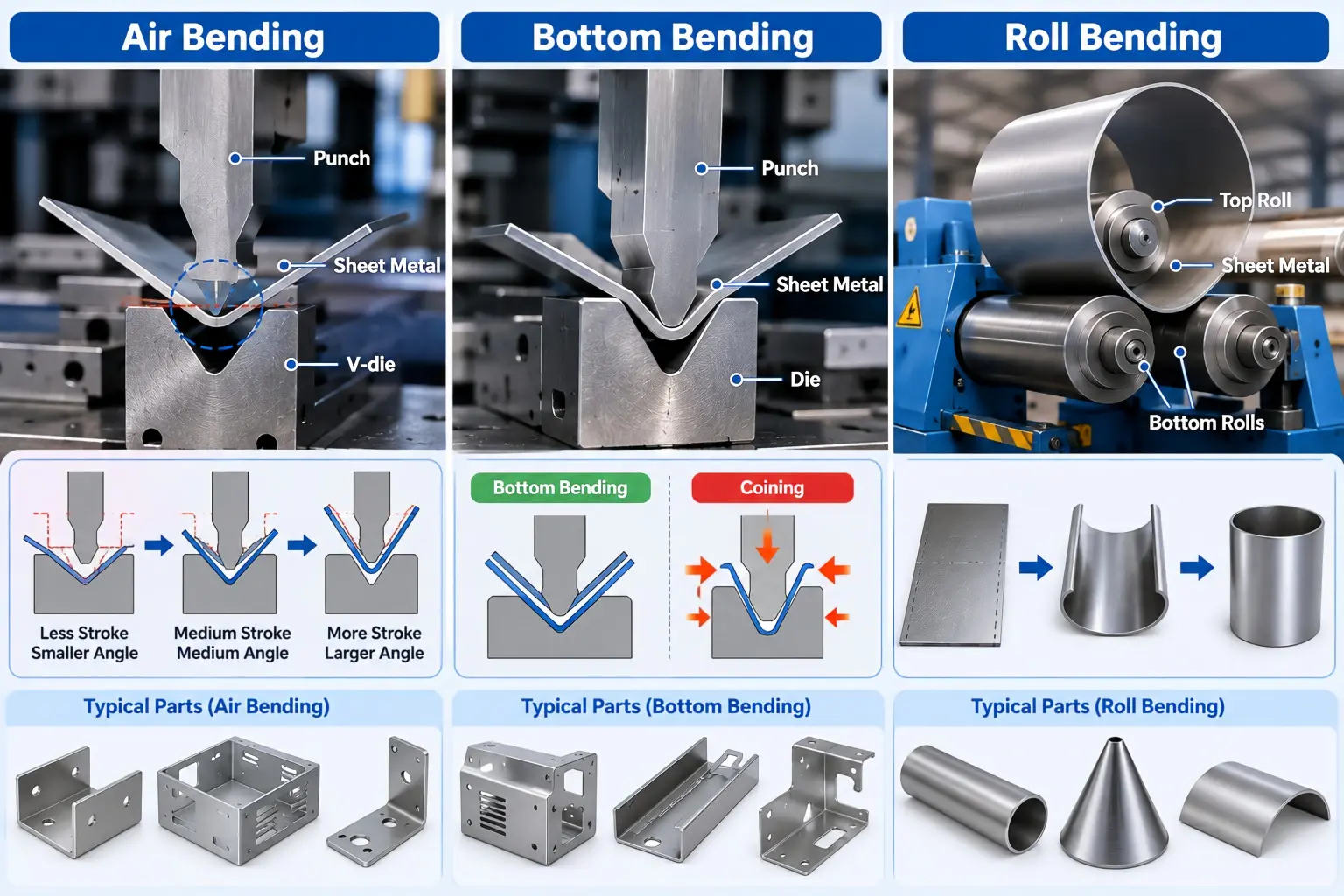
Air bending, 底部弯曲, and roll bending compared with press brake tooling, punch depth, coining differences, plate rolls, and typical formed metal parts.

Air Bending vs Bottom Bending vs Roll Bending

Comparison Item空气弯曲底部弯曲滚弯
Main equipmentPress brake with punch and V-diePress brake with closely matched punch and dieThree-roll or four-roll bending machine
Typical shapeStraight flanges, channels, 括号, boxes, and angled partsRepeated straight bends with controlled tool geometryCylinders, cones, arcs, 坦克, and large-radius sections
How the angle is formedPunch depth controls the angle without fully seating the sheet in the dieSheet is pressed more completely into matched toolingMaterial passes through adjustable rolls to form curvature
Tool flexibilityOne tool set can produce several angles within its usable rangeMore dependent on the selected punch-and-die geometryRoll position determines the radius and curvature
Required forceGenerally lower than bottoming or coiningHigher than air bendingDepends on thickness, 宽度, 材料, radius, and roll arrangement
Springback sensitivityUsually requires greater springback compensationGenerally lower springback than air bendingRadius may relax after unloading and require compensation
Main advantage灵活的, 高效的, and suitable for many sheet-metal partsRepeatable angle formation when material and tooling are controlledProduces continuous curves and cylindrical shapes
Main limitationSensitive to material thickness, 力量, grain direction, and springbackHigher force and less tooling flexibilityStraight ends, pre-bending, 圆度, and seam alignment require planning
Best starting pointMixed angles, 原型, 低音量, and general sheet-metal fabricationStable repeat work with controlled material and dedicated toolingLarge-radius and cylindrical components

Air bending is normally the most flexible of the three because the punch stroke controls the angle and one punch-and-die combination can produce multiple angles. LVD also notes that it generally requires less force than other press-brake techniques.


1. 空气弯曲

Air bending is a press-brake process in which the sheet contacts the punch tip and the upper edges of the die opening without being fully pressed against the bottom of the die.

The punch moves into the die opening, and the programmed punch depth controls the final bend angle.

空气弯曲的优点

Air bending is widely used because it provides:

  • Flexible angle adjustment
  • Lower forming force than bottom bending or coining
  • Fewer tool changes for different angles
  • Practical processing of prototypes and mixed batches
  • Compatibility with CNC angle correction and measurement systems
  • Lower tooling investment for varied part designs

One punch-and-die combination may produce several angles, provided the required radius, flange length, 材料, and machine capacity remain within the tool’s operating range.

Main Engineering Risks

Air bending is more sensitive to material variation than the original article suggests.

The final angle may change with:

  • Sheet thickness
  • Material strength
  • 脾气
  • Grain direction
  • 刀具磨损
  • V-die opening
  • Punch radius
  • Punch depth
  • Springback
  • Bend length

Air bending does not automatically prevent over-bending. The process often intentionally bends beyond the target angle to compensate for springback.

Modern angle-measurement systems can correct the ram position during bending, but the drawing and material specification still need to be clear.

典型应用

Air bending is commonly used for:

  • 括号
  • Channels
  • 外壳
  • Equipment covers
  • 安装板
  • Electrical cabinets
  • Sheet-metal housings
  • Prototype and low-volume fabricated parts
  • Components containing several different bend angles

TRUMPF describes air bending as a path-dependent method in which punch depth determines the angle, while LVD notes that material thickness, strain hardening, and grain direction can all change the bend result.


2. 底部弯曲

底部弯曲, also called bottoming, is a press-brake process in which the sheet is pressed more completely into the die than it is during air bending.

The punch, sheet, and die geometry work together to control the bend. The tooling must therefore match the required angle and form more closely.

Bottom Bending Is Not the Same as Coining

Bottom bending and coining are sometimes incorrectly treated as interchangeable.

底部弯曲时, the sheet is seated against the die and the punch depth helps determine the bend angle.

Coining applies substantially greater pressure and forces the material into closer contact with both the punch and die surfaces. It is a separate forming method rather than another name for ordinary bottom bending.

底部弯曲的优点

Bottom bending may provide:

  • Lower springback than air bending
  • Stable bend angles with controlled material
  • Good repeatability for dedicated production
  • Clear tool-defined geometry
  • Reduced dependence on punch-depth adjustment after setup

Main Engineering Risks

Bottom bending requires more force and is less flexible than air bending.

The supplier should confirm:

  • Material grade and temper
  • Sheet-thickness tolerance
  • Bend length
  • Punch angle
  • Die angle
  • Inside radius
  • Press-brake tonnage
  • Tool load capacity
  • Surface-marking requirements
  • 生产数量

Bottom bending should not automatically be described as the best method for thicker materials. Thick or high-strength plate may exceed the available machine or tooling capacity, and roll bending or another forming route may be more suitable.

典型应用

Bottom bending may be useful for:

  • Repeated brackets
  • Channels
  • 封面
  • 外壳
  • Parts with stable material and thickness
  • Production runs using dedicated tooling
  • Components requiring repeatable straight bends

TRUMPF states that bottom bending uses matched tooling and higher pressure to stabilize the angle, while LVD distinguishes bottoming from coining and notes that bottoming is commonly applied where material properties and thickness are consistent.


3. 滚弯

Roll bending forms metal into a continuous curve by passing the material through adjustable rolls.

The original article describes only a three-roll machine, but both three-roll and four-roll machines are widely used.

Possible configurations include:

  • Three-roll initial-pinch machines
  • Three-roll double-pinch machines
  • Three-roll variable-axis machines
  • Four-roll plate-bending machines
  • Section or profile bending rolls

滚弯的优点

Roll bending is suitable for:

  • Large radii
  • Cylinders
  • Cones
  • Curved panels
  • Tanks
  • Shells
  • Rings
  • Structural profiles

The roll positions can be adjusted to change the radius, and some machines support CNC-controlled repeat production.

Four-roll machines can clamp and control the plate during forming, while three-roll machines may be practical for flexible or lower-volume production.

Main Engineering Risks

Roll bending does not automatically produce a complete cylinder without further planning.

Important issues include:

  • Straight sections near the plate ends
  • Edge pre-bending
  • 圆度
  • Cone alignment
  • Material springback
  • Plate thickness variation
  • Weld-seam preparation
  • Surface marking
  • Roll deflection
  • Final diameter after welding
  • Removal of a closed cylinder from the machine

The buyer should state whether the required dimension is:

  • Inside radius
  • Outside radius
  • Centerline radius
  • Inside diameter
  • Outside diameter
  • Diameter before welding
  • Diameter after welding

典型应用

Roll bending is commonly used for:

  • Tanks
  • Cylindrical shells
  • Ducts
  • Curved covers
  • Conical sections
  • Large-radius panels
  • Pipe and structural sections
  • Industrial equipment components

DAVI manufactures both three-roll and four-roll plate-bending systems. Its four-roll design uses the bottom roll to clamp the plate during forming, while three-roll designs use different movable-roll arrangements for edge pre-bending and plate rolling.


How to Choose the Right Metal Bending Method

Project RequirementRecommended Starting Point为什么
Several different straight bend anglesAir bendingOne tooling setup may produce multiple angles
Prototype or low-volume sheet-metal partAir bendingFlexible setup and lower tooling commitment
Repeated straight bend with controlled material底部弯曲Dedicated tooling can improve angle repeatability
Very low springback requirementBottom bending or another controlled forming methodGreater tool contact reduces springback sensitivity
Cylinder or curved shellRoll bendingProduces continuous curvature rather than a straight fold
Large-radius curved panelRoll bendingBetter suited to gradual curvature
Cosmetic sheet with strict surface requirementsProcess depends on shapeTool condition, protective film, bend direction, and contact pressure must be reviewed
Thick or high-strength plateCapacity review requiredMachine tonnage, tool load, 宽度, radius, and material strength must be checked
Many small flanges and box shapesAir bending or panel bendingPart handling and bend sequence may control the best method
High-volume repeat productionProcess depends on geometryDedicated tooling, automated angle control, panel bending, or four-roll automation may be justified

The correct method cannot be selected from part thickness alone. 形状, angle, radius, bend length, 数量, 结束, machine capacity, and dimensional requirements must be considered together.


Springback, Bend Radius, 和表面风险

Springback

After the forming force is removed, the material may partially return toward its original shape. This is called springback.

Springback can change with:

  • 材质等级
  • Yield strength
  • Temper or heat treatment
  • Sheet thickness
  • Grain direction
  • Inside bend radius
  • Tool opening
  • Bending method
  • Production batch

A bend program developed for one material lot should not automatically be assumed correct for another thickness, 脾气, or supplier.

Inside Bend Radius

The drawing should clearly define the required inside bend radius.

A radius that is too small for the material and condition may increase the risk of:

  • Cracking
  • Surface tearing
  • Excessive thinning
  • 失真
  • Unstable angle correction

A larger radius may improve formability but can affect flange location, overall size, bend allowance, 和装配配合.

Surface Marks

Bending tools can leave:

  • Die lines
  • 划痕
  • Pressure marks
  • Protective-film impressions
  • Roller marks
  • Polished or coated surface damage

Cosmetic surfaces should be marked on the drawing. 保护膜, bending foil, polished tooling, larger contact radii, or another forming route may be required.

LVD’s tooling documentation specifically discusses reducing friction and tooling marks, while TRUMPF’s operating documentation describes bending foil as a way to protect the workpiece from impressions.


RFQ Information for Metal Bending Parts

询价项目需要指定什么为什么它很重要
材料Exact alloy or gradeControls strength, 成形性, springback, and cracking risk
Material condition脾气, 硬度, 热处理, or delivery conditionThe same alloy can bend differently in different conditions
厚度Nominal thickness and applicable toleranceAffects angle, force, radius, and tool selection
库存形式Sheet, 盘子, 管子, 挤压, or profileDetermines the suitable bending equipment
Bend angleFinal angle and toleranceHelps select tooling and compensation
Bend radius里面, outside, or centerline radiusPrevents interpretation disputes
Bend lengthLength of each bendRequired for force and machine-capacity review
Flange dimensionsMinimum flange length and critical edgesDetermines tool and backgauge access
Grain directionBend parallel or perpendicular to rolling direction when relevantCan affect cracking and angle behavior
Surface requirementCosmetic side, protective film, acceptable tool marks, 或涂层Controls handling and tooling protection
数量Prototype and expected repeat volumeAffects tooling and automation decisions
检查Angle, radius, profile, hole position, 平整度, or template inspectionDefines acceptance before production
后处理焊接, 加工, 去毛刺, 阳极氧化, 电镀, 绘画, or powder coatingBending can affect later dimensions and appearance

For custom brackets, channels, 封面, 外壳, curved panels, and other formed components, 回顾我们的 metal bending services.

For projects combining cutting, 弯曲, 成型, 焊接, 和整理, 回顾我们的 sheet metal processing services.

Rapid Efficient can review the drawing, 材料, 厚度, bend angle, radius, 表面要求, 数量, inspection points, and post-processing requirements before quotation.


常问问题: Types of Metal Bending

What Are the Three Main Types of Metal Bending?

A practical general classification is air bending, 底部弯曲, 和辊弯.

Air and bottom bending use press brakes for straight bends, while roll bending uses adjustable rolls to produce continuous curves.

Other classifications may also include coining, 折叠式的, hemming, panel bending, tube bending, and profile bending.

What Is the Difference Between Air Bending and Bottom Bending?

In air bending, the sheet is not completely seated in the die, and punch depth controls the angle.

底部弯曲时, the material is pressed more completely into matched tooling. Bottom bending normally requires more force and provides less tooling flexibility, but it can reduce springback under controlled conditions.

Is Bottom Bending the Same as Coining?

福田街道.

Coining applies substantially greater pressure and forces the material into closer contact with both the punch and die surfaces. Bottoming and coining should be treated as separate processes.

Does Air Bending Require Less Force?

一般来说, 是的.

Because the sheet is not forced fully into the die, air bending normally requires less force than bottom bending or coining. The actual tonnage still depends on material, 厚度, bend length, tool opening, 和力量.

Can Roll Bending Produce a Complete Cylinder?

是的, but edge pre-bending, straight ends, 圆度, welding allowance, springback, and part removal must be planned.

The required diameter should be clearly defined as inside, outside, or centerline diameter.

Which Bending Method Has the Least Springback?

Bottom bending generally produces less springback than air bending, but no method eliminates every material and thickness variation.

工装, 压力, 物质条件, grain direction, and angle-control systems still matter.

Does Metal Thickness Determine the Bending Method?

Thickness is important, but it is not the only factor.

The supplier must also check material strength, bend length, radius, angle, machine capacity, 工装, 形状, 表面要求, 和生产数量.

What Information Is Needed for a Metal Bending Quote?

Provide a 2D drawing or usable 3D model, exact material and condition, 厚度, bend angles, inside radii, bend lengths, 数量, 装饰表面, 后处理, 检验要求, and target delivery date.


结论

Air bending, 底部弯曲, and roll bending solve different forming problems.

Air bending is the most flexible starting point for many straight sheet-metal bends and mixed production quantities.

Bottom bending uses more complete tool contact to provide stable, repeated bends when the material and tooling are controlled.

Roll bending is used for continuous curves, large radii, 气缸, cones, and curved sections.

The correct choice depends on:

  • 材质等级
  • Temper or hardness
  • 厚度
  • Bend angle
  • Inside radius
  • Bend length
  • Springback
  • Surface requirements
  • Machine and tooling capacity
  • 数量
  • 检查方法
  • 后处理

The method should be selected from the finished-part requirements, not from a general statement that one bending process is always more accurate or better.

Review Your Metal Bending Project

Send the STEP file, 2D图, 材料, 厚度, bend angles, inside radii, 数量, 装饰表面, 后处理, 及检验要求.

Rapid Efficient can review the bending route, 重大风险, tooling access, springback, 表面保护, inspection points, and related sheet-metal processes before quotation.

For finish requirements after bending, 回顾我们的 surface finishes for metal parts.

For drawing review, 检查计划, and shipment checks, 回顾我们的 质量保证流程.

发表评论

滚动至顶部

获取报价

点击或拖拽文件到该区域即可上传. 您最多可以上传 10 文件.
文件格式:TXT PDF DOC DOCX XLS XLSX PPT PPTX JPG PNG ZIP RAR DWG DXF DXF DWT DWS DWS

3D文件格式: 步, STP, sldprt, IPT, prt, 坐着, IGES, IGS, catpart, X_T, OBJ, STL