
If a CNC part only needs general stainless hardware performance, 18-8 stainless steel may be acceptable. If the part will face chloride, salt spray, outdoor exposure, cleaning chemicals, food equipment conditions, medical device environments, or customer-controlled corrosion requirements, 316 stainless steel is usually the safer choice.
The difference is not only price. The real difference is risk.
18-8 stainless steel is a broad commercial description for stainless material with about 18% chromium and 8% nickel. 316 stainless steel is a more specific stainless steel grade that includes molybdenum, which improves resistance to pitting and crevice corrosion in many chloride-containing environments.
For custom CNC machined parts, Rapid Efficient generally recommends treating 18-8 as a general stainless option and 316 as a controlled material choice for corrosion-sensitive projects. If the drawing, RFQ, or end-use environment is unclear, material selection should be reviewed before production.
Fast Comparison for Buyers
| Question | Better Answer |
|---|---|
| Is 18-8 the same as 316? | No. 18-8 is a broad stainless description; 316 is a specific grade. |
| Which has better corrosion resistance? | 316, especially in chloride or marine-related environments. |
| Which is more common for general hardware? | 18-8. |
| Which is safer for custom CNC parts exposed to corrosion risk? | 316 stainless steel. |
| Which is usually more expensive? | 316. |
| Which is better for passivated parts? | Depends on the environment, but 316 is often safer for corrosion-sensitive use. |
| Can 18-8 replace 316 on a drawing? | Not without buyer approval. |
The simplest rule is this:
Use 18-8 for general stainless hardware when exact grade control is not critical. Use 316 when corrosion resistance, material certification, passivation, or customer acceptance matters.
What 18-8 Stainless Steel Means
18-8 stainless steel is a general way to describe a stainless steel family with approximately:
- 18% chromium
- 8% nickel
- austenitic stainless behavior
- general corrosion resistance
- common use in fasteners, washers, nuts, screws, brackets, and hardware
This is why 18-8 stainless is often seen in standard hardware catalogs. It is useful, available, and suitable for many non-critical indoor applications.
But for CNC machined parts, 18-8 has one weakness: it is not always a precise material grade.
A drawing that says “18-8 stainless steel” may leave open questions:
- Does the buyer expect 304?
- Is 316 acceptable or required?
- Is a material certificate needed?
- Is passivation required?
- Is the part exposed to chloride or chemicals?
- Is this a standard hardware component or a custom machined part?
- Is substitution allowed?
For general hardware, those questions may not matter. For machined components with tolerance, sealing, cosmetic, or corrosion requirements, they can matter a lot.
For components driven by strict grade compliance, mill traceability, or raw material verification risks, review the engineering comparison of 304 vs 18-8 stainless steel to avoid vague stock sourcing before production.
What 316 Stainless Steel Means
316 stainless steel is a defined austenitic stainless steel grade. It is similar to common 300-series stainless steels, but its key difference is the addition of molybdenum.
That molybdenum content helps improve resistance to:
- chloride-related corrosion
- pitting corrosion
- crevice corrosion
- salt spray exposure
- marine or coastal conditions
- some cleaning chemical environments
- more demanding outdoor applications
This does not mean 316 is corrosion-proof. Stainless steel can still corrode if the environment is harsh enough, if the surface is contaminated, if crevices trap fluid, or if the cleaning process is not suitable.
But compared with general 18-8 stainless, 316 gives buyers a clearer and stronger corrosion-resistance baseline.
For CNC machined parts, 316 is often selected for:
- marine hardware
- fluid fittings
- medical-related components
- food processing equipment parts
- chemical handling components
- outdoor brackets and housings
- corrosion-sensitive shafts, bushings, and spacers
- parts requiring passivation and documentation
Where 316 Starts to Matter
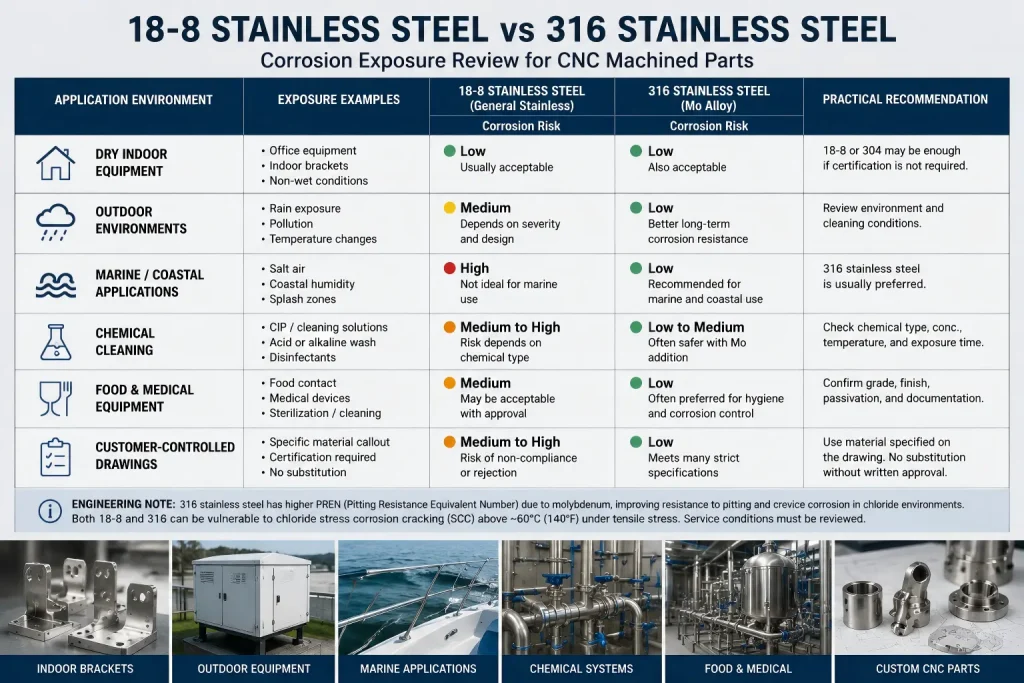
The decision between 18-8 and 316 should be based on the environment, not only the material name.
| Application Environment | 18-8 Stainless Steel | 316 Stainless Steel | Practical Recommendation |
| Dry indoor equipment | Usually acceptable | Also acceptable | 18-8 or 304 may be enough if certification is not required. |
| Basic brackets or covers | Often acceptable | Usually not necessary | Use 316 only if corrosion or customer requirements justify it. |
| Standard screws and washers | Common choice | Used when corrosion risk is higher | Match the hardware grade to the assembly environment. |
| Outdoor equipment | Depends on exposure | Safer | Review rain, pollution, temperature, and cleaning conditions. |
| Marine or coastal use | Higher risk | Better choice | 316 is usually preferred. |
| Salt spray exposure | Not ideal | Better choice | Specify 316 or 316L and review surface finish. |
| Chemical cleaning | May be risky | Often safer | Check chemical type, concentration, and cleaning frequency. |
| Medical or food equipment | Depends on requirement | Often preferred | Confirm grade, finish, passivation, and documentation. |
| Customer-controlled drawings | Use only if specified | Use if specified | Do not substitute without written approval. |
The key point is simple: 18-8 may be enough for general stainless use, but 316 becomes important when the environment can attack ordinary stainless surfaces.
There is also an important boundary for high-temperature chloride environments. 316 stainless steel improves resistance to pitting and crevice corrosion compared with general 18-8 stainless, but it is not immune to chloride stress corrosion cracking.
When a part is exposed to aqueous chlorides, elevated temperature, and tensile stress at the same time, both 18-8 stainless and 316 stainless may become vulnerable to SCC. A practical engineering warning zone often begins around 60°C / 140°F, especially for pressurized fittings, threaded parts, marine manifolds, heated cleaning systems, and structural fasteners under load.
If the component will operate in hot chloride service, heated chemical cleaning, pressurized marine equipment, or thermally cycled assemblies, 316 alone should not be assumed to solve the risk. Duplex stainless steel, higher-alloy stainless steel, or nickel alloys may need to be reviewed during the DFM and material selection stage.
Corrosion Is Usually the Real Decision
Many buyers ask whether 18-8 or 316 is “stronger.” For CNC parts, that is often the wrong first question.
The better first question is:
Will the environment make normal stainless steel fail visually, functionally, or at customer inspection?
Corrosion-related problems can appear as:
- brown staining
- pitting marks
- crevice corrosion near threads or pockets
- rust-like contamination from embedded iron
- discoloration after cleaning
- surface damage after passivation
- rejected cosmetic surfaces
- customer complaints after shipment or storage
These issues are especially common around:
- threads
- blind holes
- sharp internal corners
- sealing grooves
- press-fit areas
- thin pockets
- brushed or polished surfaces
- parts packed before fully dry
- assemblies exposed to chloride or cleaning chemicals
316 does not remove every risk, but it can reduce the chance of corrosion problems in many environments where general 18-8 stainless may be too vague or too risky.
One useful way to explain this difference is PREN, or Pitting Resistance Equivalent Number. PREN is commonly used as a comparative index for estimating stainless steel resistance to localized pitting in chloride-containing environments.
A common formula is:
PREN = %Cr + 3.3 × %Mo + 16 × %N
For a typical 18-8 stainless material such as 304, the PREN value is usually much lower because there is little or no molybdenum contribution. Typical 304 stainless steel is often around the high teens to low 20s, depending on the exact chemistry. For 316 stainless steel, the molybdenum addition raises the PREN value, often into the low-to-mid 20s, which helps explain why 316 is often selected for chloride, marine, outdoor, chemical cleaning, and corrosion-sensitive applications.
PREN should not be treated as the only selection rule. Surface finish, crevice design, temperature, cleaning chemistry, passivation, and actual service conditions still need to be reviewed. But for buyers comparing general 18-8 stainless with 316, PREN gives a clearer technical reason why 316 usually carries a higher corrosion-resistance value.
CNC Machining Behavior: 18-8 vs 316
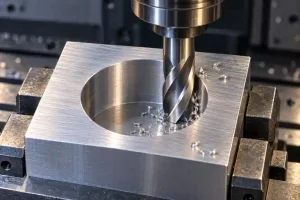
From a machining perspective, both 18-8 and 316 can be more demanding than aluminum, brass, or free-machining steel.
If the 18-8 material is 304-like, it may work harden, produce burrs, and require stable cutting parameters. 316 can also work harden and may feel tougher during cutting because of its alloy composition and corrosion-resistant behavior.
| Machining Factor | 18-8 Stainless Steel | 316 Stainless Steel |
| Material definition | Broad description | Specific grade |
| Machining predictability | Depends on exact alloy and stock condition | More predictable when grade and stock are specified |
| Work hardening | Possible | Common concern |
| Tool wear | Depends on material and geometry | Can be higher than easier stainless grades |
| Burr formation | Common on threads, slots, and edges | Common, especially on ductile features |
| Drilling and tapping | Needs good lubrication and chip evacuation | Needs controlled process, especially in deep holes |
| Surface finish | Depends on exact material | Can be controlled with correct tooling and finishing |
| Certificate review | May require clarification | Clearer if 316 is specified |
| Repeat production | Less controlled if only “18-8” is written | More controlled when 316 is locked |
For CNC machining, 316 is not automatically easier. In some cases, it can be more difficult and more expensive to machine than a general stainless option.
The benefit of 316 is not easier cutting. The benefit is clearer material control and better corrosion-risk management.
Why 18-8 Can Create RFQ Confusion
The term “18-8” is useful in hardware purchasing, but it can create problems in custom CNC RFQs.
A buyer may write:
Material: 18-8 stainless steel
But the project may actually require:
- 316 stainless steel
- 316L stainless steel
- passivation after machining
- MTR or material certificate
- PMI verification
- no material substitution
- corrosion review for chloride exposure
- cosmetic finish control
- customer approval before grade change
If those requirements are not written clearly, the supplier may quote a lower-cost stainless option that meets a broad “18-8” description but does not meet the real end-use expectation.
This is where disputes happen. The part may be machined correctly, but the material expectation may still be wrong.
For custom CNC parts, the RFQ should not rely on “stainless steel” or “18-8” if the final application needs 316-level corrosion performance.
Passivation and Surface Finish Considerations
Passivation can improve surface cleanliness and help support the stainless passive layer after machining. However, passivation is not a magic repair for poor material selection.
A passivated 18-8 part may still be the wrong choice if the environment requires 316. A 316 part may still corrode if the surface is contaminated, if cleaning chemicals are too aggressive, or if the part design traps chloride-rich fluid in crevices.
Passivation should be reviewed together with:
- material grade
- surface roughness
- burr removal
- cleaning process
- packaging method
- customer corrosion expectation
- inspection requirement
- operating environment
For corrosion-sensitive CNC parts, it is better to define the full requirement:
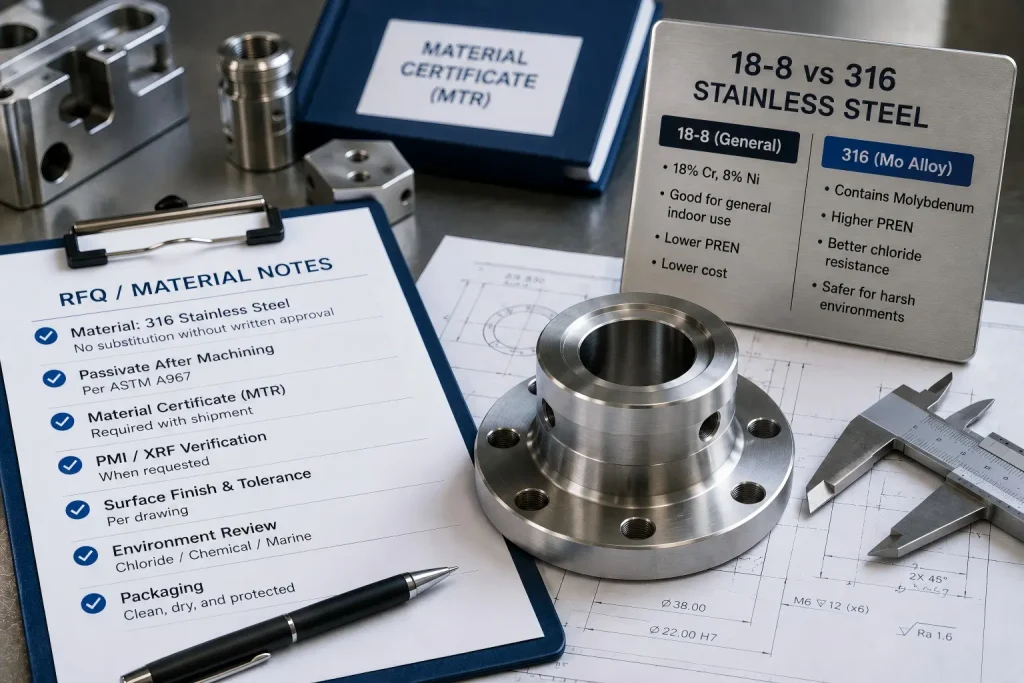
Material: 316 stainless steel. Passivate after machining. Material certificate required. Substitution requires written approval.
That note is much safer than simply writing:
Stainless steel, passivated.
For more detail, see the guide on stainless steel passivation.
316 vs 316L: Should Buyers Care?
Some projects specify 316L instead of 316. The “L” version has lower carbon content, which can be useful when welding, thermal exposure, or stricter corrosion control is involved.
For CNC machined parts that are not welded and not exposed to high-risk corrosion conditions, standard 316 may be enough. For welded assemblies, passivated parts, medical-related components, or customer-controlled projects, 316L or dual-certified 316/316L may be requested.
The safest RFQ approach is to state the exact requirement instead of assuming:
| Requirement | Better Drawing or RFQ Note |
| Standard corrosion-resistant stainless | 316 stainless steel |
| Low-carbon requirement | 316L stainless steel |
| Either grade acceptable | 316 or 316L acceptable, confirm before production |
| Certificate required | MTR required with shipment |
| No substitution allowed | Substitution requires written approval |
| Passivation required | Passivate after machining; confirm standard before production |
If your corrosion-resistant components require post-machining welding, passivation, or low-carbon material control, review the dedicated breakdown of 316 vs 316L stainless steel before confirming the RFQ material note.
Cost Difference: When 316 Is Worth Paying For
316 stainless steel is usually more expensive than general 18-8 stainless options. It may also increase machining cost depending on part geometry, tolerance, surface finish, and inspection requirements.
But cost should be judged against failure risk.
| Cost Factor | 18-8 Stainless Steel | 316 Stainless Steel |
| Raw material cost | Usually lower | Usually higher |
| Availability | Common for standard hardware | Common but may need controlled sourcing |
| Machining difficulty | Depends on exact alloy | Often more demanding than easier stainless options |
| Certification clarity | May be unclear | Clearer when specified |
| Corrosion risk | Higher in chloride or harsh environments | Lower in many corrosion-sensitive applications |
| Rejection risk | Higher if buyer expected 316 | Lower if grade matches requirement |
| Best use | General hardware and non-critical parts | Corrosion-sensitive CNC components |
If the part is a simple indoor spacer, 316 may be over-specified. If the part is used near salt, chemicals, medical cleaning, food equipment, or outdoor exposure, the higher material cost may be cheaper than replacement, rework, or customer rejection.
When 18-8 Is the Better Practical Choice
18-8 may be the better practical choice when:
- the part is standard hardware
- exact grade documentation is not required
- the environment is dry and mild
- the component is not corrosion-critical
- the buyer accepts a general stainless description
- cost matters more than grade traceability
- the part is not customer-controlled or regulated
- the application does not require 316 or 316L
Examples may include indoor brackets, simple washers, basic fasteners, covers, and non-critical hardware.
Even then, it is better to clarify whether the supplier plans to use 304-like stainless, 316, or another acceptable material.
When 316 Is the Better Practical Choice
316 is usually the better choice when:
- the drawing already specifies 316
- the part faces chloride exposure
- the application is marine or coastal
- cleaning chemicals are used
- the customer requires corrosion resistance
- passivation is required
- a material certificate is needed
- the part is used in food, medical, or chemical equipment
- surface staining would cause rejection
- repeat production needs consistent material control
316 gives the buyer and supplier a clearer material target. It also reduces the risk of choosing a broad stainless material that looks acceptable on paper but fails in the real environment.
RFQ Notes That Prevent Material Mistakes
The best way to avoid confusion is to write the material requirement clearly before quotation.
| Buyer Intention | Recommended RFQ Note |
| General stainless acceptable | 18-8 stainless steel acceptable for non-critical indoor use. |
| 316 required | Material: 316 stainless steel. No substitution without written approval. |
| 316L required | Material: 316L stainless steel. MTR required. |
| 316 or 316L acceptable | Material: 316 or 316L stainless steel, confirm grade before production. |
| Corrosion-sensitive use | Review operating environment before material confirmation. |
| Passivation required | Passivate after machining; confirm finish and inspection requirements. |
| Certificate required | Material certificate required with shipment. |
| PMI required | PMI/XRF verification required when requested by buyer. |
| Cosmetic surface required | Define visible surfaces, finish direction, and packaging requirements. |
| Repeat production | Same material grade and certificate type required for repeat batches. |
A clear RFQ note protects both sides. It helps the manufacturer quote correctly, source the correct material, plan finishing, and avoid late-stage approval disputes.
Buyer Questions Before Quotation
Is 18-8 stainless steel marine grade?
No. 18-8 is generally used for stainless hardware, but it should not be treated as marine grade. For marine or coastal environments, 316 is usually a safer choice.
Is 316 always better than 18-8?
Not always. 316 is better for many corrosion-sensitive environments, but it may be unnecessary for mild indoor parts where general stainless hardware is enough.
Can 18-8 replace 316 stainless steel?
Only if the buyer approves it and the application does not require 316-level corrosion resistance. If the drawing says 316, do not substitute 18-8 without written approval.
Is 316 harder to machine?
316 can be more demanding than easier stainless materials. It can work harden, create burrs, and require stable tooling, coolant, and chip control. The difficulty depends on part geometry and tolerance requirements.
Should I choose 316L instead of 316?
Choose 316L when the drawing, welding process, passivation requirement, or customer specification requires lower carbon content. For general CNC parts, standard 316 may be acceptable if the project allows it.
Is 316 safe for hot chloride environments?
Not always. 316 improves resistance to chloride-related pitting compared with general 18-8 stainless, but it can still be vulnerable to chloride stress corrosion cracking when chloride exposure, elevated temperature, and tensile stress occur together. Hot chloride service should be reviewed carefully before final material approval.
How Rapid Efficient Reviews 18-8 and 316 Stainless Steel RFQs
Rapid Efficient supports custom CNC machining projects for stainless steel components, including prototypes, low-volume parts, and production requirements. Before quotation, we can review material grade, corrosion risk, machining strategy, tolerance requirements, passivation needs, surface finish, inspection requirements, packaging, and delivery schedule.
For stainless steel CNC parts, we recommend sending:
- 2D drawing
- 3D CAD file
- required material grade
- operating environment
- surface finish requirement
- passivation requirement if applicable
- tolerance and inspection notes
- annual or batch quantity
- certificate or report requirements
If your drawing says “18-8 stainless steel” but the part will face chloride, cleaning chemicals, outdoor exposure, food equipment conditions, or customer corrosion requirements, send the drawing before production so the material callout can be reviewed clearly.
Material certificates, CMM reports, and inspection reports are available depending on project requirements. For suitable rapid delivery projects, lead times may be as fast as 3–7 working days after drawing review and production confirmation.
If you are not sure whether your part should specify 18-8, 304, 316, 316L, duplex stainless steel, or another corrosion-resistant alloy, send your drawing to Rapid Efficient for material and RFQ review before production.