
For many general stainless steel parts, 18-8 stainless steel and 304 stainless steel may look interchangeable, but they should not always be treated the same in CNC drawings, RFQs, material certificates, or inspection requirements.
The practical answer is simple:
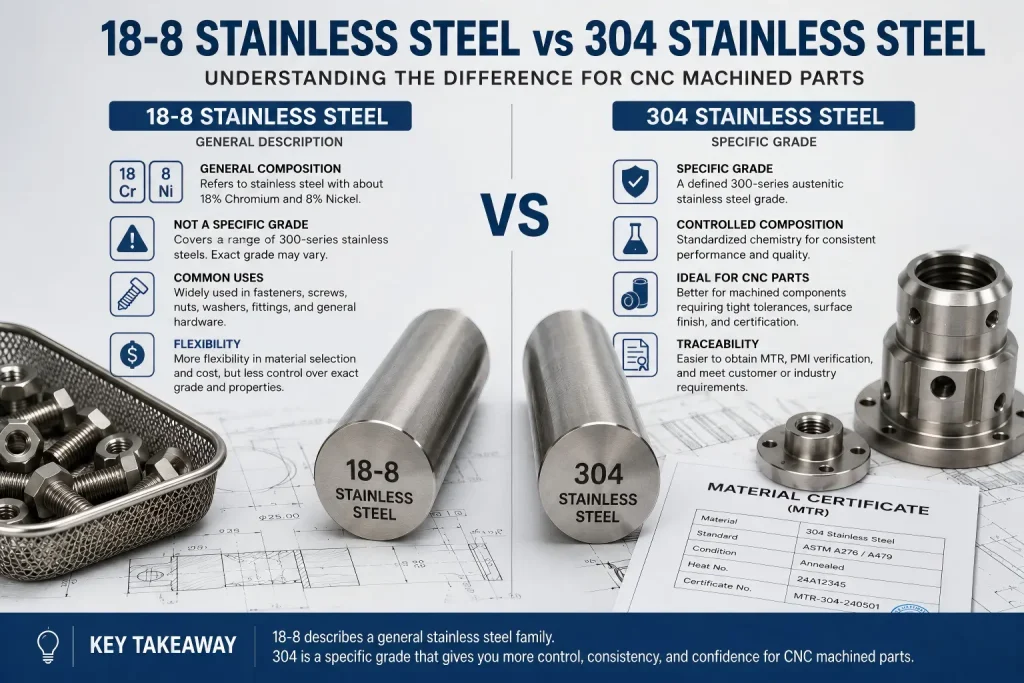
304 stainless steel is a specific stainless steel grade. 18-8 stainless steel is a broader description that usually means a stainless steel with about 18% chromium and 8% nickel. Many 304 stainless steels fall within the 18-8 family, but “18-8” is not always a precise substitute for “304” when the part requires controlled material certification, corrosion performance, passivation, or customer approval.
For CNC machined parts, Rapid Efficient generally recommends using 304 stainless steel when the drawing, assembly environment, corrosion requirement, or quality documentation must be controlled. Use 18-8 only when the application allows a more general stainless specification, such as non-critical hardware, basic brackets, spacers, or fasteners where exact grade traceability is not required.
The Practical Difference for CNC Buyers
| Question | Better Answer |
|---|---|
| Is 18-8 always the same as 304? | No. 304 is a defined grade; 18-8 is a general stainless description. |
| Can 304 be called 18-8? | Often yes, because 304 commonly fits the 18% chromium and 8% nickel description. |
| Can 18-8 replace 304 on a CNC drawing? | Only if the buyer accepts a broader stainless specification. |
| Which is safer for RFQ and inspection? | 304 stainless steel. |
| Which is better for certified CNC parts? | 304, or 304L if the drawing requires low carbon. |
| Which should be used for generic stainless hardware? | 18-8 may be acceptable if grade certification is not critical. |
The most common mistake is assuming that “18-8” automatically satisfies every 304 requirement. That may be fine for standard fasteners, but it can create problems when a CNC machined component needs material certificates, corrosion review, passivation, welding compatibility, or customer approval.
What 18-8 Stainless Steel Means
18-8 stainless steel is not one single exact grade. It is a common way to describe austenitic stainless steel with roughly:
- 18% chromium
- 8% nickel
- corrosion resistance suitable for many general indoor and light-duty environments
- non-magnetic or slightly magnetic behavior after cold working or machining
- good formability compared with many harder stainless grades
This is why 18-8 is often used in fasteners, screws, nuts, washers, fittings, brackets, and general stainless hardware.
But from a manufacturing and procurement point of view, 18-8 is less precise than 304. It may point to a material family rather than a controlled grade. If the drawing only says “18-8 stainless steel,” a supplier may need clarification before choosing the exact bar stock, plate, sheet, or fastener material.
The supply-chain risk of an ambiguous “18-8” callout is not only chemistry. It is also grade interpretation. In many purchasing contexts, 18-8 is treated as a broad commercial stainless description rather than a tightly controlled CNC material grade.
This matters because different 300-series stainless alloys can be selected for different manufacturing routes. Some are optimized for cold heading, forming, or standard fastener production rather than stable multi-axis machining. If a custom CNC drawing only says “18-8 stainless steel,” the supplier may need to clarify whether the buyer expects 304, 304L, a fastener-grade stainless material, or another acceptable stainless alloy within the same general corrosion-resistant family.
For non-critical hardware, that flexibility may be acceptable. For CNC machined parts with tight tolerances, threaded holes, cosmetic surfaces, passivation, or material certificate requirements, it can create avoidable risk. A more precise callout such as “304 stainless steel, substitution requires approval” gives both the buyer and manufacturer a clearer material baseline.
For basic commercial hardware, 18-8 may be enough. For custom CNC machined parts, 304 is usually safer.
What 304 Stainless Steel Means
304 stainless steel is a specific austenitic stainless steel grade widely used for CNC machined parts, housings, brackets, shafts, fittings, plates, covers, medical device components, food equipment parts, and corrosion-resistant assemblies.
Compared with a general 18-8 description, 304 gives the buyer and supplier a clearer basis for:
- material purchasing
- MTR or material certificate review
- PMI or XRF verification when required
- corrosion expectation
- passivation planning
- drawing notes
- customer acceptance
- repeat production consistency
304 is not always the easiest stainless steel to machine. It can work harden, generate built-up edge, produce burrs, and require stable tooling and coolant control. But because it is widely available and well understood, it is often the safer choice for custom CNC projects.
For machining-specific risks such as work hardening, burr control, and surface finish, see the guide on machining 304 stainless steel.
When 18-8 and 304 May Be Treated as Equivalent
In some purchasing situations, 18-8 and 304 may be accepted as equivalent or near-equivalent. This is most common when the part is not highly regulated and the customer mainly needs general corrosion-resistant stainless steel.
| Application Situation | Can 18-8 Be Accepted Instead of 304? | Manufacturing Comment |
| Generic stainless screws or washers | Usually yes | 18-8 is commonly used for general stainless fasteners. |
| Simple indoor brackets | Often yes | Confirm whether exact grade certification is needed. |
| Decorative covers | Sometimes | Appearance, polishing, and passivation expectations should be reviewed. |
| CNC spacers or bushings | Sometimes | Use 304 if dimensional repeatability and documentation matter. |
| Food-contact or medical-related parts | Not automatically | Drawing, regulatory, and passivation requirements should be checked. |
| Parts requiring MTR or PMI | Use 304 | A defined grade is safer for inspection and acceptance. |
| Customer-controlled drawings | Use the specified grade | Do not substitute without written approval. |
The key point is not whether 18-8 and 304 are chemically close. The key point is whether the project requires a defined material grade or only a general stainless description.
Grade Specification Risk: Where Buyers Get Into Trouble
A CNC part can look correct, measure correctly, and still create a dispute if the material specification is unclear.
Common problems include:
- The drawing says 304, but the quotation says 18-8.
- The purchase order says 18-8, but the customer expects 304 certification.
- The part is made from stainless material, but the MTR does not match the drawing.
- The customer requests PMI after production, but the RFQ never mentioned exact grade verification.
- Passivation is required, but the material condition and surface finish were not reviewed before finishing.
- A supplier treats 18-8 as acceptable, while the end customer requires 304 or 304L.
These problems are not always caused by poor machining. They often come from unclear RFQ language.
For custom CNC parts, a small wording difference can affect material sourcing, inspection cost, delivery time, and customer acceptance.
CNC Machining Behavior: 304 vs 18-8
If the 18-8 material is actually 304 or a very similar austenitic stainless grade, the machining behavior may be close. However, if the supplier only receives a broad “18-8” requirement, the exact machining response can be less predictable.
| Machining Factor | 304 Stainless Steel | Generic 18-8 Stainless Steel |
| Material definition | Specific grade | Broader description |
| Tool wear risk | Moderate to high depending on geometry | Depends on exact grade and condition |
| Work hardening | Common concern | Possible if austenitic stainless |
| Burr formation | Common on edges, slots, threads, and thin walls | Similar risk if material is 304-like |
| Tapping risk | Requires controlled feed, lubrication, and chip evacuation | Depends on exact material and hole depth |
| Surface finish | Predictable with correct tools and process | May vary if exact grade is not controlled |
| Certificate review | Clearer | May require clarification |
| Repeat orders | More consistent | Less consistent unless exact grade is locked |
For CNC projects, the machining difference may not be dramatic when both materials are similar. The bigger issue is usually specification control.
Another hidden issue is the difference between fastener-oriented stainless specifications and bar stock intended for machining. In North American purchasing, “18-8 stainless” is commonly seen in screws, bolts, washers, and other standard hardware. Those parts may be produced under fastener-focused specifications and cold-forming routes, where strength, heading behavior, and general corrosion resistance are more important than machining stability.
That does not mean generic 18-8 hardware stock is a good starting point for a custom CNC component. Cold-worked or fastener-oriented material can contain residual processing stress. When a CNC mill or lathe removes material from one side of a thin-wall, asymmetric, or flatness-critical part, the stress balance may change and the part can bow, twist, or move after unclamping.
For custom CNC machining, it is usually safer to define the required stainless grade and stock form clearly, such as 304 or 304L bar stock to an applicable bar specification when required. This helps the supplier select material suitable for turning, milling, drilling, tapping, finishing, and inspection instead of treating a standard 18-8 hardware description as a machining-grade material instruction.
If the customer expects repeatability across multiple batches, 304 is usually better than a general 18-8 callout.
Corrosion Resistance and Passivation
Both 304 and common 18-8 stainless steels offer good corrosion resistance for many environments. However, neither should be treated as corrosion-proof.
Corrosion performance depends on:
- chloride exposure
- cleaning chemicals
- temperature
- surface roughness
- embedded iron or shop contamination
- passivation quality
- crevices, threads, and trapped fluid
- welding or heat-affected zones
- final packaging and storage conditions
For mild indoor use, 304 or 18-8 may be enough. For marine, chloride-rich, chemical, or outdoor environments, 316 or 316L may be a better choice.
When passivation, welding, chemical exposure, or customer-controlled corrosion requirements are involved, the carbon limit should also be reviewed. Standard 304 stainless steel commonly allows a higher maximum carbon content than 304L. In many material references, 304 is listed with up to 0.08% carbon, while 304L is controlled to a lower 0.03% maximum carbon level.
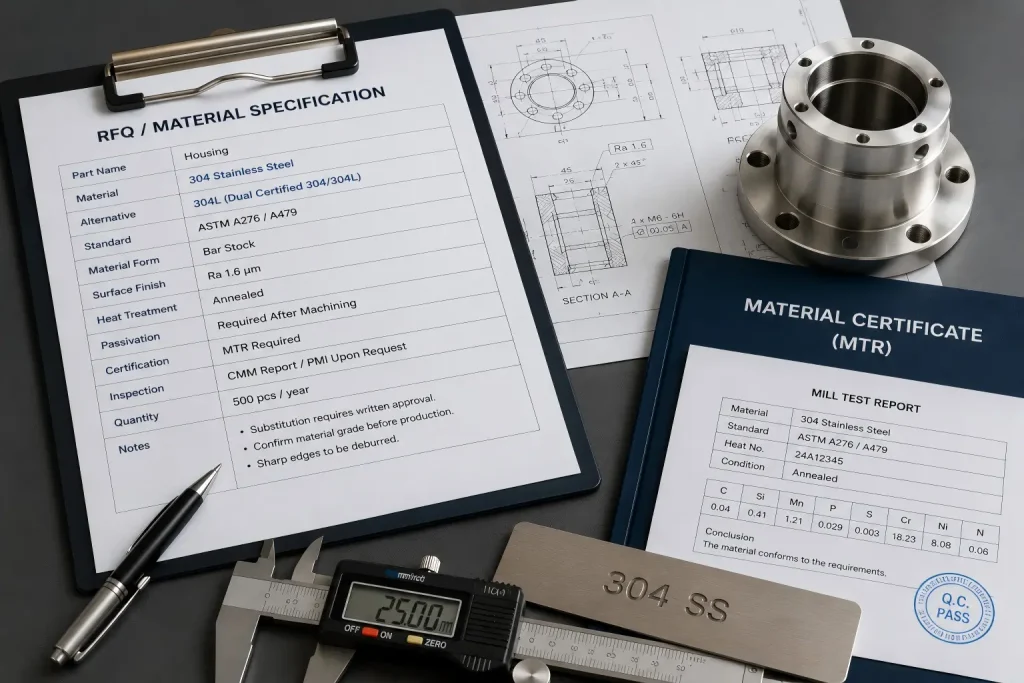
This is why some projects specify 304L or dual-certified 304/304L material. Dual-certified material can satisfy the general 304 requirement while also meeting the lower-carbon expectation of 304L, depending on the applicable standard and MTR. It may reduce risk for welded parts, passivated components, corrosion-sensitive assemblies, or projects where the customer requires tighter material documentation.
For a normal indoor CNC part, standard 304 may be enough. For passivated, welded, exported, or customer-audited parts, the RFQ should state whether 304, 304L, or dual-certified 304/304L is required, and whether material certificates or PMI verification are needed before shipment.
Passivation may be useful after machining when the part needs improved surface cleanliness and corrosion resistance. However, passivation should be reviewed together with material grade, surface finish, edge condition, and inspection expectations.
For more detail, see the guide on stainless steel passivation.
Surface Finish and Appearance Differences
304 stainless steel is often selected when the buyer wants a controlled surface finish, such as machined, brushed, bead blasted, polished, or passivated stainless parts.
Generic 18-8 stainless can also be finished, but the result depends on the exact material and stock condition. If the final appearance matters, the drawing should not rely only on the words “18-8 stainless steel.”
Surface finish should be defined separately from material grade.
Examples:
| Requirement | Better Drawing Note |
| Basic machined finish | 304 stainless steel, machined finish, deburr sharp edges |
| Brushed appearance | 304 stainless steel, brushed finish, grain direction specified if needed |
| Bead blasted surface | 304 stainless steel, bead blast finish, cosmetic surfaces defined |
| Corrosion-resistant finish | 304 stainless steel, passivated after machining |
| Critical appearance parts | Define material, surface finish, protected faces, and inspection method |
If the buyer only writes “18-8 stainless, good finish,” the supplier may not know whether the priority is appearance, corrosion resistance, roughness, or cost.
For surface finish planning, see the CNC surface finishes guide.
Drawing and RFQ Notes That Prevent Confusion
The best way to avoid substitution disputes is to make the material requirement clear before quotation.
| Buyer Requirement | Recommended RFQ or Drawing Note |
| Exact 304 required | Material: 304 stainless steel. Substitution requires written approval. |
| 304L acceptable | Material: 304 or 304L stainless steel, confirm grade before production. |
| 304/304L dual-certified required | Material: dual-certified 304/304L stainless steel, MTR required. |
| 18-8 acceptable | Material: 18-8 stainless steel acceptable for non-critical hardware application. |
| Certificate required | Material certificate required with shipment. |
| PMI required | PMI/XRF verification required when requested by buyer. |
| Passivation required | Passivate after machining; confirm standard and appearance requirements before production. |
| Corrosion-sensitive use | Review environment before material confirmation. |
| Repeat production | Same material grade and certificate type required for repeat batches. |
This is especially important when sourcing CNC machined stainless parts from overseas suppliers, because different teams may interpret “18-8” differently.
Cost and Lead Time Considerations
In many cases, 304 stainless steel is widely available and does not create unusual sourcing difficulty. For CNC machining, the cost difference between a vague 18-8 requirement and a controlled 304 requirement is not always about raw material price.
The real cost difference may come from:
- certificate requirements
- PMI or material verification
- passivation
- surface finish requirements
- tighter tolerance control
- repeat batch traceability
- customer approval before substitution
- special stock form or condition requirements
A part made from general 18-8 stainless may appear cheaper at first, but if the project later requires 304 certification, the cost of rework, replacement, or delayed acceptance can be much higher.
For RFQs, the safest approach is to define the required grade at the beginning.
When 304 Is the Better Choice
Choose 304 stainless steel when:
- the drawing already specifies 304
- the customer needs material certification
- repeat production consistency matters
- passivation is required
- the part will be assembled into a regulated or customer-controlled product
- corrosion performance must be reviewed
- cosmetic finish needs to be controlled
- the part has threaded holes, sealing faces, or thin features
- the buyer wants a clear inspection and acceptance standard
304 gives both buyer and manufacturer a clearer baseline. It reduces interpretation risk and makes the RFQ easier to control.
When 18-8 May Be Acceptable
18-8 may be acceptable when:
- the part is a generic stainless hardware item
- exact grade documentation is not required
- the application is not corrosion-critical
- the buyer allows equivalent stainless material
- the component is not safety-critical or regulated
- cost and availability are more important than grade traceability
- the purchase order clearly allows 18-8 stainless steel
Even then, it is better to confirm what the supplier actually plans to use. For custom CNC parts, “18-8” should not be used as a shortcut if the end customer expects 304.
Should You Choose 316 Instead?
304 and 18-8 are not always the right answer. If the part will be exposed to chloride, salt spray, marine environments, aggressive cleaning chemicals, or more demanding corrosion conditions, 316 or 316L may be a better material.
The decision should not be based only on stainless steel name recognition. Buyers should consider:
- operating environment
- cleaning process
- mechanical load
- cosmetic expectations
- welding or post-processing
- certification requirements
- tolerance and inspection requirements
- total project cost
For many CNC components, 304 is a strong default choice. For harsher corrosion environments, 316 may be worth reviewing.
Buyer Questions Before Quotation
Can I write “18-8 or 304 stainless steel” on a drawing?
You can, but it may create ambiguity. If both are acceptable, state that clearly. If 304 is required, write 304 stainless steel and mention that substitutions require approval.
Is 18-8 stainless steel good for CNC machining?
It can be, but the exact grade matters. If the 18-8 material is 304-like, machining behavior may be similar to 304. For controlled CNC work, a defined grade is usually safer.
Will 304 stainless steel rust?
304 has good corrosion resistance, but it can still corrode in chloride-rich, contaminated, or poorly cleaned environments. Surface finish, passivation, and operating conditions all matter.
Should I request a material certificate?
If the part is used in a controlled assembly, exported product, customer-approved project, or corrosion-sensitive application, a material certificate should be requested before production.
Is dual-certified 304/304L always required?
No. Many general CNC parts can use standard 304 if the drawing and environment allow it. Dual-certified 304/304L should be considered when welding, passivation, customer documentation, or lower-carbon requirements are important.
How Rapid Efficient Reviews 304 and 18-8 Stainless Steel RFQs
Rapid Efficient supports custom CNC machining projects for stainless steel components, including prototypes, low-volume parts, and production requirements. Before quotation, we can review material grade, machining strategy, tolerance risks, surface finish, passivation needs, inspection requirements, packaging, and delivery schedule.
For stainless steel CNC parts, we recommend sending:
- 2D drawing
- 3D CAD file
- required material grade
- surface finish requirement
- passivation requirement if applicable
- tolerance and inspection notes
- annual or batch quantity
- certificate or report requirements
If your drawing says “18-8 stainless steel” but your customer expects 304, 304L, passivation, or material certification, send the drawing before production so the material callout can be reviewed clearly.
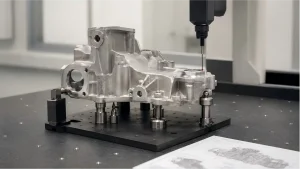
Material certificates, CMM reports, and inspection reports are available depending on project requirements. For suitable rapid delivery projects, lead times may be as fast as 3–7 working days after drawing review and production confirmation.
If you are not sure whether your part should specify 304, 304L, 18-8, or 316 stainless steel, send your drawing to Rapid Efficient for material and RFQ review before production.