
Brass is often described as an easy material to machine.
That is only partly true.
Some brass grades cut cleanly, break chips well, and produce stable threads. Other brass grades can create longer chips, higher tool wear, burr problems, surface scratches, or compliance questions before the part even reaches inspection.
For CNC buyers, the risk is simple:
Writing “brass” on a drawing is not the same as defining the brass machining route.
A C360 brass fitting, a lead-free brass insert, a decorative brass knob, and a plated brass connector may all require different tooling, deburring, surface handling, inspection, and documentation.
Brass machining should start with the actual part function:
- Is the part threaded?
- Is it a fitting, insert, bushing, connector, housing, or decorative component?
- Does it require RoHS, REACH, potable-water, or customer-specific compliance?
- Will it be plated or polished?
- Are burrs allowed near threads, holes, or sealing faces?
- Does the part need material certification?
- Are dimensions controlled before or after finishing?
Rapid Efficient supports custom brass CNC machining projects for prototypes, low-volume parts, and production requirements. Before quotation, we review the drawing together with the brass grade, thread requirements, tolerance notes, surface finish, plating needs, burr-control expectations, inspection method, packaging needs, and delivery schedule.
Brass Is Easy to Machine Only When the Grade Matches the Job
Brass is not one material.
It is a family of copper-zinc alloys, and each grade can behave differently during machining.
C360 free-cutting brass is widely used because it machines efficiently and produces cleaner chips in many conditions. It is often selected for fittings, threaded parts, inserts, bushings, valve components, connectors, and precision turned parts.
But not every project can use C360.
Some parts require low-lead or lead-free brass because of environmental, potable-water, consumer-product, medical, or export-compliance requirements.
That changes the machining conversation.
Lead-free or low-lead brass should not be treated as “the same brass with a different certificate.”
Depending on the grade, it may change:
- Cutting force
- Chip shape
- Tool wear
- Burr formation
- Thread quality
- Surface finish
- Plating behavior
- Material cost
- Inspection requirements
- Lead time
For a broader comparison between brass and copper, including conductivity and material-substitution risk, see our guide on brass vs copper for CNC machined components.
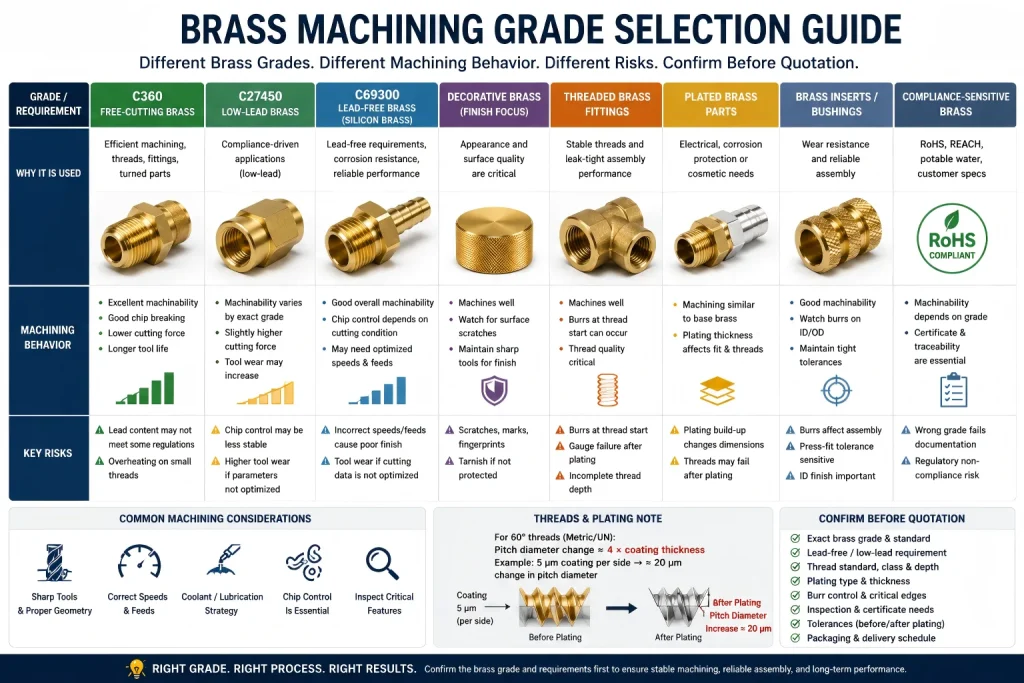
Brass Grade Review Before Machining
| Brass Grade or Requirement | Why It Is Used | Machining Concern | What Buyers Should Confirm |
|---|---|---|---|
| C360 free-cutting brass | Efficient machining, threads, fittings, turned parts | Usually machines well, but may not meet lead-free requirements | Grade, compliance needs, thread class, surface finish |
| C27450 or selected low-lead brass | Compliance-driven applications | May behave differently from C360 during cutting | Exact grade, certificate, tool wear, burr-control need |
| C69300 or selected lead-free brass | Lead-free or corrosion-focused requirements | Machinability can be good, but process route is grade-specific | Grade, standard, plating route, inspection requirement |
| Decorative brass | Appearance and finish matter | Scratches, fingerprints, polishing marks, tarnish | Visible surfaces, polishing, coating, packaging |
| Threaded brass fittings | Stable threads and assembly function | Burrs, gauge fit, plating thickness, thread start | Thread standard, gauge inspection, post-finish fit |
| Plated brass parts | Contact, corrosion, or cosmetic requirements | Plating buildup may affect threads and holes | Dimensions before/after plating, masking, inspection |
| Brass inserts or bushings | Assembly and wear behavior | Press-fit edges, bore finish, burrs | Bore tolerance, chamfer, mating part, inspection method |
| Compliance-sensitive brass | RoHS, REACH, potable-water, or customer requirements | Wrong grade can fail documentation even if part machines well | Certificate, restricted substances, customer specification |
This review prevents the quotation from being based on an easy-machining grade when the real production part requires a different alloy.
For broader material planning, review our CNC machining materials guide.
Why C360 Brass Is So Common
C360 brass is one of the most common brass grades for CNC machining because it is highly machinable.
It is often used for:
- Threaded fittings
- Inserts
- Bushings
- Valve components
- Connectors
- Precision turned parts
- Instrument parts
- Electrical hardware
- Decorative mechanical parts
- Small batch CNC components
The reason is chip control.
C360 can break chips more cleanly than many copper alloys and many lead-free brass alternatives. That makes it practical for turning, drilling, threading, grooving, and small precision features.
For many mechanical parts, C360 can reduce:
- Cycle time
- Tool wear
- Burr risk
- Threading risk
- Surface instability
- Chip evacuation problems
But C360 is not automatically acceptable for every customer.
If a project has lead-content restrictions, potable-water requirements, consumer-product compliance, or customer-specific material rules, the grade must be confirmed before quotation.
A good brass machining RFQ should not say only:
Material: brass
It should say:
Material: C360 brass, or approved lead-free brass grade required by customer specification.
Lead-Free Brass Changes the Machining Plan
Lead-free brass is not simply C360 without lead.
C36000 brass machines well partly because lead acts as a microscopic chip breaker and machining aid. It helps chips break more easily and reduces friction at the cutting edge.
When the project requires low-lead or lead-free brass, that machining behavior may change.
However, lead-free brass should not be treated as one single material group. C27450, C69300, and other lead-free or low-lead brass grades do not behave exactly the same. Some lead-free brasses are engineered for good machinability, while others may require more conservative cutting data and closer tool-wear control.
For lead-free brass machining, the process plan should review:
- Exact alloy grade
- Chip shape
- Cutting force
- Tool wear
- Surface roughness
- Burr formation
- Thread quality
- Coolant or lubrication strategy
- Tool geometry
- Inspection after finishing
If the grade uses silicon or other alloying additions to replace the machining benefit of lead, tool selection and cutting parameters should be confirmed before production. A process that works well for C36000 may not produce the same tool life, chip control, or surface finish on another brass grade.
The safest quotation method is to confirm the actual alloy first, then quote the machining route.
Do not quote “brass machining” as if every brass grade behaves like C36000.
When lead-free brass is required, review:
- Exact grade
- Certificate requirement
- Machining condition
- Chip formation
- Tool wear
- Threading method
- Burr risk
- Plating or polishing route
- Surface finish expectation
- Inspection after finishing
The key issue is not whether lead-free brass can be machined.
It can.
The issue is whether the supplier quoted the right grade, tooling route, cycle time, inspection plan, and delivery schedule.
If the RFQ says “lead-free brass” but does not define the alloy, the quotation may become unstable.
For regulated parts, the grade and documentation requirement should be confirmed before production begins.
Brass Threads Are Common, but They Still Need Control
Brass is widely used for threaded components because it often machines cleanly and can produce stable thread forms.
But threaded brass parts still fail when the details are not controlled.
Common thread-related risks include:
- Burrs at thread starts
- Poor pilot-hole size
- Thread tearing
- Plating buildup
- Damaged first thread
- Incomplete thread depth
- Wrong thread standard
- Gauge failure after finishing
- Chips trapped in blind threaded holes
- Over-deburring at thread entrances
Brass threads should be reviewed differently depending on the part type.
A decorative threaded knob, a fluid fitting, an electrical connector, and a press-fit insert may all need different thread inspection.
Before machining, confirm:
- Internal or external thread
- Thread standard
- Thread class
- Thread depth
- Blind or through hole
- Tap or thread milling route
- Gauge requirement
- Plating thickness
- Chamfer requirement
- Post-finish thread verification
For difficult threaded features, blind holes, broken-tap risk, and process selection, review our guide on thread milling vs tapping.
Burrs Often Decide Whether a Brass Part Feels “Clean”
Brass may machine more cleanly than copper, but burrs can still become the reason a part fails inspection.
Burrs matter most around:
- Thread entrances
- Small holes
- Cross holes
- Slot edges
- Sealing faces
- Press-fit bores
- Cosmetic surfaces
- Knurled or grooved areas
- Plated edges
- Internal corners
A small burr on an outside edge may be easy to remove.
A burr inside a threaded hole may cause assembly problems.
A burr near a sealing face may cause leakage.
A burr on a decorative brass surface may become more visible after polishing or plating.
Brass deburring should remove the burr without damaging the feature.
Over-deburring can create:
- Rounded locating edges
- Enlarged holes
- Uneven chamfers
- Scratched surfaces
- Damaged threads
- Poor cosmetic appearance
- Fit problems after plating
The drawing should identify which edges are functional, cosmetic, safe-to-handle, or protected from rounding.
For edge breaks, small holes, chamfers, and DFM review, use our CNC machining design guide.
Stress Corrosion and Dezincification Should Be Reviewed for Brass Parts
Brass machining risk does not end at the spindle.
Some brass parts fail later because the material, machining stress, and service environment were not reviewed together.
For selected brass components, two risks deserve attention:
- Stress corrosion cracking
- Dezincification
Stress corrosion cracking can occur when residual machining or forming stress combines with a sensitive environment. Ammonia-containing environments, moisture, certain cleaning agents, or storage conditions may increase the risk for some copper alloys and brasses.
This matters for:
- Thin-wall brass parts
- High-load threaded parts
- Press-fit brass parts
- Fluid fittings
- Valve components
- Parts shipped or stored in humid environments
- Parts exposed to unknown cleaning chemicals
- Parts with high residual stress after machining
If the brass part has high mechanical load, thin geometry, aggressive service conditions, or long-term reliability requirements, the drawing or RFQ should clarify whether stress relief annealing is required after machining.
Dezincification is another risk for brass parts used in water, fluid, valve, or plumbing-related environments. In dezincification, zinc is selectively removed from the brass, which can leave a weakened copper-rich structure.
This does not mean every brass part will dezincify.
It means the environment and alloy selection must be reviewed.
For fluid-handling or corrosion-sensitive applications, buyers should confirm:
- Service environment
- Fluid type
- Temperature
- Water chemistry when applicable
- Brass grade
- Dezincification-resistant requirement
- Stress relief requirement
- Plating or coating route
- Material certificate requirement
If dezincification resistance is required, the RFQ should specify a suitable DZR brass or customer-approved corrosion-resistant brass grade instead of writing only “brass.”
For decorative parts, dry mechanical parts, or simple indoor hardware, this may not be a major issue.
For fittings, valves, threaded connectors, or fluid-contact components, it should be reviewed before quotation.
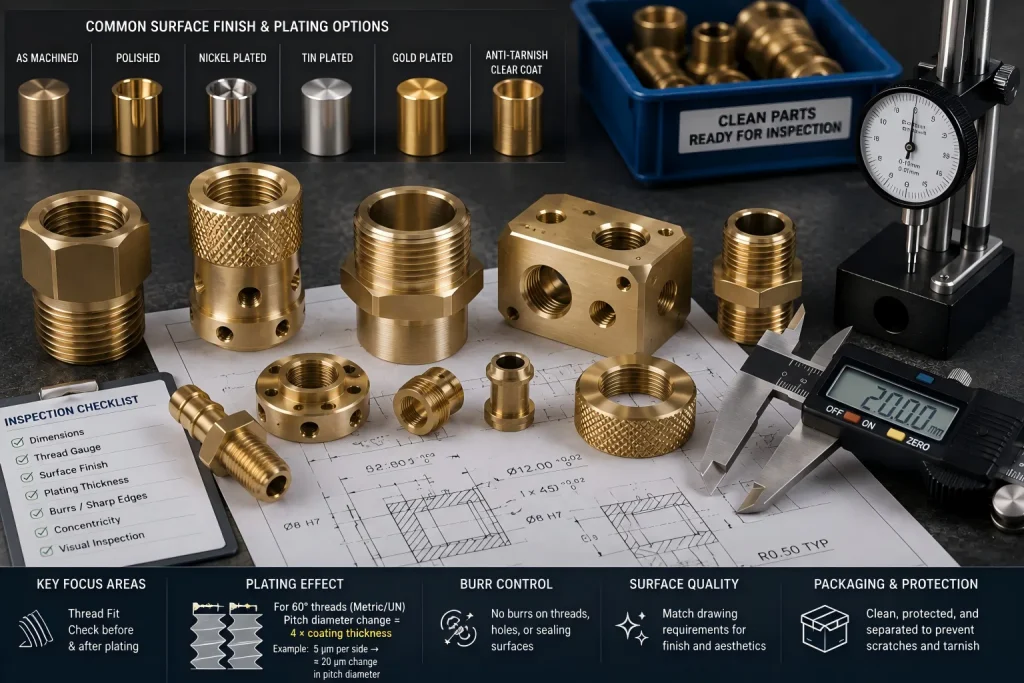
Surface Finish and Plating Can Change the Part
Brass parts are often selected not only for function, but also for appearance.
This makes surface handling important.
A brass part may require:
- As-machined finish
- Polishing
- Brushing
- Bead blasting
- Nickel plating
- Tin plating
- Gold plating for selected contact applications
- Clear coating
- Anti-tarnish treatment
- Protective packaging
Surface finish is not only cosmetic.
It can affect:
- Thread fit
- Contact resistance
- Corrosion behavior
- Assembly fit
- Sealing surfaces
- Fingerprint sensitivity
- Visual acceptance
- Packaging method
For plated brass parts, dimensions should be reviewed before and after plating.
Threaded brass parts need special attention because plating does not only change the surface visually.
It changes thread fit.
For common 60° threads such as Metric and Unified threads, pitch diameter can change by about 4 times the coating thickness. For example, if a plated brass thread receives 5 μm coating thickness per side, the pitch diameter effect can be about 20 μm.
For external threads, plating can increase the effective pitch diameter.
For internal threads, plating can reduce the available thread space.
That is why plated brass threads may machine correctly before finishing but fail a go gauge after plating.
Before producing plated brass threaded parts, confirm:
- Whether thread dimensions apply before plating or after plating
- Plating type
- Target coating thickness
- Internal or external thread
- Thread class
- Gauge requirement
- Whether oversized taps are required for internal threads
- Whether thread milling offset should be adjusted
- Whether post-plating thread inspection is required
For tight brass threads, the drawing should not only say “plated.”
It should clearly define:
Dimensions apply before plating.
or:
Dimensions apply after plating.
If the thread must pass gauge inspection after plating, the pre-plate thread size must be planned before machining.
Otherwise, a good machined thread may become a failed thread after finishing.
Threads, bores, press-fit areas, and mating faces may require masking or post-finish inspection.
A brass part can pass machining inspection and still fail after plating if buildup was not considered.
For post-processing and finishing risks, review our CNC surface finishes guide.
Tolerances Depend on Feature Function
Brass can be machined accurately, but tolerance planning still matters.
Tight dimensions are more sensitive when the part includes:
- Small threads
- Thin walls
- Long turned features
- Press-fit bores
- Cross holes
- Sealing faces
- Plated surfaces
- Knurled features
- Cosmetic edges
- Multiple datum relationships
The drawing should clarify which dimensions are functional.
A general tolerance block is useful, but it may not be enough for:
- Thread fit
- Bore diameter
- Concentricity
- Flat sealing faces
- Position of cross holes
- Slot width
- Press-fit dimensions
- Post-plating size
Inspection may include calipers, micrometers, pin gauges, thread gauges, visual checks, surface inspection, or CMM inspection for datum-related features.
For tolerance planning, measurement boundaries, and inspection review, see our CNC machining tolerances guide.
Brass Machining Problems Usually Come from Missing RFQ Details
Most brass machining problems are not caused by brass being difficult.
They are caused by incomplete requirements.
A supplier can machine a brass part, but still miss the customer’s real need if the RFQ does not define:
- Exact brass grade
- Lead-free requirement
- Thread standard
- Plating route
- Cosmetic surfaces
- Burr-sensitive edges
- Critical bores
- Sealing faces
- Inspection method
- Certificate requirement
- Packaging requirement
A buyer asking for “brass CNC parts” may receive a quote based on a standard free-cutting brass.
But the real production requirement may involve lead-free brass, nickel plating, thread gauge inspection, and protective packaging.
Those are different manufacturing jobs.
Brass Machining RFQ Checklist
Before requesting a quote, prepare:
- 2D drawing
- 3D CAD file
- Brass grade
- Quantity
- Lead-free or low-lead requirement
- RoHS, REACH, potable-water, or customer compliance requirement
- Thread standard
- Thread depth
- Internal or external threads
- Critical bores
- Surface finish
- Plating or coating requirement
- Burr-control notes
- Cosmetic surface notes
- Inspection-report requirement
- Material-certificate requirement
- Packaging requirement
- Target delivery schedule
Useful RFQ notes include:
- “C360 brass is acceptable.”
- “Lead-free brass required.”
- “Material certificate required.”
- “Threads must pass gauge inspection.”
- “Nickel plating after machining.”
- “Final dimensions apply after plating.”
- “No burrs allowed near sealing edge.”
- “Visible surface requires scratch protection.”
- “Do not round this locating edge.”
- “Stress relief annealing required after machining.”
- “DZR brass required for fluid-contact application.”
These notes reduce quotation uncertainty and help prevent rework after production.
Brass Machining Questions Buyers Usually Ask
Is brass easy to machine?
Many brass grades are easier to machine than copper, stainless steel, and some engineering plastics.
However, machinability depends on the exact grade. C360 is widely used for good machinability, while lead-free or low-lead brass grades may require different tooling, speeds, deburring, and inspection planning.
Which brass grade is best for CNC machining?
C360 brass is commonly used when machinability is the main priority.
But the best grade depends on function, compliance, corrosion behavior, plating, appearance, and customer specification. For regulated or export-sensitive projects, the required lead-free or low-lead grade should be confirmed before quotation.
Can brass parts be plated after machining?
Yes.
Brass parts are often plated, polished, or coated. However, plating may change thread fit, hole size, contact behavior, or cosmetic appearance.
Critical dimensions should clarify whether they apply before or after plating.
Why do brass threaded parts fail inspection after plating?
A common reason is pitch diameter change caused by plating thickness.
For 60° Metric or Unified threads, pitch diameter can change by about 4 times the coating thickness. If the thread is not sized correctly before plating, the part may pass before finishing but fail gauge inspection after plating.
Can brass crack after machining?
In some conditions, yes.
Stress corrosion cracking may occur when residual stress combines with a sensitive environment, such as moisture, ammonia-containing exposure, certain cleaners, or aggressive storage conditions.
For high-load, thin-wall, fluid-contact, or reliability-sensitive parts, stress relief annealing and material selection should be reviewed before production.
Does brass need special packaging?
For cosmetic, polished, plated, or anti-tarnish brass parts, packaging matters.
Fingerprints, moisture, abrasion, and part-to-part contact can affect appearance before delivery. Protective packaging should be planned when surface appearance is important.
Upload Your Brass Part Drawing for Machining Review
Send your 2D drawing, 3D CAD file, brass grade, quantity, thread requirements, plating needs, burr-control notes, inspection requirements, certificate needs, and delivery target.
Our team will review material grade, machining route, thread risk, deburring method, finishing sequence, inspection plan, packaging needs, and delivery schedule before quotation.
CTA Button: Upload Your Drawing
About Rapid Efficient
Rapid Efficient supports custom CNC machining projects for prototypes, low-volume parts, and production requirements.
With 18 years of high-precision CNC machining experience, our team reviews material behavior, machining strategy, tolerance risks, post-processing requirements, inspection methods, packaging conditions, and delivery schedules before quotation.
Our available capabilities include 4-axis, 5-axis, and multi-axis CNC machining, together with inspection equipment such as CMM, projectors, and spectrometers.
Depending on the actual part and project requirements, machining accuracy down to 0.01 mm and inspection accuracy down to 0.001 mm are available.
Rapid Efficient has obtained ISO 9001 and ISO 14001 certification.