17-4 PH不锈钢加工: 热处理, 公差, 并完成

17-4 PH 不锈钢不仅仅是另一种用于 CNC 加工的不锈钢​​牌号. It is a precipitation-hardening stainless steel used when a part needs higher strength, better hardness, 戴阻力, and reasonable corrosion resistance in one material.

对于数控买家, the most important question is not simply “Can 17-4 PH be machined?” The real question is:

Which heat treatment condition is required, and should the part be machined before or after hardening?

That decision affects tool wear, 表面饰面, 尺寸稳定性, inspection strategy, and quotation risk. 一个 17-4 PH part in Condition A does not behave the same as one in H900 or H1150. If the RFQ does not define the required condition clearly, the supplier may quote the wrong process route, miss critical allowance, or deliver a part that does not match the final mechanical requirement.


什么是 17-4 PH不锈钢?

17-4 PH stainless steel is a precipitation-hardening stainless steel commonly identified by UNS S17400. The name “17-4” refers broadly to its chromium and nickel content, while “PH” means precipitation hardening.

Unlike common austenitic stainless steels such as 304 或者 316, 17-4 PH can be strengthened through heat treatment. This makes it useful for shafts, 针脚, valve parts, mechanical housings, 固定装置, 结构件, and precision parts that require both strength and corrosion resistance.

在数控加工中, 17-4 PH is usually selected when 304 或者 316 stainless steel is not strong enough, but the part still needs stainless corrosion behavior. It is not normally chosen just for easy machining or low cost. If machinability is the main concern, 303 或者 304 may be easier choices. If high strength and controlled hardness matter more, 17-4 PH becomes more attractive.

For general stainless material behavior, 过程计划, and production risks, 看看我们的 不锈钢CNC加工指南.


Why Heat Treatment Condition Matters Before Machining

The biggest mistake with 17-4 PH parts is treating all conditions as the same material. A drawing that only says “17-4 PH stainless steel” is incomplete for manufacturing.

The required condition may be:

ConditionTypical Meaning for CNC BuyersMachining Impact
条件ASolution annealed before agingOften easier for rough machining, but final aging may cause dimensional change
H900High strength and high hardnessMore difficult for tooling, 精加工, and small features
H1025 / H1075Balanced strength and toughnessOften a practical compromise for machined components
H1150Lower hardness but better toughness and machinabilityEasier than H900, but may not meet peak strength requirements

The correct route depends on the part function. Some parts are machined close to final size in Condition A and then aged. Other parts are rough machined, 热处理, and then finish machined. 对于公差要求严格的零件, the machining plan should consider whether critical dimensions must be held before or after heat treatment.

This is why a 17-4 PH RFQ should always state the required heat treatment condition. If the condition is unknown, the buyer and supplier should clarify it before quotation.

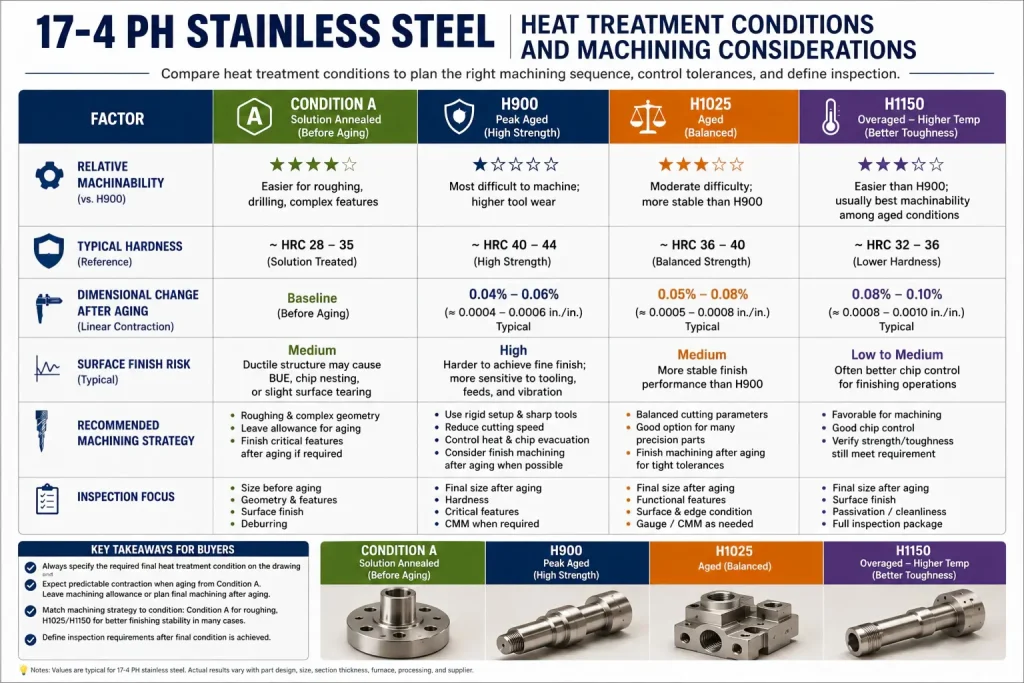
Heat treatment and machining considerations matrix for 17-4 PH stainless steel comparing Condition A, H900, H1025, and H1150 by machinability, 硬度, dimensional contraction, surface finish risk, 加工策略, and inspection focus.

机械加工 17-4 PH in Condition A

Condition A is usually easier to machine than hardened 17-4 PH during roughing, 钻孔, and general stock removal. For many CNC parts, machining in Condition A can reduce tool load and improve production stability before final aging.

This route is often suitable when:

零件要求Why Condition A Machining May Help
复杂的几何形状Easier cutting before hardening
Deep holes or small featuresLower cutting resistance helps process stability
薄壁Lower cutting forces may reduce distortion during machining
Lower-volume productionFaster setup and machining may reduce cost
Final aging requiredHeat treatment can be completed after most machining is done

然而, machining in Condition A does not remove all risk. If the part is aged after machining, the final size may change slightly. For loose-tolerance components, this may be acceptable. For precision bores, bearing fits, 密封面, or tightly controlled threaded features, the supplier may need to leave allowance for final machining or inspection after heat treatment.

Condition A also should not be treated as automatically better for every finishing requirement. Because the solution-treated structure can be more ductile, some finishing operations may experience chip nesting, 积屑瘤, or slight surface tearing if tooling, 冷却液, and cutting parameters are not controlled well.

In some aged conditions, especially higher aging-temperature conditions such as H1025, H1150, or H1150M, chip formation may become more stable for certain finishing operations. The trade-off is that the material condition, 硬度, mechanical requirement, and final surface finish must all be reviewed together. For buyer drawings, the safest approach is to define the required final condition first, then let the machining route be planned around that requirement.

A safe drawing or RFQ should not only say “17-4 PH.” It should define the final condition and which dimensions are critical after heat treatment.


机械加工 17-4 PH in H900, H1025, or H1150

机械加工 17-4 PH after precipitation hardening is possible, but the condition changes the cutting behavior.

H900 provides high strength and hardness, but it is usually the most difficult common condition for machining. Tool wear increases, cutting speed may need to be reduced, and small tools become more vulnerable. Surface finish can still be good, but process control becomes more important.

H1025 and H1075 are often more balanced. They still provide high strength, but may be less severe than H900 for machining and mechanical performance trade-offs.

H1150 is usually more forgiving for machining compared with H900. It may also be preferred where toughness, stress-corrosion resistance, or reduced brittleness is more important than maximum hardness.

Heat Treatment ConditionMachining RiskCommon Manufacturing Concern
H900Highest cutting difficulty among common aged conditions刀具磨损, small tool breakage, 毛刺控制, 表面饰面
H1025Medium-highBalance of strength, 韧性, and machining control
H1075中等的Dimensional and surface consistency
H1150Lower than H900Confirm whether strength and hardness still meet the design requirement

The condition should not be changed casually to make machining easier. If the drawing requires H900, quoting H1150 without approval may change the part’s mechanical performance. If H1150 is acceptable, the drawing or purchase requirement should state that clearly.


Tolerance and Dimensional Risk After Aging

17-4 PH is valued because its aging temperature is lower than many hardening treatments, but dimensional change can still matter. 对于公差要求严格的零件, the problem is not whether the change is large or small in general. The problem is whether it affects the features that actually control assembly.

为了 17-4 PH值, this dimensional change is not random. Published material data commonly notes predictable contraction during aging. When parts are heat treated from Condition A to H900, typical linear contraction is about 0.0004–0.0006 in./in., or approximately 0.04%–0.06%. For H1150, the contraction may be closer to 0.0008–0.0010 in./in., or approximately 0.08%–0.10%.

This may look small on a simple bracket, but it can matter on a long shaft, 轴承孔, sealing diameter, or precision groove. If a 100 mm shaft diameter changes by even 0.04%–0.06%, the potential size shift is already large enough to affect many press fits, running fits, or final grinding allowances. 为此原因, 严格的公差 17-4 PH parts should define whether critical dimensions are controlled before aging, after aging, or after final finish machining.

例子包括:

特征Why It Needs Review
Bearing boreSmall size change may affect press fit or running clearance
Shaft diameterFinal diameter may control rotation, 密封, or alignment
Threaded holeHeat treatment after tapping may affect gauge acceptance
Flat sealing faceDistortion may affect leakage risk
Thin wall pocketStress release may change shape or flatness
Precision grooveWidth and position may affect retaining rings or seals

对于简单零件, machining close to final size before aging may work. 用于精密零件, a better route may be rough machining, aging, finish machining, 和最终检验.

The RFQ should mark which dimensions are critical after heat treatment. Without that, a supplier may inspect the part before aging and miss the final functional requirement.

For more tolerance planning, 日期控制, 和检查策略, 看看我们的 CNC加工公差指南.


工装, Cutting Strategy, 和表面光洁度

17-4 PH is not the same as free-machining stainless steel. Tool selection and cutting strategy should consider hardness, workholding, 特征尺寸, and whether the material is machined before or after aging.

For milling, 锋利的硬质合金工具, 稳定的工件夹持, and controlled engagement help reduce chatter and tool wear. For turning, rigidity is especially important for shafts, 凹槽, shoulders, and thin sections. For drilling and boring, heat and chip evacuation must be controlled because stainless materials can punish weak setups quickly.

Common machining concerns include:

Machining Area风险Practical Control
Milling pocketsChatter and edge wearRigid setup, suitable cutter geometry, controlled radial engagement
Turning shaftsRunout and surface finish variationStable support, correct tool nose radius, controlled cutting pressure
钻孔Heat buildup and poor chip evacuationPecking strategy, coolant access, suitable drill geometry
无聊的Taper or poor roundnessRigid boring bar, stable cutting parameters
ThreadingBurrs and gauge failureCorrect thread process, 去毛刺, GO/NO-GO inspection
薄壁Deflection during cuttingBalanced stock removal and controlled clamping

Surface finish should also be specified realistically. A very fine finish on hardened 17-4 PH may require slower finishing passes, 工具更改, 磨削, 抛光, or additional inspection. If the surface controls sealing, 滑动, fatigue, or corrosion behavior, it should be marked clearly on the drawing.

Post-machining passivation also needs careful control for 17-4 PH不锈钢. 因为 17-4 PH is a chromium-nickel-copper precipitation-hardening alloy, the passivation process should not be treated as a generic stainless steel cleaning step. Acid type, bath temperature, immersion time, surface cleanliness, and previous heat treatment condition can all affect the final surface appearance and corrosion performance.

Nitric acid and citric acid passivation may both be used under suitable specifications, but neither should be selected casually. Poorly controlled passivation can lead to discoloration, dull surface areas, 染色, or localized attack, especially on precision sealing faces or cosmetic surfaces. If passivation is required, the RFQ should state the required standard, surface finish expectation, inspection requirement, and whether visual appearance is functionally important.

For finish options, roughness callouts, 喷砂, 钝化, 抛光, 电镀, and coating considerations, 看看我们的 CNC 表面处理指南.


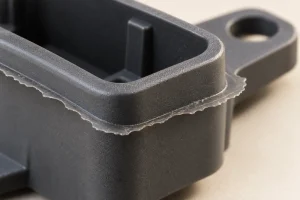
毛刺, 边缘, and Small Features

17-4 PH parts often include functional edges: 凹槽, 线程, keyways, bores, 插槽, and sealing transitions. These are exactly the areas where burrs can cause assembly problems.

Burr risk is higher when the part has:

特征Burr Concern
交叉孔Internal burrs may block flow or affect assembly
Small tapped holesThread burrs may cause gauge failure
Thin slotsEdge rollover may change functional width
Sharp shouldersBurrs may interfere with mating parts
Sealing groovesBurrs may damage O-rings or sealing surfaces
轴承座Raised edges may affect fit and alignment

A drawing should define which edges require deburring, edge break, chamfer, or burr-free control. “Remove sharp edges” is sometimes not enough for precision parts. If the edge is functional, the requirement should be more specific.

例如:

Weak NoteBetter Manufacturing Note
去除毛刺Remove burrs from all threaded holes and cross holes
Break edgesEdge break 0.1–0.3 mm unless otherwise specified
No sharp edgesBurr-free sealing grooves and bearing shoulders
Deburr partNo raised burrs allowed on mating face A

This helps the supplier inspect the feature that matters, instead of treating deburring as a cosmetic operation only.

For design notes related to holes, 线程, 墙壁, internal radii, functional edges, and machining feasibility, 看看我们的 CNC加工设计指南.


17-4 PH vs 304 和 316 Stainless Steel for CNC Parts

17-4 PH should not automatically replace 304 或者 316 不锈钢. Each grade has a different role.

材料Best Used WhenCNC Buyer Warning
304 不锈钢General corrosion resistance and cost balance强度低于 17-4 PH值
316 不锈钢Better chloride corrosion resistance than 304Not selected for precipitation hardening
17-4 PH不锈钢Higher strength, 硬度, and wear resistance are neededHeat treatment condition must be defined
303 不锈钢Machinability is more important than corrosion resistanceNot suitable for all corrosion or strength needs

If the part only needs general corrosion resistance, 304 或者 316 may be enough. If the part needs higher strength, 戴阻力, or controlled hardness, 17-4 PH may be worth reviewing.

对于买家, the key is to avoid choosing 17-4 PH only because it sounds stronger. The heat treatment condition, 成本, 加工路线, and inspection plan must match the part’s function.


Typical CNC Parts Made from 17-4 PH不锈钢

17-4 PH is often considered for parts that combine strength, 尺寸控制, and stainless corrosion behavior. The final choice still depends on load, 环境, heat treatment condition, 及检验要求.

零件类型为什么 17-4 PH May Be SelectedManufacturing Point to Review
Shafts and pins力量, 戴阻力, 和尺寸稳定性Diameter, runout, 表面饰面, and final hardness
Valve componentsStrength and corrosion resistance密封面, 凹槽, 线程, 和钝化
Mechanical housingsStronger stainless option for loaded structures平整度, 螺纹孔, and heat treatment timing
High-load bracketsHigher strength than standard stainless gradesMaterial certificate, final condition, and inspection scope
Pump or fluid control partsStainless corrosion behavior with better strengthInternal burrs, 密封面, 和表面饰面
精密治具Hardness and repeatable location surfacesDatum surfaces, bores, and wear areas

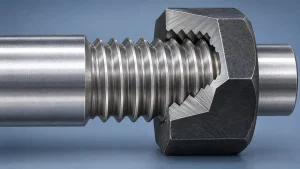
For turned shafts, 针脚, 螺纹组件, and round precision parts, the review should also include workholding, 同心度, shoulder locations, and burr control. 看看我们的 CNC turning parts guide for more turning-specific design and inspection points.


Inspection Points for 17-4 PH CNC Parts

Inspection should match the manufacturing route. If the part is heat treated after machining, the final inspection should confirm critical features after the final condition is reached.

Important inspection items may include:

特征类型Suggested Inspection Focus
Precision boreDiameter, 圆度, 位置, final fit
Shaft featureDiameter, runout, shoulder location, 表面饰面
Threaded holeGO/NO-GO gauge, 深度, burr condition
Flat face平整度, 并行性, 表面饰面
GrooveWidth, 深度, 边缘条件
Heat-treated partFinal condition, hardness requirement, critical dimensions after aging
Functional surfaceRoughness, 毛刺, 划痕, coating or passivation impact

CMM inspection may be useful for GD&T features, 真实位置, 并行性, 垂直度, or complex datum structures. Manual tools may still be enough for simple dimensions, but they may not capture geometric relationships that affect assembly.

If a buyer needs a CMM report, hardness record, 材料证明, or inspection report, these should be requested before quotation.

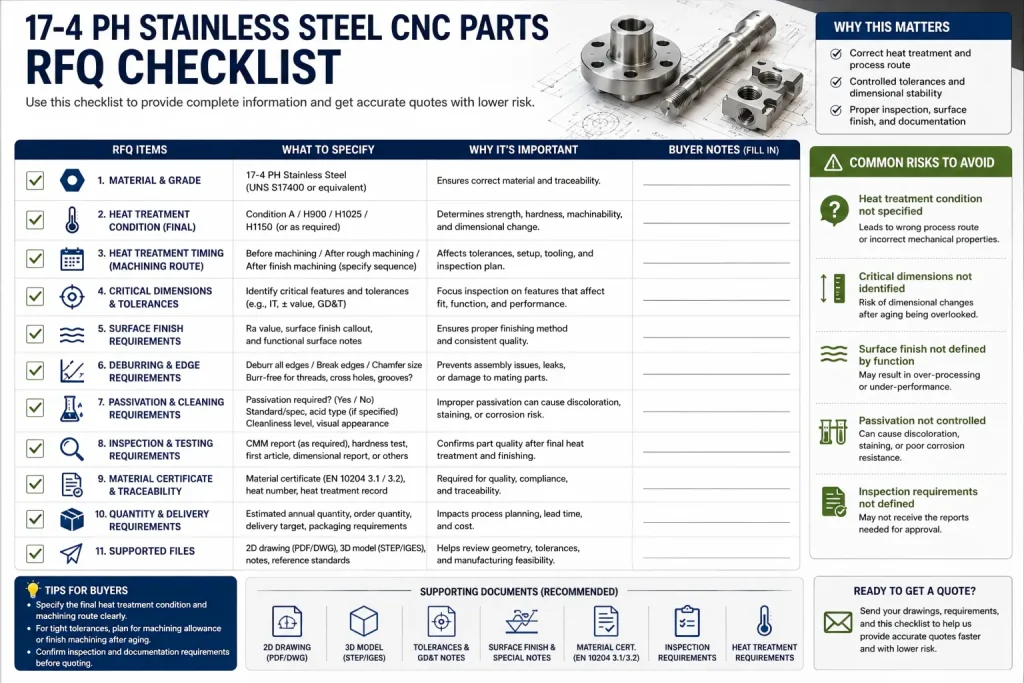
RFQ checklist for 17-4 PH stainless steel CNC parts showing material grade, heat treatment condition, 临界公差, 表面饰面, 钝化, 检查, certificates, 数量, and supported files.

RFQ Checklist for 17-4 PH不锈钢加工

A clear RFQ can prevent most 17-4 PH problems before production starts.

Before sending a quotation request, 包括:

RFQ Item为什么它很重要
材质等级Confirms 17-4 PH值 / UNS S17400 or equivalent
Heat treatment conditionDefines final mechanical requirement
Heat treatment timingClarifies before machining, after machining, or between roughing and finishing
2D图Shows tolerances, 日期, 线程, 结束, and inspection notes
步骤文件Helps review geometry, 工具访问, and machining strategy
关键尺寸Identifies features that must be controlled after final condition
表面光洁度要求Prevents mismatch between machined finish and functional finish
Deburring requirementControls threads, 凹槽, 孔, and mating edges
钝化要求Clarifies acid type, 标准, visual expectation, and inspection scope
Inspection report requirementDefines CMM, 硬度, or dimensional report needs
Material certificateHelps confirm material traceability when required
Quantity and delivery targetAffects machining route, 夹具规划, 和成本

If the heat treatment condition is missing, the quote may look cheaper but carry more risk. The supplier may quote a machining route that does not match the final part requirement.

For broader RFQ preparation, drawing information, 公差注释, 检查期望, and quote planning, 回顾我们的 manufacturing FAQ.


Common Mistakes When Buying 17-4 PH CNC Parts

The most common problems are not caused by the material itself. They come from unclear requirements.

错误Possible Result
Drawing only says “17-4 PH”Supplier does not know the required final condition
Heat treatment condition is changed without approvalPart may not meet strength or toughness requirement
Critical dimensions are inspected before aging onlyFinal assembly fit may fail
H900 is requested for every part by defaultMachining cost and brittleness risk may increase unnecessarily
Surface finish is specified without functionSupplier may overprocess or underprocess the surface
Passivation is treated as a generic cleaning step变色, dull areas, 染色, or localized attack may occur
Burr-free requirement is not definedInternal holes, 线程, or grooves may create assembly issues
No inspection scope is requestedBuyer may not receive the report needed for acceptance

A good 17-4 PH machining project starts with a clear conversation about final condition, functional features, 表面处理, and inspection evidence.


你什么时候应该选择 17-4 PH不锈钢?

17-4 PH may be a good choice when the part needs:

要求为什么 17-4 PH May Help
强度高于 304 或者 316Precipitation hardening can increase mechanical performance
耐磨性Higher hardness can improve sliding or contact behavior
Stainless corrosion behaviorUseful where carbon steel is not acceptable
Precision machined geometryCNC machining can produce complex functional features
Controlled heat treatmentFinal condition can be matched to strength or toughness needs

It may not be the best choice when:

情况Better Review
Lowest machining cost is the priority303, 304, or aluminum may be easier
Severe chloride corrosion is expected316 or other corrosion-resistant alloys may need review
No heat treatment requirement is knownMaterial selection is incomplete
Very fine features require easy machiningCondition and process route must be checked carefully
The part only needs basic corrosion resistance304 或者 316 may be enough

Material selection should match the real load, 环境, 宽容, and inspection requirement.


How Rapid Efficient Supports 17-4 PH Stainless Steel CNC Parts

Rapid Efficient can review 17-4 PH stainless steel CNC projects before quotation, including material grade, heat treatment condition, 加工路线, 耐受风险, 表面饰面, passivation requirement, deburring notes, 及检验要求.

For precision 17-4 PH parts, we can help check whether the drawing should define Condition A, H900, H1025, H1150, 或其他必要条件. We can also review which dimensions may need final inspection after heat treatment, which features may require CMM inspection, and whether material certificates or inspection reports should be included in the RFQ.

If you are sourcing shafts, 针脚, 外壳, 配件, 螺纹组件, or other 17-4 PH stainless steel parts, send us your STEP file, 2D图, 数量, heat treatment requirement, 表面光洁度注释, passivation requirement, and inspection expectations. Our team can review the machining and delivery requirements before quotation.


常问问题

是 17-4 PH stainless steel easy to machine?

17-4 PH stainless steel can be machined, but machinability depends strongly on the heat treatment condition. Condition A is often easier for rough machining and general stock removal, while some aged conditions may provide more stable chip control for certain finishing operations. Hardened 17-4 PH may require slower cutting, stronger tooling, and more careful process control.

Should 17-4 PH be machined before or after heat treatment?

It depends on the tolerance and part function. Many parts can be machined in Condition A and then aged. Tight-tolerance features may require rough machining, 热处理, finish machining, 和最终检验.

What does H900 mean for 17-4 PH不锈钢?

H900 is a precipitation-hardened condition that provides high strength and hardness. It may also increase machining difficulty compared with Condition A or higher aging temperature conditions such as H1025 or H1150.

Does 17-4 PH shrink during heat treatment?

是的. 17-4 PH can show predictable contraction during aging. Published material data commonly notes about 0.0004–0.0006 in./in. contraction from Condition A to H900 and about 0.0008–0.0010 in./in. for H1150. Tight-tolerance features should be reviewed after final heat treatment when required.

是 17-4 PH better than 316 不锈钢?

17-4 PH is better when higher strength and hardness are required. 316 stainless steel is often preferred when corrosion resistance, especially in chloride environments, is more important than precipitation-hardened strength. The better choice depends on load, 环境, 加工, 及检验要求.

能 17-4 PH stainless steel be passivated?

是的, 17-4 PH stainless steel parts may be passivated when required. The buyer should confirm the passivation standard, acid type if specified, 表面饰面, cleaning expectation, visual requirement, and any inspection or documentation needed after finishing.

What should be included in a 17-4 PH machining RFQ?

A good RFQ should include the material grade, required heat treatment condition, 步骤文件, 2D图, 公差注释, 表面饰面, deburring requirements, passivation requirements, 数量, inspection report needs, and whether material certificates are required.

发表评论

滚动至顶部

获取报价

点击或拖拽文件到该区域即可上传. 您最多可以上传 10 文件.
文件格式:TXT PDF DOC DOCX XLS XLSX PPT PPTX JPG PNG ZIP RAR DWG DXF DXF DWT DWS DWS

3D文件格式: 步, STP, sldprt, IPT, prt, 坐着, IGES, IGS, catpart, X_T, OBJ, STL