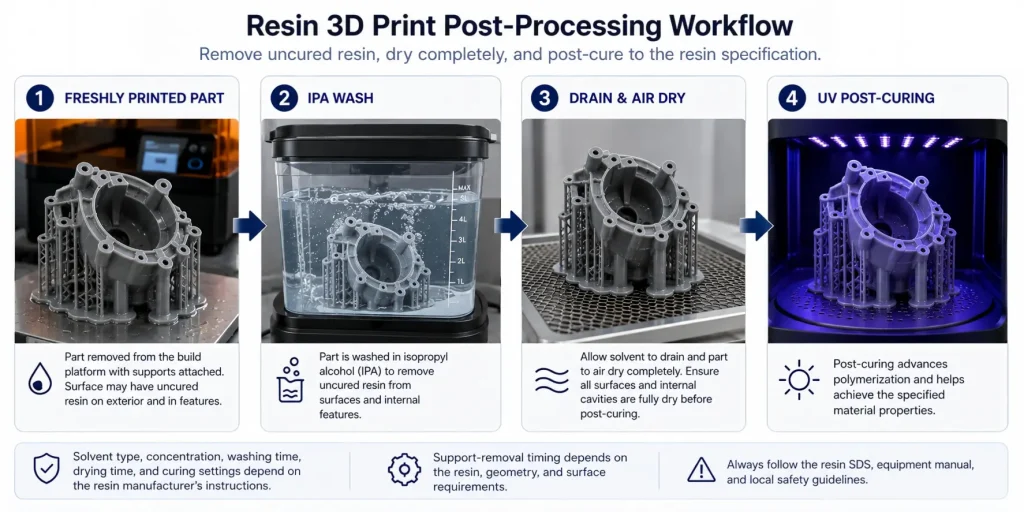
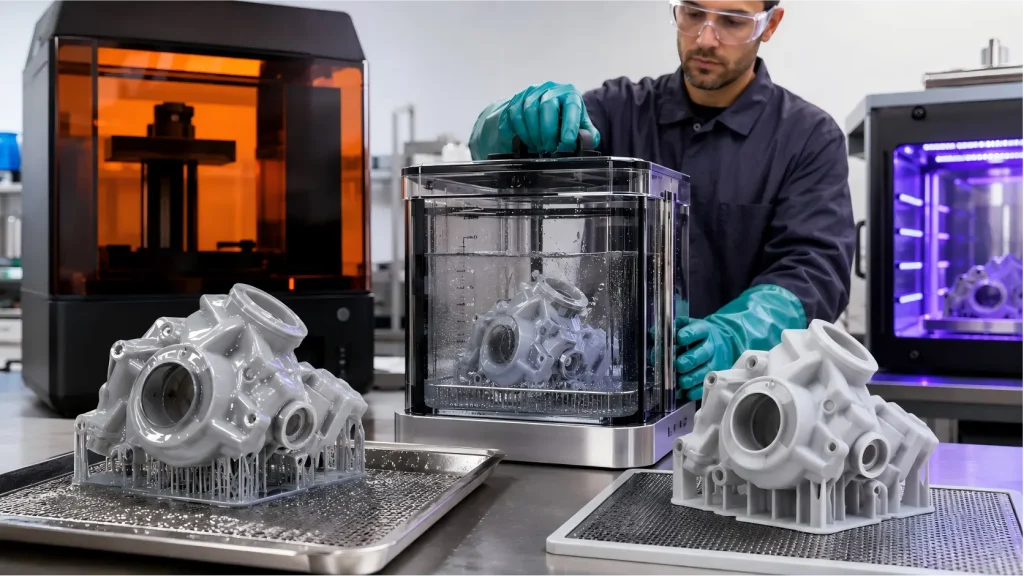
异丙醇, usually called IPA, is used after SLA, 数字光处理, and similar resin 3D printing processes to remove uncured liquid resin from the printed part.
A freshly printed resin part may look solid, but liquid resin can still remain on:
- External surfaces
- Support contact areas
- 小孔
- Internal channels
- Recessed features
- The build platform
IPA dissolves and carries away this uncured resin so the part can be dried, 检查, and post-cured.
IPA does not cure the part, and it does not remove support structures by itself. Support removal is a separate mechanical step that may be completed before or after washing depending on the resin, 几何学, surface priorities, and manufacturer instructions.
快速解答: Why Is IPA Used for Resin Prints?
IPA is widely used because it:
- Dissolves many uncured photopolymer resins
- Evaporates relatively quickly
- Reaches small features when the part is properly agitated
- Works with many manual and automated washing systems
- Helps prepare the surface for drying and post-curing
然而, IPA is not suitable for every resin.
The correct solvent, concentration, wash time, 温度, drying time, and post-curing cycle must follow the resin manufacturer’s instructions. Some specialized materials require a different solvent or a tightly controlled washing procedure.
What Does IPA Remove From a Resin 3D Print?
During resin printing, light cures selected areas of liquid photopolymer into the required shape.
After the build is complete, the solid part is still covered with a thin layer of uncured resin. Liquid resin may also collect inside:
- 盲孔
- Drainage holes
- Internal cavities
- Lattice structures
- Textured surfaces
- Support clusters
IPA acts as a washing solvent. It loosens the uncured resin so agitation, circulation, 刷牙, or a controlled rinse can remove it from the part.
IPA does not replace post-curing.
Washing removes surface contamination. Post-curing continues the resin’s chemical reaction under controlled light and, for some materials, 热. The two steps perform different functions.
Why Must Resin Prints Be Washed Before Post-Curing?
Post-curing a poorly washed part can harden residual resin onto the surface.
This may cause:
- Sticky or uneven surfaces
- Loss of fine detail
- 堵孔
- Resin deposits inside channels
- Glossy patches
- Poor paint or coating adhesion
- Dimensional changes around small features
- Contamination of curing equipment
A clean part should normally be fully drained and dried before entering the curing unit.
No visible liquid IPA or uncured resin should remain on the surface, inside holes, or in recessed areas before post-curing begins. Manufacturer guidance should determine the required drying time for the selected material.
What IPA Concentration Should Be Used for Resin 3D Printing?
There is no universal concentration for every resin.
For many general-purpose SLA resin systems, IPA with a concentration of 90% 或更高 is a common starting point. Some material guides require 96% 或者 99%, especially where validated properties or regulated applications are involved.
The old idea that 70% IPA mixed with water is automatically the best solution for resin printing is incorrect.
| IPA concentration | Practical interpretation |
|---|---|
| 70% | Common for some disinfection uses, but not a universal resin-print washing standard |
| 90% 或更高 | Commonly recommended for many general SLA resin washing workflows |
| 96–99% | Required by some specific material and validated processing guides |
| Non-IPA solvent | Required or preferred for selected resins and production systems |
Always check:
- Resin instructions for use
- Washing-equipment compatibility
- Required concentration
- Wash duration
- Drying requirements
- Post-curing requirements
- Local safety and disposal rules
Formlabs generally recommends 90% or higher IPA for many standard resin washing applications, but its individual material instructions also show that some resins require different concentrations, timings, or solvents.
Step-by-Step IPA Washing Workflow
1. Check the Resin Instructions
Before washing, 确认:
- Approved solvent
- Minimum concentration
- Recommended wash time
- Whether supports remain attached
- Whether a second wash is required
- Required drying time
- Post-curing temperature and duration
Do not copy the wash settings from a different resin only because both materials were printed on the same machine.
2. Allow Excess Resin to Drain
打印后, allow excess liquid resin to drain back toward the build platform or an appropriate collection area.
Removing avoidable surface resin before washing can help:
- Extend solvent life
- Reduce contamination of the wash bath
- Improve cleaning consistency
- Reduce the amount of resin transferred between containers
3. Complete the First Wash
Place the part in the approved washing container or machine.
The cleaning method may use:
- Controlled agitation
- Solvent circulation
- A manufacturer-approved washing station
- A gentle brush for suitable surfaces
- A squeeze bottle for difficult details
- Manual movement in a closed container
Avoid uncontrolled spraying because it can spread resin-contaminated solvent and increase vapor exposure.
4. Inspect Holes and Internal Features
Pay special attention to:
- Drain holes
- 盲孔
- Narrow channels
- Hollow parts
- Enclosed cavities
- Lattice structures
- Support-dense areas
Trapped liquid resin can remain even when the exterior appears clean.
Part orientation and drainage access should therefore be reviewed before printing, not only during post-processing.
5. Use a Clean Final Rinse When Required
A two-stage process can improve results:
- First bath for removing most of the resin
- Cleaner second bath or controlled rinse for the final surface
A heavily contaminated wash bath can leave a diluted resin film on the part. When the IPA evaporates, the resin remains and may make the surface feel sticky. Rewashing in clean IPA may solve this problem.
6. Drain and Dry the Part
Remove the part from the wash bath and allow the solvent to drain.
Inspect the part after the IPA has evaporated. Do not begin post-curing while liquid solvent remains trapped inside holes, 腔, or surface details.
7. Remove Supports at the Planned Stage
IPA does not dissolve or automatically remove supports.
Depending on the selected resin and part geometry, supports may be removed:
- Before washing
- Between washing stages
- After washing but before curing
- After a controlled partial or full post-cure
The correct sequence should balance:
- Surface-mark risk
- Part strength
- 处理损坏
- Cleaning access
- Thin-feature stability
- Manufacturer instructions
8. Post-Cure According to the Resin Specification
Post-curing conditions affect the final:
- 力量
- 硬度
- 耐热性
- 尺寸稳定性
- 表面状况
- Material performance
Use the specified curing light, 时间, 温度, and part orientation for the selected resin.

How Long Should Resin Prints Stay in IPA?
There is no single correct wash time.
The required time depends on:
- Resin chemistry
- 零件尺寸
- Surface area
- Internal geometry
- Support density
- Wash equipment
- Agitation
- IPA concentration
- Solvent contamination
- Whether a second bath is used
Longer washing is not always better.
Excessive solvent exposure can affect the dimensions, 表面, or material properties of some resins. Certain specialized materials have very short maximum IPA exposure times, while others should not be washed in IPA at all.
Use the resin manufacturer’s recommended time as the starting point. Increase or change the process only after checking:
- Whether the IPA is contaminated
- Whether the part has trapped resin
- Whether agitation is reaching the feature
- Whether a clean second rinse is needed
- Whether the selected solvent is correct
Why Is a Resin Print Still Sticky After IPA Washing?
A sticky surface does not always mean the part needs a much longer wash.
常见原因包括:
The IPA Is Contaminated
As more parts are washed, the solvent accumulates dissolved resin.
The IPA may still look usable but can leave a resin film on the part.
The Final Rinse Is Not Clean Enough
A dirty first wash may remove bulk resin but still leave contamination on detailed surfaces.
A short second rinse in cleaner solvent may be more effective than greatly extending the first wash.
Resin Is Trapped Inside the Part
Hollow parts and small channels can retain uncured resin.
The part may need:
- Better drainage holes
- A different washing orientation
- Controlled flushing
- Revised support placement
- A split-part design
The Part Was Cured Before It Was Clean
Ambient light or premature post-curing can harden residual resin onto the surface.
The Material Requires a Different Process
Some resins naturally feel different after washing, and certain materials require a specific post-curing step to reach their final surface condition.
A resin-specific troubleshooting check is more reliable than repeatedly increasing the IPA wash time.
Should Resin Prints Be Rinsed With Water After IPA?
不作为普遍规则.
Standard IPA-washed resin parts are not automatically rinsed with water. In many workflows, the part is removed from the IPA, drained, allowed to dry, 检查, and then post-cured.
Water may be used when:
- The resin manufacturer specifically permits it
- A water-washable resin system is being used
- TPM or another approved solvent requires a secondary rinse
- A validated production guide includes water rinsing
The result can vary by resin.
Water that contacts uncured resin or resin-contaminated solvent must not automatically be treated as ordinary household wastewater. It should be managed according to the resin SDS and local waste rules.
Can IPA Be Used to Clean the Resin Printer?
IPA may be suitable for selected printer surfaces, 工具, build platforms, or resin spills, but it must not be applied to every component.
Printer manufacturers may restrict the use of IPA on:
- Tank films
- Optical surfaces
- Coated windows
- Acrylic components
- Sensors
- 密封件
- Painted parts
- Plastic housings
Cleaning instructions can also vary between printer generations.
Do not use a generic article as the maintenance procedure for a specific resin tank or optical system. Follow the printer manufacturer’s cleaning instructions for each component.
The original article’s approach of describing one tank-cleaning method as universal should therefore be removed. Formlabs, 例如, provides component-specific instructions and limits where IPA may be used.
异丙醇的替代品
IPA is common, but it is not the only option.
Possible alternatives include:
Manufacturer-Approved Resin Washing Solution
Dedicated washing solutions may offer:
- Lower flammability
- Greater resin capacity
- Different odor characteristics
- Compatibility with automated washing systems
Compatibility must still be checked for the selected resin and equipment.
全员生产管理
Tripropylene glycol monomethyl ether, or TPM, is used in some resin washing workflows.
It evaporates more slowly than IPA and may require a secondary rinse using clean IPA or water, depending on the resin and approved process.
Other Resin-Specific Solvents
Some specialized resins require solvents such as PGDA or other manufacturer-defined mixtures.
Do not replace IPA with:
- Acetone
- Denatured alcohol
- Colored alcohol
- Household cleaner
- Soap and water
unless the resin and equipment manufacturer explicitly approve that choice.
An inexpensive solvent can damage the printed part, washer seals, tank, or machine surfaces even when it appears to remove the resin successfully.
IPA Safety, 贮存, and Disposal
IPA is a flammable liquid.
Its vapors can also irritate the eyes, nose, and throat, and higher exposure may cause headache, dizziness, or drowsiness. Repeated skin exposure can contribute to dryness and cracking.
Use controls appropriate to the facility and the applicable SDS:
- Work in a properly ventilated area
- Keep containers closed when not in use
- Keep IPA away from flames, sparks, 热, and ignition sources
- Wear chemically suitable gloves
- Use eye protection where splashing is possible
- Avoid spraying or atomizing IPA
- Store clean and used solvent in labeled compatible containers
- Separate uncured resin waste from normal trash
- Prepare for spills using the facility’s chemical-handling procedure
A basic dust mask does not control solvent vapor. Respiratory protection, when required by the risk assessment or SDS, must be selected correctly rather than treated as a substitute for ventilation.
Used IPA contains dissolved resin and should not be poured into a sink, drain, or outdoor area.
Waste classification and disposal depend on:
- Resin composition
- Solvent contamination
- Local regulations
- Waste volume
- Facility requirements
Follow the IPA SDS, resin SDS, and local waste-management requirements. Do not assume that an empty plastic solvent bottle can automatically enter normal recycling while it remains contaminated.
Industrial SLA Post-Processing Requires More Than an IPA Bath
For prototype and low-volume resin parts, washing should be planned together with:
- Resin selection
- Build orientation
- Support placement
- Drainage-hole design
- Hollow-section access
- Surface priorities
- Dimensional requirements
- Post-curing
- Support removal
- Sanding or polishing
- 绘画
- 检查
- 包装
A part with inaccessible internal cavities may remain difficult to clean regardless of IPA concentration.
During project review, Rapid Efficient can evaluate the model according to its geometry, 表面期望, resin requirements, support-sensitive areas, cleaning access, post-curing route, 和预期用途.
For detailed prototypes and appearance-focused resin components, 回顾我们的 SLA 3D printing services.
For a broader comparison of resin and other polymer printing routes, 回顾我们的 plastic 3D printing services. Rapid Efficient’s existing service pages already cover cleaning, post-curing, support removal, 精加工, and inspection as parts of the wider manufacturing route.
FAQ About IPA and Resin 3D Printing
是 70% IPA Good for Washing Resin Prints?
It is not the default recommendation for most standard resin-print washing workflows.
Many systems use 90% or higher IPA, while some materials require 96%, 99%, or a different solvent. Follow the instructions for the exact resin.
是 99% IPA Always Better?
福田街道.
Higher concentration may be required by some materials, but the correct result also depends on wash time, agitation, solvent cleanliness, 几何学, and drying.
使用 99% IPA does not correct a poorly designed drainage hole or a heavily contaminated wash bath.
Does IPA Remove Resin Supports?
福田街道.
IPA removes uncured liquid resin. Supports must be removed mechanically at the stage specified for the resin and part geometry.
Can a Resin Print Stay in IPA Overnight?
Do not do this unless the material manufacturer specifically permits it.
Excessive solvent exposure can affect the surface, 方面, or material properties of some parts.
Why Does My Resin Print Turn White After Washing?
可能的原因包括:
- Residual resin contamination
- Incomplete drying
- Excessive solvent exposure
- Water contamination
- Surface microcracking
- Incorrect cleaning solvent
- Curing before the part is fully dry
Check the resin-specific instructions before repeating the wash.
Can I Reuse IPA?
是的, within the limits of the washing process.
IPA gradually accumulates dissolved resin and becomes less effective. It should be monitored, settled, filtered, recovered, or replaced according to the equipment instructions and facility waste procedure.
Can I Pour Used IPA Down the Drain?
福田街道.
Used IPA may contain uncured resin and must be handled according to the solvent SDS, resin SDS, and local waste regulations.
Do Water-Washable Resins Eliminate Chemical-Waste Concerns?
福田街道.
Water used to clean uncured resin becomes contaminated. It should not automatically be discharged into a normal drain.
Plan Your SLA Part Before Printing
A reliable resin part depends on more than printer resolution.
Send the 3D model together with:
- Intended application
- Required resin properties
- 数量
- Important dimensions
- Surface expectations
- Transparent or colored appearance requirements
- Support-sensitive areas
- Internal cavities and drainage needs
- Painting or finishing requirements
- 检验要求
Rapid Efficient can review the project and coordinate a suitable SLA printing, 打扫, post-curing, 精加工, 检查, 包装, and delivery route according to the part requirements.