
Choose by Service Conditions, Not Material Prestige
7075-T6/T651 aluminum and Ti-6Al-4V Grade 5 titanium can both work well for high-performance CNC parts, but neither material is universally better.
Choose 7075 aluminum when the project prioritizes:
- Low mass at equal volume
- High room-temperature structural strength
- Shorter machining cycles
- Lower finished-part cost
- Easier scaling from prototypes to repeat production
Choose Grade 5 titanium when the design genuinely requires:
- Higher absolute strength and stiffness
- Stronger resistance in many aggressive or marine environments
- Useful mechanical performance at elevated temperatures
- Compact, highly loaded geometry
- A titanium-specific material or certification requirement
The final decision should consider the exact temper or material condition, stock form, loading, service temperature, corrosion exposure, geometry, surface finish, quantity, and inspection plan.
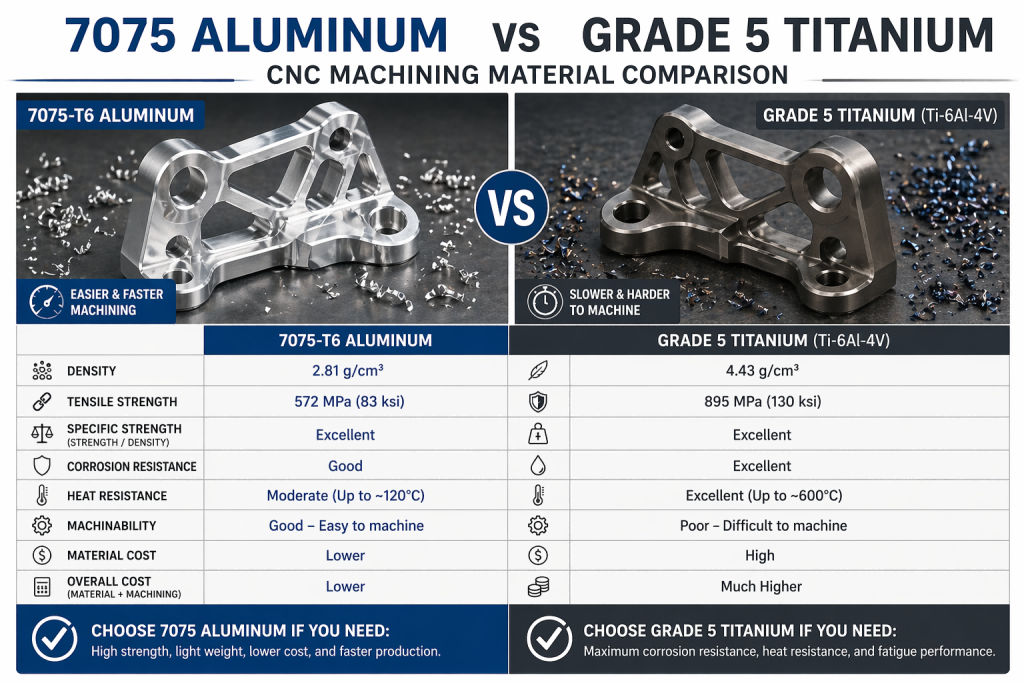
7075 Aluminum vs Grade 5 Titanium: Key Property Comparison
| Property | 7075-T6/T651 Aluminum | Ti-6Al-4V Grade 5 Titanium |
|---|---|---|
| Density | About 2.80 g/cm³ | About 4.42 g/cm³ |
| Weight at equal volume | Baseline | About 58% heavier |
| Representative yield strength | About 503 MPa typical for T6/T651 rod and bar | About 828 MPa minimum for common annealed Grade 5 product specifications |
| Elastic modulus | About 71 GPa | About 107–122 GPa |
| Room-temperature structural use | High strength with very low density | Higher absolute strength and stiffness |
| CNC machining behavior | Generally more production-friendly | Requires tighter control of heat, engagement, coolant, and tool life |
| Corrosion behavior | Temper, environment, stress direction, and protection matter | Strong general and seawater corrosion resistance |
| Elevated-temperature use | More limited; review the actual service temperature | Retains useful properties to substantially higher temperatures |
| Raw material and machining cost | Usually lower | Usually higher |
| Best fit | Lightweight, cost-sensitive structural components | Highly loaded, corrosive, hot, or titanium-specified components |
Note: These are representative values, not universal design allowables. Final properties depend on temper, product form, thickness, heat treatment, specification, material certification, and test direction.
Strength-to-Weight Ratio: Similar Goal, Different Route
For lightweight engineering, absolute strength and total mass must be evaluated together.
Specific strength = material strength ÷ density
The formula may use yield strength or tensile strength, but the same strength definition and comparable material conditions must be used for both materials.
7075 achieves strong weight efficiency mainly through its very low density. Grade 5 titanium is denser, but it provides higher absolute strength and stiffness. Depending on the load case, titanium may support a smaller section, so equal-volume weight is not always the same as final component weight.
7075-T6/T651 is commonly considered for room-temperature structural components such as:
- Drone frames
- Aerospace-related brackets
- Motorsport components
- Robotic structures
- Portable equipment
- Compact mechanical supports
The design still needs to account for fatigue, buckling, stress concentration, fastener loads, corrosion exposure, and the required safety factor.
When titanium is unnecessary but the aluminum grade is still open, compare 6061 vs 7075 aluminum for CNC machining before finalizing the drawing.
Machining Behavior Changes the Finished-Part Cost
Ti-6Al-4V is more demanding to machine than 7075-T6/T651, but not simply because titanium is “harder.”
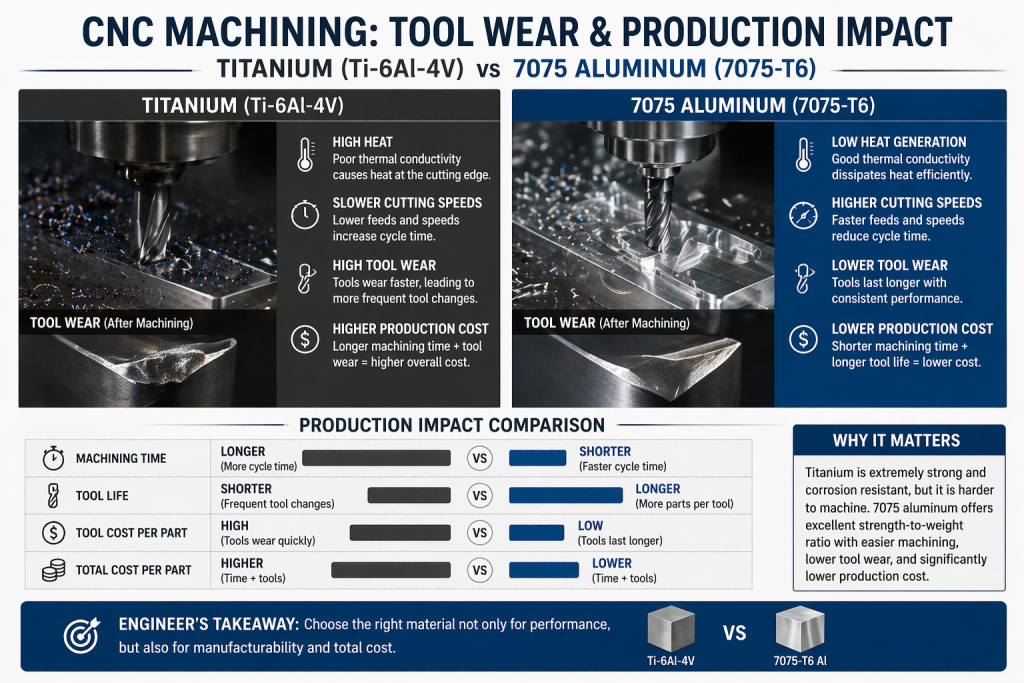
Grade 5 titanium has much lower thermal conductivity. More cutting heat remains near the tool–workpiece interface instead of moving quickly into the material. Its strength and chemical reactivity also increase the need for:
- Rigid workholding
- Short and stable tool projection
- Controlled radial and axial engagement
- Reliable coolant delivery
- Careful chip control
- Tool-life monitoring
- Stable finishing passes
7075-T6/T651 is generally more production-friendly, but it should not be treated like every other aluminum alloy. Its higher strength can increase cutting force, spindle load, fixture load, and tool-edge stress compared with softer aluminum grades.
The machining comparison should therefore be based on the actual:
- Part geometry
- Material condition
- Tool access
- Pocket depth
- Thin-wall features
- Tolerance
- Surface finish
- Quantity
- Inspection requirement
Do not apply a generic titanium or aluminum cost multiplier without reviewing the part.
Why Finished-Part Cost Separates the Two Materials
Titanium is expensive for two reasons:
Material, Stock Form, and Buy-to-Fly Ratio
Titanium stock is generally more expensive than 7075 aluminum, but raw price per kilogram is not enough to predict the finished-part cost.
The quotation also depends on:
- Required stock size
- Available plate, bar, or forging dimensions
- Material certification
- Material removed during machining
- Scrap value
- Minimum purchase quantity
- Risk of losing an expensive blank
At equal volume, Grade 5 titanium is also about 58% heavier than 7075. However, a titanium design may use a smaller section where its higher strength and stiffness create a genuine engineering advantage.
Machining Time and Process Control
For many CNC projects, the larger cost difference comes from the complete machining route rather than raw stock alone.
Grade 5 titanium may require more:
- Machine time
- Cutting tools
- Coolant and heat control
- Tool changes
- Process monitoring
- Setup validation
- Dimensional inspection
- Scrap-risk allowance
7075 normally provides the lower finished-part cost when both materials can meet the same room-temperature load, fatigue, corrosion, and durability requirements.
The comparison should use the finished geometry and required inspection plan—not equal raw blocks or price per kilogram alone.
Corrosion and Temperature Can Override Machining Cost
TitaGrade 5 titanium offers a stronger starting point for many marine, humid, chemical, and elevated-temperature applications.
TIMET describes Ti-6Al-4V as highly resistant to general seawater corrosion and states that reasonable properties are retained to approximately 350°C (660°F). The final design limit must still follow the applicable specification, load, environment, section size, and safety factor.
7075-T6/T651 requires more careful environmental review. Its suitability may depend on:
- Humidity and salt exposure
- Sustained tensile stress
- Grain direction
- Galvanic contact
- Temper
- Protective finishing
- Inspection and maintenance conditions
Anodizing, conversion coating, painting, sealing, or another suitable finish may improve protection, but a coating does not make 7075 equivalent to titanium in every corrosive or elevated-temperature environment.
For masking, fitted features, corrosion protection, and dimensional effects after finishing, review our surface-finish options for CNC-machined parts.
Where Each Material Usually Makes Sense
7075-T6/T651 Is Often the Practical Choice For
- Lightweight brackets and structural supports
- Drone, robotics, and motorsport components
- Performance housings and fixtures
- Portable equipment structures
- Room-temperature mechanical components
- Parts where machining throughput and total cost matter
- Designs that can use suitable corrosion protection when required
Grade 5 Titanium Is Often Considered For:
- Highly loaded compact components
- Aerospace parts specifically designed and approved for titanium
- Marine and selected chemical-service hardware
- High-strength fasteners, shafts, joints, and structural interfaces
- Components exposed to higher service temperatures
- Parts requiring titanium-specific corrosion or material compatibility
- Medical-device components using the applicable medical material specification
Implantable applications should not be described simply as “Grade 5 titanium parts.” They may require medical-grade Ti-6Al-4V ELI, commonly known as Grade 23, together with the applicable material specification, traceability, biocompatibility, manufacturing validation, and regulatory controls.
Ordinary industrial Grade 5 stock should not automatically be treated as suitable for an implantable device.
Can 7075 Replace Grade 5 Titanium?
Sometimes—but the substitution must be treated as a design change, not a purchasing shortcut.
7075 may replace Grade 5 titanium in selected room-temperature structural parts when the revised design still meets:
- Static strength
- Stiffness and deflection
- Fatigue life
- Buckling resistance
- Fastener and bearing loads
- Corrosion protection
- Service temperature
- Impact requirements
- Required certification
7075 should not be treated as a direct substitute when the design depends on titanium’s higher modulus, higher absolute strength, elevated-temperature capability, corrosion resistance, galvanic compatibility, or a titanium-specific material specification.
The correct comparison is between two complete part designs—not two equal-size blocks made from different metals.
FAQ
Is 7075 stronger than titanium?
Not when representative 7075-T6/T651 is compared with common Ti-6Al-4V Grade 5 conditions. Grade 5 titanium generally provides higher absolute yield and tensile strength.
7075 remains highly competitive in strength-to-weight applications because its density is much lower. Exact values depend on material condition, product form, thickness, direction, heat treatment, and specification.
Is titanium lighter than 7075 aluminum?
No. Grade 5 titanium has a density of approximately 4.42 g/cm³, compared with approximately 2.80 g/cm³ for 7075 aluminum. At equal volume, Grade 5 titanium is about 58% heavier.
A titanium component may still achieve competitive final mass when its higher strength allows the design to use a smaller section.
Which Is Easier to CNC Machine: 7075 or Grade 5 Titanium?
7075-T6/T651 is generally more production-friendly.
Grade 5 titanium requires greater attention to cutting heat, tool life, engagement, rigidity, coolant delivery, and chip control. The actual difference in cycle time still depends on geometry, tolerance, tool reach, finish, quantity, and inspection.
Why is titanium expensive?
The finished-part cost may include higher stock cost, longer machining time, greater tool consumption, additional process control, more inspection effort, and higher risk when an expensive blank is scrapped.
Raw material price alone does not explain the complete cost difference.
Why Is 7075 Used Instead of Titanium in Some Aerospace Parts?
7075 is useful when its low density, strength, room-temperature performance, machining efficiency, availability, and total cost satisfy the design.
Titanium may be selected instead when higher absolute strength, temperature capability, corrosion resistance, fatigue requirements, carbon-fiber compatibility, or the approved material specification controls the design.
Aerospace applications do not use one material as a universal replacement for the other.
Can 7075 replace titanium?
It can replace titanium in selected applications after the load, stiffness, fatigue, temperature, corrosion, geometry, joining method, finish, and certification requirements are reviewed.
It should not be presented as a direct material swap without design verification.
Need Help Choosing the Right Material?
Send Rapid Efficient your drawing, quantity, loading conditions, service temperature, corrosion exposure, surface finish, critical tolerances, and inspection requirements.
We can review whether 7075 aluminum, Grade 5 titanium, or another project-specific material offers the more practical machining route for the part.
Learn more about our CNC machining services for custom metal parts.