
Injection molding cost includes the tool, the production runs, and the work needed to deliver acceptable parts. A quoted piece price may cover only some of those items. Before using it in a budget, establish whether tooling, startup losses, gate removal, inspection, and packaging are included.
The production cost also depends on what happens during each shot. A 20 g component can consume more than 20 g of purchased resin, and a four-cavity mold does not deliver four accepted parts on every cycle. These differences link mold design and process assumptions to what the buyer ultimately pays.
Start with the required finished condition and the planned order releases. Then examine the material, machine time, and tooling behind the price.
Identify What the Tooling Payment Covers
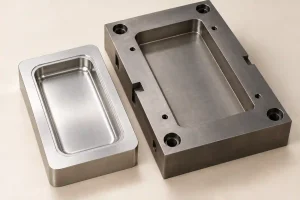
A tooling payment may cover a complete mold, interchangeable inserts, or tooling retained within a supplier’s production system. Confirm the deliverable before comparing the amount. Our soft tooling versus hard tooling guide explains the construction, ownership, and transfer questions in more detail.
For the cost comparison, identify whether mold design, manufacture, initial trials, agreed corrections, and sample inspection are included. Separate changes needed to meet the approved specification from buyer-requested design revisions. The quotation should explain how each is handled.
Also establish whether tooling is paid separately or recovered through the piece price. Adding the full mold purchase to a price that already contains tooling recovery can count the same cost twice. Conversely, a low piece price may depend on a separate tooling payment or a committed purchasing quantity.
Spreading the tool charge over forecast demand produces an allocated cost per part. It does not change the upfront payment or guarantee that the forecast quantity will be ordered. Use a realistic quantity for the design revision that the tool can actually produce.
Follow the Resin Through the Entire Shot
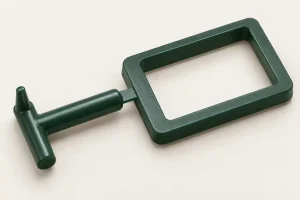
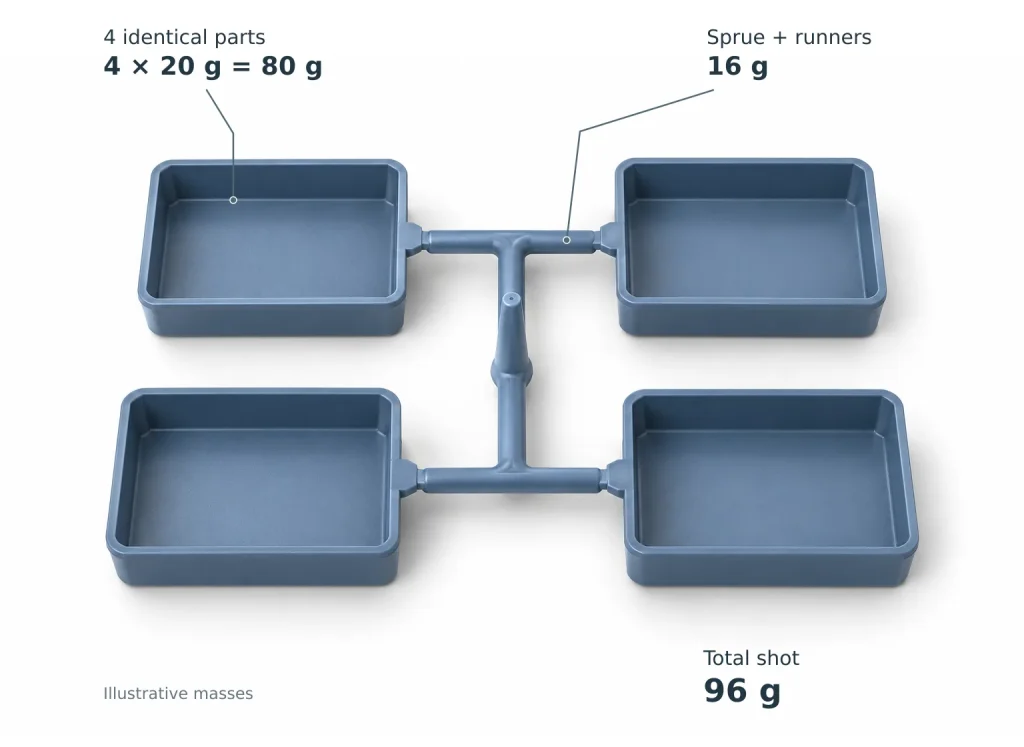
For a conventional cold-runner mold, the shot includes the parts plus the solidified sprue and runners. These feed the cavities but do not become delivered components. Production rejects consume resin too.
A useful starting relationship, with no material recovery, is:
Material per accepted molded part = Total production-shot mass ÷ Expected accepted parts per shot
Consider a hypothetical four-cavity tool making identical 20 g parts, with a combined sprue-and-runner mass of 16 g:
- Total shot mass = 4 × 20 + 16 = 96 g.
- At an assumed 96% molding yield, expected accepted output = 4 × 0.96 = 3.84 parts per shot.
- Material consumed per accepted molded part = 96 ÷ 3.84 = 25 g.
The 3.84 figure is an average across production, not a fractional part leaving the mold. This example excludes startup purging and trial shots, which will be budgeted separately.
The material budget follows the complete shot and its accepted output, not just the weight of one finished component.
Regrind can change the calculation, but only where reuse is permitted and controlled. Confirm the resin grade, application restrictions, contamination controls, and allowed reuse conditions. Grinding, handling, drying where required, and rejected material still have costs. Do not assume that every runner returns as an equal-value replacement for purchased resin.
A hot-runner system keeps resin molten in the distribution system and can eliminate the cold runner ejected with each shot. Husky’s explanation of hot-runner systems describes that material-flow difference. The financial comparison still needs the added tooling and controls, maintenance, startup waste, and actual production volume. A hot runner does not eliminate every source of material loss.
Convert the Cycle into Accepted Parts
The cycle time should cover the complete repeating cycle, including the operations needed to fill, pack, cool, open, remove the parts, and close the mold. Use the elapsed cycle; do not add overlapping activities twice.
For identical parts produced under steady conditions:
Machine cost per accepted molded part = Hourly machine rate × Cycle time in seconds ÷ (3,600 × Active cavities × Molding yield)
Continuing the example, assume a 30-second cycle and a costing rate of $72 per cycling hour:
Machine cost per accepted molded part = $72 × 30 ÷ (3,600 × 4 × 0.96) = $0.15625
This is the machine-time component under those assumptions. It is not a complete piece price. Confirm what the hourly rate includes, such as operating labor, energy, or overhead, before adding those items again.
Use the cavities that will actually produce the required component. If one cavity is unavailable, the same four-cavity calculation no longer applies. For a family mold producing a housing and a cover, calculate the accepted output of each component separately. If the order is priced per complete set, count sets containing both an accepted housing and an accepted cover. Different components cannot simply be counted as interchangeable units.
More cavities can spread machine time over more output, but the proposed tool may need a larger press, a different cycle, additional handling, or more maintenance. Compare the complete alternatives. Protolabs’ injection molding cost guidance discusses the tooling-versus-piece-price tradeoff of multi-cavity molds, along with design features that add cost.
A shorter cycle must still produce acceptable parts. Reducing cooling until a housing distorts after ejection does not establish a useful saving. Distinguish a cycle-time estimate from a result demonstrated with the proposed resin, tool, and acceptance requirements.
Compare One Production Run with Four
The same annual quantity can carry different costs when production is split into separate runs. Mold installation, material preparation, purging, stabilization, and startup checks may recur. Four deliveries do not necessarily mean four production runs: parts could be molded once and stored, which creates a different inventory and delivery arrangement.
Use the following illustrative budget to see the effect. These figures are assumptions, not supplier quotations, market prices, or Rapid Efficient performance claims.
The program requires 19,200 accepted parts of one unchanged design and resin specification. It uses the four-cavity, 96 g shot and 30-second cycle above, with 96% molding yield. Assume no regrind recovery, no additional losses during secondary operations, and the same stable process in every run.
Additional assumptions are:
- Purchased resin: $5/kg.
- Tooling and agreed initial qualification: $9,600.
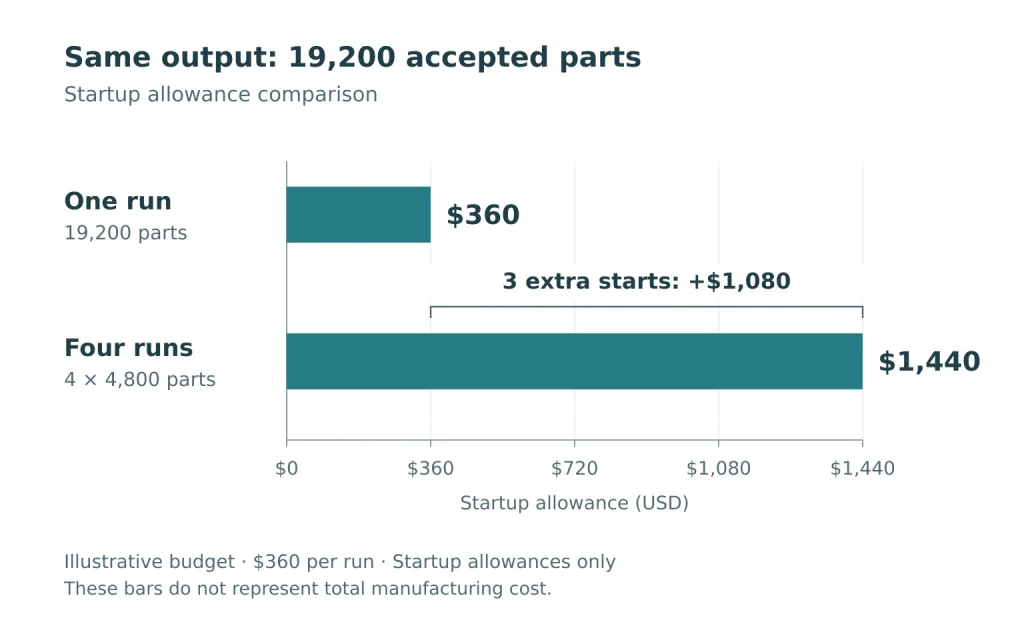
- Startup allowance for each production run: $360.
- Agreed post-molding work, inspection, and packaging: $0.18 per accepted part.
The startup allowance covers setup time and startup material losses separately from steady-production yield. Initial tool qualification is included only in the tooling line. The example excludes freight, duties, taxes, storage, design changes, and unplanned interruptions.
Production shots = 19,200 ÷ (4 × 0.96) = 5,000
Cycling time = 5,000 × 30 ÷ 3,600 = 41.6667 hours
Production resin = 5,000 × 96 ÷ 1,000 = 480 kg
| Budget item | Calculation basis | One run of 19,200 accepted parts | Four runs of 4,800 accepted parts |
|---|---|---|---|
| Tooling and initial qualification | Paid once | $9,600 | $9,600 |
| Production resin | 480 kg × $5/kg | $2,400 | $2,400 |
| Machine cycling | 41.6667 hours × $72/hour, using unrounded time | $3,000 | $3,000 |
| Production startup allowances | $360 per run | $360 | $1,440 |
| Post-molding work, inspection, and packaging | 19,200 × $0.18 | $3,456 | $3,456 |
| Total within the stated scope | Sum of the items above | $18,816 | $19,896 |
| Average per accepted part | Total ÷ 19,200, rounded to three decimal places | $0.980 | $1.036 |
The four-run budget is $1,080 higher, or $0.05625 per accepted part, solely because this model repeats the startup allowance. Actual runs may have different losses, purchase prices, or process conditions.
A quantity discount is meaningful only when the production-run plan and cost inclusions are clear.
Producing everything at once is not automatically the better purchase. It ties up inventory and can leave unusable parts if demand or the design changes. Ask for prices against the releases you expect to authorize, then compare any consolidated-production option with its storage and delivery conditions.
If a supplier already quotes a price per accepted delivered part that includes normal losses, use that stated basis. Do not divide the quoted price by yield again. The calculation above helps explain a cost model; it does not authorize adding duplicate charges to a supplier’s offer.
Check What Happens After Ejection
A molded housing may still need gate removal, insert installation, printing, selected machining, cleaning, or special packaging. Determine where the quoted piece price ends.
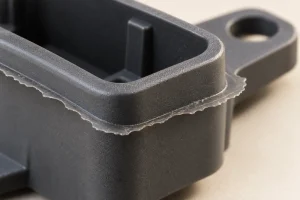
For example, a housing with a precision locating bore might be quoted as molded or with the bore machined afterward. Those offers need a common finished-part requirement before their prices can be compared. Similarly, a gate removed by automatic separation may still need additional work to meet a specified residual-mark limit.
Inspection scope matters too. A sample dimensional report, routine production checks, cavity-specific records, and a functional assembly test are different deliverables. Define what the purchase actually requires. The first article inspection guide explains how initial inspection evidence relates to drawing requirements.
If a secondary operation can reject parts, the budget must account for the additional upstream parts and work needed to replace them. Do not apply one blanket scrap percentage to every cost line without checking which operations the rejected parts have already passed through.
Compare quotations at the same delivery endpoint, currency, and stated tax treatment. For international orders, identify who carries the freight and import charges rather than treating an ex-works price as the delivered cost.
Price the Specific Design Change
Useful cost reduction starts with the item creating the expense.
A bulky boss may consume extra resin and extend the cooling needed for safe ejection. Coring it can change both costs, but the revised boss must still support the fastener and load. A hand-loaded feature may add labor and time on every shot. Revising its release path can affect recurring cost as well as tooling.
A cosmetic requirement may add polishing or texture work to the mold and increase the inspection burden on the part. Identify the surfaces that need that requirement rather than applying the same finish to hidden and visible areas without a functional reason.
For each proposal, ask for the specific geometry or specification change, its effect on tooling and piece price, and the validation it requires. A cheaper resin, relaxed fit, or altered gate location is a design decision that needs approval.
Keep the original compliant quotation available while evaluating alternatives. Otherwise, a lower price can quietly become the price of a different part.
For a cost review, share the resin grade and color, the first release and expected repeat quantities, and the operations required after molding. Include any proposed cavity count, runner arrangement, cycle-time assumption, and separate tooling or setup charges. Rapid Efficient can review these inputs through its injection molding services to clarify the production scope before quotation.