
Choose between ABS and polycarbonate (PC) for a machined housing by matching the offered stock grade to the service conditions and finished cost. Strength, stiffness and impact data can point to different choices, even for the same pair of products. PC may offer a useful temperature or transparency advantage; ABS remains a candidate when its specified grade meets the housing’s duty.
This comparison concerns housings cut from machinable stock, especially parts that do not need to be transparent. Injection-molding resin, printed filament and PC/ABS blends require separate material definitions. A PC/ABS blend is a formulated material, not another name for either of the two plastics.
Two Stock Products Give More Than One Ranking
Consider the published data for Ensinger’s TECARAN ABS grey and TECANAT natural polycarbonate. Both are stock-shape products. Their data sheets provide the following comparison values:
| Property and listed method | TECARAN ABS grey | TECANAT natural PC |
|---|---|---|
| Tensile strength at yield, DIN EN ISO 527-2, 50 mm/min | 32 MPa | 69 MPa |
| Tensile modulus, DIN EN ISO 527-2, 1 mm/min | 1,700 MPa | 2,200 MPa |
| Notched Charpy impact strength, DIN EN ISO 179-1eA | 34 kJ/m² | 14 kJ/m² |
| Density | 1.04 g/cm³ | 1.19 g/cm³ |
These are manufacturer guideline values for the named products, not guaranteed specification limits. The sheets list the same methods for the corresponding mechanical properties, but they are separate product data sheets rather than a controlled comparison of two finished housings. Stock dimensions, specimen orientation and test conditions still matter when assessing a proposed supply.
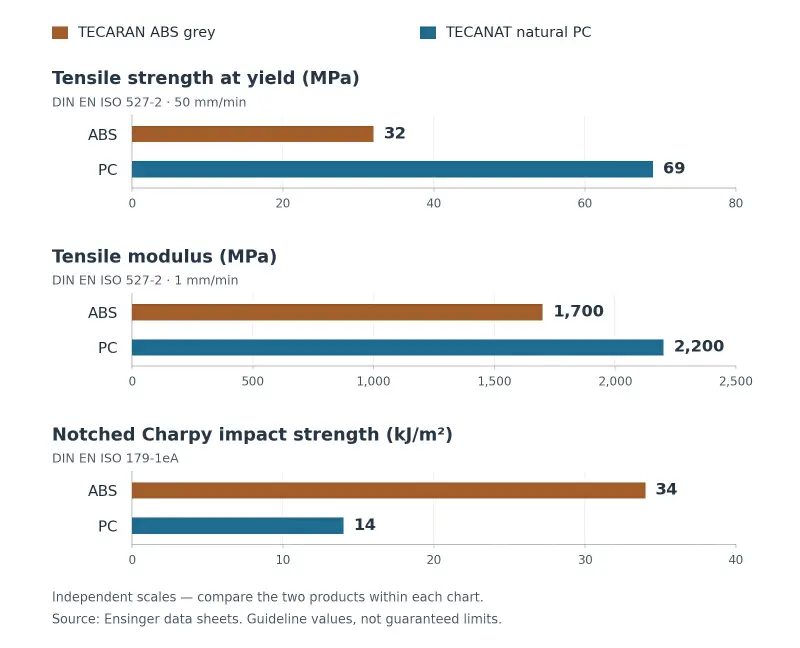
For this pair, PC has the higher tensile yield strength and tensile modulus. Yield strength describes the stress at yielding in the stated test. Modulus describes elastic stiffness. The different increases matter: a higher yield value does not mean the wall becomes proportionally stiffer. A broad panel may exceed its permitted movement well before the material yields.
The notched impact values run in the opposite direction. That prevents a blanket claim that PC must outperform ABS in every impact test. It also does not establish that the ABS housing will survive a drop better. A notched Charpy specimen has a defined notch, support arrangement and impact method; an assembled housing presents different edges, supports and load paths.
Use the table to identify what evidence is missing. For a deflection concern, obtain stiffness data relevant to the working conditions. For a cracking concern at a connector opening, examine the opening’s geometry and test the relevant impact condition. Selecting the largest number from an unrelated property row can lead to the wrong change.
Temperature and Impact Must Match the Housing’s Duty
The same product sheets list long-term service-temperature guidance of 75°C for the ABS product and 120°C for the PC product. They also require application-specific assessment. These figures help screen candidates; they are not allowable temperatures for every loaded wall, screw joint or mounting feature.
Take a hypothetical housing around a warm instrument. The outside air temperature may differ from the temperature near an internal heat source. Establish the temperature at the critical plastic feature, how long it remains there, and what force it carries. A warm mounting flange under sustained screw load needs evidence for movement over time, not only a room-temperature tensile result.
Creep is gradual deformation under sustained load. If the flange moves enough to alter seating or clamping, the assembly can lose function while the plastic remains intact. Where heat drives the material change, compare the proposed ABS and PC grades using relevant temperature-dependent data and an agreed duration under load. A higher listed service temperature makes the PC product worth investigating; the finished geometry still needs to meet its limit.
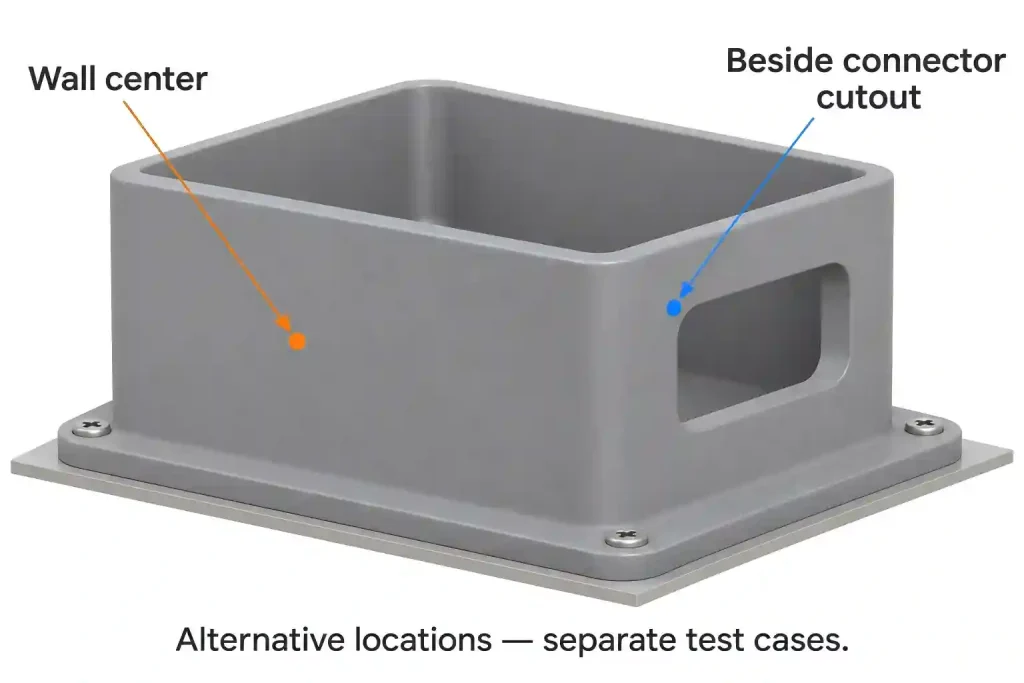
Impact raises a different question. A strike near the middle of a supported wall and a strike beside a connector cutout load the housing differently. The notch in a laboratory specimen is not a substitute for that cutout. Define the contact location, impact condition, housing support and permitted damage before comparing sample parts. For a dropped instrument, include the installed contents and mounting arrangement in the test definition.
The environment can change the result further. Check cleaners, paint systems and assembly chemicals against the actual grade and exposure. PC can suffer stress cracking from incompatible chemicals, particularly where internal or applied tensile stress is present. Our polycarbonate machining guide covers how machining, finishing and assembly can contribute to that problem. Choosing ABS instead still requires its own compatibility review.
Any required flame behavior, outdoor durability or color belongs in the grade selection. Properties from a natural stock product should not be assigned without verification to a differently formulated colored, filled or flame-retardant product. A quotation that replaces a named grade with “equivalent PC” leaves those differences unresolved.
Compare the Cost of the Delivered Housing
For an opaque housing, PC’s available transparency may offer no functional benefit. If the drawing calls for an opaque exterior, compare suitable colored stock or an approved finishing route. Painting a clear machined housing adds preparation and compatibility work. Conversely, a genuinely required viewing area changes the material decision; its optical finish needs a separate requirement from the surrounding body.
A fair cost comparison starts with two complete CNC machining proposals for the same housing revision and quantity. Each should identify the stock manufacturer, grade, color, blank size and finished surface condition. Resin price per kilogram leaves out blank yield, material removal and the operations needed to reach that condition.
The drawing also needs to distinguish cosmetic faces from mounting faces, connector openings and other functional features. A uniform appearance requirement over every surface can add work without helping the mounting interface. State where tool marks are acceptable and where the appearance must match an agreed sample or finish description.
Separate a stock substitution from a redesigned housing. Increasing an ABS wall thickness can change the blank, the machining work and the space left for the instrument. Revised supports, fasteners and finishing also belong to that alternative’s scope. Its price can be compared with a PC version as a complete design option, but it no longer isolates the cost of changing the plastic.
If both proposals meet the defined duty, choose on the delivered cost, availability and maintenance requirements of the approved versions. If only one has adequate evidence for a critical condition, resolve that difference before treating the prices as comparable. Record which housing requirement justified the choice. A higher tensile yield strength can support a decision about yielding; it does not explain a purchase intended to solve an impact or appearance problem.