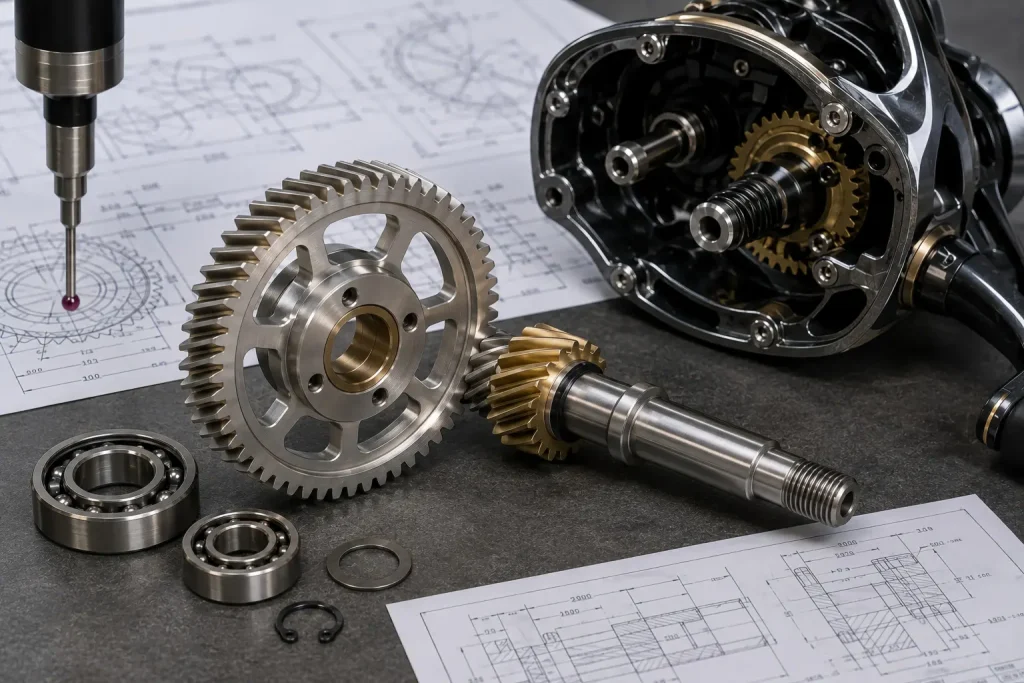
渔线轮齿轮可能很小, 但他们的制造要求并不简单.
卷轴感觉粗糙, 嘈杂, 松动的, or inconsistent even when every individual gear looks visually acceptable. The final result depends on the complete transmission system, 包括:
- Gear tooth geometry
- Main gear and pinion pairing
- 间隙
- 轴中心距
- Gear blank runout
- 孔同心度
- Bearing alignment
- Housing stiffness
- Material and hardness pairing
- 润滑
- 表面处理
- Assembly condition
CNC machining can produce accurate gear blanks, 钻孔, 枢纽, 口袋, 轴, and selected tooth profiles. 然而, a smooth fishing reel cannot be guaranteed from a general dimensional tolerance or surface-roughness value alone.
绘图, gear specification, 加工路线, 检查计划, 润滑, and final assembly must work together.
快速解答
A practical fishing reel gear manufacturing plan should confirm:
- The function of each gear in the reel
- Gear type and tooth geometry
- Module or diametral pitch
- Pressure angle
- Tooth count
- Helix angle and hand, 适用时
- Required backlash
- 轴中心距
- Bore and hub relationship
- Material grade and final hardness
- 阳极氧化, 电镀, 钝化, or other treatment
- 腐蚀暴露
- 润滑
- Gear accuracy and inspection standard
- 原型或生产数量
For many fishing reel projects, the main gear may prioritize low mass, sufficient strength, and corrosion protection, while the pinion may prioritize tooth strength, 戴阻力, shaft alignment, and surface durability.
That does not mean every main gear should be 7075 aluminum or every pinion should be 304, 316, 或黄铜. The correct pairing depends on load, 尺寸, gear ratio, tooth form, bearing support, 润滑, 环境, expected life, and manufacturing cost.
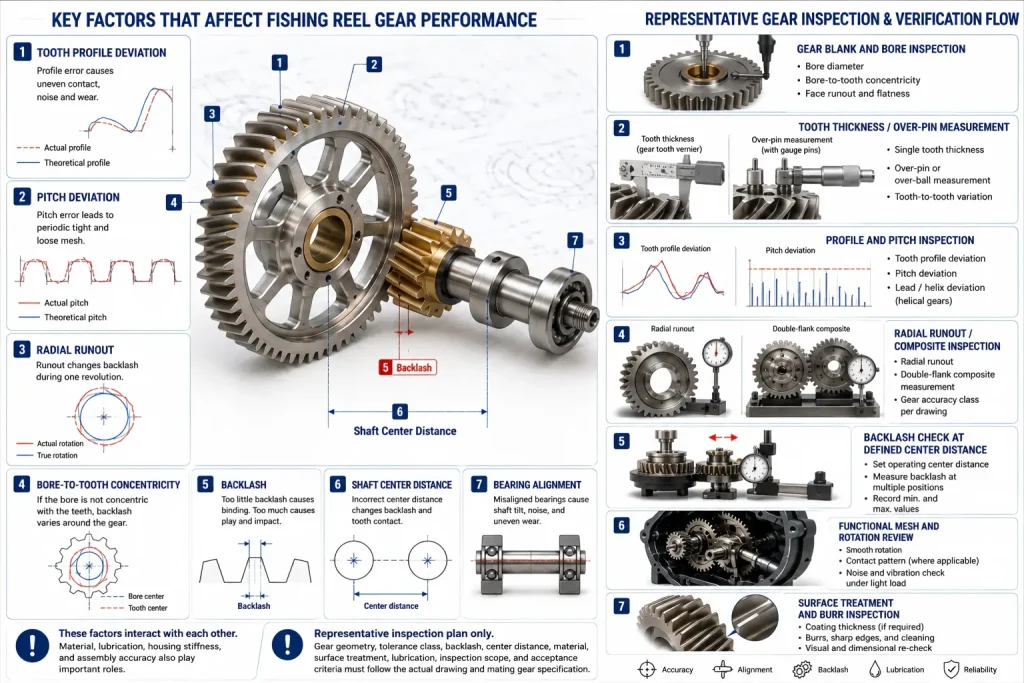
Why Fishing Reel Gears Feel Rough or Noisy
Noise and rough rotation are often blamed on the gear material. Material is only one possible cause.
Tooth Profile Error
A tooth may have the correct overall size but an incorrect involute profile or local flank form.
This can create:
- Uneven contact
- Periodic resistance
- Concentrated load
- Noise during rotation
- 加速磨损
Pitch Error
Pitch error changes the spacing between adjacent teeth.
A local pitch error may cause the gear pair to become tight and loose at different angular positions.
Gear Blank Runout
If the tooth geometry is not concentric with the bore or bearing axis, backlash can change during one revolution.
The reel may feel smooth in one position and tight in another.
Incorrect Backlash
Backlash is the clearance between mating tooth flanks.
Too little backlash may cause:
- Binding
- 热
- 噪音
- Sensitivity to coating thickness
- Sensitivity to center-distance variation
Too much backlash may cause:
- Handle play
- Impact during load reversal
- Clicking
- Uneven tooth contact
Backlash cannot be selected independently from center distance, tooth thickness, profile shift, bearing clearance, housing alignment, and thermal or coating effects.
Shaft and Bearing Misalignment
Accurate gears can still mesh poorly when:
- Bearing bores are misaligned
- Shafts are tilted
- Housing datums are inconsistent
- Bearings move under load
- The side cover changes position after tightening
Lubrication and Contamination
Incorrect grease quantity, incompatible lubricant, dirt, corrosion products, and damaged tooth surfaces can also change the reel’s sound and feel.
ISO 1328 provides a tolerance-classification system for individual cylindrical gear flanks, including profile, 沥青, and helix-related deviations. AGMA inspection publications also distinguish tooth-flank measurement, tooth thickness, gear blank geometry, center distance, and double-flank composite inspection. This shows why one general linear tolerance cannot fully define gear performance.
Main Gear, Pinion, and Other Reel Transmission Parts
Fishing reel designs vary, but a transmission may include several different components.
Main Gear
The main gear commonly receives torque from the handle and transfers it to the pinion or another gear stage.
Important requirements may include:
- Tooth strength
- Hub rigidity
- 孔同心度
- Low rotating mass
- Controlled deformation
- Stable attachment to the handle shaft
- 耐腐蚀
Pinion Gear
The pinion is usually smaller and may rotate at a higher speed than the main gear.
其性能可能取决于:
- Tooth hardness
- Shaft straightness
- Bearing support
- Bore or shaft concentricity
- Surface wear
- Axial location
- Engagement with the spool or drive system
Oscillation and Level-Wind Components
Some reels include additional gears, worm shafts, sliding blocks, or oscillation mechanisms.
These components may prioritize:
- 耐磨性
- Low noise
- Controlled clearance
- Repeated direction changes
- 低摩擦
- 耐腐蚀
The material and inspection plan should be based on each component’s actual function rather than using one specification for the entire reel.
Material Options for Fishing Reel Gears
铝合金
Aluminum may be selected for a main gear, gear blank, carrier, or other lightweight component.
Potential advantages include:
- Low mass
- 良好的机械加工性
- 良好的强度重量比
- Compatibility with anodizing
- Practical production of integrated hubs and pockets
Possible risks include:
- Thin-rim distortion
- Tooth damage during handling
- Coating-related dimensional change
- Lower wear resistance than a suitable hardened steel
- Galvanic interaction with more noble metals in wet environments
- Cosmetic variation after anodizing
可能的等级包括 6061 和 7075, but the choice must follow the required load, 壁厚, tooth geometry, 阳极氧化路线, 和成本.
7075 provides higher strength than 6061 in common heat-treated conditions, but it is not automatically the best gear material. A lighter-load or corrosion-sensitive design may obtain a better overall result from a different alloy or material pairing.
Brass and Bronze
Brass or bronze may be considered where the design needs a balance of:
- 机械加工性
- 磨损行为
- 耐腐蚀
- Stable tooth geometry
- Compatibility with a mating material
The exact alloy matters.
易切削黄铜, high-strength brass, 磷青铜, aluminum bronze, and other copper alloys do not have the same:
- 力量
- 硬度
- Corrosion performance
- 加工行为
- Wear characteristics
- 成本
The drawing should specify the alloy rather than using only brass gear.
不锈钢
Stainless steel may be chosen for pinions, 轴, small gears, or corrosion-resistant transmission components.
然而, stainless steel 不是完整的材料规格.
304 和 316 offer useful corrosion resistance but are not automatically the best wear or tooth-contact materials. 取决于设计, the project may require:
- A different stainless grade
- A hardened stainless steel
- Precipitation-hardening stainless steel
- Heat-treated alloy steel with suitable corrosion protection
- A brass or bronze mating component
年级, 硬度条件, tooth-cutting route, 表面处理, and lubricant compatibility must be confirmed before production.
工程塑料
Engineering plastics may be used for selected low-load gears or auxiliary transmission components where the design values:
- Low mass
- Low operating noise
- Electrical isolation
- Reduced corrosion risk
- Lower inertia
- Material-specific friction behavior
Plastic gears also introduce risks such as:
- 热膨胀
- Moisture-related dimensional change
- Tooth creep
- Lower stiffness
- Sensitivity to assembly load
- Changes in backlash after storage or temperature exposure
KHK notes that temperature and humidity can change plastic-gear dimensions, including tooth diameter, 钻孔, and backlash.
For a broader comparison of aluminum, 不锈钢, 铜合金, 黄铜, 青铜, 和工程塑料, 回顾我们的 CNC加工材料指南.
Why Material Pairing Matters
The main gear and pinion should be evaluated as a pair.
A harder material is not automatically better for both gears.
The review should consider:
- Relative hardness
- Contact stress
- Sliding and rolling behavior
- Tooth size
- 润滑
- 腐蚀
- Sacrificial wear strategy
- Replacement cost
- Noise target
- 体重目标
- Expected service life
If both mating components are very hard but poorly aligned, the system may become noisy or develop localized wear.
If one component is much softer, it may wear rapidly unless that behavior is intentionally accepted.
Dissimilar metals can also create galvanic-corrosion risk when they are electrically connected in a wet, salt-containing environment. The risk depends on the specific alloys, electrolyte, 电接触, protective finishes, and relative exposed areas—not merely on the names of the two metals.
Gear Data Required Before Machining
A 3D model showing tooth shapes is not always enough to manufacture or inspect a gear correctly.
The drawing or gear data sheet should include:
| Required Information | 为什么它很重要 |
|---|---|
| Gear type | Defines the tooth and machining route |
| Module or diametral pitch | Defines tooth size |
| Pressure angle | Controls tooth geometry and mesh |
| Tooth count | Controls ratio and reference diameter |
| Helix angle and hand | Required for helical gears |
| Profile shift | Affects tooth thickness and operating geometry |
| Backlash requirement | Controls running clearance |
| Center distance | Affects final mesh |
| Gear accuracy class | Defines allowable flank deviations |
| Bore, hub, and datum | Connects teeth to the rotating axis |
| Material and hardness | 控制力度, 穿, 及制造路线 |
| 表面处理 | May change tooth and bore dimensions |
| Mating gear data | Needed for functional review |
| 数量 | Influences the tooth-cutting method |
| 检验要求 | Defines what must be measured and reported |
Do not apply a blanket ±0.01 mm tolerance to the whole gear.
A linear tolerance does not replace requirements for:
- Tooth profile
- 沥青
- Helix
- Tooth thickness
- Radial runout
- 孔同心度
- Face runout
- Composite mesh behavior
For datum, 合身, 跳动, 轮廓, 和检查计划, 回顾我们的 CNC加工公差指南.
间隙, Center Distance, and Runout Must Be Reviewed Together
Backlash measured at one angular position may not represent the whole rotation.
If the gear blank or bore has runout, the minimum and maximum backlash may change around the gear.
A practical review may include:
- Tooth thickness
- Span or over-pin measurement
- Bore-to-tooth concentricity
- Radial runout
- Center-distance tolerance
- Bearing clearance
- Housing position
- Gear-pair composite testing
- Functional rotation under light load
The specified backlash should also consider:
- Lubricant film
- 表面处理
- 工作温度
- Housing deflection
- Bearing position
- Manufacturing variation
- Wear over service life
Trying to remove all detectable backlash may create a gear pair that binds after anodizing, 电镀, 集会, temperature change, or housing tightening.
Gear Blank Machining and Tooth-Cutting Routes
Fishing reel gears may require more than one machining process.
Gear Blank Turning
Turning may establish:
- Bore
- Hub
- 外径
- Faces
- Shoulders
- Retaining features
The tooth reference should remain aligned with the functional bore and mounting datums.
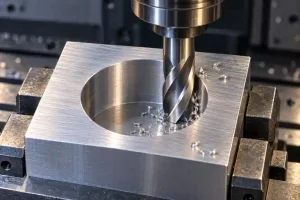
Milling of Pockets and Weight-Reduction Features
CNC milling may produce:
- Lightening pockets
- Spokes
- Handle interfaces
- Screw holes
- Key or spline-related features
- Noncircular hubs
Removing too much material from a thin gear blank can change flatness or radial runout.
Tooth Cutting
Depending on the design and production quantity, tooth generation may use:
- Hobbing
- Gear shaping
- Form milling
- CNC gear milling
- Power skiving
- Wire EDM for selected geometries
- Dedicated custom tooling
No single process is automatically best.
The selection depends on:
- External or internal teeth
- Spur or helical geometry
- Module or pitch
- Face width
- Material and hardness
- Required accuracy
- 工具访问
- Prototype or repeat quantity
A three-axis or 3+2-axis machine should not be advertised as automatically capable of producing every fishing reel gear profile.
Controlling Distortion in Thin Aluminum Gear Blanks
Large-diameter aluminum gears with thin rims, spokes, or heavily pocketed webs may move after material removal.
可能的原因包括:
- Residual stress in the stock
- Unbalanced pocket machining
- 锁模力过大
- Weak temporary geometry
- 切削热
- Removing the hub or rim support too early
- Anodizing pretreatment and coating
A practical process may include:
- 确认材料等级, 脾气, 和库存形式
- Establish the functional bore and datum faces
- Rough pockets in a balanced sequence
- Retain temporary support where needed
- Leave controlled finishing allowance
- Release the part and check movement
- Re-clamp from verified datums
- Finish the bore, 面孔, and critical geometry
- Cut or finish the teeth using the selected route
- Inspect again after unclamping and surface treatment
Natural aging should not be described as a guaranteed method that eliminates gear runout.
The actual process depends on the blank diameter, rim thickness, spoke design, 库存状况, 夹具, tooth-cutting method, 及检验要求.
Anodizing and Coating Allowance
Anodizing may be used on aluminum components for:
- 腐蚀防护
- 耐磨性
- 外貌
- Surface identification
- 电气行为
It also changes dimensions.
Anodic coating grows partly into the aluminum and partly above the original surface. The dimensional result depends on the alloy, 预处理, 阳极氧化型, 涂层厚度, and process conditions.
For gear components, this may affect:
- Tooth thickness
- Tooth-space width
- 孔径
- Shaft fit
- 螺纹配合
- 间隙
- Hub interfaces
- 轴承座
The Aluminum Anodizers Council recommends reviewing the intended anodizer and process because alloy, 涂层类型, 蚀刻, and other process conditions affect dimensional change. Critical bores, 线程, and other features can also be masked where appropriate.
Do not use one fixed hard-anodize thickness for every fishing reel gear.
The drawing should confirm:
- Type of anodizing
- Coating-thickness requirement
- Dyed or clear finish
- Masked features
- Tooth treatment
- Bore and thread condition
- 处理后适用的尺寸
- Cosmetic acceptance standard
- Post-anodize inspection
For anodizing, 钝化, 电镀, 掩蔽, and dimensional allowance, 回顾我们的 surface finishes for CNC parts.
Saltwater Corrosion and Galvanic Risk
Saltwater reel components face more than general surface rust.
Potential risks include:
- Crevice corrosion
- 点蚀
- Galvanic corrosion
- Coating damage
- Trapped salt and moisture
- Lubricant contamination
- Corrosion beneath fasteners
- Attack at scratched or uncoated areas
A corrosion review should include the complete assembly:
- Main gear
- Pinion
- 轴
- 轴承
- 紧固件
- Housing
- 封面
- 涂料
- Lubricant
- Drainage and cleaning access
Protective strategies may include:
- Selecting compatible materials
- Isolating dissimilar metals where practical
- Applying suitable surface treatments
- Protecting coating contact points
- Using appropriate lubricants
- Avoiding water-trapping crevices
- Defining cleaning and maintenance requirements
A corrosion-resistant material does not compensate for a damaged coating, trapped saltwater, unsuitable lubricant, or poor assembly design.
毛刺, Tooth Edges, and Cleaning
Small gear teeth are sensitive to burrs and handling damage.
Burrs may form at:
- Tooth exits
- Bore edges
- Lightening pockets
- 交叉孔
- Keyways
- Thread entries
- Machining transitions
Uncontrolled deburring may also damage:
- Tooth tips
- Tooth flank geometry
- Sharp reference edges
- Coating-sensitive areas
- Thin rims
The deburring method should be selected according to:
- 材料
- Tooth size
- Gear accuracy
- 边缘要求
- 表面处理
- 生产数量
After machining and finishing, the gear should be cleaned so the assembly does not contain:
- Metal chips
- Abrasive media
- Polishing residue
- Anodizing residue
- Corrosion products
- Contaminated lubricant
Gear Inspection and Functional Meshing Checks
A general CMM report may verify the gear blank, 钻孔, 面孔, 和安装特点. It does not automatically provide a complete gear-flank inspection.

Depending on the drawing and gear size, verification may include:
- 孔径
- Bore-to-tooth concentricity
- Face runout
- Gear blank flatness
- Tooth thickness
- Span measurement
- Measurement over pins or balls
- Pitch deviation
- Profile deviation
- Helix deviation
- Radial runout
- Double-flank composite measurement
- Backlash in the actual center-distance condition
- Functional meshing with a master or mating gear
- Visual and burr inspection
- Coating-thickness review
ISO 1328-1 covers tolerance classes for individual cylindrical gear flanks, while ISO 1328-2 addresses double-flank radial composite deviations. These measurements answer different questions and should be selected according to the actual drawing.
For dimensional, 线, 表面, burr, 材料, and reporting controls, 回顾我们的 CNC加工零件的质量保证.
Common Problems and Process Checks
| Observed Problem | Possible Cause | 回顾什么 |
|---|---|---|
| Reel becomes tight at one angular position | Gear or bore runout | Bore datum, tooth concentricity, composite inspection |
| Rough feel through the full rotation | 轮廓, 沥青, 结盟, 润滑, or burrs | Gear flank inspection and assembly |
| Excessive handle play | Too much backlash or assembly clearance | Tooth thickness, center distance, 轴承 |
| Noise increases under load | Localized contact or housing movement | 结盟, 刚性, tooth contact |
| Aluminum gear loses shape after machining | Thin blank distortion | 物质条件, sequence, 夹具 |
| Gear becomes tight after anodizing | No coating allowance | Tooth, 钻孔, 和掩蔽计划 |
| Tooth wear is concentrated on one side | Shaft or bearing misalignment | Housing bores, face runout, 集会 |
| Saltwater corrosion appears near contact points | Coating damage or galvanic couple | Material pairing and isolation |
| Burrs damage mating teeth | Incomplete deburring | Tooth-edge inspection and cleaning |
| Prototype works but batches vary | Undefined gear and inspection data | 绘画, accuracy class, process controls |
Information to Provide Before Quotation
Send the following information for a fishing reel gear project:
- 3CAD模型
- 2D图
- Main gear and mating gear data
- Gear type
- Module or diametral pitch
- Pressure angle
- Tooth count
- Helix angle and hand
- Profile shift, 适用时
- Required backlash
- Operating center distance
- Gear accuracy class
- Bore and datum requirements
- 材质等级
- 最终硬度
- 表面处理
- Saltwater or freshwater environment
- Lubrication requirements
- 原型及生产数量
- Inspection method and report requirements
- Mating shafts, 轴承, and housing information where relevant
A gear quotation made from tooth count and outside diameter alone may not define the required function.
常问问题
是 7075 Aluminum the Best Material for a Fishing Reel Main Gear?
Not in every reel.
7075 may provide a useful combination of strength and low weight, but the final choice also depends on tooth size, blank stiffness, 腐蚀保护, wear pairing, 阳极氧化, 加载, 和成本.
Is Brass Better Than Aluminum for Reel Gears?
Neither material is universally better.
Brass may provide useful machinability and wear-related behavior. Aluminum offers lower mass and can provide high strength in suitable grades. The mating pinion, 润滑, corrosion environment, and expected life must be considered.
是 316 Stainless Steel the Best Pinion Material?
不会自动.
316 offers corrosion resistance, but gear performance also depends on hardness, 力量, 戴阻力, tooth geometry, 及制造路线. A different stainless, 淬火钢, or copper alloy may be more suitable.
What Causes Fishing Reel Gear Noise?
可能的原因包括:
- Tooth profile error
- Pitch error
- 跳动
- Incorrect backlash
- 轴承不对中
- Housing movement
- 毛刺
- 穿
- 腐蚀
- Insufficient or contaminated lubrication
Does a Lower Ra Value Make the Reel Smoother?
不是靠它自己.
Gear feel depends more strongly on tooth geometry, contact pattern, backlash, 跳动, 结盟, 润滑, 和组装. Surface roughness may matter, but one Ra number cannot prove smooth operation.
Can CNC Milling Produce Fishing Reel Gear Teeth?
It can produce selected tooth forms, especially for prototypes or suitable geometries.
Other projects may require hobbing, shaping, skiving, form milling, wire EDM, or dedicated gear-cutting equipment. The method depends on tooth type, 准确性, 材料, 和数量.
Should Aluminum Gear Teeth Be Hard Anodized?
Only after reviewing the application.
Hard anodizing may improve selected surface properties, but it also changes tooth and bore dimensions. 涂层厚度, 掩蔽, backlash, tooth geometry, and mating-material wear must be considered.
How Should Fishing Reel Gears Be Inspected?
The inspection plan may include gear blank dimensions, bore concentricity, 跳动, tooth thickness, 轮廓, 沥青, helix, composite mesh, backlash, 涂层, 毛刺, and functional rotation.
The exact scope should follow the drawing and risk.
Review Your Fishing Reel Gear Before Production
Fishing reel gears should be reviewed as a complete transmission system rather than isolated machined parts.
Send the gear drawings, mating-part data, material and hardness requirements, backlash, center distance, 表面处理, 运行环境, 数量, 及检验要求.
快速高效可审核:
- Gear blank manufacturability
- Bore and datum relationships
- Material and hardness requirements
- Tooth-cutting access
- Thin-rim deformation risk
- 表面处理余量
- 检验要求
- 原型和小批量生产路线
- Packaging and international delivery requirements
For custom gear blanks, 轴, 枢纽, 外壳, and other close-tolerance components, 回顾我们的 精密加工服务.