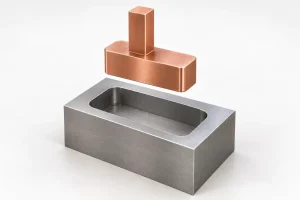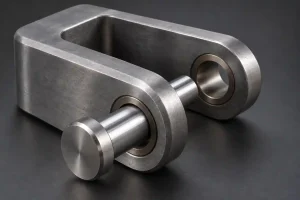

Choose between sinker EDM and wire EDM by checking how the electrode can reach the feature while leaving the required material intact. A wire can follow a suitable through-profile. A shaped sinker electrode can produce a blind recess, provided its entry, working motion, and withdrawal are possible.
For a purchased CNC part, this check belongs before quotation. Two features may have the same outline in a top view but need different preparation, 工装, and machining routes because one retains a floor. Both processes require an electrically conductive workpiece, but conductivity alone does not establish that a feature is accessible.
The practical task is to identify the EDM features, show the material that must remain, and ask for a complete route to those features.
Read a Section Through the Feature
Consider an illustrative steel insert with a rectangular opening drawn on its top face. That view does not show whether the opening passes through the insert, stops at a floor, or widens below a narrow mouth.
These are three different access problems:
| Geometry shown in section | Electrode-path check | Consequence for the machining enquiry |
|---|---|---|
| An opening passes through the insert | Can the wire span the thickness and move around the required contour without cutting material that must remain? | Review wire EDM, including threading access and how the removable core will be held. |
| A pocket stops above a required floor | A wire passed through the pocket in the illustrated top-to-bottom direction would also cut the floor. | Review an accessible sinker electrode, 铣削, or a combination that preserves the floor. |
| A blind recess widens behind a narrower mouth | A full-width, rigid electrode cannot simply plunge through a smaller opening. | Request a specific electrode and motion plan; do not assume ordinary straight plunging can form the recess. |
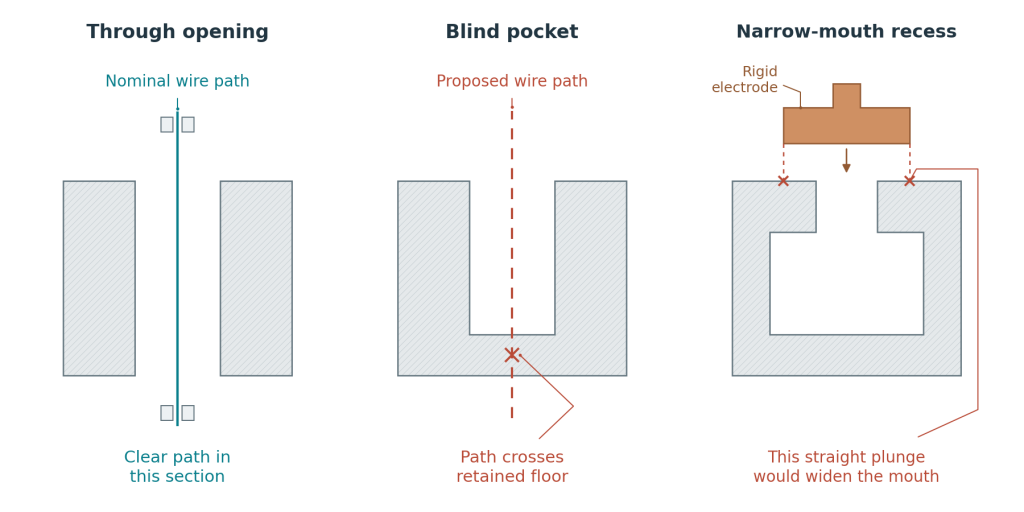
The third case is not a blanket rejection of sinker EDM. It identifies a collision in one proposed approach. A different electrode arrangement, working direction, or approved part redesign may change the result. The supplier must show how the proposed approach reaches the required surfaces.
YCM’s comparison of sinker and wire EDM describes the basic distinction between a shaped electrode used for cavity work and a traveling wire used for through-cutting. The section review applies that distinction to the actual part.
A blind pocket is open at its mouth; it is not the same as a fully enclosed internal void. Neither process gains access to an enclosed feature merely because it appears in a CAD model. Show the opening, the remaining floor, and any hidden shoulders in the enquiry.
Trace the Wire Beyond the Cut
For a conventional wire EDM setup, review the entire wire span between the guides, including the wire diameter and discharge gap. A clear contour on the top face is insufficient if the cut would remove material from another wall or a retained step farther down.
A closed internal profile normally needs a through-opening for threading. If there is no suitable opening, the route must include making a start hole. Place it within material that will be removed, with space for the lead-in path. Its size and location should suit the proposed wire and threading method, rather than an arbitrary drawing default.
An accessible external profile can instead be entered from an edge. A separate start hole is therefore not required for every wire-cut feature. 然而, cutting from an outside edge into an internal window would leave an entry slit. That slit is a design change when the surrounding wall must remain continuous.
For the through-opening in the table, ask the supplier to identify three things on the model:
- Where the wire will be threaded or enter from an edge.
- How it will reach and follow the finished contour.
- How the core or cut-off piece will be supported as it separates.
The last point affects the setup and completion of the cut. A loose core must not be allowed to move unpredictably into the wire or damage the required surfaces. If a temporary bridge is proposed, its removal and the finishing of that location belong in the quoted route.
Wire EDM can also produce suitable tapered profiles by moving the guides relative to one another. It is not limited to vertical walls. The nominal wire span is still straight between its guides, so it cannot bend around a retained obstruction. Changing the top and bottom contours does not make every intermediate three-dimensional shape possible.
Part orientation can change access. It can also change clamping, guide clearance, and the relationship between the EDM feature and previously machined datums. Review the proposed orientation before treating a rotated CAD view as a workable setup.
Check How a Shaped Electrode Enters and Leaves
电火花成型机, also called ram or die-sinking EDM, uses a shaped electrode to remove material across a controlled discharge gap. The electrode and its planned movement determine which surfaces can be reached.
For the blind pocket, the review should follow the electrode from above the opening to its deepest working position and back out. Include the holder and any sideward working motion. Clearance at the mouth alone does not establish clearance throughout the operation.
A deeper detail may be accessible to a slender electrode, yet difficult to flush. Dielectric fluid must reach the working region and debris must be removed from the gap. Ask how the proposed electrode geometry and machining sequence address that access; a narrow passage should not be accepted only because a solid model fits inside it.
An electrode is not an exact, full-size copy of the finished cavity: its dimensions and planned motion must account for the discharge gap and machining conditions. State the finished geometry and permitted corner radii, and confirm who designs and supplies the electrodes. “Use sinker EDM” alone does not define an acceptable corner radius or the finishing route.
For a recess that widens below its mouth, ask for an explanation of how the electrode reaches the wider region and then leaves it. A proposal that only names sinker EDM has not resolved the geometry. Do not approve a larger opening, a split insert, or an added access hole without checking the part’s function and revising the drawing as needed.
Turn the Access Review into a Machining Scope
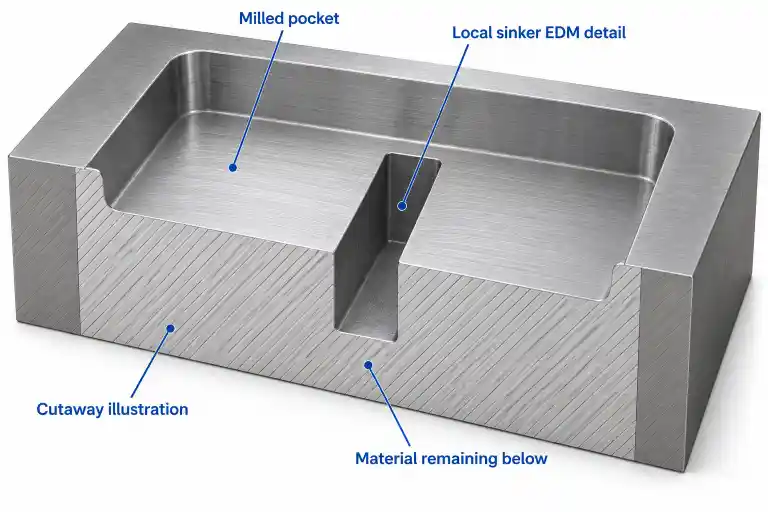
The process choice need not apply to the whole part. An insert can have milled datums, a wire-cut through-window, and a blind detail made by sinker EDM, provided each operation is feasible and the features can be located correctly relative to one another.
同样地, a blind pocket does not automatically require sinker EDM. If a rotating cutter can reach the surfaces and produce the permitted radii, milling may be suitable. Where only a deep, narrow detail needs EDM, the supplier can review milling the accessible volume first. The transition between the milled and EDM surfaces must still meet the drawing.
Compare proposals using the same required geometry. If milling requires a corner radius outside the drawing’s permitted limits, treat the quote as an alternative design proposal requiring approval. A quote based on removing the pocket floor changes the feature even if it makes wire cutting straightforward.
For a wire route, identify whether start-hole preparation, 核心支撑, final separation, and finishing at the entry or bridge location are included. For a sinker route, identify whether electrode design and manufacture, any preliminary pocket machining, and the required finishing operations are included. These are scope questions, not a universal claim that one process costs less.
对于重复订单, clarify whether suitable electrodes and fixtures will be retained, who owns them, and what happens after a drawing revision. Existing tooling should not be counted as reusable before its condition and compatibility have been checked.
Keep the finished-part requirements separate from the access decision. 尺寸, 地点, 表面纹理, and any required surface-integrity controls still apply after the route has been selected. 这 EDM machining tolerance guide covers that acceptance review in more detail.
For a through-profile enquiry, provide the section view and proposed entry restrictions with the files submitted for wire EDM services. For a part combining milled and EDM features, 使用 CNC machining review to identify the features that need separate process assessment. Mark the floor or walls that must remain, any prohibited access holes or slits, and the relationship of each EDM feature to the machined datums. Confirm the proposed EDM process and supply scope before ordering.