
对于数控零件, cold-rolled steel is worth considering when its supplied surface and dimensions can remove work from the manufacturing route. Hot-rolled stock can be a practical choice when the required faces will be machined and the blank provides enough usable material. Neither option wins from its price per kilogram alone.
The useful comparison starts with the finished drawing: which surfaces can remain as supplied, which must be cut, and what happens when material is removed? Those answers determine whether a better stock finish saves an operation or simply becomes chips.
This article focuses on flat steel blanks for machined plates, 封面, 和安装零件. Bar terminology is addressed separately because cold-rolled sheet, cold-drawn bar, and other cold-finished products are not interchangeable descriptions.
Decide Which Supplied Surfaces Can Stay
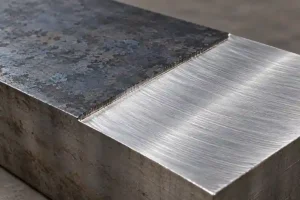
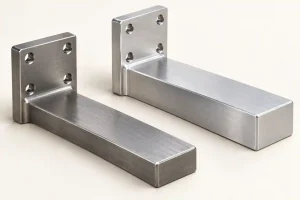
Consider an illustrative mounting plate with machined seating areas, 定位孔, and a broad face that does not contact another component. The drawing may allow that broad face to retain its supplied finish. 如果是这样, buying an acceptable surface could avoid machining the entire face.
If that face has specified flatness, 厚度, or surface-roughness limits, the supplied surface may remain only when it meets them. A smooth-looking cold-rolled surface does not prove that those limits are met.
Mark the intended treatment of each supplied surface before comparing blanks:
| Supplied surface or edge | Requirement on the finished part | What to check before buying stock |
|---|---|---|
| Broad face allowed to remain as supplied | Defined appearance, 厚度, and any applicable form requirement | Whether the offered surface and dimensional limits meet the drawing without face milling |
| Face that will become a mounting or sealing surface | Specified geometry and finish after machining | Enough material to remove the original surface and finish the entire required area |
| Opposite faces that will both be machined | Final thickness and relationship between the faces | Usable thickness across the blank, including its shape and the planned removal from each side |
| Original edge near a finished corner | Required edge profile, 角形状, and overall width | Whether edge rounding or the cut-edge condition leaves material where the finished corner must be |
| Surface used only for the first setup | Suitable support and location during machining | Whether cleaning, 调平, or preliminary machining is needed before the functional datum can be established |
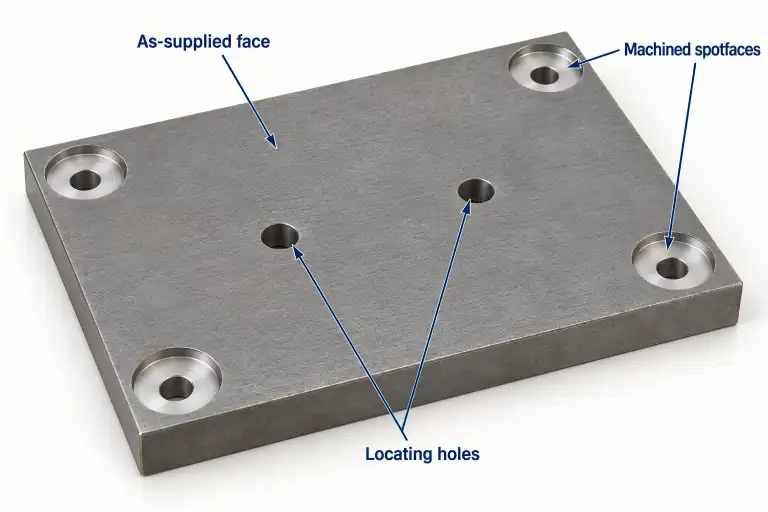
A retained surface still needs an acceptance requirement. “Leave as supplied” should not silently override the drawing’s general tolerances or finish notes.
反过来, machining every face does not make the stock condition irrelevant. More consistent blank dimensions may simplify loading, 夹紧, and roughing. The question is which benefit the proposed process will actually use.
Read the Delivered Condition Behind “Hot Rolled” and “Cold Rolled”
Hot rolling shapes steel at elevated temperature. Cold rolling applies further reduction at a lower temperature and can provide a smoother surface and closer dimensional control. These names describe processing routes; they do not identify a complete steel grade or final property specification.
Cold-rolled sheet is not necessarily supplied in its hardest condition. Nucor’s sheet product descriptions distinguish cold-rolled full-hard material from cold-rolled annealed material. Annealing changes the condition produced by cold reduction. A blanket statement that cold-rolled steel is always stronger than hot-rolled steel therefore misses the grade and delivered condition.
The same source identifies hot-rolled pickled-and-oiled stock. Pickling removes surface oxides, while oil is applied afterward. This remains a hot-rolled product. Removing scale does not turn it into cold-rolled stock or establish precision flatness.
For a flat blank, identify the actual product: cut sheet, 盘子, 条, or flat bar. Confirm the grade, applicable product specification, thickness range, 尺寸公差, 和供货条件. Do not assume that a thick flat bar and a piece cut from cold-rolled sheet were made by the same route.
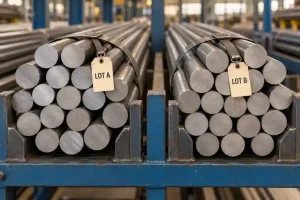
Bar quotations need particular care. Cold drawing, 转动, 磨削, and polishing are different operations that may be combined in a finishing route. Drawing changes the section by deformation; turning and grinding remove material. A bright bar surface does not establish the production route or the delivered condition.
If the real choice is between steel grades, make that decision separately. 这 1018 相对 1045 比较 addresses grade selection and hardening requirements rather than the value of a supplied surface.
Make the Finished Part Fit Inside the Usable Stock
Nominal blank thickness minus finished thickness is only an initial check. It does not establish that every required surface can be machined clean.
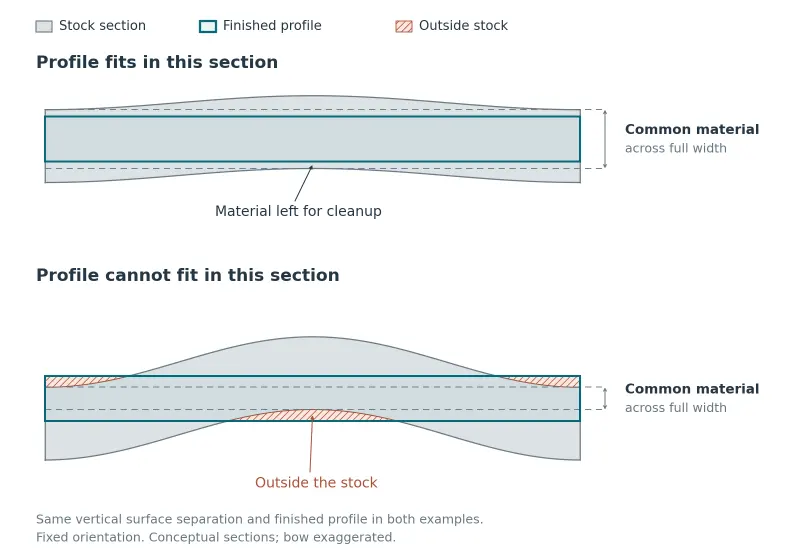
Review the smallest permitted incoming size, the blank’s shape over the relevant length and width, and the surfaces that must be removed. A plate may have enough thickness at each measured point but still require additional stock to produce two flat, parallel faces because the supplied surfaces are bowed.
同样地, a rounded original edge can leave a missing corner in the intended finished profile. Extra thickness does not necessarily solve a shortage of width. The finished part must fit inside the usable material in the actual setup, including the allowance needed for subsequent operations.
For scaled hot-rolled stock, removing loose scale is not the same as machining the underlying surface to the required condition. Any specified surface-defect or decarburization limits must also be considered where relevant. Do not assign one universal cleanup allowance to all grades, 尺寸, and product forms.
Cold-rolled stock needs this check too. A near-finished nominal thickness can leave too little material to correct shape or remove surface damage. Buying closer to size saves cutting only when the remaining allowance is sufficient.
Blank preparation also matters. Ask whether the piece is saw-cut, sheared, or thermally cut, and whether cut-edge effects need further removal. State which edges will remain and which will be machined.
The machining supplier should evaluate the proposed blank against the finished profile and setup plan. If the blank is marginal, review a larger size, a different supplied condition, or an approved change to which surfaces remain unmachined. Do not rely on clamping a distorted blank flat as proof that the finished part will fit after release.
Allow for Movement After Material Removal
Incoming dimensional accuracy and stability during machining are different questions.
Residual stresses can remain in steel after its manufacturing and finishing operations. Removing material changes their balance and can change the part’s shape. Cold processing, subsequent heat treatment, and straightening history all matter; the labels “hot rolled” and “cold rolled” alone do not predict the amount of movement.
For the mounting plate, a deep pocket on one side deserves review because it removes material unevenly and leaves a less rigid section. A supplier may need to rough the part, release and inspect it, then re-establish the setup before finishing. The need for that sequence depends on the actual blank, 几何学, 和宽容.
Stress relief may be useful for a suitable material and route, but it should be specified and reviewed rather than added automatically. Its effect on the required material condition and later finishing must be considered. Leaving a part on a bench is not a defined thermal stress-relief treatment.
Agree on the support and restraint used for final inspection. A flatness result obtained while forcing the part against a fixture may not represent its released shape. The broader CNC machining deformation guide covers workholding and machining controls in more detail.
Compare the Machining Each Stock Option Still Needs
Ask for the same finished part and acceptance scope from each proposed blank. The useful price comparison includes the work remaining after the stock arrives.
For the illustrative mounting plate, the review may lead to different routes:
- A broad face remains as supplied. An acceptable cold-rolled surface may eliminate face machining. Confirm that its thickness, 形状, and appearance are suitable before counting that saving.
- Both broad faces require full machining. Hot-rolled stock may remain competitive if cleanup and finishing allowances are adequate. Cold-rolled stock may still save roughing or setup work, but its original surface finish is no longer a finished-part benefit.
- Heavy one-sided removal controls the process. The supplied condition and movement after roughing may matter more than the initial surface appearance. Include any required intermediate inspection or additional finishing.
Identify stock preparation, blank yield, first-setup preparation, 粗加工, 精加工, and any required treatment in the comparison. These items need not become separate invoice lines, but they should not disappear from one supplier’s scope.
Confirm the actual available size and order quantity. An option that requires substantially more stock removal, a larger minimum purchase, or different blank preparation may change the finished-part comparison. Use current quotations; there is no universal price premium or saving percentage for these processing labels.
Before releasing an order, keep the accepted material grade and condition connected to the blank proposal. Identify the supplied faces permitted to remain, the finished surfaces that require full cleanup, and the dimensions that apply after all specified operations.
For a machining-stock review, send the finished drawing with the retained stock surfaces marked, the functional datums, and the candidate blank descriptions. Include supplied size limits, flatness or straightness requirements where relevant, and any planned treatment after roughing. Rapid Efficient can review how those choices affect stock allowance, 加工, and inspection through our 数控加工服务.