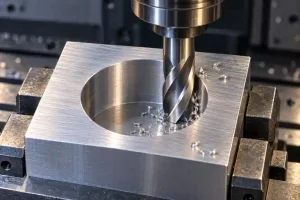

17-4 PH stainless steel is not just another stainless steel grade for CNC machining. It is a precipitation-hardening stainless steel used when a part needs higher strength, better hardness, wear resistance, and reasonable corrosion resistance in one material.
For CNC buyers, the most important question is not simply “Can 17-4 PH be machined?” The real question is:
Which heat treatment condition is required, and should the part be machined before or after hardening?
That decision affects tool wear, surface finish, dimensional stability, inspection strategy, and quotation risk. A 17-4 PH part in Condition A does not behave the same as one in H900 or H1150. If the RFQ does not define the required condition clearly, the supplier may quote the wrong process route, miss critical allowance, or deliver a part that does not match the final mechanical requirement.
What Is 17-4 PH Stainless Steel?
17-4 PH stainless steel is a precipitation-hardening stainless steel commonly identified by UNS S17400. The name “17-4” refers broadly to its chromium and nickel content, while “PH” means precipitation hardening.
Unlike common austenitic stainless steels such as 304 or 316, 17-4 PH can be strengthened through heat treatment. This makes it useful for shafts, pins, valve parts, mechanical housings, fixtures, structural components, and precision parts that require both strength and corrosion resistance.
In CNC machining, 17-4 PH is usually selected when 304 or 316 stainless steel is not strong enough, but the part still needs stainless corrosion behavior. It is not normally chosen just for easy machining or low cost. If machinability is the main concern, 303 or 304 may be easier choices. If high strength and controlled hardness matter more, 17-4 PH becomes more attractive.
For general stainless material behavior, process planning, and production risks, see our stainless steel CNC machining guide.
Why Heat Treatment Condition Matters Before Machining
The biggest mistake with 17-4 PH parts is treating all conditions as the same material. A drawing that only says “17-4 PH stainless steel” is incomplete for manufacturing.
The required condition may be:
| Condition | Typical Meaning for CNC Buyers | Machining Impact |
|---|---|---|
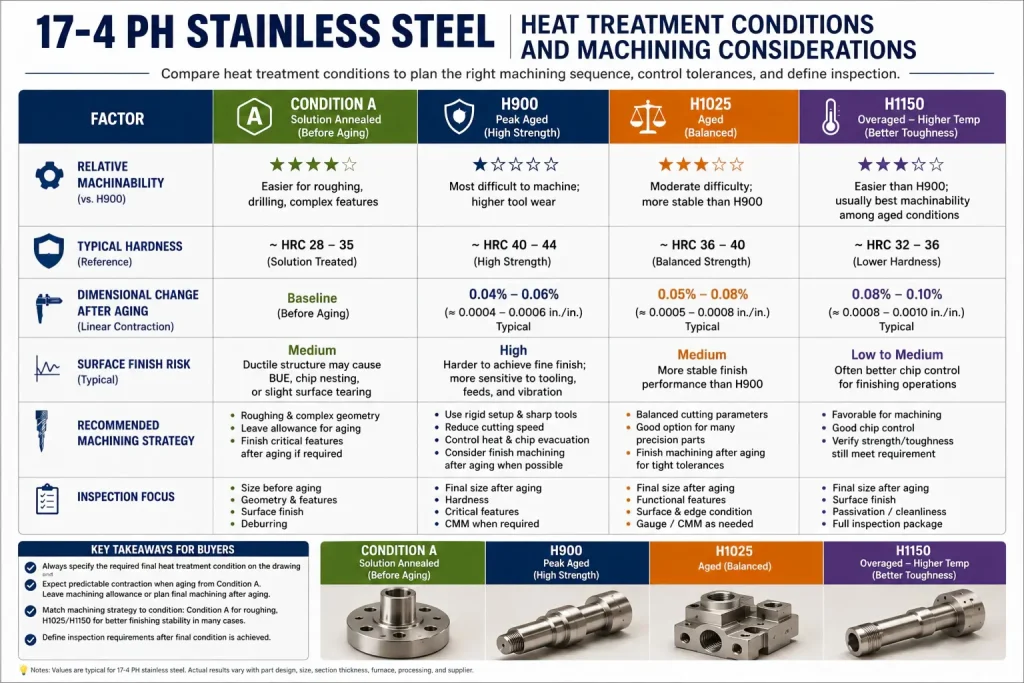
| Condition A | Solution annealed before aging | Often easier for rough machining, but final aging may cause dimensional change |
| H900 | High strength and high hardness | More difficult for tooling, finishing, and small features |
| H1025 / H1075 | Balanced strength and toughness | Often a practical compromise for machined components |
| H1150 | Lower hardness but better toughness and machinability | Easier than H900, but may not meet peak strength requirements |
The correct route depends on the part function. Some parts are machined close to final size in Condition A and then aged. Other parts are rough machined, heat treated, and then finish machined. For tight-tolerance parts, the machining plan should consider whether critical dimensions must be held before or after heat treatment.
This is why a 17-4 PH RFQ should always state the required heat treatment condition. If the condition is unknown, the buyer and supplier should clarify it before quotation.
Machining 17-4 PH in Condition A
Condition A is usually easier to machine than hardened 17-4 PH during roughing, drilling, and general stock removal. For many CNC parts, machining in Condition A can reduce tool load and improve production stability before final aging.
This route is often suitable when:
| Part Requirement | Why Condition A Machining May Help |
| Complex geometry | Easier cutting before hardening |
| Deep holes or small features | Lower cutting resistance helps process stability |
| Thin walls | Lower cutting forces may reduce distortion during machining |
| Lower-volume production | Faster setup and machining may reduce cost |
| Final aging required | Heat treatment can be completed after most machining is done |
However, machining in Condition A does not remove all risk. If the part is aged after machining, the final size may change slightly. For loose-tolerance components, this may be acceptable. For precision bores, bearing fits, sealing faces, or tightly controlled threaded features, the supplier may need to leave allowance for final machining or inspection after heat treatment.
Condition A also should not be treated as automatically better for every finishing requirement. Because the solution-treated structure can be more ductile, some finishing operations may experience chip nesting, built-up edge, or slight surface tearing if tooling, coolant, and cutting parameters are not controlled well.
In some aged conditions, especially higher aging-temperature conditions such as H1025, H1150, or H1150M, chip formation may become more stable for certain finishing operations. The trade-off is that the material condition, hardness, mechanical requirement, and final surface finish must all be reviewed together. For buyer drawings, the safest approach is to define the required final condition first, then let the machining route be planned around that requirement.
A safe drawing or RFQ should not only say “17-4 PH.” It should define the final condition and which dimensions are critical after heat treatment.
Machining 17-4 PH in H900, H1025, or H1150
Machining 17-4 PH after precipitation hardening is possible, but the condition changes the cutting behavior.
H900 provides high strength and hardness, but it is usually the most difficult common condition for machining. Tool wear increases, cutting speed may need to be reduced, and small tools become more vulnerable. Surface finish can still be good, but process control becomes more important.
H1025 and H1075 are often more balanced. They still provide high strength, but may be less severe than H900 for machining and mechanical performance trade-offs.
H1150 is usually more forgiving for machining compared with H900. It may also be preferred where toughness, stress-corrosion resistance, or reduced brittleness is more important than maximum hardness.
| Heat Treatment Condition | Machining Risk | Common Manufacturing Concern |
| H900 | Highest cutting difficulty among common aged conditions | Tool wear, small tool breakage, burr control, surface finish |
| H1025 | Medium-high | Balance of strength, toughness, and machining control |
| H1075 | Medium | Dimensional and surface consistency |
| H1150 | Lower than H900 | Confirm whether strength and hardness still meet the design requirement |
The condition should not be changed casually to make machining easier. If the drawing requires H900, quoting H1150 without approval may change the part’s mechanical performance. If H1150 is acceptable, the drawing or purchase requirement should state that clearly.
Tolerance and Dimensional Risk After Aging
17-4 PH is valued because its aging temperature is lower than many hardening treatments, but dimensional change can still matter. For tight-tolerance parts, the problem is not whether the change is large or small in general. The problem is whether it affects the features that actually control assembly.
For 17-4 PH, this dimensional change is not random. Published material data commonly notes predictable contraction during aging. When parts are heat treated from Condition A to H900, typical linear contraction is about 0.0004–0.0006 in./in., or approximately 0.04%–0.06%. For H1150, the contraction may be closer to 0.0008–0.0010 in./in., or approximately 0.08%–0.10%.
This may look small on a simple bracket, but it can matter on a long shaft, bearing bore, sealing diameter, or precision groove. If a 100 mm shaft diameter changes by even 0.04%–0.06%, the potential size shift is already large enough to affect many press fits, running fits, or final grinding allowances. For this reason, tight-tolerance 17-4 PH parts should define whether critical dimensions are controlled before aging, after aging, or after final finish machining.
Examples include:
| Feature | Why It Needs Review |
| Bearing bore | Small size change may affect press fit or running clearance |
| Shaft diameter | Final diameter may control rotation, sealing, or alignment |
| Threaded hole | Heat treatment after tapping may affect gauge acceptance |
| Flat sealing face | Distortion may affect leakage risk |
| Thin wall pocket | Stress release may change shape or flatness |
| Precision groove | Width and position may affect retaining rings or seals |
For simple parts, machining close to final size before aging may work. For precision parts, a better route may be rough machining, aging, finish machining, and final inspection.
The RFQ should mark which dimensions are critical after heat treatment. Without that, a supplier may inspect the part before aging and miss the final functional requirement.
For more tolerance planning, datum control, and inspection strategy, see our CNC machining tolerances guide.
Tooling, Cutting Strategy, and Surface Finish
17-4 PH is not the same as free-machining stainless steel. Tool selection and cutting strategy should consider hardness, workholding, feature size, and whether the material is machined before or after aging.
For milling, sharp carbide tools, stable workholding, and controlled engagement help reduce chatter and tool wear. For turning, rigidity is especially important for shafts, grooves, shoulders, and thin sections. For drilling and boring, heat and chip evacuation must be controlled because stainless materials can punish weak setups quickly.
Common machining concerns include:
| Machining Area | Risk | Practical Control |
| Milling pockets | Chatter and edge wear | Rigid setup, suitable cutter geometry, controlled radial engagement |
| Turning shafts | Runout and surface finish variation | Stable support, correct tool nose radius, controlled cutting pressure |
| Drilling | Heat buildup and poor chip evacuation | Pecking strategy, coolant access, suitable drill geometry |
| Boring | Taper or poor roundness | Rigid boring bar, stable cutting parameters |
| Threading | Burrs and gauge failure | Correct thread process, deburring, GO/NO-GO inspection |
| Thin walls | Deflection during cutting | Balanced stock removal and controlled clamping |
Surface finish should also be specified realistically. A very fine finish on hardened 17-4 PH may require slower finishing passes, tool changes, grinding, polishing, or additional inspection. If the surface controls sealing, sliding, fatigue, or corrosion behavior, it should be marked clearly on the drawing.
Post-machining passivation also needs careful control for 17-4 PH stainless steel. Because 17-4 PH is a chromium-nickel-copper precipitation-hardening alloy, the passivation process should not be treated as a generic stainless steel cleaning step. Acid type, bath temperature, immersion time, surface cleanliness, and previous heat treatment condition can all affect the final surface appearance and corrosion performance.
Nitric acid and citric acid passivation may both be used under suitable specifications, but neither should be selected casually. Poorly controlled passivation can lead to discoloration, dull surface areas, staining, or localized attack, especially on precision sealing faces or cosmetic surfaces. If passivation is required, the RFQ should state the required standard, surface finish expectation, inspection requirement, and whether visual appearance is functionally important.
For finish options, roughness callouts, bead blasting, passivation, polishing, plating, and coating considerations, see our CNC surface finishes guide.
Burrs, Edges, and Small Features
17-4 PH parts often include functional edges: grooves, threads, keyways, bores, slots, and sealing transitions. These are exactly the areas where burrs can cause assembly problems.
Burr risk is higher when the part has:
| Feature | Burr Concern |
| Cross holes | Internal burrs may block flow or affect assembly |
| Small tapped holes | Thread burrs may cause gauge failure |
| Thin slots | Edge rollover may change functional width |
| Sharp shoulders | Burrs may interfere with mating parts |
| Sealing grooves | Burrs may damage O-rings or sealing surfaces |
| Bearing seats | Raised edges may affect fit and alignment |
A drawing should define which edges require deburring, edge break, chamfer, or burr-free control. “Remove sharp edges” is sometimes not enough for precision parts. If the edge is functional, the requirement should be more specific.
For example:
| Weak Note | Better Manufacturing Note |
| Remove burrs | Remove burrs from all threaded holes and cross holes |
| Break edges | Edge break 0.1–0.3 mm unless otherwise specified |
| No sharp edges | Burr-free sealing grooves and bearing shoulders |
| Deburr part | No raised burrs allowed on mating face A |
This helps the supplier inspect the feature that matters, instead of treating deburring as a cosmetic operation only.
For design notes related to holes, threads, walls, internal radii, functional edges, and machining feasibility, see our CNC machining design guide.
17-4 PH vs 304 and 316 Stainless Steel for CNC Parts
17-4 PH should not automatically replace 304 or 316 stainless steel. Each grade has a different role.
| Material | Best Used When | CNC Buyer Warning |
| 304 stainless steel | General corrosion resistance and cost balance | Lower strength than 17-4 PH |
| 316 stainless steel | Better chloride corrosion resistance than 304 | Not selected for precipitation hardening |
| 17-4 PH stainless steel | Higher strength, hardness, and wear resistance are needed | Heat treatment condition must be defined |
| 303 stainless steel | Machinability is more important than corrosion resistance | Not suitable for all corrosion or strength needs |
If the part only needs general corrosion resistance, 304 or 316 may be enough. If the part needs higher strength, wear resistance, or controlled hardness, 17-4 PH may be worth reviewing.
For buyers, the key is to avoid choosing 17-4 PH only because it sounds stronger. The heat treatment condition, cost, machining route, and inspection plan must match the part’s function.
Typical CNC Parts Made from 17-4 PH Stainless Steel
17-4 PH is often considered for parts that combine strength, dimensional control, and stainless corrosion behavior. The final choice still depends on load, environment, heat treatment condition, and inspection requirements.
| Part Type | Why 17-4 PH May Be Selected | Manufacturing Point to Review |
| Shafts and pins | Strength, wear resistance, and dimensional stability | Diameter, runout, surface finish, and final hardness |
| Valve components | Strength and corrosion resistance | Sealing faces, grooves, threads, and passivation |
| Mechanical housings | Stronger stainless option for loaded structures | Flatness, threaded holes, and heat treatment timing |
| High-load brackets | Higher strength than standard stainless grades | Material certificate, final condition, and inspection scope |
| Pump or fluid control parts | Stainless corrosion behavior with better strength | Internal burrs, sealing faces, and surface finish |
| Precision fixtures | Hardness and repeatable location surfaces | Datum surfaces, bores, and wear areas |
For turned shafts, pins, threaded components, and round precision parts, the review should also include workholding, concentricity, shoulder locations, and burr control. See our CNC turning parts guide for more turning-specific design and inspection points.
Inspection Points for 17-4 PH CNC Parts
Inspection should match the manufacturing route. If the part is heat treated after machining, the final inspection should confirm critical features after the final condition is reached.
Important inspection items may include:
| Feature Type | Suggested Inspection Focus |
| Precision bore | Diameter, roundness, position, final fit |
| Shaft feature | Diameter, runout, shoulder location, surface finish |
| Threaded hole | GO/NO-GO gauge, depth, burr condition |
| Flat face | Flatness, parallelism, surface finish |
| Groove | Width, depth, edge condition |
| Heat-treated part | Final condition, hardness requirement, critical dimensions after aging |
| Functional surface | Roughness, burrs, scratches, coating or passivation impact |
CMM inspection may be useful for GD&T features, true position, parallelism, perpendicularity, or complex datum structures. Manual tools may still be enough for simple dimensions, but they may not capture geometric relationships that affect assembly.
If a buyer needs a CMM report, hardness record, material certificate, or inspection report, these should be requested before quotation.
RFQ Checklist for 17-4 PH Stainless Steel Machining
A clear RFQ can prevent most 17-4 PH problems before production starts.
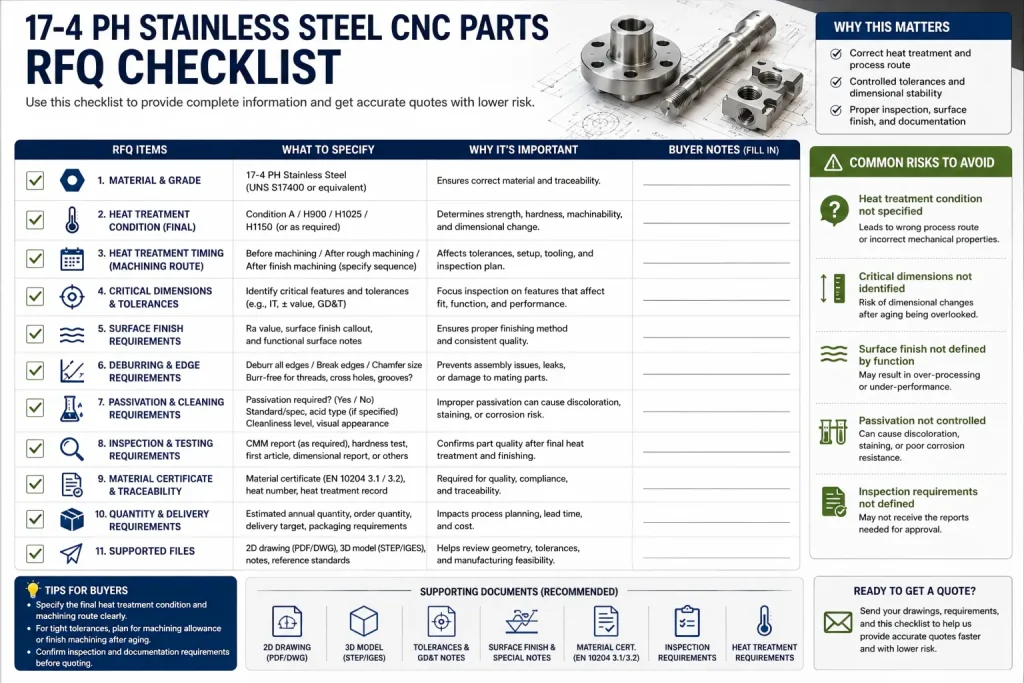
Before sending a quotation request, include:
| RFQ Item | Why It Matters |
| Material grade | Confirms 17-4 PH / UNS S17400 or equivalent |
| Heat treatment condition | Defines final mechanical requirement |
| Heat treatment timing | Clarifies before machining, after machining, or between roughing and finishing |
| 2D drawing | Shows tolerances, datums, threads, finish, and inspection notes |
| STEP file | Helps review geometry, tool access, and machining strategy |
| Critical dimensions | Identifies features that must be controlled after final condition |
| Surface finish requirement | Prevents mismatch between machined finish and functional finish |
| Deburring requirement | Controls threads, grooves, holes, and mating edges |
| Passivation requirement | Clarifies acid type, standard, visual expectation, and inspection scope |
| Inspection report requirement | Defines CMM, hardness, or dimensional report needs |
| Material certificate | Helps confirm material traceability when required |
| Quantity and delivery target | Affects machining route, fixture planning, and cost |
If the heat treatment condition is missing, the quote may look cheaper but carry more risk. The supplier may quote a machining route that does not match the final part requirement.
For broader RFQ preparation, drawing information, tolerance notes, inspection expectations, and quote planning, review our manufacturing FAQ.
Common Mistakes When Buying 17-4 PH CNC Parts
The most common problems are not caused by the material itself. They come from unclear requirements.
| Mistake | Possible Result |
| Drawing only says “17-4 PH” | Supplier does not know the required final condition |
| Heat treatment condition is changed without approval | Part may not meet strength or toughness requirement |
| Critical dimensions are inspected before aging only | Final assembly fit may fail |
| H900 is requested for every part by default | Machining cost and brittleness risk may increase unnecessarily |
| Surface finish is specified without function | Supplier may overprocess or underprocess the surface |
| Passivation is treated as a generic cleaning step | Discoloration, dull areas, staining, or localized attack may occur |
| Burr-free requirement is not defined | Internal holes, threads, or grooves may create assembly issues |
| No inspection scope is requested | Buyer may not receive the report needed for acceptance |
A good 17-4 PH machining project starts with a clear conversation about final condition, functional features, surface treatment, and inspection evidence.
When Should You Choose 17-4 PH Stainless Steel?
17-4 PH may be a good choice when the part needs:
| Requirement | Why 17-4 PH May Help |
| Higher strength than 304 or 316 | Precipitation hardening can increase mechanical performance |
| Wear resistance | Higher hardness can improve sliding or contact behavior |
| Stainless corrosion behavior | Useful where carbon steel is not acceptable |
| Precision machined geometry | CNC machining can produce complex functional features |
| Controlled heat treatment | Final condition can be matched to strength or toughness needs |
It may not be the best choice when:
| Situation | Better Review |
| Lowest machining cost is the priority | 303, 304, or aluminum may be easier |
| Severe chloride corrosion is expected | 316 or other corrosion-resistant alloys may need review |
| No heat treatment requirement is known | Material selection is incomplete |
| Very fine features require easy machining | Condition and process route must be checked carefully |
| The part only needs basic corrosion resistance | 304 or 316 may be enough |
Material selection should match the real load, environment, tolerance, and inspection requirement.
How Rapid Efficient Supports 17-4 PH Stainless Steel CNC Parts
Rapid Efficient can review 17-4 PH stainless steel CNC projects before quotation, including material grade, heat treatment condition, machining route, tolerance risks, surface finish, passivation requirement, deburring notes, and inspection requirements.
For precision 17-4 PH parts, we can help check whether the drawing should define Condition A, H900, H1025, H1150, or another required condition. We can also review which dimensions may need final inspection after heat treatment, which features may require CMM inspection, and whether material certificates or inspection reports should be included in the RFQ.
If you are sourcing shafts, pins, housings, fittings, threaded components, or other 17-4 PH stainless steel parts, send us your STEP file, 2D drawing, quantity, heat treatment requirement, surface finish notes, passivation requirement, and inspection expectations. Our team can review the machining and delivery requirements before quotation.
FAQ
Is 17-4 PH stainless steel easy to machine?
17-4 PH stainless steel can be machined, but machinability depends strongly on the heat treatment condition. Condition A is often easier for rough machining and general stock removal, while some aged conditions may provide more stable chip control for certain finishing operations. Hardened 17-4 PH may require slower cutting, stronger tooling, and more careful process control.
Should 17-4 PH be machined before or after heat treatment?
It depends on the tolerance and part function. Many parts can be machined in Condition A and then aged. Tight-tolerance features may require rough machining, heat treatment, finish machining, and final inspection.
What does H900 mean for 17-4 PH stainless steel?
H900 is a precipitation-hardened condition that provides high strength and hardness. It may also increase machining difficulty compared with Condition A or higher aging temperature conditions such as H1025 or H1150.
Does 17-4 PH shrink during heat treatment?
Yes. 17-4 PH can show predictable contraction during aging. Published material data commonly notes about 0.0004–0.0006 in./in. contraction from Condition A to H900 and about 0.0008–0.0010 in./in. for H1150. Tight-tolerance features should be reviewed after final heat treatment when required.
Is 17-4 PH better than 316 stainless steel?
17-4 PH is better when higher strength and hardness are required. 316 stainless steel is often preferred when corrosion resistance, especially in chloride environments, is more important than precipitation-hardened strength. The better choice depends on load, environment, machining, and inspection requirements.
Can 17-4 PH stainless steel be passivated?
Yes, 17-4 PH stainless steel parts may be passivated when required. The buyer should confirm the passivation standard, acid type if specified, surface finish, cleaning expectation, visual requirement, and any inspection or documentation needed after finishing.
What should be included in a 17-4 PH machining RFQ?
A good RFQ should include the material grade, required heat treatment condition, STEP file, 2D drawing, tolerance notes, surface finish, deburring requirements, passivation requirements, quantity, inspection report needs, and whether material certificates are required.