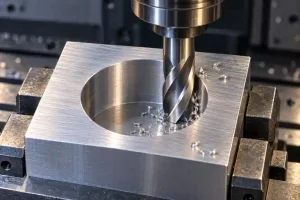

Phosphor bronze and brass are both copper alloys, but they are not interchangeable materials.
Brass is usually easier to machine and more cost-effective for general CNC parts. Phosphor bronze is usually better when the part needs spring behavior, fatigue resistance, wear resistance, low friction, or reliable electrical contact under repeated loading.
The practical difference is this:
Choose brass when machinability, cost, appearance, general conductivity, and easy production are the main priorities. Choose phosphor bronze when the part must flex, slide, wear, maintain contact force, or survive repeated mechanical stress.
For CNC buyers, the mistake is not choosing one material over the other. The mistake is writing “bronze” or “brass” too generally on a drawing without defining the exact alloy grade, temper, lead-free requirement, contact function, wear surface, or inspection boundary.
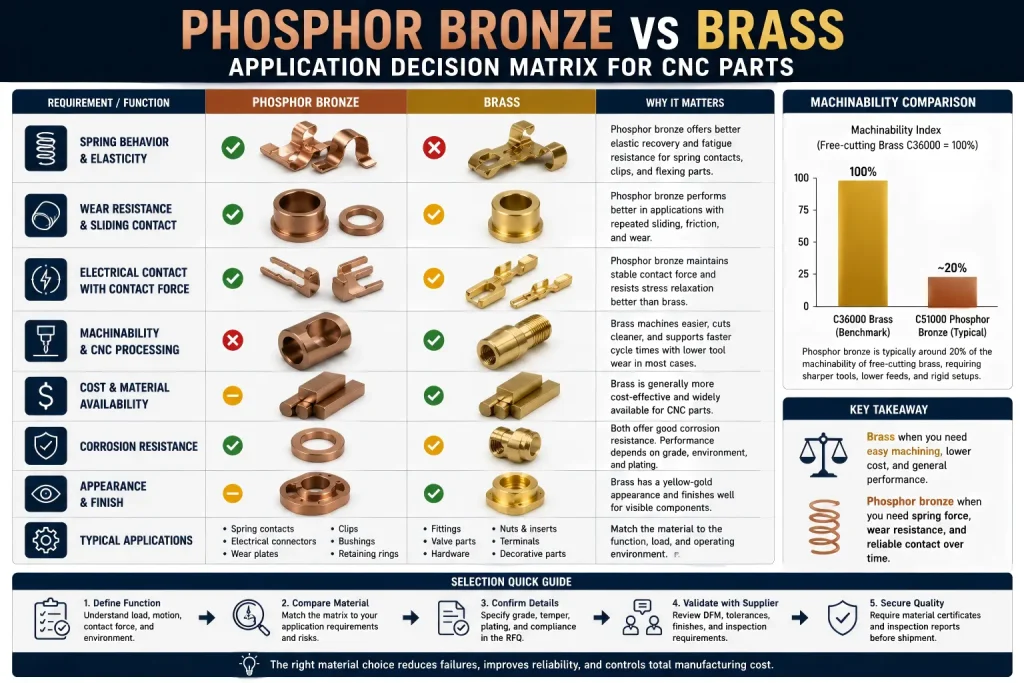
Fast Decision Matrix for Buyers
| Requirement | Better Starting Choice | Why It Matters |
|---|---|---|
| Lowest machining cost | Brass | Many brass grades machine efficiently and produce clean chips. |
| High-speed CNC turning | Brass | Free-machining brass is commonly used for turned fittings, inserts, nuts, and small components. |
| Spring contact or repeated flexing | Phosphor bronze | Better fatigue behavior and elastic performance than most common brasses. |
| Wear surface or sliding contact | Phosphor bronze | Often better for bushings, clips, sliding contacts, and low-friction parts. |
| Decorative appearance | Brass | Brass has a recognizable yellow-gold appearance and finishes well. |
| Electrical contact with contact force | Phosphor bronze | Useful when conductivity and mechanical spring pressure both matter. |
| Simple threaded parts | Brass | Easier machining and stable threading in many grades. |
| Lead-free requirement | Depends on grade | Do not assume all brass or bronze grades are lead-free. |
| High strength with corrosion resistance | Phosphor bronze | Can offer better strength and wear performance than common brass grades. |
| General hardware with moderate loads | Brass | Usually more economical and easier to source. |
The quick rule:
Brass is often the production-friendly choice. Phosphor bronze is often the performance-driven choice.
What Is Brass?
Brass is a copper-zinc alloy. Different brass grades may also contain lead, tin, iron, aluminum, manganese, or other elements depending on the required machinability, strength, corrosion resistance, or forming behavior.
For CNC machining, brass is often selected because it can offer:
- good machinability
- clean chip formation in suitable grades
- attractive appearance
- reasonable corrosion resistance
- good electrical and thermal conductivity
- stable dimensional machining
- good threading behavior
- broad material availability
- lower cost than many bronze alloys
Common CNC brass applications include:
- threaded inserts
- nuts
- fittings
- valve components
- electrical terminals
- decorative parts
- bushings for light-duty use
- instrument components
- small turned parts
- connectors and hardware
Brass is not one single material. C360 free-machining brass, naval brass, cartridge brass, lead-free brass, and forging brass can behave differently. Buyers should specify the grade instead of only writing “brass” on a drawing.
For a broader comparison between brass and copper, see difference between brass and copper.
What Is Phosphor Bronze?
Phosphor bronze is a copper-tin-phosphorus alloy. Tin helps improve strength and corrosion resistance, while phosphorus is used as a deoxidizer and can contribute to wear resistance, stiffness, and fatigue behavior depending on the alloy and temper.
Phosphor bronze is often selected when a part needs:
- spring behavior
- fatigue resistance
- wear resistance
- low-friction sliding contact
- good corrosion resistance
- stable electrical contact force
- good formability in strip or spring forms
- better performance under repeated loading
Common phosphor bronze applications include:
- spring contacts
- electrical connectors
- switch parts
- clips
- washers
- bushings
- wear plates
- bearing-like components
- sliding elements
- precision stamped parts
- small CNC components with repeated contact or movement
For CNC parts, phosphor bronze is usually not chosen only because it is “bronze.” It is chosen because the part needs a specific combination of strength, wear, fatigue, and contact reliability.
Main Difference: Machinability vs Mechanical Performance
The biggest difference between phosphor bronze and brass is not color. It is the trade-off between machinability and performance.
Brass is usually easier to machine. In suitable grades, it cuts cleanly, holds detail well, and supports efficient turning, drilling, threading, and milling. This makes it attractive for precision hardware and high-volume turned parts.
Phosphor bronze can be more demanding. It may be tougher, more abrasive on tools, and less forgiving than free-machining brass. However, it can provide better spring behavior, wear resistance, fatigue performance, and durability in moving or loaded contact applications.
| Factor | Brass | Phosphor Bronze |
| CNC machinability | Usually easier | Usually more demanding |
| Tool wear | Usually lower | Can be higher |
| Chip control | Often cleaner in free-machining grades | More dependent on grade and condition |
| Cost | Usually lower | Usually higher |
| Wear resistance | Moderate, grade-dependent | Often better |
| Spring behavior | Limited in common brass grades | Usually better |
| Fatigue resistance | Moderate | Often better |
| Electrical contact reliability | Good for simple terminals | Better when spring force matters |
| Cosmetic appearance | Yellow-gold brass appearance | Reddish-brown bronze tone |
| RFQ risk | Grade and lead content | Grade, temper, and function |
If the part is just a simple threaded fitting, brass may be the better choice. If the part is a spring clip, wear bushing, sliding contact, or connector that must maintain pressure, phosphor bronze may be the safer material.
When Brass Is the Better Choice
Brass is often better when the part needs fast machining, lower cost, good appearance, and stable general performance.
Choose brass when:
- the part is a fitting, insert, nut, spacer, or connector
- the design has many threads
- high-speed CNC turning matters
- cost control is important
- the part does not need spring behavior
- the part does not carry heavy sliding wear
- the contact pressure is not fatigue-critical
- the application needs a brass appearance
- the drawing already specifies a known brass grade
- lead-free or RoHS-compliant brass can be specified when needed
Brass is especially useful for small turned parts because many brass grades cut efficiently and can produce clean surfaces with lower cutting forces.
However, brass selection still needs control. A buyer should not only say:
Brass material
A better RFQ note is:
Brass C360, or lead-free brass if RoHS compliance is required. Confirm material certificate before production.
If the product is used in electronics, drinking water, medical devices, food equipment, or regulated markets, lead content and material compliance should be reviewed before ordering.
For more machining-specific considerations, see the brass machining guide.
When Phosphor Bronze Is the Better Choice
Phosphor bronze is often better when the part must perform mechanically over time.
Choose phosphor bronze when:
- the part works as a spring contact
- the part bends or flexes repeatedly
- contact force must remain stable
- sliding wear resistance matters
- the part touches another moving component
- fatigue resistance matters
- corrosion resistance is important
- the part acts as a clip, contact, washer, or bushing
- the part cannot lose tension after repeated use
- the design needs both conductivity and mechanical resilience
Phosphor bronze can be a better choice for connector contacts, spring fingers, retaining clips, low-friction sliding parts, and wear-related CNC components.
When phosphor bronze is specified for spring-loaded or flexing components, the material temper can be just as important as the alloy grade. A drawing that only says “C510 phosphor bronze” may still leave room for the wrong mechanical condition.
Phosphor bronze spring behavior is strongly influenced by cold working and temper condition. If the material is too soft for the intended function, spring fingers, clips, or contact arms may deform permanently during assembly or repeated use.
For CNC parts that must flex, hold contact pressure, or resist fatigue, the RFQ should confirm the required temper or mechanical property range before production. Cold-worked tempers such as hard or spring conditions may be reviewed when the part needs elastic recovery, but the final choice should match the drawing, forming requirement, machining route, and functional load.
A better RFQ note is:
Phosphor bronze grade and temper to be confirmed before production. Spring function and contact force must be reviewed before material purchase.
This helps prevent a common purchasing mistake: selecting the right alloy family but the wrong material condition.
But phosphor bronze is not automatically better for every copper-alloy part. If the part is simple, thick, non-flexing, and cost-sensitive, brass may be more practical.
The right question is not:
Which material is stronger?
The better question is:
What failure mode are we trying to prevent: machining cost, wear, fatigue, contact force loss, corrosion, or assembly failure?
Wear Resistance and Sliding Contact
Wear resistance is one of the strongest reasons to choose phosphor bronze over brass.
In sliding or repeated contact applications, phosphor bronze may provide better resistance to wear, galling, and surface damage than common brass grades. This is why it is often considered for bushings, washers, clips, sliding electrical contacts, and bearing-like components.
Brass can still work in light-duty wear applications, especially when cost and machinability matter. But if the part must survive repeated sliding, pressure, vibration, or contact movement, phosphor bronze should be reviewed.
| Application | Brass Risk | Phosphor Bronze Advantage |
| Sliding washer | May wear faster under repeated motion | Better wear resistance. |
| Electrical contact spring | May lose contact pressure if not suitable | Better spring behavior and fatigue resistance. |
| Light bushing | Can work in moderate conditions | Better for higher wear demand. |
| Moving clip | May deform or relax depending on grade | Better elastic performance. |
| Precision mating surface | Easy to machine | More durable contact surface. |
For wear-related parts, the RFQ should define the mating material, load, motion type, lubrication condition, surface finish, and expected life. Without this context, material selection becomes guesswork.
Electrical Conductivity vs Contact Reliability
Both brass and phosphor bronze can be used in electrical applications, but they solve different problems.
Brass can be useful for:
- terminals
- connectors
- threaded electrical hardware
- conductive fittings
- grounding parts
- cost-sensitive electrical components
Phosphor bronze is often selected when the electrical function also requires mechanical spring behavior, such as:
- contact fingers
- spring terminals
- switch contacts
- connector clips
- sliding contacts
- battery contacts
- stamped electrical parts
In many electrical parts, the most important feature is not only conductivity. It is the ability to maintain contact pressure over repeated use.
A highly conductive part that loses spring force may fail electrically. A slightly lower conductivity material with better elastic behavior may perform better in a real connector or contact application.
Another important factor is stress relaxation resistance. In an electrical contact, the part does not only need to conduct current. It must also maintain enough mechanical pressure at the contact interface over time.
Under continuous deflection, vibration, or elevated operating temperature, some copper alloys may gradually lose part of their initial clamping force. When contact force drops, interface resistance can increase, which may cause unstable signals, heat buildup, or contact reliability problems.
This is one reason phosphor bronze is often reviewed for spring contacts, socket pins, leaf springs, clips, and battery terminals. Its combination of spring behavior, fatigue resistance, and stress relaxation resistance can make it more reliable than common brass in applications where contact pressure must remain stable over repeated operating cycles.
Brass may still be suitable for many electrical terminals, threaded conductive parts, and low-stress hardware. But when the design depends on long-term spring force, phosphor bronze is usually the safer material to evaluate.
For electrical contact parts, buyers should define:
- current requirement
- contact force
- spring function
- plating requirement
- mating material
- wear cycle
- operating environment
- compliance requirement
Do not choose phosphor bronze or brass only by color or generic conductivity assumptions.
CNC Machining Behavior
Brass is generally more CNC-friendly than phosphor bronze, especially in free-machining grades.
Brass may offer:
- clean chip breaking
- lower cutting force
- good drilled holes
- stable threading
- good turned surface finish
- fast cycle times
- lower tool wear
Phosphor bronze may require more attention to:
- tool sharpness
- tool wear
- cutting speed
- chip control
- workholding
- burr formation
- heat control
- small feature stability
- surface finish consistency
This does not mean phosphor bronze is difficult in every case. It means the machining strategy should match the grade, condition, feature size, and tolerance requirement.
The machining cost difference is not only a supplier preference. It comes from a real processing gap between free-machining brass and phosphor bronze.
Free-cutting brass such as C36000 is commonly used as a machinability benchmark at 100%. Standard C51000 phosphor bronze is often listed around a 20% machinability rating. This lower rating means slower cutting conditions, higher tool attention, and more careful process control may be needed.
One reason is that phosphor bronze does not machine like leaded free-cutting brass. Without the same free-machining behavior, cutting forces can be higher, tool wear can increase, and chip control may become more sensitive.
This matters most on thin-walled contacts, small clips, slender pins, precision slots, and burr-sensitive edges. If the part is small or flexible, higher cutting resistance may contribute to tool deflection, vibration, burr formation, or dimensional variation.
For phosphor bronze CNC parts, suppliers may need sharper tools, rigid workholding, controlled feeds and speeds, and careful deburring planning to maintain stable quality across the batch.
For precision phosphor bronze CNC parts, suppliers may review:
- whether the part is milled, turned, or stamped
- material temper
- wall thickness
- burr-sensitive edges
- thread depth
- thin spring features
- flatness after machining
- surface finish and plating requirement
- inspection method
For broader copper-alloy machining behavior, see the CNC machining materials guide and copper CNC machining.
Burrs, Edges, and Small Features
Both brass and phosphor bronze can form burrs, but the risk is different.
Brass often machines cleanly in suitable grades, but burrs can still form around holes, slots, thin walls, threads, and milled exits.
Phosphor bronze may create tougher burrs or edge deformation depending on grade, temper, and cutting conditions. This matters for small contacts, clips, thin spring features, and precision slots.
Burrs are especially important when the part has:
- small holes
- threaded holes
- spring arms
- thin fingers
- connector slots
- sliding surfaces
- mating faces
- plated or coated surfaces
- user-contact edges
- internal passages
A burr on a simple spacer may be easy to remove. A burr on a spring contact edge may change contact behavior or create a scratch risk.
For edge control planning, see what is deburring.
Surface Finish, Plating, and Appearance
Brass and phosphor bronze have different natural colors and finishing behavior.
Brass has a yellow-gold appearance and is often used when the visible metallic color matters. It can be polished, brushed, plated, or passivated depending on the application.
Phosphor bronze usually has a darker reddish-brown bronze tone. It may also be plated for electrical contact, corrosion resistance, solderability, wear, or appearance.
Surface finishing risks include:
- visible machining marks
- polishing variation
- plating thickness buildup
- burrs before plating
- color mismatch between batches
- contact surface performance
- masking requirements
- solderability requirement
- corrosion testing requirement
For electrical or connector applications, plating may matter more than the base material appearance. Nickel, tin, silver, or gold plating may be specified depending on the contact function and cost.
A buyer should not only specify:
Phosphor bronze, plated
A better note is:
Phosphor bronze C510, temper to be confirmed, tin plating on contact area, no burrs on contact edge, certificate required.
For finishing options, see the CNC surface finishes guide.
Cost and Availability
Brass is usually more cost-effective and widely available for CNC machining.
Phosphor bronze is usually more expensive because of alloy content, material availability, performance requirements, and machining difficulty. Some phosphor bronze grades may also have longer lead times or more limited stock forms.
Cost differences may come from:
- raw material price
- alloy grade
- material form
- temper
- machining time
- tool wear
- burr control
- plating requirement
- inspection requirement
- certificate requirement
- minimum order quantity
If the part does not need the spring, wear, fatigue, or contact performance of phosphor bronze, brass may be the more practical choice.
If the part fails because brass cannot hold contact force or wear resistance, the cheaper material becomes expensive later.
The best material is the one that controls the real failure mode.
Lead, RoHS, and Material Compliance
Lead content is an important purchasing risk in brass and some copper alloys.
Many free-machining brass grades use lead to improve machinability. This can be acceptable for some industrial parts, but it may be restricted in electronics, consumer products, medical devices, food-contact equipment, drinking water systems, or regulated markets.
Phosphor bronze is often selected for electrical and spring applications, but buyers should still confirm the exact grade and compliance requirement.
Do not assume:
- all brass is lead-free
- all bronze is lead-free
- all copper alloys are RoHS-compliant
- a supplier can substitute a similar copper alloy without approval
- material certificates are automatically included
Better RFQ notes include:
Lead-free material required.
RoHS compliance required.
Material certificate required with shipment.
No material substitution without written approval.
Confirm grade and temper before production.
Compliance risk is usually easier to prevent before quotation than after parts are machined.
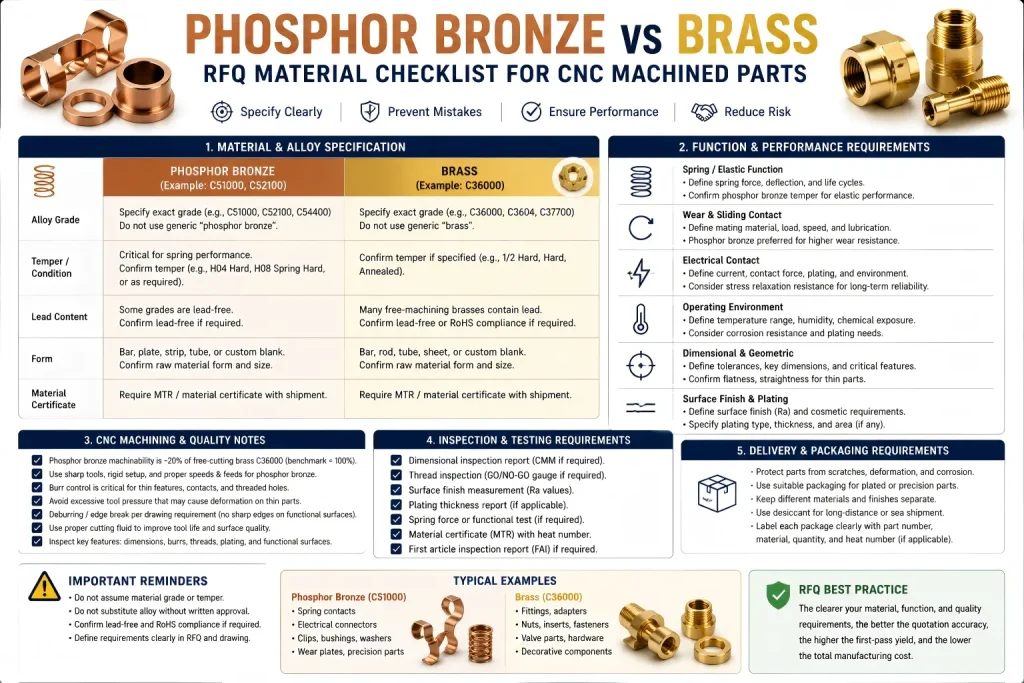
RFQ Notes That Prevent Material Selection Mistakes
| Buyer Requirement | Better RFQ or Drawing Note |
| General brass part | Specify exact brass grade, not only “brass.” |
| Free-machining brass | Confirm lead content and compliance requirement. |
| Lead-free requirement | Lead-free brass or suitable copper alloy required. |
| Spring contact | Phosphor bronze grade and temper must be confirmed. |
| Wear surface | Define mating material, motion, load, lubrication, and surface finish. |
| Electrical contact | Define contact force, plating, conductivity, and inspection requirement. |
| Cosmetic brass part | Define visible surfaces and finish direction. |
| Threaded brass part | Define thread class, burr removal, and gauge inspection if required. |
| Phosphor bronze thin feature | Review flatness, burr risk, and distortion after machining. |
| Plated contact part | Define plating type, thickness, masking, and contact area. |
| Material certificate | MTR or material certificate required before shipment. |
| No substitution | No alloy substitution without written approval. |
| Temper-sensitive spring part | Confirm phosphor bronze temper and spring function before material purchase. |
| Contact reliability requirement | Review stress relaxation, contact pressure, plating, and operating temperature. |
A good RFQ does not just ask for material. It explains what the material must do.
Phosphor Bronze vs Brass by Application
| Application | Better Choice | Reason |
| CNC threaded insert | Brass | Easy machining, cost-effective, good threading. |
| Electrical spring contact | Phosphor bronze | Better contact force and fatigue behavior. |
| Decorative knob or fitting | Brass | Better yellow-gold appearance. |
| Sliding washer | Phosphor bronze | Better wear and sliding performance. |
| Low-cost spacer | Brass | Cost and machinability. |
| Connector clip | Phosphor bronze | Elastic performance and contact reliability. |
| Valve fitting | Brass | Common, machinable, and widely available. |
| Precision bushing | Phosphor bronze | Better wear resistance when load and motion matter. |
| Simple terminal block | Brass | Practical for many electrical hardware parts. |
| Battery contact | Phosphor bronze | Useful when spring pressure matters. |
| Cosmetic cover part | Brass | Better decorative metallic appearance. |
| Fatigue-loaded thin arm | Phosphor bronze | Better repeated flexing behavior. |
This table is only a starting point. Final selection should depend on load, tolerance, contact pressure, environment, finish, and compliance requirements.
Inspection Considerations
Inspection for brass and phosphor bronze CNC parts should match the material function.
For brass parts, common inspection points include:
- thread quality
- dimensional accuracy
- surface finish
- burr removal
- cosmetic appearance
- plating quality if specified
- lead-free or compliance documentation if required
For phosphor bronze parts, inspection may also need to check:
- spring feature geometry
- contact area condition
- flatness
- burrs on thin edges
- wear surfaces
- plating on contact zones
- material temper
- part distortion after machining
- functional fit or contact pressure if required
For tight tolerance parts, inspection should be planned before machining and finishing. See the CNC machining tolerances guide for broader tolerance planning.
Buyer Questions Before Quotation
Is phosphor bronze stronger than brass?
Often, phosphor bronze provides better strength, fatigue resistance, and spring behavior than many common brass grades. But the exact answer depends on the alloy grade, temper, form, and application.
Is brass easier to machine than phosphor bronze?
Usually yes. Many brass grades are easier to machine and more cost-effective than phosphor bronze. Standard C51000 phosphor bronze is often listed around a much lower machinability rating than free-cutting brass, so tool selection and process control may need more attention.
Is phosphor bronze better for electrical contacts?
It can be better when the contact must maintain spring force or survive repeated flexing. Brass can still work for many terminals and conductive hardware parts, but phosphor bronze is often preferred for spring contacts and connector clips.
Why does temper matter for phosphor bronze?
Temper affects strength, elasticity, spring behavior, and fatigue performance. If a spring contact is made from the wrong temper, it may not hold contact pressure as expected. The grade and temper should be confirmed before production.
What is stress relaxation in electrical contacts?
Stress relaxation is the gradual loss of clamping force under continuous deflection, vibration, or heat. In electrical contacts, lower clamping force can increase contact resistance. This is one reason phosphor bronze is often reviewed for spring contacts and battery terminals.
Is brass cheaper than phosphor bronze?
Usually yes. Brass is commonly more economical and easier to source. Phosphor bronze is often selected when the performance benefit justifies the higher material and machining cost.
Can brass replace phosphor bronze?
Sometimes, but not when the part depends on spring force, fatigue resistance, wear resistance, or repeated sliding contact. Material substitution should be approved before production.
Can phosphor bronze replace brass?
Sometimes, but it may increase cost and machining complexity. If the part only needs simple machining, general conductivity, or a decorative yellow appearance, brass may be better.
Which is better for bushings?
For light-duty and cost-sensitive applications, brass may work. For higher wear, sliding contact, and longer service life, phosphor bronze may be a better starting point. Load, lubrication, mating material, and surface finish should be reviewed.
Should I specify the alloy grade?
Yes. Always specify the exact brass or phosphor bronze grade when material performance matters. Generic “brass” or “bronze” notes can cause supplier interpretation problems.
How Rapid Efficient Reviews Brass and Phosphor Bronze RFQs
Rapid Efficient supports custom CNC machining projects using brass, phosphor bronze, copper, aluminum, stainless steel, and engineering plastics. Before quotation, we can review alloy selection, material grade, temper, machinability, burr risk, wear surfaces, contact function, surface finish, plating, tolerance requirements, inspection needs, packaging, and delivery schedule.
For brass or phosphor bronze CNC parts, we recommend sending:
- 2D drawing
- 3D CAD file
- material grade
- material temper if required
- lead-free or RoHS requirement if applicable
- spring function or contact force requirement
- operating temperature if contact force matters
- wear surface requirement
- plating or surface finish requirement
- thread and burr requirements
- tolerance and inspection requirements
- annual or batch quantity
If your drawing only says “brass” or “bronze,” send the file before production so the material requirement can be reviewed clearly.
Material certificates, CMM reports, and inspection reports are available depending on project requirements. For suitable rapid delivery projects, lead times may be as fast as 3–7 working days after drawing review and production confirmation.
If you are not sure whether your CNC part should use brass, phosphor bronze, copper, or another copper alloy, send your drawing to Rapid Efficient for material and RFQ review before production.