
A removable plastic insert can fit a metal rack at room temperature and still jam after a warm wash. Machining it narrower buys clearance, but it also leaves less material resting on the rack’s two ledges when the insert contracts in the cold room. For this part, choosing between polypropylene (PP) and polyethylene (PE) means finding a grade and a finished width that work at both temperatures.
What does “PE” on the quote buy?
Suppose one shop quotes polypropylene homopolymer (PP-H) sheet and another offers “PE.” Ask the second shop to name its stock. Low-density polyethylene (LDPE) is generally more flexible than high-density polyethylene (HDPE). Flexibility may be useful in a liner that bends during installation. A flat insert that carries parts across an unsupported opening has a different job. Even at the same outside dimensions, the load it can carry within an allowed deflection depends on the grade, thickness and span.
Compare two natural extruded sheets from Röchling, Polystone P homopolymer natural and Polystone G HD natural. The manufacturer lists long-term service temperature guidelines of 0 to 100°C for this PP-H and −50 to 80°C for this HDPE. For a rack that regularly holds parts at −10°C between washes, the HDPE grade is the better-supported candidate for a trial. Selecting the quoted PP-H for that duty would require additional low-temperature evidence. A supplier offering a PP copolymer can identify that grade and provide its own data.
Temperature ratings alone leave the fit question open. Both products list 40°C within their long-term ranges. Will an insert made from either sheet still lift out of the rack at that temperature?
How much of the side clearance survives the wash?
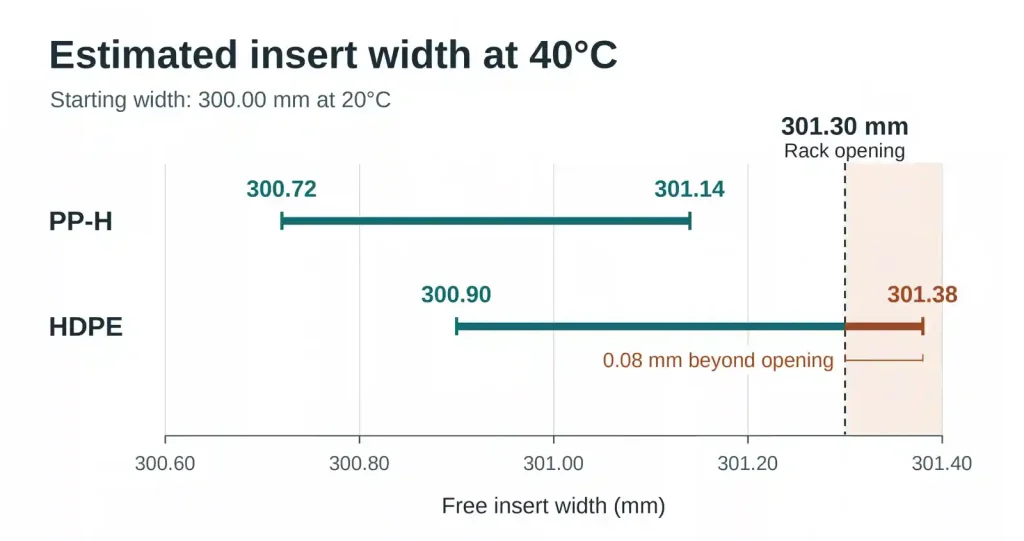
Take an illustrative insert 300.00 mm wide at 20°C, sitting freely between rack walls 301.20 mm apart. The total starting clearance is 1.20 mm across both sides. Assume the insert warms uniformly to 40°C. For this example, take 301.30 mm as the opening between the hot rack walls. On a real rack, measure that opening during the wash trial.
Multiply the starting width by the temperature rise and the coefficient of linear thermal expansion to estimate how much wider the free insert becomes. Röchling gives a range for each sheet under DIN 53752. The example uses those ranges as screening values over a temperature rise of 20 K.
| At 40°C | PP-H sheet | HDPE sheet |
|---|---|---|
| Published expansion coefficient, µm/(m·K) | 120–190 | 150–230 |
| Estimated increase in the 300 mm width | 0.72–1.14 mm | 0.90–1.38 mm |
| Estimated free insert width | 300.72–301.14 mm | 300.90–301.38 mm |
| Total clearance in the 301.30 mm opening | +0.16 to +0.58 mm | −0.08 to +0.40 mm |
At the upper end of the HDPE range, the insert would need 301.38 mm of free width. The rack offers 301.30 mm. The 0.08 mm shortfall flags possible interference. The PP-H estimate stays positive, but its tightest result leaves just 0.16 mm in total for the example dimensions. Neither result includes production variation or the clearance an operator needs to lift the insert out easily.
For an actual wash cycle, use the temperatures reached by the plastic and the frame. The wash water, plastic insert and metal frame can each reach a different temperature. Check the widest permitted insert against the narrowest hot opening, including variation along the rack. A CNC machining tolerance on the insert controls its size at the agreed inspection condition. Hot removal is a separate functional check.
A narrower insert has less ledge to sit on
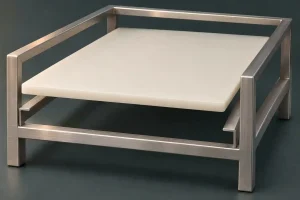
Look at the rack in cross-section. The vertical side walls define the largest width the hot insert can occupy. The inner edges of the two support ledges define the opening the cold insert must bridge. These are two different rack dimensions, both visible on the same section.
Use the insert width and the clear span between the ledges at the cold operating temperature. The difference is the total overlap across both ledges. Each ledge carries half that width only when the insert is centered. The two product sheets give no expansion coefficient specifically for the interval from 20°C down to −10°C, so measure the cold dimensions for this check.
Suppose that at −10°C the insert is 298.00 mm wide, the ledges are 294.00 mm apart at their inner edges, and the insert can shift 0.80 mm to either side of center. Centered, it rests on (298.00 − 294.00) ÷ 2 = 2.00 mm of each ledge. At full shift, the overlap on the opposite ledge falls to 1.20 mm. If the drawing calls for at least 1.50 mm on each side, that edge falls 0.30 mm short. These are illustrative cold dimensions. For production, check the narrowest permitted cold insert against the widest cold span at the greatest allowed shift. Under load, also check how far the insert bends across the span.
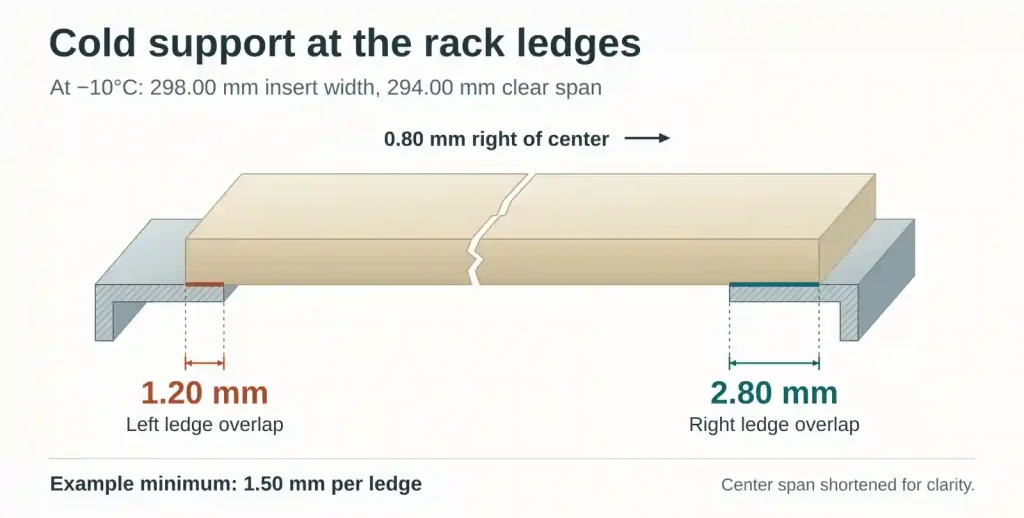
Before trimming a tight HDPE insert to improve hot removal, check how much cold overlap the cut would leave. If the rack design can change, extending the ledges inward can add bearing area while preserving room between the side walls. Check the minimum clear opening on the rack drawing before extending either ledge.
What the machined trial settles before molding
On a CNC-machined sample from the named sheet, run the representative wash and check that the operator can lift the insert out with the required clearance. Then cool the insert and rack to the specified cold condition. Move the insert to its least-supported position and check the overlap on both ledges. Hold the intended load for the required time and measure deflection against the drawing limit. Record the sample width, rack dimensions and part temperatures so a second supplier can reproduce the trial.
If repeat orders will use machined sheet, put the approved stock grade and width limits on the order. If production moves to injection molding, specify the molding resin separately. Shrinkage and warpage during molding can change both the outside width and how evenly the insert sits on its ledges. Carry the rack and the two service checks forward, then repeat them on parts from the production mold.
For the −10°C rack, trial the named HDPE sheet first. Approve its finished width only after the operator can lift it out following the wash and the cold insert, shifted to its least-supported position, meets both the edge-overlap and loaded-deflection requirements.