如何避免精密数控加工过程中的污染和损坏?

快速解答

Contamination and damage in precision CNC machining are commonly caused by chips trapped between locating surfaces, 脏刀柄, unstable coolant condition, tramp oil, incorrect lubricants, excessive clamping force, incompatible cleaning chemicals, poor handling, and inadequate packaging.

Effective control must continue through the complete production route:

  • Incoming material inspection
  • Fixture and datum cleaning
  • Tool and toolholder preparation
  • Chip and coolant management
  • Controlled machining parameters
  • Part cleaning and drying
  • Dimensional and cosmetic inspection
  • Protected storage and packaging

A clean workshop alone does not guarantee clean or undamaged parts. The supplier must also protect functional datums, 线程, 钻孔, 密封面, 化妆脸, coating areas, and inspection surfaces throughout machining and delivery.

对于买家, the RFQ should identify critical surfaces, prohibited contaminants, cleaning restrictions, finish requirements, inspection conditions, and packaging expectations before production.

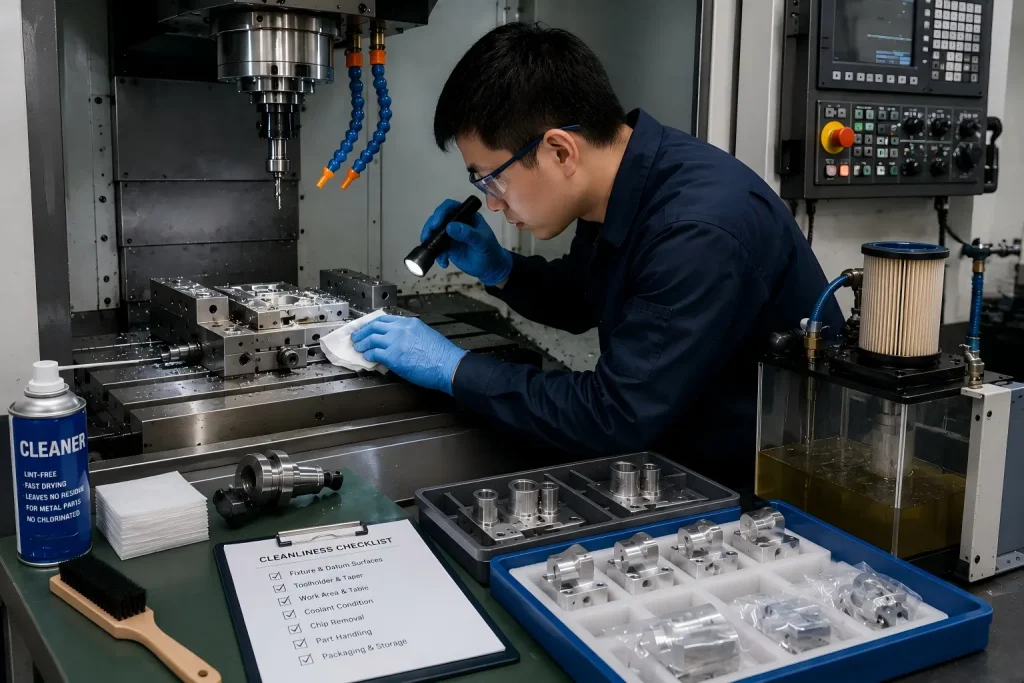
Technician cleaning a stopped CNC fixture and inspecting datum surfaces, toolholders, coolant filtration, 筹码, and protected machined parts to prevent contamination and handling damage.

CNC Machining Contamination and Damage Control Overview

Risk SourcePossible Part or Process Damage实际控制Buyer Should Define
Chips on datum or fixture surfacesPosition error, 凹痕, 夹紧不稳定, and runoutClean and inspect all locating surfaces before loading the partCritical datums and geometric requirements
Dirty spindle taper or toolholder刀具跳动, 振动, 糟糕的完成, and tool failureKeep tapers, collets, holders, and tool seats clean and undamagedSurface finish and critical tool-access features
Incorrect clamping形变, jaw marks, 划痕, and unstable dimensionsUse controlled force, clean soft jaws, and suitable support化妆品面孔, 薄壁, and clamping restrictions
Coolant outside its specified condition腐蚀, 残留物, foam, poor tool life, 染色, or odorMaintain concentration and condition according to coolant-supplier instructions材料, 结束, 清洁度, and prohibited fluids
Tramp oil and dirty coolantSmoke, 残留物, bacteria, 清洁不善, and surface contaminationRemove tramp oil and chips and maintain filtrationFinal part-cleanliness requirement
Incorrect lubricant or blocked lubrication lineMachine wear, 热, 警报, and unstable movementFollow the machine OEM specification and inspect delivery, 压力, and leaksNo buyer action unless machine condition affects the parts
Incompatible cleaner蚀刻, 染色, 点蚀, 开裂, or coating failureMatch the cleaner to the material, 结束, 和污染Approved and prohibited cleaning chemicals
Poor handling after machining指纹, 划痕, 凹痕, mixed parts, and damaged threadsUse clean trays, separators, plugs, gloves where safe, and controlled storageCosmetic acceptance and packaging
Incorrect inspection conditionDisputes caused by temperature or material stabilization differencesDefine measurement temperature and stabilization when technically necessaryTight tolerances and acceptance method
Inadequate packagingContact marks, 腐蚀, damaged edges, and foreign materialUse separators, wrapping, plugs, 腐蚀保护, and clean packagingTransport conditions and unpacking cleanliness

1. Work Environment and Cleanliness Control

Separate Clean and Dirty Operations

The required cleanliness level depends on the part, 材料, 表面饰面, 和最终申请.

A normal CNC workshop does not automatically need cleanroom conditions. 然而, operations that generate dust or abrasive particles should be separated from final inspection, 打扫, and packaging when contamination could affect the finished part.

Potentially dirty operations include:

  • 研磨
  • Abrasive blasting
  • Heavy deburring
  • 抛光
  • Rust removal
  • Saw cutting
  • Chip handling
  • Coolant-tank maintenance

有用的控件包括:

  • Enclosed machining areas
  • Scheduled machine and floor cleaning
  • Chip collection and filtration
  • Covered storage for finished parts
  • Separate clean trays for inspected parts
  • Dedicated packaging areas
  • Clear identification of accepted and nonconforming parts

Do not direct chips, 冷却液, or compressed air toward electrical cabinets, guideways, open bearings, clean parts, or inspection equipment.

Temperature and Measurement Conditions

Temperature affects the dimensions of the machine, 工件, 夹具, and measuring equipment. The risk becomes more important for:

  • Large components
  • Aluminum and engineering-plastic parts
  • 薄壁零件
  • Tight fits
  • Flatness and position requirements
  • Parts measured shortly after machining

A fixed workshop requirement of 20°C ±2°C and 40%–60% RH is not necessary for every CNC project.

反而, the supplier should:

  • Avoid direct airflow from heaters or air-conditioning outlets onto the machine
  • Avoid placing major heat sources beside precision equipment
  • Allow critical parts to stabilize before final measurement
  • Record or control temperature when required by the tolerance and inspection plan
  • Define the measurement condition for temperature-sensitive parts

ISO 1 establishes 20°C as the standard reference temperature for geometrical and dimensional specifications, but that does not mean every machining workshop must continuously operate at exactly 20°C. The practical control depends on the part, uncertainty and agreed inspection method.


2. Raw Material and Workpiece Protection

Incoming Material Inspection

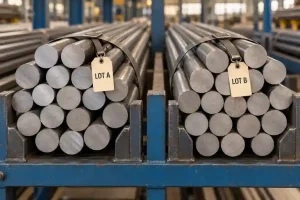
加工开始之前, check the incoming material against the drawing, 采购规格, and material documents.

The review may include:

  • 材质等级
  • Temper or heat-treatment condition
  • 库存形式
  • 方面
  • Lot identification
  • Visible corrosion
  • Scale
  • 凹痕
  • 保护膜
  • Embedded debris
  • Oil or unknown surface residue
  • Material-certificate requirements

Material with severe corrosion, unknown contamination, deep damage, or inconsistent identification should be isolated until its suitability is confirmed.

Material Cleaning Before Machining

Do not automatically clean every material with an organic solvent or abrasive blasting.

The correct method depends on:

  • 铝, 钢, 不锈钢, 铜, 黄铜, 钛, 或塑料
  • Oil, 生锈, 规模, 粘合剂, 灰尘, or protective-film residue
  • Cosmetic or functional surfaces
  • Later anodizing, 电镀, 钝化, 绘画, 或粘合
  • Part thickness and deformation risk
  • Chemical compatibility

Possible methods include:

  • Wiping with an approved cleaner
  • Water-based degreasing
  • Controlled solvent cleaning
  • Mechanical rust removal
  • Abrasive blasting when the resulting surface is acceptable
  • Rinsing and complete drying

Abrasive blasting changes the surface texture and may embed media or damage thin and cosmetic material. It should not be treated as a universal cleaning method.

Workpiece Clamping Protection

Fixture contacts, 软颚, parallels, chuck jaws, support points, and locating surfaces should be clean before every setup.

A chip trapped beneath the workpiece can cause:

  • Datum error
  • Part tilt
  • 凹痕
  • Unstable clamping
  • 跳动
  • Incorrect hole position
  • Scrap during a later setup

Suitable workholding may include:

  • Machined soft jaws
  • Clean protective films
  • Non-marring fixture surfaces
  • Vacuum fixtures
  • Distributed supports
  • Sacrificial tabs
  • Custom nests
  • Controlled chuck or vise pressure

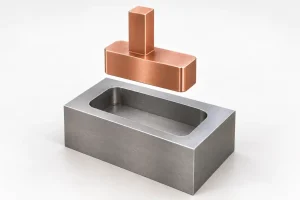
Loose copper sheets and rubber pads should not be used as a default solution. Copper can mark or interfere with location, while soft rubber can compress, move, or contaminate the workpiece.

For thin-wall or easily distorted parts, the fixture should support the geometry without hiding unstable clamping beneath a soft pad.


3. 工装, Toolholder, and Chip Control

Tool and Toolholder Cleanliness

Before installing a cutting tool, 检查:

  • Cutting edges
  • Tool flutes
  • Insert seats
  • 螺丝
  • Collets
  • Toolholder tapers
  • Spindle-taper contact surfaces
  • Pull studs
  • Coolant passages
  • 刀具跳动

薯片, oil films, 毛刺, or damage between precision contact surfaces can cause runout, poor balance, 振动, unstable tool life, and surface defects.

Damaged tools should not remain in production only because they can still remove material.

The original statement that coated carbide tools should be used to machine “carbide materials” should be deleted. Fully sintered cemented carbide commonly requires grinding, 电火花加工, or other specialized processing rather than ordinary coated-carbide milling tools.

Cutting Parameters and Chip Evacuation

切割速度, 喂养, 切削深度, tool engagement, 刀具路径, 冷却液, and chip evacuation should be selected together.

The objective is to prevent:

  • 切屑重切
  • 内置边缘
  • 毛刺形成
  • Excessive heat
  • Tool rubbing
  • 喋喋不休
  • 薄壁变形
  • Surface scratching
  • Chips trapped in blind holes

用于薄壁零件, simply raising spindle speed and lowering feed is not a universal solution.

The correct strategy may involve:

  • Balanced stock removal
  • Suitable radial and axial engagement
  • 锋利的工具
  • Stable support
  • Reduced cutting force
  • Consistent tool engagement
  • Roughing and finishing separation
  • Toolpath direction control
  • Effective air or coolant delivery
  • Intermediate dimensional checks

Before transferring the part to another setup, remove chips from datum surfaces, 螺纹孔, 沉头孔, 口袋, and locating features.


4. Coolant and Lubrication Management

Coolant Selection and Maintenance

Coolant should be selected according to the workpiece material, 手术, 工装, machine requirements, 表面饰面, and later cleaning or coating process.

The supplier should monitor:

  • Coolant concentration
  • Coolant level
  • Water quality
  • pH or alkalinity when required by the coolant supplier
  • Tramp oil
  • Chips and sediment
  • 过滤
  • Foam
  • Odor
  • Biological contamination
  • Rust or staining
  • Compatibility with seals and machine components

Coolant concentration should be checked with a suitable refractometer and maintained within the coolant manufacturer’s specified range.

Do not use one universal percentage for every product. A concentration that is too low or too high can affect corrosion protection, tool performance, 残留物, foam, 打扫, and operator exposure.

Haas specifically recommends checking coolant concentration with a refractometer and verifying it against the coolant manufacturer’s specification.

Coolant residue should be removed when it may interfere with:

  • 阳极氧化
  • 电镀
  • 钝化
  • 绘画
  • Adhesive bonding
  • 密封
  • 电接触
  • 外观检验
  • Clean packaging

Lubrication-System Maintenance

Machine lubrication must follow the machine manufacturer’s instructions.

Routine checks may include:

  • Reservoir level
  • Correct lubricant
  • Pump operation
  • Pressure or flow alarms
  • Tubing condition
  • 配件
  • 计量单位
  • Delivery to required points
  • Active leakage
  • 污染
  • Abnormal axis or spindle temperature

Do not use a universal rule that guideway oil or ball-screw lubricant must be replaced every three to six months. Some systems consume lubricant continuously, while others have different inspection and service schedules.

Do not mix lubricants unless compatibility has been confirmed.

For leak causes, pressure problems, 损坏的管道, 密封, 水库, and blocked lubrication components, 查看我们的指南 CNC machining center oil leakage.


5. Operator Practices and Safe Part Handling

Training and Process Discipline

Operators should understand:

  • Machine operating procedures
  • Drawing revisions
  • Material identification
  • Tool and offset control
  • Fixture-cleaning requirements
  • Coolant and lubrication checks
  • 过程检验
  • Nonconforming-part control
  • Final cleaning and packaging requirements
  • Machine-specific safety procedures

Cleaning responsibilities should be defined rather than assumed. The process should identify who cleans:

  • Fixture contacts
  • Toolholders
  • Finished parts
  • Blind holes and threads
  • Inspection surfaces
  • 托盘
  • Packaging materials

Gloves and Personal Hygiene

Clean gloves can protect cosmetic surfaces and reduce fingerprints when handling stopped parts, 工具, 包装, or approved chemicals.

然而, gloves should not be worn where they can become caught in rotating tools, 主轴, 轴, 演习, or other moving machinery.

Use gloves only when appropriate for the task and machine state. OSHA documents the entanglement risk created when gloves approach rotating machinery.

Operators should also:

Follow machine guarding and lockout procedures

Keep loose clothing and jewelry away from machinery

Use appropriate eye and hearing protection

Keep unrelated items off the machine table

Separate raw, in-process, accepted, and rejected parts

Use clean trays rather than stacking parts directly

Avoid touching sealing, 光学的, electrical-contact, 或装饰表面


6. Finished-Part Cleaning, 检查, and Packaging

Contamination control should continue after the machining cycle ends.

Remove Chips and Burrs

查看:

  • 盲孔
  • 内螺纹
  • 交叉孔
  • 财力雄厚
  • Counterbores
  • Coolant passages
  • Grooves
  • Intersecting holes
  • Small internal corners

A part can pass dimensional inspection and still fail during assembly because chips or burrs remain in an inaccessible feature.

Select a Compatible Cleaning Method

The cleaning method should match the material, 几何学, 结束, 和污染.

Possible methods include:

  • Controlled wiping
  • Aqueous cleaning
  • Solvent cleaning
  • Ultrasonic cleaning
  • Flushing
  • Approved air drying
  • Vacuum removal
  • Rinsing and controlled drying

The process should not leave:

  • Cleaner residue
  • Abrasive media
  • Lint
  • 薯片
  • 指纹
  • Coolant film
  • Corrosive chemicals

For a detailed comparison of mechanical, 化学, ultrasonic, 漂洗, and drying methods, 查看我们的指南 metal parts cleaning.

Inspect After Cleaning

Cleaning can reveal or create defects such as:

  • 划痕
  • 污渍
  • 腐蚀
  • 蚀刻
  • Edge damage
  • Water marks
  • Material discoloration
  • 毛刺
  • Residue trapped in holes

Critical dimensions may need to be rechecked after cleaning, 松开, 冷却, or material stabilization.

For functional dimensions and agreed inspection conditions, 回顾我们的 CNC加工公差 资源.

Protect the Part During Storage and Shipping

Packaging may require:

  • 单独包装
  • Clean trays
  • Separators
  • Thread protectors
  • Bore plugs
  • 保护膜
  • 腐蚀防护
  • 干燥剂
  • Vacuum packaging
  • Non-contact support for cosmetic surfaces
  • Labels preventing mixed lots

Parts should not be allowed to strike or rub against one another during transport.


CNC Part Cleanliness and Damage-Control Checklist

询价项目需要指定什么为什么它很重要
Critical surfaces日期, 密封面, 轴承座, 线程, 钻孔, 电触点, and cosmetic facesDetermines where contamination or marks are unacceptable
Cleanliness requirementGeneral shop-clean, visibly clean, residue-free, or application-specific standard“Clean” can have different meanings
禁用物质硅酮, sulfur, 氯化物, 油, 润滑脂, lint, 研磨介质, or customer-specific restrictionsPrevents coating, bonding, 密封, or application failure
Cleaning restrictionsApproved or prohibited solvent, alkaline cleaner, acid, ultrasonic cleaning, 或爆破Protects the material and surface finish
表面光洁度加工状态, 喷珠, 阳极氧化, 镀, 钝化的, 抛光的, or paintedChanges contamination and handling controls
Dimension conditionBefore cleaning, after finish, or after stabilizationReduces inspection disputes
化妆品验收Viewing distance, 灯光, scratch limits, 架痕, and visible surfacesDefines handling and packaging expectations
包装单独包装, trays, plugs, 腐蚀保护, or clean packagingPrevents transit damage and recontamination
检查Visual, dimensional, 残留物, 涂层, particle, or customer-specific reportDefines acceptance before production
Quantity and repeat ordersPrototype and repeat volumeHelps establish reusable trays, 固定装置, and cleaning controls

常问问题: CNC Machining Contamination and Damage Control

What Contaminants Commonly Affect CNC Machined Parts?

Common contaminants include chips, abrasive dust, 冷却液残留物, tramp oil, lubricant, 生锈, 指纹, 清洁化学品, lint, 水, blasting media, and packaging debris.

The importance of each contaminant depends on the material, 表面饰面, 集会, 涂层, 电气, 密封, 和清洁度要求.

Can a Small Chip Affect CNC Machining Accuracy?

是的.

A chip trapped between the workpiece and a datum, jaw, parallel, or fixture surface can tilt or dent the part and change the location of later features.

The actual error depends on chip size, 锁模力, contact location, 零件刚性, and setup sequence.

Must Precision CNC Machining Be Performed at 20°C?

并不总是.

20°C is the standard reference temperature for dimensional specifications, but many CNC parts can be machined under other stable workshop conditions.

Temperature control and stabilization become more important for large parts, 紧张的公差, high-expansion materials, and measurement disputes.

How Should CNC Coolant Be Maintained?

Follow the coolant manufacturer’s instructions for concentration, water quality, pH or alkalinity, filtration, tramp-oil removal, and replacement.

Use a refractometer where applicable, and do not assume that one concentration is suitable for every coolant and material.

Should CNC Operators Wear Gloves?

Gloves can be useful for handling stopped parts, 锋利的边缘, cleaners, and cosmetic surfaces.

They should not be worn where they can become caught in rotating tools, 主轴, 轴, or other moving equipment.

What Is the Best Cleaning Method for CNC Parts?

There is no single best method.

正确的选择取决于材料, 污染, 零件几何形状, 盲孔, 线程, 表面饰面, corrosion risk, and later coating or assembly process.

How Can Cosmetic CNC Parts Be Protected?

Identify visible surfaces on the drawing, use clean soft jaws or protective fixtures, separate the parts in trays, avoid direct metal-to-metal stacking, inspect after cleaning, and use protective packaging.

An approved cosmetic sample may be useful for parts with strict appearance requirements.

What Should a Buyer Specify About Part Cleanliness?

Specify critical surfaces, prohibited residues, acceptable cleaning methods, 表面饰面, 检验条件, 化妆品要求, 包装, and any application-specific cleanliness standard.

Do not rely only on a general note such as “parts must be clean.”


结论

Contamination and damage control in precision CNC machining begins before the first cut and continues until the parts are unpacked by the customer.

The main controls include:

  • Verifying incoming material
  • Cleaning fixture and datum surfaces
  • Protecting toolholder and spindle contacts
  • Preventing chip recutting
  • Maintaining coolant and lubrication correctly
  • Controlling clamping force
  • Using compatible cleaning methods
  • Inspecting parts after cleaning and stabilization
  • Separating cosmetic and critical surfaces
  • Using protective storage and packaging

A visually clean machine does not automatically produce clean, damage-free parts. The process must define what is critical, how it will be protected, and how acceptance will be verified.

Review Your CNC Part Cleanliness Requirements

快速高效可以审核您的图纸, 材料, 临界面, 公差, 表面饰面, cleaning restrictions, 检验要求, 包装, 以及报价前的订单数量.

For custom metal and engineering-plastic parts, 回顾我们的 数控加工服务.

发表评论

滚动至顶部

获取报价

点击或拖拽文件到该区域即可上传. 您最多可以上传 10 文件.
文件格式:TXT PDF DOC DOCX XLS XLSX PPT PPTX JPG PNG ZIP RAR DWG DXF DXF DWT DWS DWS

3D文件格式: 步, STP, sldprt, IPT, prt, 坐着, IGES, IGS, catpart, X_T, OBJ, STL