高速钢与硬质合金刀具: CNC加工哪个更好?

快速解答: 您应该选择高速钢还是硬质合金刀具?

选择高速钢, 或高速钢, 当操作需要更大韧性时, 降低模具成本, easier regrinding, or better resistance to shock and interrupted cutting.

Choose cemented carbide when the machine, 夹具, and toolholder are rigid enough to support higher cutting speeds, stronger wear resistance, and longer tool life in stable production.

The term “tungsten steel” is commonly used in some supplier markets to describe tungsten carbide or cemented carbide. It is not a standard English name for a conventional steel grade.

Carbide is not automatically the better choice for every CNC operation. The correct tool material depends on the workpiece, 手术, 刀具直径, machine capability, tool overhang, 冷却液, 生产数量, surface requirement, and cost per finished part.

1. What Are High-Speed Steel and Cemented Carbide?

High-speed steel is a heat-treated tool steel used to make drills, 水龙头, 铰刀, 铣刀, broaches, form tools, and other cutting tools.

Common HSS families include:

  • M2 general-purpose HSS
  • Cobalt-alloyed grades such as M35 and M42
  • Powder-metallurgy HSS
  • Tungsten-type HSS grades
  • Coated and uncoated HSS tools

HSS combines hardness with relatively good toughness. This allows a cutting edge to tolerate vibration, shock, interrupted contact, and less-rigid machining conditions better than many carbide tools.

Cemented carbide is a composite tool material rather than a conventional steel. A typical grade contains hard tungsten carbide particles held together by a metallic binder, commonly cobalt.

Carbide grades can be adjusted through:

  • Tungsten carbide grain size
  • Binder percentage
  • Binder chemistry
  • Additional carbide phases
  • 表面涂层
  • Cutting-edge preparation

A harder carbide grade may provide better wear resistance but lower fracture toughness. A tougher carbide grade may better resist chipping but provide less abrasion resistance.

The comparison should therefore be between a defined HSS grade and a defined carbide grade—not simply “steel versus tungsten.”

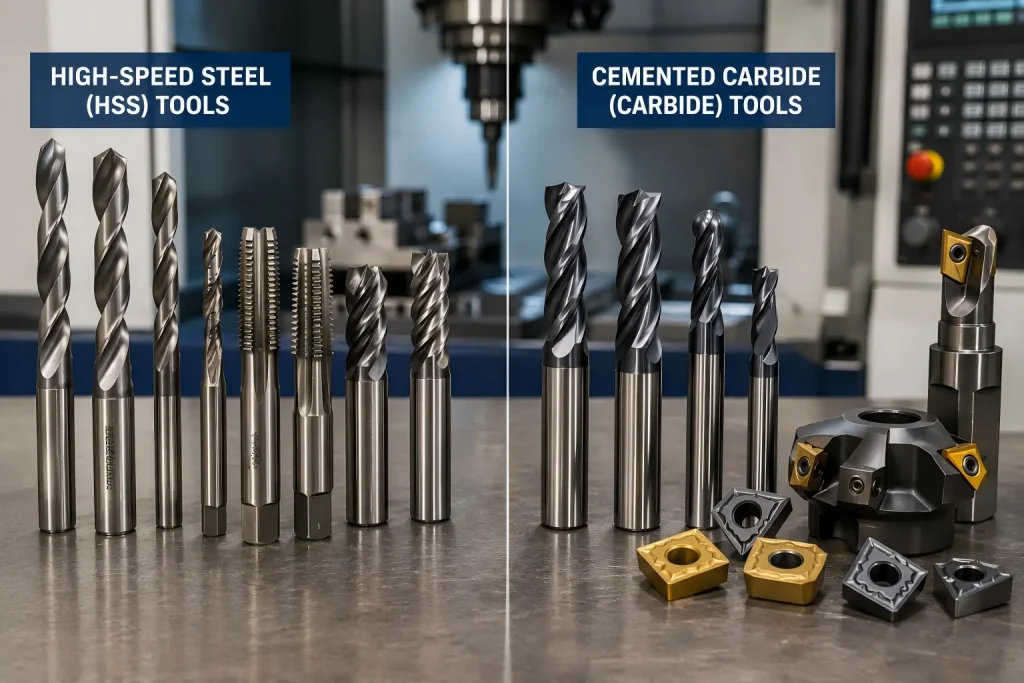
High-speed steel drills, taps, and end mills compared with solid carbide tools and indexable carbide inserts for CNC machining.

2. Composition and Material Structure

High-speed steel is an iron-based alloy. Depending on the grade, its composition may include:

  • Chromium
  • Vanadium
  • Cobalt

These alloying elements and the heat-treatment route control hardness, hot hardness, carbide distribution, 戴阻力, 韧性, and edge stability.

Not every HSS grade contains the same amount of tungsten or cobalt. 例如, M2 is a widely used molybdenum-tungsten HSS, while cobalt-alloyed HSS grades are selected when higher hot hardness is needed.

Cemented carbide has a different structure. It normally contains:

  • Tungsten carbide particles
  • A metallic binder, commonly cobalt
  • Optional additional carbides or alloying additions
  • An optional wear-resistant coating

The tungsten carbide particles provide hardness and abrasion resistance. The binder holds the particles together and contributes to toughness.

Increasing binder content or using coarser carbide grains can improve fracture toughness, but usually reduces hardness and abrasion resistance. Reducing binder content or using finer grains can increase hardness and wear resistance, but may make the grade more sensitive to chipping.

This hardness-versus-toughness balance is why carbide suppliers offer many grades for different cutting conditions.


HSS vs Carbide Tools: 快速比较

Comparison Item高速钢Cemented CarbidePractical Meaning
材质类型Heat-treated iron-based tool steelTungsten carbide particles in a metallic binderThey are different material families
Hardness reportingCommonly specified in HRCCommonly specified in HRA or HV, depending on gradeDo not directly compare raw HRC and HRA values
ToughnessGenerally higherGenerally lower, but varies by gradeHSS is often more tolerant of shock and unstable setups
耐磨性好的, depending on grade and coatingGenerally higher in stable cuttingCarbide often lasts longer in repeat production
Hot hardness好的Generally supports higher cutting temperatures and speedsCarbide often enables higher productivity
Edge chipping riskUsually lowerHigher when setup, runout, or engagement is unstableCarbide requires better process control
切割速度Usually lowerUsually higher when conditions are suitableMachine and fixture rigidity matter
Small tool flexibilityGood for many small drills, 水龙头, 和表单工具Excellent for many solid tools, but more brittleChoose by diameter and operation
RegrindingOften easier and more economicalPossible, but geometry and coating restoration may be more demandingHSS can be practical for reusable special tools
Initial tool costOften lowerOften higherInitial cost is not the same as cost per part
Best fitLow-volume work, interrupted cuts, special forms, less-rigid conditionsStable CNC production, higher speed, abrasive workpieces, longer runsNeither is universally better

3. 硬度, 耐磨性, and Toughness

Hardness helps a cutting edge resist deformation and abrasive wear, but hardness alone does not determine whether a tool will perform reliably.

A useful cutting-tool material must balance:

  • 硬度
  • 耐磨性
  • Fracture toughness
  • Edge stability
  • Hot hardness
  • Compressive strength
  • Resistance to thermal and mechanical shock

HSS Behavior

Properly heat-treated HSS provides high hardness while retaining more toughness than cemented carbide in many applications.

This can make HSS useful when:

  • The cut is interrupted
  • The setup is less rigid
  • The tool is long or slender
  • The machine has limited spindle speed
  • The tool geometry is complex
  • The cutting edge may experience shock
  • A small batch does not justify higher tool cost

HSS tools can still chip or wear rapidly if cutting speed, 热处理, 工具几何形状, or coolant conditions are unsuitable.

Carbide Behavior

Cemented carbide generally provides higher wear resistance and compressive strength, allowing stable tools to operate at higher cutting speeds.

然而, carbide is more sensitive to:

  • Excessive runout
  • 喋喋不休
  • Interrupted engagement
  • Poor workholding
  • Long tool overhang
  • Incorrect edge preparation
  • Thermal shock
  • Sudden changes in cutting load

A carbide tool that chips early may cost more per part than an HSS tool running at a lower but stable speed.

The correct choice is therefore not “harder is always better.” The goal is to select enough wear resistance without sacrificing the toughness required by the operation.


4. Hot Hardness and Cutting Speed

Hot hardness describes a cutting-tool material’s ability to retain hardness and edge strength as the cutting zone becomes hotter.

Both HSS and carbide are designed to resist heat better than ordinary carbon steel tools, but carbide generally supports higher cutting speeds when the machining system is stable.

Carbide’s productivity advantage is most useful when the process has:

  • Adequate spindle speed and power
  • Low tool runout
  • Rigid workholding
  • Short tool overhang
  • Stable cutter engagement
  • Suitable coolant or dry-cutting strategy
  • Effective chip evacuation
  • Enough production volume to use the available tool life

HSS may still be the more reliable choice when the operation is slow, interrupted, 灵活的, or difficult to support.

Coated HSS, cobalt HSS, powder-metallurgy HSS, 涂层硬质合金, uncoated carbide, and different carbide substrates also behave differently. The tool specification matters more than a simple material name.

The cutting temperature should not be controlled only by selecting a “more heat-resistant” tool. 切割速度, 喂养, 切削深度, 冷却液, 刀具路径, 排屑, and workpiece material must be planned together.


5. Common CNC Applications for HSS and Carbide

Common HSS Tool Applications

HSS remains practical for:

  • Twist drills
  • Taps
  • Reamers
  • Broaches
  • Countersinks
  • Form cutters
  • Gear-cutting tools
  • Small special-purpose tools
  • Tools that will be reground
  • Interrupted or shock-loaded operations

HSS can be especially useful when the cutting edge needs toughness or when the machine cannot use carbide’s higher cutting-speed capability.

Cobalt HSS and powder-metallurgy HSS can extend the useful range of HSS where standard grades do not provide enough hot hardness or wear resistance.

Common Carbide Tool Applications

Cemented carbide is widely used for:

  • Solid carbide end mills
  • Solid carbide drills
  • Indexable turning inserts
  • Indexable milling inserts
  • Reamers
  • Boring tools
  • Thread mills
  • High-volume machining
  • Abrasive workpiece materials
  • High-speed finishing
  • Stable roughing operations

Carbide is often preferred when cycle time, repeat tool life, and resistance to abrasive wear are important.

Tool Coatings Also Matter

Tool performance is not determined by the substrate alone.

Depending on the workpiece and operation, tools may use coatings or polished surfaces to control:

  • 附着力
  • 内置边缘
  • Abrasive wear
  • Heat flow
  • Friction
  • Crater wear
  • Edge chipping

For aluminum milling, flute geometry, edge sharpness, chip space, 涂层选择, and chip evacuation can be as important as choosing HSS or carbide.

For a focused comparison of flute count, 几何学, 涂层, and tool reach, 请参阅我们的指南 best end mill for aluminum.


6. Effect on Cycle Time, 刀具寿命, and Dimensional Control

Tool material affects machining efficiency, but it does not work independently from the rest of the process.

周期

Carbide may support a higher cutting speed and material-removal rate when the machine, 夹具, 刀架, and part are stable.

HSS may require a lower cutting speed, but it can provide a more reliable process when vibration, interrupted cutting, or limited machine rigidity would cause carbide chipping.

刀具寿命

Carbide often provides longer wear life in stable repeat production. 然而, premature chipping can end tool life before normal wear develops.

HSS may wear faster, but gradual wear can sometimes be easier to monitor than unexpected carbide fracture.

Tool life should be evaluated by:

  • Number of acceptable parts
  • Cutting time
  • Tool-change frequency
  • Tool-adjustment time
  • 报废风险
  • Surface-finish stability
  • 尺寸漂移
  • Cost of regrinding or replacement

Dimensional Control

A carbide tool does not automatically produce a tighter tolerance.

Final dimensional results also depend on:

  • Machine condition
  • Tool runout
  • Toolholder rigidity
  • 刀具偏转
  • 切割参数
  • 工件夹持
  • Thermal movement
  • Tool-wear compensation
  • 检查时机
  • 零件几何形状

Carbide’s wear resistance may reduce gradual tool-size change during a stable production run. But if the tool chips, chatters, or deflects, dimensional consistency can become worse.

For guidance on how tooling, 设置计数, 材料, 宽容, and inspection affect total machining performance, 看看我们的 CNC turning and milling efficiency guide.


7. Tool Cost vs Cost per Finished Part

HSS tools often have a lower initial purchase cost, but the cheapest tool is not always the lowest-cost production choice.

The real comparison should include:

  • Tool purchase price
  • Regrinding cost
  • Coating cost
  • 工具寿命
  • 切割速度
  • 机器时间
  • Tool-change time
  • Offset adjustment
  • 报废风险
  • Surface-finish consistency
  • Unplanned tool failure
  • Batch quantity

When HSS May Cost Less Overall

HSS may provide the lower total cost when:

  • The batch is small
  • Cutting speed is not the bottleneck
  • The machine has limited spindle speed
  • The cut is interrupted
  • Tool toughness is more important than wear resistance
  • A special tool will be reground several times
  • Carbide chipping risk is high
  • The operation uses a hand or machine tap under variable conditions

When Carbide May Cost Less Overall

Carbide may provide the lower cost per part when:

  • The setup is rigid and repeatable
  • The machine can use higher cutting speeds
  • The production quantity is large enough
  • Tool-change downtime is expensive
  • The workpiece is abrasive
  • Longer stable tool life reduces adjustment
  • Cycle-time reduction has meaningful value
  • The process can monitor wear before failure

A useful comparison is:

Total tooling and machine cost ÷ number of accepted parts

This approach is more meaningful than comparing only the price of one HSS tool with one carbide tool.

For more information about flank wear, 积屑瘤, 芯片, and parameter-related tool failure, see our guide to machining wear and its prevention.


8. How to Choose Between HSS and Carbide Tools

Start with the operation rather than the tool-material name.

Machining ConditionHSS May Be BetterCarbide May Be Better
Small prototype batchLower initial cost and flexible toolingWhen cycle time or abrasive wear is still critical
Large repeat batchWhen the operation is slow or interruptedLonger stable tool life and higher productivity
Interrupted cuttingHigher toughness can reduce sudden fractureUse only with a suitable tough carbide grade and stable setup
高主轴转速May not use the full machine capabilityUsually better suited to high-speed CNC machining
Limited machine rigidityMore tolerant in some unstable conditionsChatter and chipping risk may increase
Abrasive workpieceMay wear more quicklyOften provides better wear resistance
Small taps and form toolsHSS or cobalt HSS is often practicalCarbide can work, but setup and tool fragility need review
Long tool overhangToughness can help, but deflection remains a riskRequires carefully controlled geometry and cutting load
Regrindable special toolsOften practical and economicalPossible, but edge geometry and coating may be more difficult to restore
Stable aluminum millingCan work at moderate speedsSharp carbide tools are common for productivity and finish
Uncertain or variable setupMore forgiving in some casesBest when the cutting conditions are repeatable

Before selecting a tool, 确认:

  • Workpiece material and hardness
  • 铣削, 转动, 钻孔, 窃听, or reaming
  • Continuous or interrupted cutting
  • 刀具直径
  • Tool reach and overhang
  • Machine spindle speed and power
  • Toolholder and workholding rigidity
  • Coolant or dry-cutting condition
  • Required surface finish
  • Batch quantity
  • Acceptable tool-change frequency
  • Tool failure consequences

The correct answer may also be coated HSS, cobalt HSS, powder-metallurgy HSS, a tougher carbide grade, a wear-resistant carbide grade, or an indexable tool rather than a simple HSS-or-carbide choice.


Tool Selection Information to Confirm Before Production

A complete tooling decision requires more information than the workpiece material name.

InformationWhat to Confirm为什么它很重要
手术铣削, 转动, 钻孔, 窃听, 旋转, or boringDifferent operations load the cutting edge differently
Workpiece精确的材料等级, 硬度, 涂层, 或热处理Controls wear, 热, adhesion, and cutting force
特征Diameter, 深度, corner radius, thread, or surface requirementDetermines tool geometry and access
MachineSpindle speed, 力量, 扭矩, and rigidityDetermines whether higher carbide cutting speeds can be used
ToolholdingCollet, hydraulic holder, shrink fit, chuck, or insert holderRunout and rigidity affect edge life
EngagementContinuous or interrupted cuttingInfluences chipping and toughness requirements
刀具悬伸Required reach and unsupported lengthLonger reach increases deflection and vibration
冷却液Flood, through-tool, mist, air blast, or dry cuttingChanges chip evacuation and thermal conditions
数量原型, 低音量, 或重复生产Determines whether higher tool investment is justified
Acceptance厚度, roughness, burr limits, 和检查计划Defines the required tool stability

Rapid Efficient can review the drawing, 工件材质, feature access, 宽容优先, 表面饰面, 数量, and machining route before quotation. The final cutting-tool grade and parameters should be confirmed for the actual machine, 设置, and production conditions.


9. 结论

High-speed steel and cemented carbide solve different cutting-tool problems.

HSS generally provides greater toughness, a lower initial cost, easier regrinding, and better tolerance of some interrupted or less-rigid cutting conditions.

Carbide generally provides greater wear resistance, stronger hot hardness, and the ability to use higher cutting speeds when the machine, 刀架, 夹具, and toolpath are stable.

The correct decision should consider:

  • Tool grade
  • 工件材料
  • Type of operation
  • Continuous or interrupted cutting
  • Machine capability
  • 工具范围
  • Workholding rigidity
  • 冷却液
  • Batch quantity
  • Required finish
  • Tool-failure risk
  • Cost per accepted part

Do not select carbide only because it is harder, and do not select HSS only because it is cheaper. The best tool is the one that provides stable cutting, acceptable tool life, predictable dimensions, and the lowest practical finished-part cost.

Review Your CNC Machining Project

快速高效可以审核您的图纸, 材料, 几何学, 宽容优先, 表面光洁度要求, 检查需要, and order quantity before quotation.

For custom housings, 括号, 盘子, 口袋, 插槽, 钻孔特征, and multi-surface components, 回顾我们的 CNC milling services.


常问问题: 高速钢与硬质合金刀具

Is Tungsten Steel the Same as Tungsten Carbide?

The term “tungsten steel” is sometimes used informally for cemented tungsten carbide. In standard technical English, tungsten carbide or cemented carbide is clearer because the material is a carbide composite, not a conventional steel grade.

Is Carbide Always Better Than HSS?

福田街道. Carbide usually provides higher wear resistance and supports higher cutting speeds, but HSS can be more reliable where toughness, interrupted cutting, lower machine rigidity, or lower tooling cost matter more.

Which Tool Material Is Better for High-Speed CNC Machining?

Carbide is generally the more practical choice when the machine, 夹具, holder, and toolpath are rigid and stable enough to use higher cutting speeds. HSS may be more suitable when cutting conditions are unstable or the available spindle speed is limited.

Is HSS Better for Taps and Small Drills?

HSS and cobalt HSS are commonly used for taps, 演习, and special tools because they provide useful toughness and can be economical to regrind. Carbide tools may provide higher productivity, but setup stability and tool fragility must be considered.

Does Carbide Produce Tighter Tolerances Than HSS?

Not automatically. Carbide’s wear resistance can help reduce tool-wear drift in stable production, but tolerance also depends on machine condition, runout, 偏转, workholding, 温度, 刀具路径, compensation, 和检查.

Which Tool Material Is Cheaper?

HSS often has a lower initial tool price. Carbide can produce a lower cost per part when its longer tool life and higher cutting speed are fully used. The correct comparison includes machine time, 工具更改, regrinding, 废料, and accepted-part quantity.

Can HSS Tools Be Reground?

是的. Many HSS drills, 铰刀, form cutters, broaches, and other tools can be reground. 工具几何形状, 涂层, remaining size, and required accuracy should be checked before reuse.

What Causes Carbide Tools to Chip?

Common causes include excessive runout, 喋喋不休, unstable workholding, interrupted cutting, excessive tool overhang, unsuitable grade, incorrect edge preparation, poor entry strategy, and sudden changes in cutting load.

发表评论

滚动至顶部

获取报价

点击或拖拽文件到该区域即可上传. 您最多可以上传 10 文件.
文件格式:TXT PDF DOC DOCX XLS XLSX PPT PPTX JPG PNG ZIP RAR DWG DXF DXF DWT DWS DWS

3D文件格式: 步, STP, sldprt, IPT, prt, 坐着, IGES, IGS, catpart, X_T, OBJ, STL