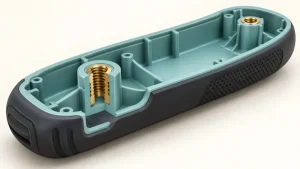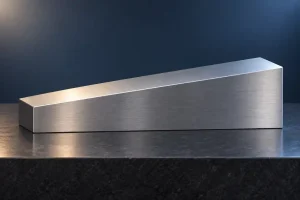

Quick Answer: Mirror polishing is a surface finishing process that removes machining marks, scratches, and surface defects to create a smooth, reflective finish. For CNC machined parts, the process usually includes surface cleaning, sanding or grinding, progressive abrasive polishing, fine polishing, buffing, and final inspection. Mirror polishing can improve appearance, reduce surface roughness, and support certain functional surfaces, but it also increases cost, lead time, and dimensional control risk if critical edges, holes, or tolerances are not protected.
Introduction
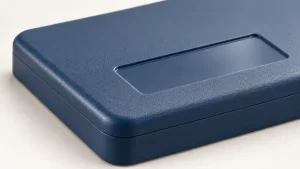
Mirror polishing is used when a CNC machined part needs a highly smooth, bright, and reflective surface. It is common for visible metal parts, cosmetic housings, stainless steel components, aluminum parts, molds, fixtures, display parts, and some sliding or sealing surfaces.
However, mirror polishing is not only a cosmetic step. It can affect dimensions, edges, flatness, surface roughness, corrosion behavior, coating adhesion, and final inspection. If the part has tight tolerances, sharp edges, small holes, threaded features, or mating surfaces, polishing requirements should be confirmed before production.
This guide explains the mirror polishing process for parts, suitable materials, tools, process steps, quality risks, inspection points, and RFQ notes for buyers. For other finishing choices, buyers can also compare common surface finishes for CNC parts before selecting mirror polishing.
1. What is Mirror Polishing?
Mirror polishing is the process of achieving a high-gloss, reflective surface finish on a part by gradually removing imperfections and refining the surface. Unlike basic polishing, mirror polishing gives the part a mirror-like sheen with minimal distortion. This process is widely used in automotive, aerospace, electronics, and medical industries where both aesthetics and functionality are essential.
2. Materials Suitable for Mirror Polishing
Not every material is equally suitable for mirror polishing. The final result depends on material hardness, surface defects, machining marks, grain structure, coating requirement, and part geometry.
| Material | Mirror Polishing Suitability | Notes for CNC Parts |
|---|---|---|
| Stainless steel | Very good | Common for cosmetic, corrosion-resistant, and visible metal parts |
| Aluminum | Good, but softer | Easy to polish, but scratches and edge rounding must be controlled |
| Brass / copper | Good for decorative or conductive parts | Tarnish and oxidation protection may be needed after polishing |
| Tool steel / mold steel | Good with proper process | Often requires controlled grinding and fine polishing steps |
| Titanium | Possible but more difficult | Heat, galling, and surface consistency should be controlled |
| Acrylic / polycarbonate | Possible for clear or glossy surfaces | Requires suitable abrasives to avoid haze or heat damage |
| Glass | Possible in special polishing processes | Less common for CNC metal part suppliers |
For CNC machined metal parts, stainless steel and aluminum are usually the most common materials for mirror polishing. The polishing method should be selected based on the material, visible surface requirement, tolerance, and final application.
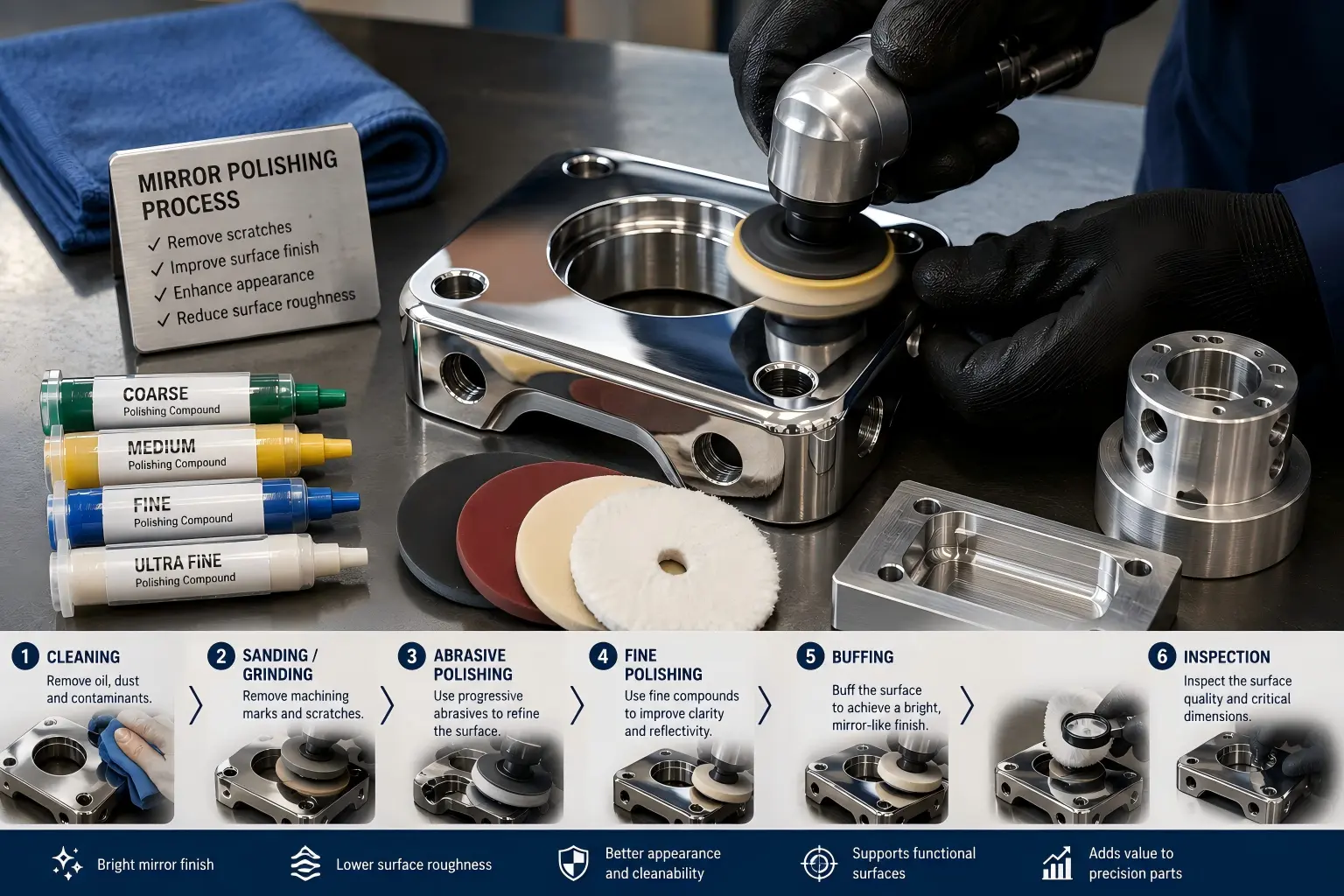
3. Mirror Polishing Process: Step by Step
3.1 Cleaning and Surface Preparation
Before polishing, the part should be cleaned to remove oil, coolant residue, chips, fingerprints, and surface contamination. Deep scratches, burrs, dents, oxidation, or machining marks should be reviewed before starting the polishing process.
If defects are too deep, polishing alone may not remove them without changing the part shape or dimensions.
3.2 Sanding or Grinding
Sanding or grinding removes visible machining marks and prepares the surface for finer polishing. The abrasive grade should be selected based on surface condition, material hardness, and required final finish.
For flat surfaces, the process should avoid uneven pressure that can create waves, rounded edges, or local low spots.
3.3 Progressive Abrasive Polishing
Mirror polishing usually requires moving from coarser abrasives to finer abrasives step by step. Skipping abrasive grades may leave scratches that become visible after final buffing.
For precision parts, critical edges, holes, datum surfaces, threads, and sealing faces should be protected or inspected after polishing.
3.4 Fine Polishing
Fine polishing uses finer compounds, pastes, or polishing media to reduce visible scratches and improve reflectivity. The polishing direction, pressure, speed, and time should be controlled to keep the surface consistent.
3.5 Buffing and Final Finish
Buffing is used to create the final bright appearance. Depending on material and application, the part may also need cleaning, passivation, anti-tarnish protection, coating, or careful packaging after polishing. For residue control after finishing, see our guide to metal parts cleaning methods before packaging or inspection.
3.6 Final Inspection
After mirror polishing, the part should be inspected for scratches, waves, rounded edges, stains, pits, polishing residue, and dimensional change on critical features.
4.Tools and Equipment Used in Mirror Polishing
| Tool or Material | Purpose | Risk to Control |
|---|---|---|
| Sandpaper / abrasive belts | Remove machining marks and scratches | Uneven sanding, edge rounding, visible sanding lines |
| Grinding wheels | Prepare rough or damaged surfaces | Overheating, material removal, shape change |
| Polishing pads | Smooth the surface before buffing | Inconsistent pressure or surface waves |
| Buffing wheels | Create bright reflective finish | Heat buildup, contamination, rounded corners |
| Polishing compounds | Improve gloss and remove fine marks | Wrong compound may stain or scratch the material |
| Ultrasonic or cleaning tools | Remove residue after polishing | Trapped compound inside holes or threads |
| Inspection tools | Check surface and critical features | Visual inspection alone may miss dimensional change |
5. Factors Affecting Mirror Polishing Quality
| Factor | Why It Matters |
|---|---|
| Material hardness | Hard materials may need more time and controlled abrasive selection |
| Initial surface condition | Deep machining marks or scratches require more preparation |
| Part geometry | Corners, holes, grooves, and thin walls are harder to polish evenly |
| Surface roughness target | A lower roughness target usually increases cost and process time |
| Operator pressure | Uneven pressure may create waves, rounded edges, or inconsistent reflection |
| Polishing compound | Wrong compound can cause stains, scratches, or poor gloss |
| Heat control | Excessive heat may affect soft metals, plastics, or surface consistency |
| Cleaning after polishing | Residue can remain in holes, threads, and corners if not removed properly |
6.Applications of Mirror Polishing
Mirror polishing is used when the part needs a bright appearance, smooth surface feel, reduced roughness, or easier cleaning.
Common applications include:
- Stainless steel decorative parts
- Aluminum cosmetic housings
- Mold and tooling surfaces
- Display parts and visible covers
- Fixtures and appearance samples
- Consumer product metal components
- Sliding or low-friction surfaces
- Sealing or mating surfaces where roughness must be controlled
For functional parts, mirror polishing should be reviewed together with tolerance, edge condition, surface roughness, and inspection method.
7.Common Mirror Polishing Problems and Solutions
| Polishing Problem | Common Cause | Practical Solution |
|---|---|---|
| Visible scratches after buffing | Coarse sanding marks were not fully removed | Use progressive abrasive steps and inspect before final buffing |
| Rounded edges | Excessive pressure or polishing time | Protect critical edges and define edge requirements |
| Surface waves | Uneven polishing pressure on flat surfaces | Use controlled process and inspect reflected surface consistency |
| Pitting or stains | Wrong compound, contamination, or material reaction | Match polishing compound to material and clean thoroughly |
| Dimensional change | Too much material removed from critical surfaces | Mask or protect functional features and inspect after polishing |
| Residue in holes or threads | Polishing compound trapped in small features | Use cleaning, air blow, ultrasonic cleaning, or thread inspection |
| Inconsistent gloss | Different pressure, time, abrasive, or batch condition | Standardize process and define acceptable appearance level |
Inconsistent gloss | Different pressure, time, abrasive, or batch condition | Standardize process and define acceptable appearance level
For polished precision parts, buyers should also review CNC machining tolerances because polishing may affect edges, holes, mating surfaces, and tight-fit features.
8. Benefits and Limits of Mirror Polishing
Mirror polishing can improve appearance, reduce visible machining marks, and create a smoother surface. It may also help reduce friction, improve cleanability, or support better appearance for visible components.
However, mirror polishing is not suitable for every part. It may increase cost, extend lead time, round sharp edges, change dimensions, expose material defects, or make surface scratches more visible after handling.
| Benefit | Possible Limit |
|---|---|
| Bright reflective appearance | Higher cost and longer finishing time |
| Smoother surface feel | Risk of edge rounding |
| Reduced visible machining marks | Deep defects may still remain |
| Better cleanability | Cleaning residue must be removed after polishing |
| Improved cosmetic quality | Scratches and fingerprints may become more noticeable |
| Functional surface improvement | Critical dimensions must be protected and inspected |
FAQ: Mirror Polishing Process for Parts
What is the mirror polishing process?
Mirror polishing is a surface finishing process that uses sanding, abrasive polishing, fine polishing, and buffing to create a smooth, bright, reflective surface on a part.
Which materials are suitable for mirror polishing?
Stainless steel, aluminum, brass, copper, mold steel, tool steel, acrylic, polycarbonate, and some other materials can be mirror polished. The final result depends on material hardness, surface condition, geometry, and polishing method.
Is mirror polishing only for appearance?
No. Mirror polishing is often used for appearance, but it may also help reduce surface roughness, improve cleanability, reduce friction, or prepare certain functional surfaces.
Can mirror polishing change part dimensions?
Yes. Mirror polishing removes material from the surface, so it can affect edges, flatness, holes, mating surfaces, and tight-tolerance features. Critical dimensions should be protected or inspected after polishing.
What surface finish is needed for mirror polishing?
Mirror polishing usually requires a much smoother surface than standard machined finish. The exact roughness target should be confirmed based on appearance, function, material, and inspection requirement.
What should buyers specify before requesting mirror polishing?
Buyers should specify material, visible surfaces, surface roughness target if required, cosmetic standard, critical dimensions, edge requirements, coating needs, inspection method, and acceptable appearance level.
Conclusion
The mirror polishing process can improve the appearance, smoothness, and functional surface quality of CNC machined parts. A good result depends on material, initial surface condition, part geometry, abrasive sequence, polishing compound, operator control, cleaning, and final inspection.
For precision parts, mirror polishing should not be treated as a simple cosmetic add-on. It may affect dimensions, edges, holes, threads, mating surfaces, and surface roughness. Critical features should be identified before polishing begins. If dimensional verification is required after polishing, CMM inspection for CNC machined parts may be useful for critical surfaces, holes, and datum-related features.
Rapid Efficient can review drawings, material grade, visible surfaces, surface finish requirements, tolerance risks, polishing areas, and inspection needs before quotation to help select a suitable mirror polishing approach for custom CNC machined parts.