
Quick Answer: In CNC machining, the rake angle mainly affects cutting force, chip evacuation, heat generation, and tool sharpness, while the clearance angle controls friction between the tool flank and the workpiece. A larger positive rake angle can make cutting easier, but may weaken the edge. A larger clearance angle can reduce rubbing and flank wear, but too much clearance may reduce tool strength and accuracy.
Tool geometry has a direct impact on CNC machining cost, tool life, surface finish, and dimensional accuracy. Among all cutting tool angles, the rake angle and clearance angle are two of the most important because they affect how the tool enters the material, how chips are removed, how much heat is generated, and how stable the cutting edge remains during machining.
For buyers and engineers, understanding these two angles helps explain why the same material may produce different results under different cutting conditions. A suitable tool angle can reduce cutting force, improve chip control, extend tool life, and help maintain stable part quality.
Because tool angle affects cutting force, tool wear, and machining time, it also affects the final project cost. For a broader cost breakdown, see our CNC machining cost guide.
Quick Comparison: Rake Angle vs Clearance Angle
| Item | Rake Angle | Clearance Angle |
|---|---|---|
| Main function | Controls cutting sharpness, chip flow, cutting force, and heat generation | Reduces friction between the tool flank and the machined surface |
| Positive effect | Lower cutting resistance, smoother chip evacuation, lower cutting temperature | Less rubbing, reduced flank wear, better cutting freedom |
| Risk if too large | Weaker cutting edge, higher risk of chipping when cutting hard materials | Reduced edge strength, possible vibration, lower dimensional stability |
| Better for | Soft materials, low-rigidity setups, easier-to-cut materials | Soft or ductile materials where flank friction is a problem |
| Use smaller angle for | Hard materials, interrupted cutting, heavy cutting load | Hard materials, high cutting strength, stable edge support |
| Buyer impact | Affects machining cost, surface quality, tool life, and cutting efficiency | Affects tool wear, part accuracy, surface finish, and process stability |
Rake Angle of CNC Tools
Generally speaking, the rake angle significantly influences cutting force, chip evacuation, and tool durability.
The Impact of the Rake Angle of CNC Tools
- A positive rake angle usually creates a sharper cutting action and can help chips flow away from the cutting edge.
- Increasing the positive rake angle can reduce cutting resistance in many machining conditions, but the effect depends on material, tool geometry, cutting depth, feed rate, coolant, and machine rigidity.
- Excessively large positive rake angles reduce cutting edge strength; excessively large negative rake angles increase cutting forces.
Engineer’s Note: A positive rake angle is often helpful when machining aluminum, copper, brass, and some engineering plastics because it reduces cutting resistance and improves chip evacuation. However, when machining stainless steel, hardened steel, titanium, or interrupted surfaces, an excessively large positive rake angle may weaken the cutting edge and increase the risk of chipping.
How Rake Angle Affects CNC Machining Results
| Rake Angle Choice | Typical Effect | When to Use |
|---|---|---|
| Large positive rake angle | Lower cutting force, sharper edge, better chip flow | Soft metals, plastics, low-rigidity workpieces, light cutting |
| Small positive rake angle | Balanced cutting force and edge strength | General CNC turning and milling applications |
| Neutral or negative rake angle | Stronger cutting edge but higher cutting force | Hard materials, interrupted cutting, roughing, heavy load cutting |
For difficult-to-cut materials, tool geometry must be selected more carefully. You can also read our guide on stainless steel CNC machining difficulties and solutions.
CNC tools with small or negative rake angles are often used for:
- Cutting harder materials where edge strength is more important.
- Interrupted cutting or rough surfaces with scale, oxide layers, or cast skin.
CNC tools with positive rake angles are often used for:
- Cutting softer materials such as aluminum, copper, brass, and some plastics.
- Reducing cutting resistance when chip evacuation and surface finish are important.
- Lower-rigidity setups where reducing cutting force may help, as long as the cutting edge remains strong enough.
Benefits of Using a Rake Angle in CNC Tool Cutting
- A suitable rake angle can reduce cutting resistance and help improve machining efficiency.
- It can support smoother chip evacuation and help control cutting heat in suitable materials.
- It may reduce tool wear when the angle, tool material, coating, and cutting parameters match the workpiece material.
- When selected correctly, the rake angle can improve cutting stability, surface finish, and tool edge reliability.
Disadvantages of an Excessively Large Rake Angle
- An excessively large positive rake angle can weaken the cutting edge and increase the risk of chipping, especially in hard materials, interrupted cutting, or heavy roughing.
- If the tool material, coating, or cutting condition is not suitable, an overly aggressive rake angle may reduce tool edge reliability and shorten tool life.
Clearance Angle in CNC Cutting Tools
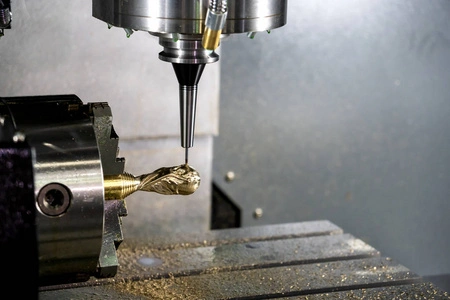
The clearance angle reduces friction between the tool flank and the workpiece, allowing the tool to cut freely into the material.
The Impact of the Clearance Angle on CNC Tools
- A larger clearance angle can reduce rubbing between the tool flank and the machined surface, which may help reduce flank wear in suitable cutting conditions.
- However, an excessively large clearance angle can reduce tool tip strength and make the cutting edge less stable.
Engineer’s Note: The clearance angle must be large enough to prevent rubbing between the tool flank and the workpiece, but not so large that the cutting edge loses support. In precision CNC machining, an unsuitable clearance angle can cause poor surface finish, accelerated flank wear, vibration, or dimensional drift.
How Clearance Angle Affects CNC Machining Results
| Clearance Angle Choice | Typical Effect | Possible Risk |
|---|---|---|
| Small clearance angle | Stronger cutting edge and better support | Higher friction, more flank wear, possible surface damage |
| Moderate clearance angle | Balanced friction control and edge strength | Usually best for general CNC machining |
| Large clearance angle | Less rubbing and lower flank wear | Weaker edge, vibration, faster edge breakdown under heavy load |
A small clearance angle is used for:
- Cutting hard materials.
- When high cutting strength is required.
A large clearance angle is used for:
- Cutting soft materials.
- Cutting materials that easily harden.
Benefits of Clearance Angle Cutting
- A large clearance angle reduces tool flank wear. If rake wear is not excessive, this extends tool life.
- When cutting ductile and soft materials, welding tends to occur between the workpiece and tool flank. This increases resistance and reduces accuracy. Using a larger clearance angle avoids this issue.
Limitations of CNC Tool Cutting with Clearance Angles
- For materials with low thermal conductivity (e.g., titanium alloys, stainless steel), a large clearance angle accelerates rake face wear and may cause tool breakage.
- While a large clearance angle reduces flank wear, it accelerates edge degradation. Cutting depth decreases, affecting accuracy, so regular tool angle adjustments are required.
- When machining hard materials, excessive clearance angles create high resistance, causing rake corners to chip or break under compressive forces.
Tool Angle Selection for Different CNC Materials
| Material | Tool Angle Strategy | Reason |
|---|---|---|
| Aluminum | Use a sharper tool with a positive rake angle | Reduces built-up edge, improves chip evacuation, and helps achieve better surface finish |
| Stainless steel | Use balanced rake and clearance angles with strong edge support | Controls work hardening, heat buildup, and tool wear |
| Titanium alloy | Avoid excessive clearance and maintain strong cutting edge geometry | Titanium has low thermal conductivity and can accelerate tool wear |
| Copper and brass | Use sharp geometry and good chip control | Helps reduce burrs, smearing, and unstable surface finish |
| Engineering plastics | Use sharp cutting edges and low cutting resistance | Reduces heat generation, melting, and dimensional deformation |
| Hardened steel | Use stronger edge geometry and avoid overly large positive rake angles | Prevents chipping during heavy or interrupted cutting |
When tool angle selection affects surface finish or dimensional stability, inspection becomes important. Our CMM inspection guide for CNC machined parts explains how critical dimensions are verified before shipment.
FAQ: CNC Tool Rake Angle and Clearance Angle
What is the rake angle in CNC cutting tools?
The rake angle is the angle of the tool face that controls how the cutting edge enters the material and how chips flow away from the cutting zone. It affects cutting force, heat generation, chip evacuation, and tool life.
What is the clearance angle in CNC tools?
The clearance angle is the angle between the tool flank and the machined surface. It prevents rubbing, reduces flank wear, and allows the tool to cut freely into the workpiece.
What happens if the rake angle is too large?
An excessively large positive rake angle can make the tool sharper, but it may weaken the cutting edge and increase the risk of chipping, especially when machining hard materials or interrupted surfaces.
What happens if the clearance angle is too large?
An overly large clearance angle can reduce friction, but it may also weaken edge support, increase vibration, and reduce dimensional stability during CNC machining.
How do rake and clearance angles affect machining cost?
Incorrect tool angles can increase cutting force, tool wear, machining time, surface defects, and scrap rate. Proper geometry helps improve tool life, process stability, and overall machining efficiency.
Conclusion
Rake angle and clearance angle both affect CNC cutting performance, but they should not be selected in isolation. A positive rake angle can reduce cutting resistance and improve chip flow in suitable materials, while the clearance angle helps reduce rubbing between the tool flank and the machined surface.
For CNC machining, the right tool geometry depends on workpiece material, tool material, coating, cutting depth, feed rate, rigidity, surface finish requirement, and tool life target. Aluminum, copper, brass, stainless steel, hardened steel, titanium, and engineering plastics may all require different rake and clearance angle choices.
When tool wear, burrs, poor surface finish, vibration, or dimensional drift appear during machining, tool geometry should be reviewed together with cutting parameters, fixture stability, coolant, and inspection results.